
Write The Origin, Insertion Nerve Supply & Action Of Muscles of Front Of Arm. 10 mark
Reading File
Finding Sources
Finding Sources
Finding Sources
Finding Sources
Reading File
Reading File
I have the key table and detailed descriptions. Let me also get the Brachialis section.
Finding Sources
Searching Images
muscles of anterior compartment of arm biceps brachii brachialis coracobrachialis
Reading File
Loading Image
I now have all the information needed. Here is a comprehensive 10-mark answer:
Muscles of the Front (Anterior Compartment) of the Arm
The anterior compartment of the arm contains three muscles: Coracobrachialis, Biceps Brachii, and Brachialis. All three are innervated primarily by the musculocutaneous nerve (C5, C6, C7).
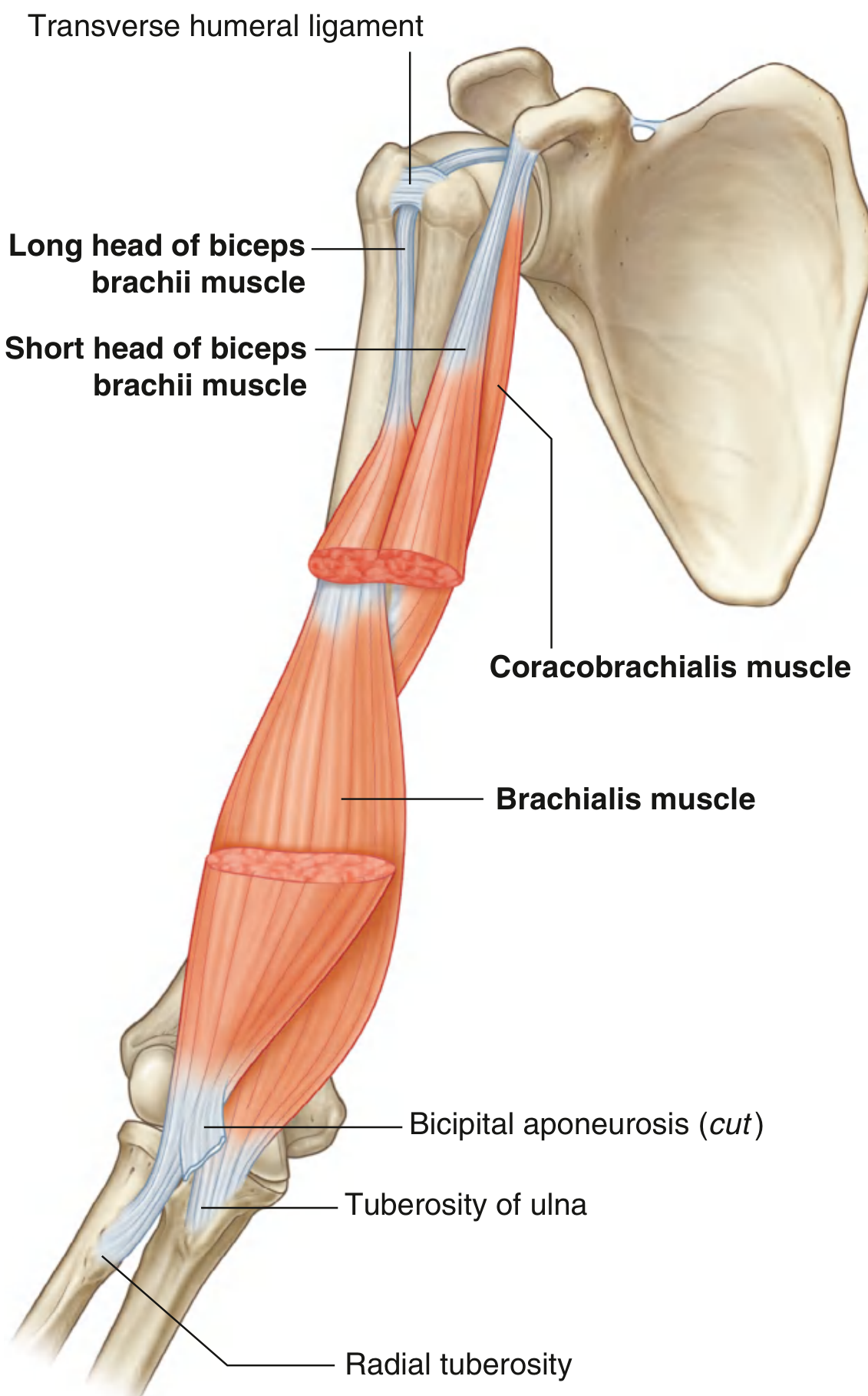
1. Coracobrachialis
| Feature | Details |
|---|---|
| Origin | Apex of the coracoid process of the scapula (in conjunction with the short head of biceps brachii) |
| Insertion | Linear roughening on the medial aspect of the humerus, approximately at midshaft |
| Nerve Supply | Musculocutaneous nerve (C5, C6, C7) — the nerve actually pierces through this muscle to enter the arm |
| Action | Flexion of the arm at the glenohumeral joint |
Note: The musculocutaneous nerve passes through (not around) the coracobrachialis, making it a useful surgical landmark.
2. Biceps Brachii
This is a two-headed muscle (hence the name biceps).
| Feature | Details |
|---|---|
| Origin | Long head — Supraglenoid tubercle of the scapula; its tendon passes over the humeral head deep to the joint capsule and through the intertubercular (bicipital) groove, held by the transverse humeral ligament. Short head — Apex of the coracoid process of the scapula |
| Insertion | Both heads converge to insert as a single tendon onto the radial tuberosity. A flat aponeurosis (bicipital aponeurosis) fans medially from the tendon into the deep fascia of the forearm |
| Nerve Supply | Musculocutaneous nerve (C5, C6) — tests mainly C6 (biceps jerk reflex) |
| Action | 1. Powerful flexion of the forearm at the elbow joint (primary action) 2. Powerful supination of the forearm (most effective when elbow is flexed) 3. Accessory flexion of the arm at the glenohumeral joint (both heads cross the shoulder) 4. Long head prevents superior migration of the humeral head on the glenoid |
3. Brachialis
| Feature | Details |
|---|---|
| Origin | Anterior aspect of the distal half of the humerus (medial and lateral surfaces) and adjacent intermuscular septa |
| Insertion | Tuberosity of the ulna (and anterior surface of the coronoid process) |
| Nerve Supply | Predominantly musculocutaneous nerve (C5, C6); a small lateral portion is also supplied by the radial nerve (C7) — making it the only muscle of the anterior compartment with dual innervation |
| Action | Powerful flexion of the forearm at the elbow joint — it is the true flexor of the elbow as it acts regardless of forearm position (pronation or supination) |
Note: Brachialis is sometimes called the "workhorse" of elbow flexion because, unlike biceps brachii, its power is not affected by forearm rotation.
Summary Table
(Gray's Anatomy for Students, Table 7.8)
| Muscle | Origin | Insertion | Innervation | Action |
|---|---|---|---|---|
| Coracobrachialis | Apex of coracoid process | Medial midshaft of humerus | Musculocutaneous nerve (C5, C6, C7) | Flexion of arm at glenohumeral joint |
| Biceps Brachii | Long head: supraglenoid tubercle; Short head: apex of coracoid process | Radial tuberosity | Musculocutaneous nerve (C5, C6) | Flexion & supination of forearm; accessory shoulder flexion |
| Brachialis | Anterior surface of distal humerus & intermuscular septa | Tuberosity of ulna | Musculocutaneous nerve (C5, C6); radial nerve (C7) to lateral part | Flexion of forearm at elbow |
Key Clinical Points
- Biceps tendon rupture: Rupture of the long head tendon causes the muscle belly to retract distally ("Popeye sign"). The patient retains some elbow flexion via brachialis.
- Biceps reflex (C6): Tapping the biceps tendon at the antecubital fossa tests primarily C6 spinal segment.
- Musculocutaneous nerve injury: Causes weakness of elbow flexion and loss of sensation over the lateral forearm (via its continuation as the lateral cutaneous nerve of the forearm).
— Gray's Anatomy for Students, pp. 852, 874–875
This is a shared conversation. Sign in to Orris to start your own chat.