
Iodide is accumulated in salivary gland , placenta , choroid plexus and mammary gland too . But they do not form thyroid hormones . Why ?
These tissues accumulate iodide via the same sodium-iodide symporter (NIS) as the thyroid, but they lack the key enzymatic machinery needed to organify iodide into thyroid hormones - specifically thyroid peroxidase (TPO) and thyroglobulin. Without TPO to oxidize iodide and incorporate it into tyrosine residues on thyroglobulin, no MIT/DIT or T3/T4 can be formed. The iodide simply accumulates and is then secreted unchanged.
Searching sources...
Reading File
Finding Sources
Finding Sources
Finding Sources
Reading File
The textbook source is very clear. Now let me fetch the diagram to include visually.
Loading Image
Here is the complete, authoritative answer.
Why Non-Thyroidal Tissues Cannot Make Thyroid Hormones Despite Concentrating Iodide
The Shared Step: NIS-Mediated Iodide Uptake
The sodium-iodide symporter (NIS) is expressed not only in thyrocytes but also in:
- Salivary glands
- Gastric mucosa
- Placenta
- Choroid plexus
- Mammary glands
- Ciliary body of the eye
All these tissues use NIS to transport iodide against a concentration gradient (co-transporting 2 Na+ ions per I- ion). However, as Ganong's Review of Medical Physiology states directly:
"The salivary glands, the gastric mucosa, the placenta, the ciliary body of the eye, the choroid plexus, the mammary glands... also express NIS and can transport iodide against a concentration gradient, but the transporter in these tissues is not affected by TSH."
- Ganong's Review of Medical Physiology, 26e
The Missing Steps: Why They Cannot Organify Iodide
Thyroid hormone synthesis requires a highly specific, multi-step process that goes far beyond just accumulating iodide. Non-thyroidal tissues are missing every one of these downstream steps:
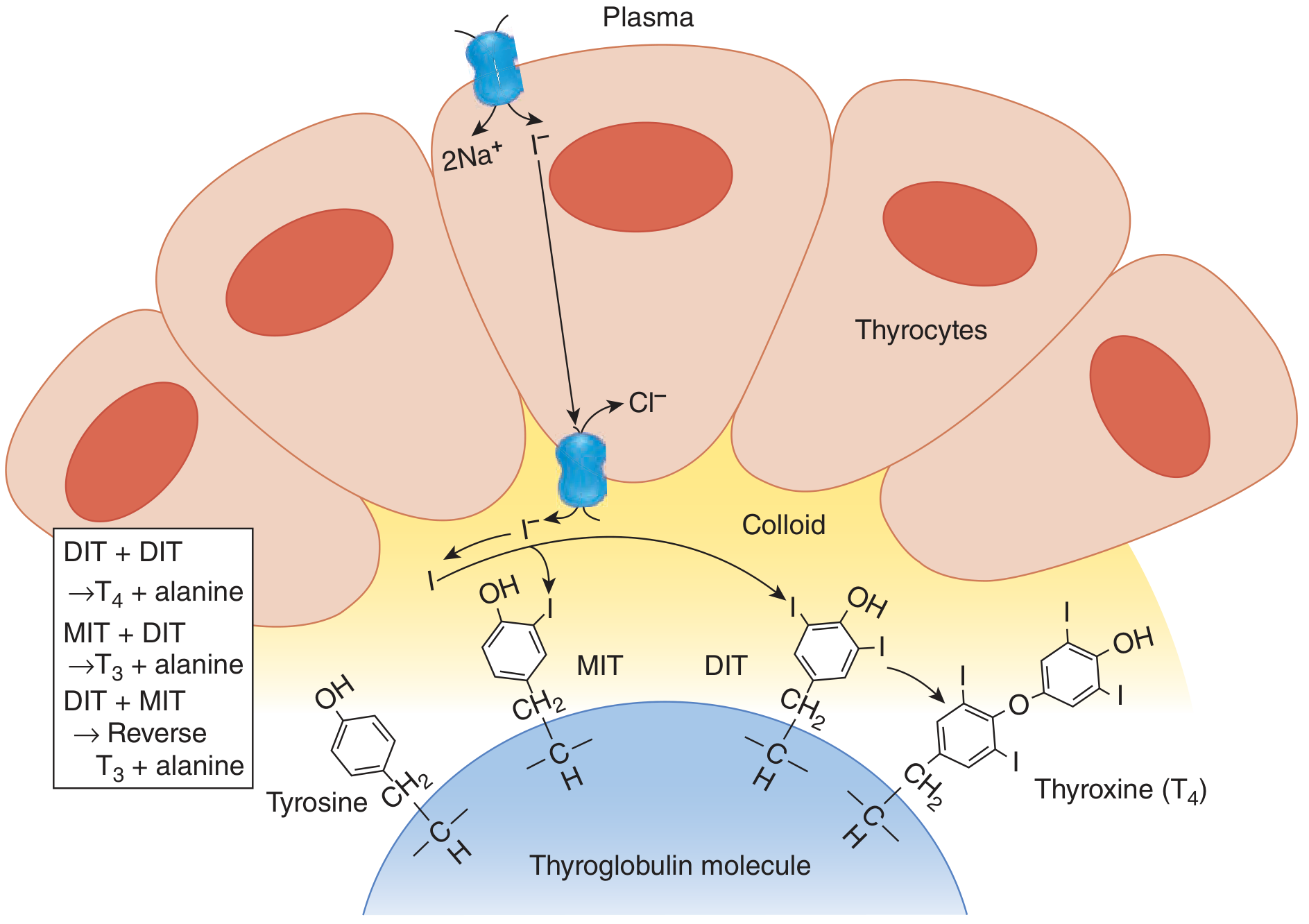
Thyroid hormone biosynthesis - Ganong's Review of Medical Physiology, 26e
Step 1 - Oxidation of Iodide (requires Thyroid Peroxidase)
In the thyroid, iodide (I-) is oxidized to active iodine (I+, or iodonium ion) at the apical border of thyrocytes. This reaction is catalyzed by thyroid peroxidase (TPO), a membrane-bound heme-enzyme. Non-thyroidal tissues do not express TPO, so iodide cannot be activated.
"The oxidation of iodide to its active form is accomplished by thyroid peroxidase."
- Goodman & Gilman's Pharmacological Basis of Therapeutics
Step 2 - Organification (requires Thyroglobulin)
Activated iodine is then incorporated into tyrosine residues of thyroglobulin - a large glycoprotein (660 kDa, 123 tyrosine residues) that is synthesized exclusively by thyrocytes and secreted into the colloid. This process, called organification, produces monoiodotyrosine (MIT) and diiodotyrosine (DIT).
Non-thyroidal tissues do not synthesize thyroglobulin, so there is no scaffold on which iodination can occur.
Step 3 - Coupling Reaction (again requires TPO)
TPO then catalyzes an oxidative coupling of two iodotyrosine residues still attached to thyroglobulin:
- DIT + DIT → T4 (thyroxine) + alanine
- MIT + DIT → T3 + alanine
Without TPO, this coupling step also cannot happen.
Step 4 - Proteolysis and Secretion
Finally, thyrocytes endocytose colloid and lysosomal proteases hydrolyze thyroglobulin to release free T3 and T4 into the circulation. Non-thyroidal tissues lack this entire secretory machinery.
Summary Table
| Step | Enzyme/Molecule Required | Present in Thyroid? | Present in Salivary/Mammary/Placenta/Choroid Plexus? |
|---|---|---|---|
| Iodide uptake | NIS | Yes | Yes - but NOT TSH-regulated |
| Iodide oxidation | Thyroid Peroxidase (TPO) | Yes | No |
| Iodination scaffold | Thyroglobulin | Yes | No |
| Coupling of MIT/DIT | Thyroid Peroxidase (TPO) | Yes | No |
| Hormone release | Lysosomal proteases on Tg | Yes | No |
Why Do These Tissues Concentrate Iodide at All?
The physiological significance of extrathyroidal iodide accumulation is not fully understood. Proposed roles include:
- Mammary glands: Secreting iodide into breast milk to supply the neonatal thyroid with iodine (especially important since the neonatal gut also expresses NIS)
- Placenta: Facilitating iodide transfer to the fetus
- Salivary/gastric: Recycling iodide back into the gut for reabsorption (enterosalivary circulation of iodide)
- Choroid plexus: Possibly regulating CSF iodide levels
A clinically useful consequence: because NIS is expressed in many cancers derived from these tissues (e.g., breast cancer, thyroid cancer metastases), radioiodine (I-131) can be used for diagnostic imaging or ablation of NIS-expressing tumors.
In short: NIS is the transport mechanism - a "door" that lets iodide in. But making thyroid hormones also requires the "factory machinery" inside the cell: TPO to activate and organify the iodide, and thyroglobulin to serve as the protein backbone. Non-thyroidal tissues have the door but completely lack the factory.
This is a shared conversation. Sign in to Orris to start your own chat.