
Why rmp is negatively charged
The resting membrane potential (RMP) is negative (around -70 mV inside relative to outside) due to the unequal distribution of ions and selective membrane permeability. Here's the short version:
- K+ leaks out: At rest, the membrane is most permeable to K+ (via leak channels). K+ diffuses down its concentration gradient out of the cell, leaving behind negatively charged proteins inside.
- Na+ stays out: Na+ is more concentrated outside but can't freely enter at rest (low resting permeability).
- Large anions trapped inside: Negatively charged proteins and organic anions can't cross the membrane, keeping the inside negative.
- Na+/K+ ATPase pump: Pumps 3 Na+ out for every 2 K+ in, creating a net outward positive charge movement - making the inside even more negative.
Searching sources...
Reading File
Finding Sources
Searching the Web
why is resting membrane potential negative ionic basis
Reading File
Reading File
Loading Image
Reading File
Here is a thorough explanation of why the resting membrane potential (RMP) is negative, drawing directly from Guyton & Hall and Costanzo Physiology:
Why Is the Resting Membrane Potential Negative?
The RMP of most excitable cells (neurons, muscle) is about -70 to -90 mV inside relative to outside. Three interacting mechanisms cause this negativity:
1. K+ Diffusion Potential (The Dominant Factor)
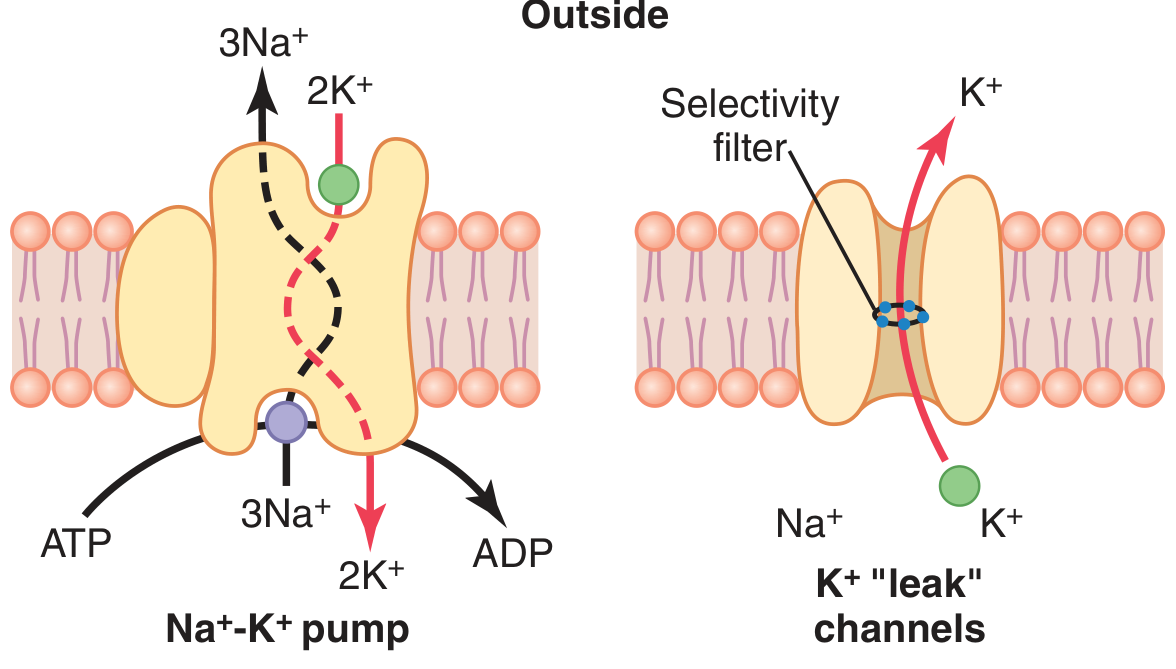
Inside the cell, K+ concentration is ~140 mEq/L vs. ~4 mEq/L outside (a 35:1 ratio). At rest, the membrane has abundant K+ "leak" channels that are always open, making it far more permeable to K+ than to any other ion.
- K+ follows its concentration gradient and diffuses outward through these leak channels.
- As K+ leaves, it carries positive charge out, making the inside progressively more negative.
- This continues until the electrical gradient (negative interior attracting K+ back in) balances the chemical gradient - this equilibrium point is the K+ equilibrium potential (E_K ≈ -94 mV).
- Since Na+ permeability at rest is ~100 times lower than K+, the small inward Na+ leak pulls the RMP slightly toward E_Na (+61 mV), giving a real-world resting potential of about -86 mV from diffusion alone.
2. Large Intracellular Anions (Impermeant Negative Ions)
Inside cells there are large negatively charged proteins, phosphates, and organic anions that cannot cross the membrane. They are permanently trapped inside and directly contribute to intracellular negativity. These anions also help retain K+ inside via electrostatic attraction, setting up the concentration gradient in the first place.
3. The Na+/K+ ATPase Pump (Electrogenic Contribution)
The Na+/K+ pump actively transports 3 Na+ out for every 2 K+ in. This is an unequal exchange of positive charges:
- Net result: more positive charge moves out than comes in.
- This electrogenic action adds about -4 mV of additional negativity directly.
- More importantly, the pump maintains the K+ and Na+ concentration gradients that drive the diffusion potentials above. Without the pump, the gradients would dissipate and the RMP would collapse.
Summary: How It All Adds Up
| Factor | Contribution to RMP |
|---|---|
| K+ diffusion outward (dominant) | ~ -94 mV (if K+ alone) |
| Na+ slight inward leak (opposes) | Pulls toward +61 mV slightly |
| Net diffusion (K+ + Na+) | ~ -86 mV |
| Na+/K+ pump electrogenic effect | Additional -4 mV |
| Final RMP | ~ -90 mV (nerve fiber) |
As Costanzo Physiology explains: "Ions with the highest permeabilities at rest will make the greatest contributions to the resting membrane potential... the resting membrane potential is close to the equilibrium potentials for K+ and Cl- because the permeability to these ions at rest is high."
One-Line Summary
The RMP is negative primarily because K+ leaks out through always-open channels (driven by its high intracellular concentration), leaving negative charges behind - with the Na+/K+ pump maintaining the gradient and adding a small direct electrogenic effect.
- Guyton and Hall Textbook of Medical Physiology, pp. 78-79
- Costanzo Physiology 7th Edition, p. 26
This is a shared conversation. Sign in to Orris to start your own chat.