
Glycogen storage disorders investigations
Reading File
Finding Sources
Finding Sources
Good findings. Now let me read the most relevant sources in parallel — the laboratory medicine textbook (Tietz + Henry's) which will cover investigations specifically, plus the pathology and clinical medicine texts.
Reading File
Reading File
Reading File
Reading File
Excellent content found. Now let me read the detailed investigation tables and the Goldman-Cecil block 35 for clinical management/diagnosis details:
Reading File
Reading File
Excellent detail. Let me read more of the Tietz block for Types III–VII investigations, and also the Goldman-Cecil block for the investigations/diagnosis section:
Reading File
Reading File
I now have comprehensive detail. Let me also fetch the glycogen metabolism diagram and search for the Henry's investigation table:
Loading Image
Reading File
I now have comprehensive information from multiple authoritative textbooks. Let me compile the complete answer.
Glycogen Storage Disorders — Investigations
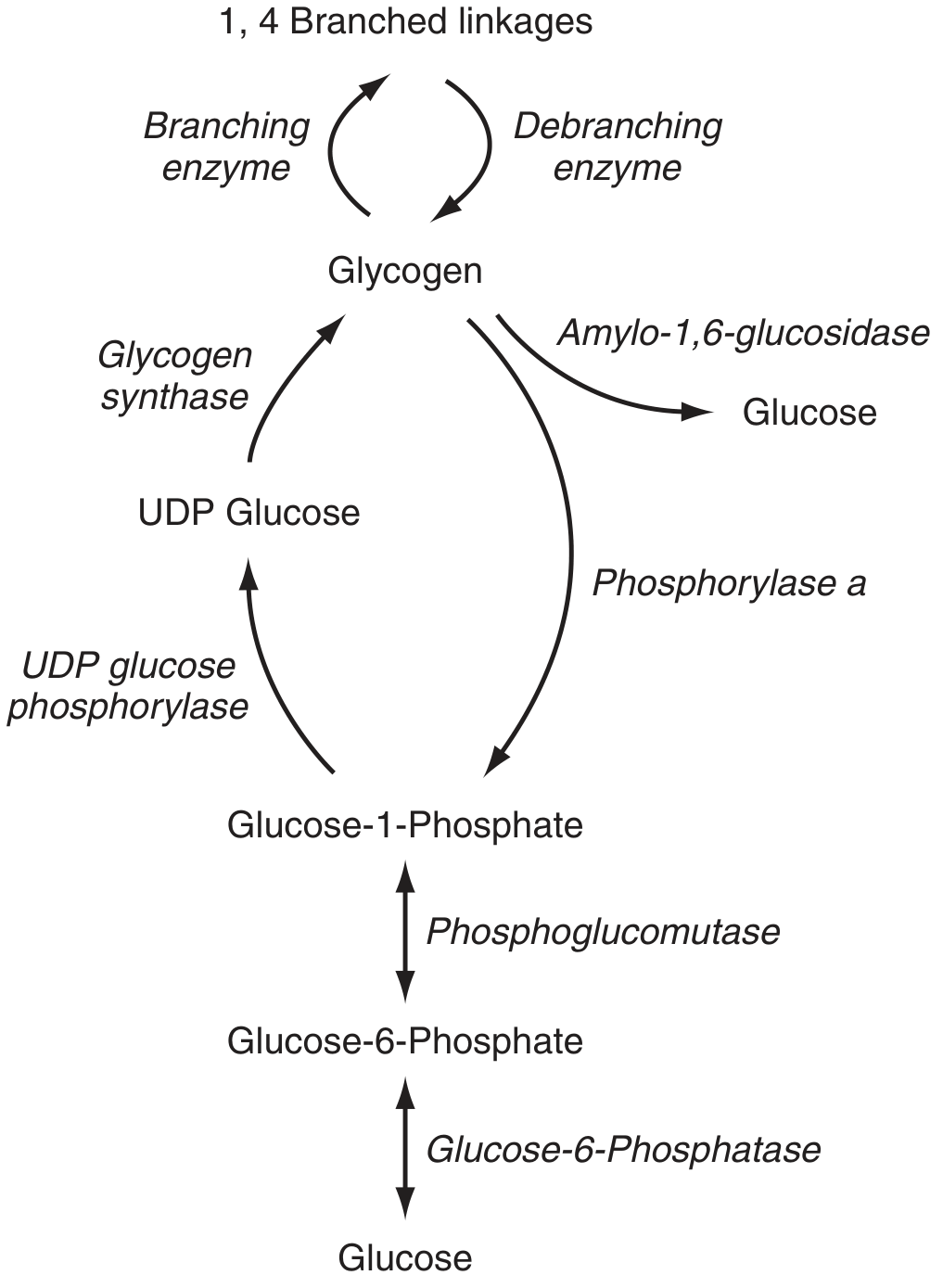
Overview
Glycogen storage diseases (GSDs) are ≥12 inherited disorders of glycogen metabolism. Collectively they occur in ~1:10,000–25,000 births. Because liver and skeletal muscle have the highest glycogen turnover, these are the tissues most affected. Investigation follows a tiered approach: biochemical screening → metabolic provocation tests → enzyme assay → molecular genetics.
First-Line Biochemical Investigations (All Types)
| Test | Significance |
|---|---|
| Fasting plasma glucose | Hypoglycemia is hallmark of hepatic GSDs (GSD I, III, VI, IX); blood glucose 20–50 mg/dL tolerated without symptoms because ketones/lactate serve as alternative CNS fuel |
| Serum lactate | Markedly elevated in GSD I (↑↑↑); normal or mildly elevated in GSD III; absent lactic acidosis helps distinguish GSD III from GSD I |
| Uric acid | Hyperuricemia in GSD I (lactate competitively inhibits renal tubular urate secretion + increased uric acid synthesis) |
| Triglycerides / lipid profile | Hypertriglyceridaemia in GSD I (↑↑↑ lipolysis due to low glucose); also elevated in GSD III |
| Liver transaminases (ALT/AST) | Markedly elevated in GSD III (and GSD IV); helps differentiate from GSD I (where transaminases are normal/mildly raised) |
| Creatine kinase (CK) | Elevated at rest in GSD III (myopathic form), V (McArdle), and VII (Tarui); key marker of muscle involvement |
| Insulin / glucagon ratio | Low insulin and raised glucagon during hypoglycemia |
| Ketones | Ketonaemia/ketonuria during hypoglycaemia — present in GSD III/VI/IX; absent or low in GSD I |
Provocation / Dynamic Tests
Glucagon stimulation test
- Administer glucagon (0.02–0.03 mg/kg IV/IM); measure glucose at 0, 15, 30, 45, 60 min
- Normal: glucose rises ≥30 mg/dL
- GSD I: no rise in blood glucose; lactate rises markedly
- GSD III, VI, IX: blunted or absent rise after prolonged fasting, but partial response post-prandially (distinguishes from GSD I)
Galactose tolerance test (oral or IV)
- Galactose → glucose-1-phosphate → glucose-6-phosphate → glucose (via glucose-6-phosphatase)
- GSD I: failure of blood glucose to rise after galactose administration is diagnostic (glucose-6-phosphatase cannot complete the final step); lactate rises instead
- Still used to confirm GSD I before enzyme assay
Epinephrine tolerance test (historical)
- IM epinephrine: normal response = blood glucose rises 35–45 mg/dL within 40–60 min
- GSD I: no glucose rise; GSD III: no rise after fasting, partial rise after carbohydrate feeding
- Rarely used today; replaced by molecular testing
Ischaemic forearm exercise test (McArdle / GSD V & VII)
- Patient squeezes hand dynamometer 30× under tourniquet (ischaemic conditions)
- Blood sampled for lactate and ammonia before and 1, 2, 3, 5, 10 min after
- Normal: both lactate and ammonia rise (2–5× baseline lactate)
- GSD V (McArdle) / GSD VII (Tarui): ammonia rises normally, but lactate fails to rise (blocked glycolysis in muscle)
- Caution: the non-ischaemic (aerobic) version is safer and preferred now
Enzyme Assays (Tissue-Specific)
The specific diagnosis is confirmed by demonstrating the enzyme defect in relevant tissue:
| GSD Type | Enzyme Deficiency | Diagnostic Tissue |
|---|---|---|
| I (von Gierke) | Glucose-6-phosphatase | Liver biopsy (intact vs. disrupted microsomes differentiates Ia from Ib) |
| II (Pompe) | Acid α-glucosidase (GAA) | Dried blood spot (DBS) for newborn screening; confirmed by leukocytes, muscle, or fibroblasts |
| III (Cori/Forbes) | Glycogen debranching enzyme (amylo-1,6-glucosidase) | Liver + muscle biopsy; erythrocytes (occasionally) |
| IV (Andersen) | Branching enzyme | Leukocytes, cultured fibroblasts, liver/muscle biopsy |
| V (McArdle) | Muscle phosphorylase | Muscle biopsy (histochemistry + enzymatic) |
| VI (Hers) | Liver phosphorylase | Liver biopsy; RBCs or WBCs |
| VII (Tarui) | Muscle phosphofructokinase | Muscle biopsy; erythrocytes (also show partial enzyme deficiency → haemolysis) |
| IX | Phosphorylase kinase | RBCs/WBCs (for X-linked form); liver/muscle biopsy |
Molecular Genetic Testing
Now the primary recommended method of diagnosis (Goldman-Cecil):
- Gene-targeted testing: single-gene sequencing or multigene panel (clinically preferred first-line where genotype is strongly suspected)
- Comprehensive testing: whole-exome sequencing (WES) or whole-genome sequencing (WGS) when panel testing is non-diagnostic
- Common mutations are population-specific (e.g. GSD Ia: p.Arg83Cys in Caucasian/Jewish; c.648G→T splicing in Japanese; GSD Ib: c.1042_1043delCT in Caucasian)
- Used for prenatal diagnosis and carrier detection
Tissue Biopsy
| Biopsy Finding | Significance |
|---|---|
| Liver biopsy — light microscopy with PAS/diastase | Massive glycogen accumulation (PAS+, diastase-sensitive); fat accumulation in GSD I; fibrosis/cirrhosis in GSD III and IV |
| Liver biopsy — electron microscopy | Monoparticulate glycogen (GSD I, III, VI) vs. abnormal polyglucosan/amylopectin-like material (GSD IV) |
| Muscle biopsy — ATPase, phosphorylase histochemistry | Absent phosphorylase staining in GSD V; sub-sarcolemmal vacuoles in GSD II (lysosomal glycogen) |
| Muscle biopsy — EM | Lysosomal glycogen accumulation characteristic of GSD II (Pompe) |
Imaging
| Modality | Findings |
|---|---|
| Ultrasound abdomen | Hepatomegaly (bright, echogenic liver); renomegaly in GSD I; splenomegaly in GSD III/IV |
| MRI liver | Increased glycogen content; distinguishes steatosis (GSD I) from fibrosis |
| Echocardiography | Hypertrophic cardiomyopathy in GSD II (Pompe) — critical for management; also GSD III |
| ECG | Short PR interval and massive QRS voltages in infantile Pompe; conduction defects in GSD III |
| Skeletal X-ray/bone densitometry | Osteoporosis in GSD I (long-term) |
Newborn Screening (GSD II — Pompe)
- Dried blood spot (DBS) acid α-glucosidase (GAA) enzyme activity assay — several countries include GSD II in neonatal screening
- Confirmed by GAA gene sequencing ± lymphocyte/fibroblast enzyme assay
- Rationale: enzyme replacement therapy (ERT) with alglucosidase alfa is most effective when started before symptom onset
Type-Specific Investigation Highlights
GSD I (von Gierke) — Key Lab Fingerprint
- Hypoglycaemia + lactic acidosis + hyperuricaemia + hypertriglyceridaemia + hepatomegaly
- No glucose response to glucagon or galactose
- Confirm: liver biopsy → G6Pase assay (intact microsomes: Ia; + disrupted microsomes required: Ib); G6PC1 / SLC37A4 sequencing
GSD II (Pompe) — Key Lab Fingerprint
- Infantile: cardiomegaly, hypotonia, elevated CK, very high GAA deficiency on DBS
- Late-onset: progressive proximal myopathy, respiratory failure, CK elevated, normal/mild CK in some
- Confirm: DBS GAA activity → GAA gene sequencing; muscle biopsy shows lysosomal glycogen
GSD III (Cori/Forbes) — Distinguishing from GSD I
- Elevated transaminases (GSD I has normal AST/ALT), elevated CK (muscle involvement in IIIa)
- Hyperglycaemic response to galactose (unlike GSD I)
- Lower uric acid and lactate than GSD I
- Confirm: debranching enzyme (AGL) assay in erythrocytes or liver/muscle; AGL gene sequencing
GSD IV (Andersen) — Key Findings
- Hepatosplenomegaly → cirrhosis → liver failure
- Abnormal glycogen (amylopectin-like) on biopsy (PAS+, poorly diastase-digestible)
- Confirm: branching enzyme (GBE1) assay in leukocytes/fibroblasts; GBE1 sequencing
GSD V (McArdle) — Key Lab Fingerprint
- Elevated resting CK; myoglobinuria after exercise
- Ischaemic forearm test: ammonia rises, lactate fails to rise
- "Second-wind" phenomenon
- Confirm: absent phosphorylase on muscle biopsy histochemistry; PYGM sequencing
GSD VII (Tarui) — Key Lab Fingerprint
- Like GSD V but also haemolytic anaemia (RBCs share the PFK defect)
- Hyperbilirubinaemia + reticulocytosis + pigmenturia
- Glucose does not relieve symptoms (unlike GSD V)
- Confirm: PFK assay in RBCs + muscle biopsy; PFKM sequencing
Summary Algorithm
Suspected GSD
     │
     ├── Hepatic features (hepatomegaly, hypoglycaemia)
     │         ├── + Lactic acidosis + ↑↑ uric acid + ↑↑ TG → GSD I → galactose test → liver biopsy/G6PC gene
     │         ├── + ↑ transaminases + ↑ CK ± cardiomyopathy → GSD III → AGL enzyme/gene
     │         ├── + Cirrhosis/liver failure → GSD IV → GBE enzyme/gene
     │         └── Mild, asymptomatic hepatomegaly → GSD VI / IX → phosphorylase/kinase assay
     │
     └── Muscle features (exercise intolerance, cramps, rhabdomyolysis)
               ├── + Cardiomyopathy + hypotonia (infant) → GSD II → DBS GAA assay
               ├── + Forearm test: ↑↑ NH₃, flat lactate + "second wind" → GSD V → PYGM gene
               └── + Haemolytic anaemia + flat lactate forearm test → GSD VII → PFK assay
Sources:
- Tietz Textbook of Laboratory Medicine, 7th Edition — Table 35.1, GSD types I–VII
- Henry's Clinical Diagnosis and Management by Laboratory Methods — Tables 17.6 & 17.7
- Goldman-Cecil Medicine (International Edition) — Chapter 191 (Kishnani)
- Sleisenger & Fordtran's GI and Liver Disease — Chapter 77
This is a shared conversation. Sign in to Orris to start your own chat.