
Lecithin surfactant
I'll look up lecithin surfactant in the medical library for you.
Searching sources...
Reading File
Finding Sources
Finding Sources
Good hits. Let me read the most relevant sections from multiple textbooks in parallel.
Reading File
Reading File
Reading File
Reading File
I now have rich content from multiple textbooks. Let me also fetch the surfactant stability diagram and read a bit more on the L:S ratio context and Fishman's pulmonary section.
Loading Image
Reading File
Reading File
I now have comprehensive information from multiple authoritative textbooks. Here is a thorough answer:
Lecithin as Pulmonary Surfactant
What Is It?
Lecithin is the common name for phosphatidylcholine (PC). In the context of pulmonary physiology, the critical form is dipalmitoylphosphatidylcholine (DPPC) - also called dipalmitoyl lecithin - the single most important lipid component of lung surfactant.
Pulmonary surfactant is a complex mixture of:
- Lipids ~90% (responsible for surface-active properties)
- Proteins ~10% (four apoproteins: SP-A, SP-B, SP-C, SP-D; plus albumin and secretory IgA)
Of the lipid fraction, ~50% is DPPC, making it the dominant component. The next most common lipid is phosphatidylglycerol (~11%), followed by phosphatidylcholine molecules with unsaturated fatty-acid chains.
Chemical Structure of DPPC (Dipalmitoyl Lecithin)
DPPC has two fully saturated 16-carbon fatty-acid chains (palmitate) at positions 1 and 2 on the glycerol backbone. This full saturation is what allows it to pack tightly at the air-water interface and dramatically lower surface tension.
- Medical Physiology, p. 897
How Is It Synthesized?
DPPC is made and secreted by type II pneumocytes (alveolar type II cells). The principal biosynthetic pathway is the CDP-choline pathway (Kennedy pathway):
- Glucose → pyruvate → acetyl-CoA → palmitate (16:0) via fatty acid synthesis
- Two palmitoyl-CoA molecules esterify a glycerol-3-phosphate backbone
- The phosphocholine head group is added via a CDP-choline intermediate
Secretion from type II cells: Surfactant components are assembled in lamellar bodies (~1 µm diameter, concentric layers of lipid and protein). These are secreted by constitutive exocytosis into the thin aqueous layer lining the alveoli. Each hour, the normal lung secretes ~10% of the material in its lamellar bodies.
Recycling: Surfactant is continuously retrieved from the alveolar surface and reused, maintaining an efficient cycle of formation, removal, and replenishment.
- Biochemistry, 8th ed. Lippincott, p. 574
- Medical Physiology, p. 898
Physiologic Role - Laplace's Law
By Laplace's Law, the pressure inside a spherical alveolus is:
P = 2T / r
Where T = surface tension, r = radius.
Without surfactant, surface tension is constant. As a small alveolus shrinks, its radius decreases, causing pressure to increase - so small alveoli would collapse into larger ones (atelectasis). Surfactant solves this by making tension variable with lung volume:
- At low lung volumes (small r) → T decreases → P stays equal to adjacent larger alveoli
- At high lung volumes (large r) → T is relatively higher
This keeps alveoli of different sizes in equilibrium and prevents collapse on expiration.
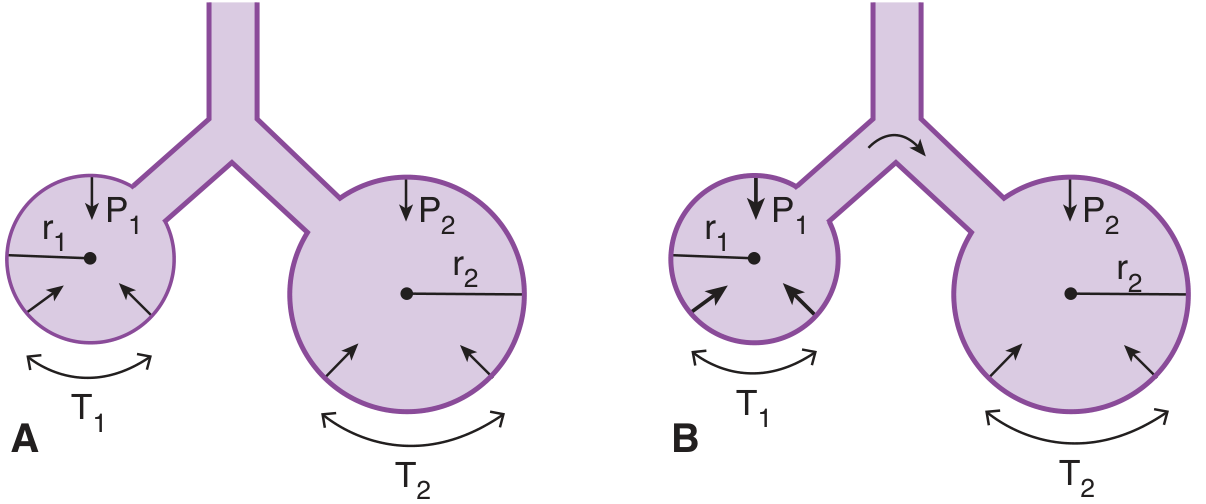
Panel A (with surfactant): r1 < r2, T1 < T2, P1 = P2 - stable. Panel B (without surfactant): r1 < r2, T1 = T2, P1 > P2 - small alveolus collapses into large one.
- Fishman's Pulmonary Diseases and Disorders, p. 195
The Four Surfactant Apoproteins
| Apoprotein | Solubility | Role |
|---|---|---|
| SP-A | Water-soluble | Innate immunity (opsonin); forms tubular myelin; feedback regulation of secretion |
| SP-B | Lipid-soluble | Speeds monolayer formation; forms tubular myelin. Hereditary absence = fatal RDS |
| SP-C | Lipid-soluble | Speeds monolayer formation |
| SP-D | Water-soluble | Innate immunity (opsonin); surfactant metabolism |
SP-B and SP-C are hydrophobic intrinsic membrane proteins that greatly accelerate the rate at which surfactant spreads as a surface film at the air-water interface.
- Medical Physiology (Table 27-1, p. 897)
Developmental Timeline and Fetal Lung Maturity
The composition of lecithin in surfactant changes during gestation:
| Gestation | Predominant Lecithin |
|---|---|
| Before 35 weeks | α-palmitic β-myristic lecithin |
| After 35 weeks | Dipalmitic lecithin (DPPC) predominates |
| ~36 weeks | Phosphatidylglycerol (PG) appears |
Secretion from type II cells is low throughout fetal life. Just before birth, a surge in glucocorticoids triggers both synthesis and secretion - this is the basis for giving antenatal corticosteroids to mothers threatening preterm delivery.
Tests for Fetal Lung Maturity (Amniotic Fluid)
Since lecithin passes into amniotic fluid via fetal respiratory activity, it can be measured to assess lung maturity before scheduled preterm delivery.
1. Lecithin:Sphingomyelin (L:S) Ratio
- Sphingomyelin levels remain constant throughout pregnancy; lecithin rises
- Measured by thin-layer chromatography (TLC) with densitometry
- Immature surfactant: L:S ≈ 1:1
- Mature surfactant: L:S > 2.0–2.5 (virtually certain maturity if PG also present)
- Shift occurs at ~32 weeks' gestation
Pitfalls of L:S ratio:
- Less reliable in maternal diabetes (RDS can still occur with L:S > 2.0 in diabetic patients)
- Meconium contamination falsely decreases the ratio
- Blood contamination normalizes the ratio to ~1.5
2. Phosphatidylglycerol (PG) Concentration
- Appears ~1 week after dipalmitic lecithin predominates
- Indicates lung maturity; increases until term
- Advantage: Neither blood nor meconium interferes
- Disadvantage: Late marker, so limited utility for borderline cases
- Can be detected by slide agglutination with PG-specific antisera
3. Lamellar Body Count (LBC)
- Lamellar bodies are ~platelet-sized, measured on the platelet channel of a standard hematology analyzer
- Mature: count ≥ 50,000 (high negative predictive value for RDS)
- Blood contamination decreases LBC; meconium increases it
4. Other tests
-
Fluorescence polarization, foam stability index, optical density
-
Henry's Clinical Diagnosis and Management by Laboratory Methods
-
Quick Compendium of Clinical Pathology, 5th ed., p. 1533-1561
Surfactant Deficiency - Clinical Significance
Neonatal/Infant RDS (IRDS)
- Premature infants lack sufficient DPPC → high alveolar surface tension → alveolar collapse → hyaline membrane disease
- Manifests as hypoxia, acidemia, vascular protein transudation into alveoli
- Management:
- Antenatal glucocorticoids (to the mother) to accelerate lung maturation
- Postnatal exogenous surfactant (natural or synthetic, given by intratracheal instillation)
Acute RDS (ARDS) in adults
- Alveolar damage from infection, injury, or aspiration causes fluid accumulation and surfactant dysfunction (not deficiency)
- Results in markedly increased surface tension → alveolar stiffening, instability, and collapse
Stimuli that enhance postnatal surfactant secretion:
-
Hyperinflation (sighing, yawning)
-
Exercise
-
β-adrenergic agonists
-
Ca²⁺ ionophores
-
Biochemistry, 8th ed. Lippincott, p. 575
-
Medical Physiology, p. 898-899
-
Fishman's Pulmonary Diseases and Disorders, p. 196
Summary in one line: Lecithin (DPPC) is the main surface-active lipid of pulmonary surfactant, made by type II pneumocytes, that prevents alveolar collapse by reducing and dynamically varying surface tension with lung volume - its fetal maturation is tracked clinically via the L:S ratio in amniotic fluid.
This is a shared conversation. Sign in to Orris to start your own chat.