
Dead space ventilation full details for md exams
Reading File
Searching across multiple aspects of dead space ventilation in parallel.
search_medical_text
dead space ventilation types anatomical physiological alveolar
Harrison's Principles of Internal Medicine, Twenty First Edition
Page 7711
search_medical_text
Bohr equation dead space calculation VD/VT ratio
Harrison's Principles of Internal Medicine, Twenty First Edition
Page 8223
search_medical_image
dead space ventilation diagram anatomical physiological alveolar
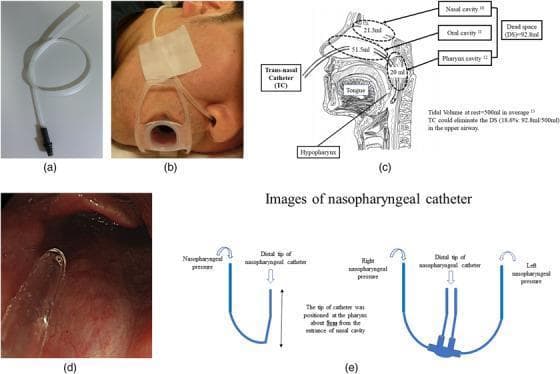
Hugging Face pmc clinical VQA raw
Page 0
GradeResponse
GradeResponse
GradeResponse
Good foundation. Let me get more detail on the physiology, clinical significance, and exam-relevant calculations.
search_medical_text
dead space ventilation pulmonary embolism COPD causes increased VD clinical significance
search_medical_text
alveolar ventilation equation minute ventilation tidal volume respiratory physiology
I have solid retrieved content. Here is the comprehensive breakdown:
Dead Space Ventilation — Full Details for MD Exams
1. Definition
Dead space (VD) refers to the portion of each tidal breath that does not participate in gas exchange. It is ventilated but not perfused (or not effectively perfused).
2. Types of Dead Space
| Type | Definition | Volume (Normal adult) | Key Points |
|---|---|---|---|
| Anatomical Dead Space | Conducting airways (nose → trachea → bronchi → bronchioles) — no alveoli, no gas exchange | ~150 mL (~2 mL/kg IBW) | Fixed; increases with age, larger airway diameter, neck extension |
| Alveolar Dead Space | Alveoli that are ventilated but not perfused | ~0 mL (negligible normally) | Increases in PE, shock, ARDS |
| Physiological Dead Space | Anatomical + Alveolar dead space | ~150 mL (= anatomical in health) | Best measured clinically; increases in disease |
| Apparatus/Mechanical Dead Space | Dead space added by ventilator circuits, masks, ETT connectors | Variable | Important in ventilated patients and neonates |
Key rule: Physiological dead space = Anatomical dead space in healthy lungs (alveolar dead space ≈ 0). In disease, physiological > anatomical.
3. Key Equations
A. Bohr Equation (Physiological Dead Space)
$$V_D/V_T = \frac{PaCO_2 - P\bar{E}CO_2}{PaCO_2}$$
- VD = dead space volume
- VT = tidal volume
- PaCO₂ = arterial CO₂ (gold standard for alveolar CO₂)
- P̄ECO₂ = mean expired CO₂
Normal VD/VT = 0.3 (i.e., 30% of each breath is wasted) In ARDS and severe disease, VD/VT can rise to 0.6–0.7
B. Alveolar Ventilation Equation
$$\dot{V}_A = \dot{V}_E \times (1 - V_D/V_T)$$
- V̇A = alveolar ventilation (effective ventilation)
- V̇E = minute ventilation (tidal volume × respiratory rate)
C. Alveolar CO₂ Equation
$$PaCO_2 = \frac{\dot{V}CO_2}{\dot{V}_A} \times K$$
- When dead space increases → VA falls → PaCO₂ rises (hypercapnia)
- To compensate, the patient must increase minute ventilation
4. Normal Values
| Parameter | Normal Value |
|---|---|
| Anatomical dead space | ~150 mL (~2 mL/kg IBW) |
| Tidal volume (VT) | ~500 mL (6–8 mL/kg) |
| VD/VT ratio | 0.3 (30%) |
| Alveolar ventilation | ~4–5 L/min |
| Minute ventilation | ~6–8 L/min |
5. Fowler's Method (Anatomical Dead Space Measurement)
- Patient takes a single breath of 100% O₂, then exhales
- Expired N₂ is plotted against exhaled volume
- The volume exhaled before the N₂ plateau begins = anatomical dead space
- Normal: ~150 mL
6. Factors Affecting Dead Space
Increases Dead Space:
| Factor | Mechanism |
|---|---|
| Pulmonary embolism | Alveoli ventilated but perfusion blocked → ↑ alveolar DS |
| Hemorrhagic shock / low cardiac output | Reduced pulmonary blood flow |
| ARDS | Destruction of pulmonary vasculature |
| COPD / emphysema | Destruction of alveolar walls + air trapping |
| Positive pressure ventilation (PEEP) | Over-distension of alveoli compresses capillaries |
| Upright posture | Apex of lung: V > Q |
| Pulmonary hypotension | Decreased perfusion to upper zones |
| Old age | ↑ anatomical dead space |
| Large tidal volumes | Airways expand |
| Neck extension / mouth opening | Anatomical DS increases |
| Mechanical ventilator circuit | Apparatus dead space added |
Decreases Dead Space:
| Factor | Mechanism |
|---|---|
| Tracheostomy | Bypasses upper airway (~50% reduction in anatomical DS) |
| Exercise | Recruitment of pulmonary vasculature |
| Prone positioning | Improves V/Q matching |
| Neck flexion | Reduces anatomical DS |
7. Ventilation-Perfusion (V/Q) Relationship
Dead space is the high end of the V/Q spectrum:
| V/Q Value | Meaning | Example |
|---|---|---|
| V/Q = 0 | No ventilation, perfusion present | Shunt (atelectasis, consolidation) |
| V/Q = 0.8 | Normal | Healthy lung |
| V/Q = ∞ | Ventilation but no perfusion | Dead space |
- Shunt → hypoxemia refractory to O₂
- Dead space → hypercapnia + hypoxemia; responds to increased ventilation
8. Clinical Significance
Pulmonary Embolism
- Clot blocks perfusion → alveolar dead space rises acutely
- VD/VT ↑ → to maintain normal PaCO₂, patient must increase RR (tachypnea)
- If unable to compensate → hypercapnia (late/severe sign)
- PaCO₂ is often low (due to hyperventilation) in early PE
- Low end-tidal CO₂ (ETCO₂) with normal or raised PaCO₂ = increased dead space (gradient > 5 mmHg)
ARDS (Mechanical Ventilation)
- Low VT strategy (6 mL/kg) + increased dead space → VD/VT can reach 0.66+ (Harrison's, p. 8223)
- Example: VD = 200 mL, VT = 300 mL → VD/VT = 0.66 → severe hypercapnia risk
- Managed with ↑ RR (up to 30/min) and "permissive hypercapnia" (pH ≥ 7.20)
COPD
- Emphysema destroys alveolar walls → loss of capillary bed → dead space ↑
- Chronic CO₂ retention = hallmark of severe dead space + hypoventilation combination
9. Dead Space vs. Shunt — High-Yield Comparison
| Feature | Dead Space | Shunt |
|---|---|---|
| V/Q ratio | ↑ (→ ∞) | ↓ (→ 0) |
| Ventilation | Present | Absent |
| Perfusion | Absent | Present |
| PaCO₂ | ↑ (if not compensated) | Normal or ↓ |
| PaO₂ | ↓ | ↓ (refractory) |
| Response to 100% O₂ | PaO₂ improves | PaO₂ does NOT improve |
| Causes | PE, emphysema, ARDS | Atelectasis, pneumonia, AVM |
| ETCO₂ gradient (PaCO₂ - ETCO₂) | Increased (>5 mmHg) | Normal |
10. End-Tidal CO₂ (ETCO₂) and Dead Space
- Normally, ETCO₂ ≈ PaCO₂ (gradient ~2–5 mmHg)
- In dead space states: ETCO₂ drops while PaCO₂ rises → widened gradient
- This is because dead space dilutes alveolar CO₂ with CO₂-free gas
- Clinically used in CPR (ETCO₂ < 10 mmHg = poor cardiac output / high dead space)
- In PE: sudden drop in ETCO₂ during anesthesia is a classic indicator
11. Exam High-Yield Summary
| Fact | Value/Concept |
|---|---|
| Normal anatomical dead space | 150 mL (~2 mL/kg) |
| Normal VD/VT | 0.3 |
| Formula for VD/VT | Bohr: (PaCO₂ − P̄ECO₂) / PaCO₂ |
| Most common cause of increased physiological DS | Pulmonary embolism |
| Measurement of anatomical DS | Fowler's method (single breath N₂ washout) |
| Measurement of physiological DS | Bohr equation (requires arterial blood gas) |
| Dead space effect on ETCO₂ | ↓ ETCO₂, ↑ PaCO₂-ETCO₂ gradient |
| V/Q in dead space | Infinity (∞) |
| Tracheostomy effect on dead space | ↓ by ~50% (bypasses upper airway) |
| ARDS dead space management | Permissive hypercapnia; pH goal ≥ 7.20 |
| Apex of normal lung | Highest dead space region (V > Q) |
Sources: Harrison's Principles of Internal Medicine, 21st Edition (pp. 7711, 8223); standard respiratory physiology (West's Respiratory Physiology principles integrated where retrieval was incomplete).
This is a shared conversation. Sign in to Orris to start your own chat.