
Actions of heart
Reading File
Finding Sources
Finding Sources
Finding Sources
Finding Sources
Reading File
Reading File
Finding Sources
Finding Sources
Reading File
Reading File
Reading File
Searching Images
cardiac cycle diagram pressure volume heart sounds
Now let me get the detailed cardiac cycle phases with their specific descriptions from Costanzo's Physiology, which had the most detailed breakdown:
Reading File
Loading Image
I now have comprehensive information to provide a detailed answer on the actions of the heart (cardiac cycle). Here is the full response:
Actions of the Heart (Cardiac Cycle)
The cardiac cycle encompasses all mechanical and electrical events from the beginning of one heartbeat to the beginning of the next. At a normal heart rate of 72 beats/min, each cycle lasts ~0.833 seconds. The cycle is initiated by spontaneous action potentials in the sinoatrial (SA) node, spreading through the atria, then — after a delay of >0.1 s at the AV node — into the ventricles. This delay allows the atria to contract and top up ventricular filling before ventricular contraction begins.
The cycle is classically divided into 7 phases (A–G):
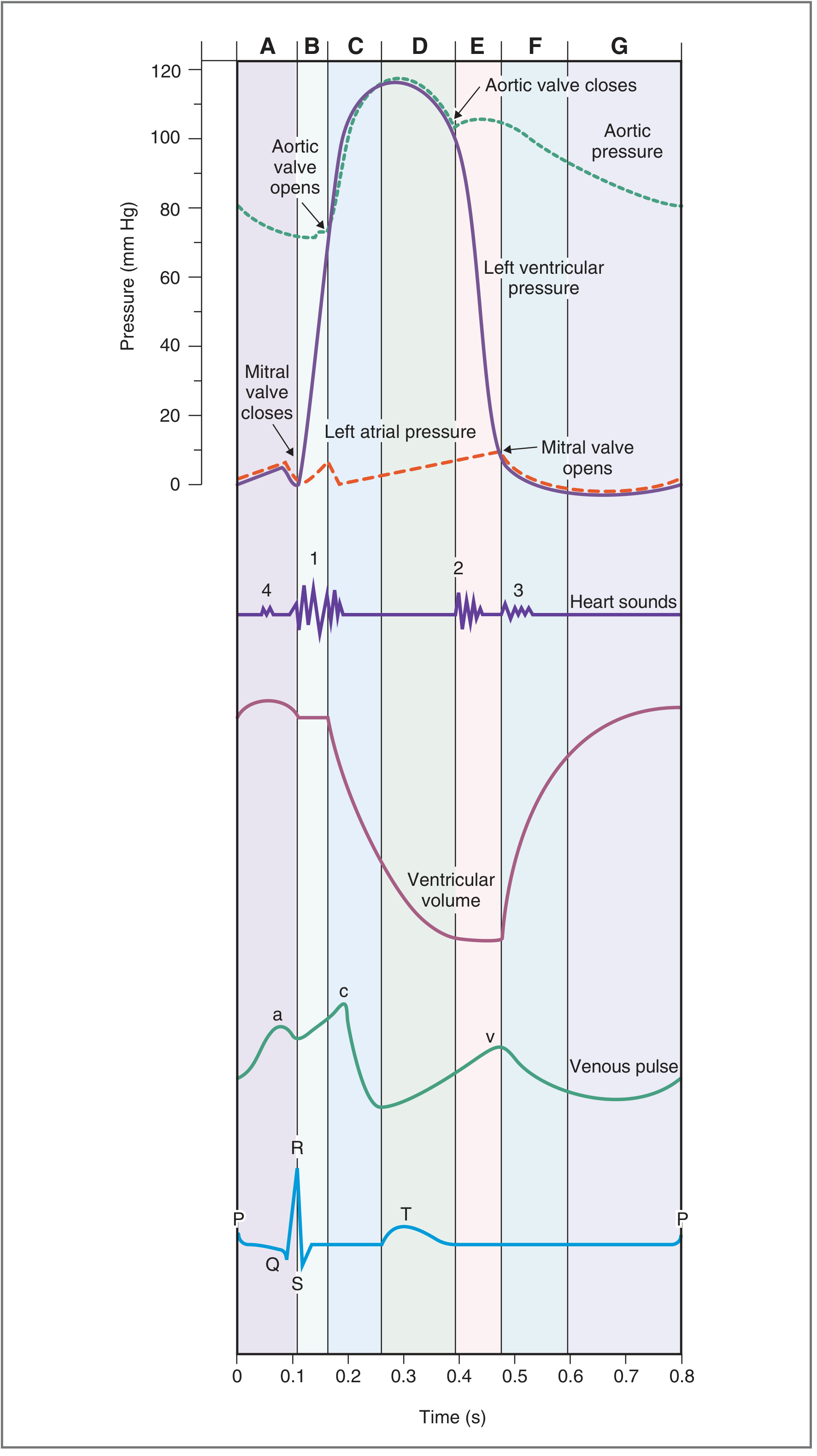
Phase A — Atrial Systole
| Parameter | Events |
|---|---|
| ECG | P wave → PR interval |
| Valves | Mitral valve open; aortic valve closed |
| Heart sound | S4 (not normally audible) |
- The P wave marks atrial depolarization and triggers atrial contraction.
- Left atrial pressure rises, actively ejecting blood through the open mitral valve into the already-filling left ventricle.
- This contributes the final ~20–30% of ventricular filling (the "atrial kick").
- The rise in atrial pressure appears on the venous pulse as the "a" wave.
- S4 may be heard when ventricular compliance is reduced (e.g., ventricular hypertrophy).
Phase B — Isovolumetric Ventricular Contraction
| Parameter | Events |
|---|---|
| ECG | QRS complex |
| Valves | Mitral closes, aortic still closed — all valves closed |
| Heart sound | S1 ("lub") |
- Ventricular depolarization (QRS) triggers contraction.
- Ventricular pressure rises sharply, but no blood is ejected because the aortic valve has not yet opened.
- Ventricular volume remains constant (isovolumetric).
- Mitral valve closure generates S1.
- The c wave of the venous pulse corresponds to the slight bulging of the tricuspid valve back toward the atrium.
Phase C — Rapid Ventricular Ejection
| Parameter | Events |
|---|---|
| ECG | ST segment |
| Valves | Aortic valve opens (when LV pressure > aortic pressure ~80 mmHg) |
| Heart sound | None |
- Once LV pressure exceeds aortic diastolic pressure, the aortic valve opens.
- Blood is ejected rapidly into the aorta; ventricular pressure rises to its maximum (~120 mmHg).
- Aortic pressure also rises and reaches its peak (systolic BP).
- Ventricular volume falls sharply — this is the major ejection phase.
- ~70% of stroke volume is ejected during this phase.
Phase D — Reduced Ventricular Ejection
| Parameter | Events |
|---|---|
| ECG | T wave |
| Valves | Aortic valve still open |
| Heart sound | None |
- Ventricular repolarization (T wave) begins; contraction force wanes.
- Ejection continues but at a slower rate.
- Ventricular volume reaches its minimum (end-systolic volume, ESV).
- Aortic pressure begins to fall as blood runs off into the peripheral arteries.
- The v wave of the venous pulse builds as blood accumulates in the atria (AV valves still closed).
Phase E — Isovolumetric Ventricular Relaxation
| Parameter | Events |
|---|---|
| ECG | After T wave (isoelectric) |
| Valves | Aortic valve closes — all valves closed |
| Heart sound | S2 ("dub") |
- LV pressure falls below aortic pressure → aortic valve closes → S2.
- The dicrotic notch on the aortic pressure trace marks valve closure.
- Ventricular pressure continues to fall, but volume is constant (isovolumetric relaxation).
- This phase ends when LV pressure falls below left atrial pressure.
Phase F — Rapid Ventricular Filling
| Parameter | Events |
|---|---|
| ECG | Isoelectric |
| Valves | Mitral valve opens |
| Heart sound | S3 (not normally audible in adults) |
- LV pressure falls below LA pressure → mitral valve opens.
- Blood rushes passively from atrium into ventricle — ventricular volume increases rapidly.
- Ventricular pressure remains low and relatively constant (active relaxation/lusitropy).
- S3, when present, is due to rapid ventricular filling; it is normal in children, but abnormal in adults (suggests reduced ventricular compliance, as in heart failure).
Phase G — Reduced Ventricular Filling (Diastasis)
| Parameter | Events |
|---|---|
| ECG | Isoelectric |
| Valves | Mitral valve open |
| Heart sound | None |
- Filling continues at a slow rate as the pressure gradient between atrium and ventricle equalizes.
- This phase ends when the next P wave fires and atrial systole begins (Phase A of the next cycle).
Summary Table
| Phase | Name | ECG | Valve Event | Heart Sound |
|---|---|---|---|---|
| A | Atrial systole | P wave | — | S4 |
| B | Isovolumetric ventricular contraction | QRS | Mitral closes | S1 |
| C | Rapid ventricular ejection | ST segment | Aortic opens | — |
| D | Reduced ventricular ejection | T wave | — | — |
| E | Isovolumetric ventricular relaxation | — | Aortic closes | S2 |
| F | Rapid ventricular filling | — | Mitral opens | S3 |
| G | Diastasis | — | — | — |
Key Volumes and Pressures
| Parameter | Value |
|---|---|
| End-diastolic volume (EDV) | ~120–130 mL |
| End-systolic volume (ESV) | ~50–60 mL |
| Stroke volume (SV = EDV − ESV) | ~70 mL |
| Ejection fraction (EF = SV/EDV) | ~55–65% |
| Peak LV systolic pressure | ~120 mmHg |
| LV diastolic pressure | ~0–5 mmHg |
Effect of Heart Rate on the Cycle
At faster heart rates, the duration of diastole shortens disproportionately more than systole. At very high heart rates, incomplete ventricular filling can compromise stroke volume. At 3× normal rate, systole occupies ~65% of the entire cycle (vs. ~40% at 72 bpm).
Sources: Costanzo Physiology 7th Ed.; Guyton and Hall Textbook of Medical Physiology; Ganong's Review of Medical Physiology, 26th Ed.
This is a shared conversation. Sign in to Orris to start your own chat.