
Brain hemorrhage treatment
I'll start with a quick overview while I pull from the medical library.
Brain hemorrhage treatment depends on the type (intracerebral, subarachnoid, subdural, epidural), size, location, and the patient's clinical status. General principles include: securing the airway, reversing anticoagulation, controlling blood pressure, reducing intracranial pressure, and surgical evacuation when indicated.
Searching sources...
Reading File
Searching the Web
brain hemorrhage treatment guidelines 2024 2025
Searching PubMed
"intracranial hemorrhage" AND treatment
Now let me search the medical library for detailed content on brain hemorrhage treatment, covering all types in parallel.
Finding Sources
Finding Sources
Searching PubMed
"intracerebral hemorrhage" AND "surgical treatment" AND "minimally invasive"
Finding Sources
Finding Sources
Good - I have strong leads. Now let me read the key sections in parallel from multiple textbooks.
Reading File
Reading File
Reading File
Excellent content. Let me now read the treatment sections from Tintinalli (emergency management) and Goldman-Cecil (SAH treatment) more completely, plus the Frameworks book.
Reading File
Reading File
Reading File
Let me also get the SAH treatment section and the coagulation reversal/surgical details.
Reading File
Reading File
I now have comprehensive, detailed content from multiple authoritative textbooks plus updated 2025 guideline data. Let me compile the full answer.
Loading Image
Here is a thorough, textbook-grounded overview of brain hemorrhage treatment, organized by hemorrhage type.
Brain Hemorrhage Treatment
Brain (intracranial) hemorrhage falls into several categories - intracerebral hemorrhage (ICH), subarachnoid hemorrhage (SAH), and traumatic forms (epidural/subdural hematoma). Together they account for about 20% of all strokes worldwide. Treatment priorities differ by type but share common emergency principles.
CT Imaging - The First Step
Non-contrast CT is the initial imaging of choice. Blood appears hyperdense (bright white). The appearance below shows a large right-sided parietal intraparenchymal hemorrhage:
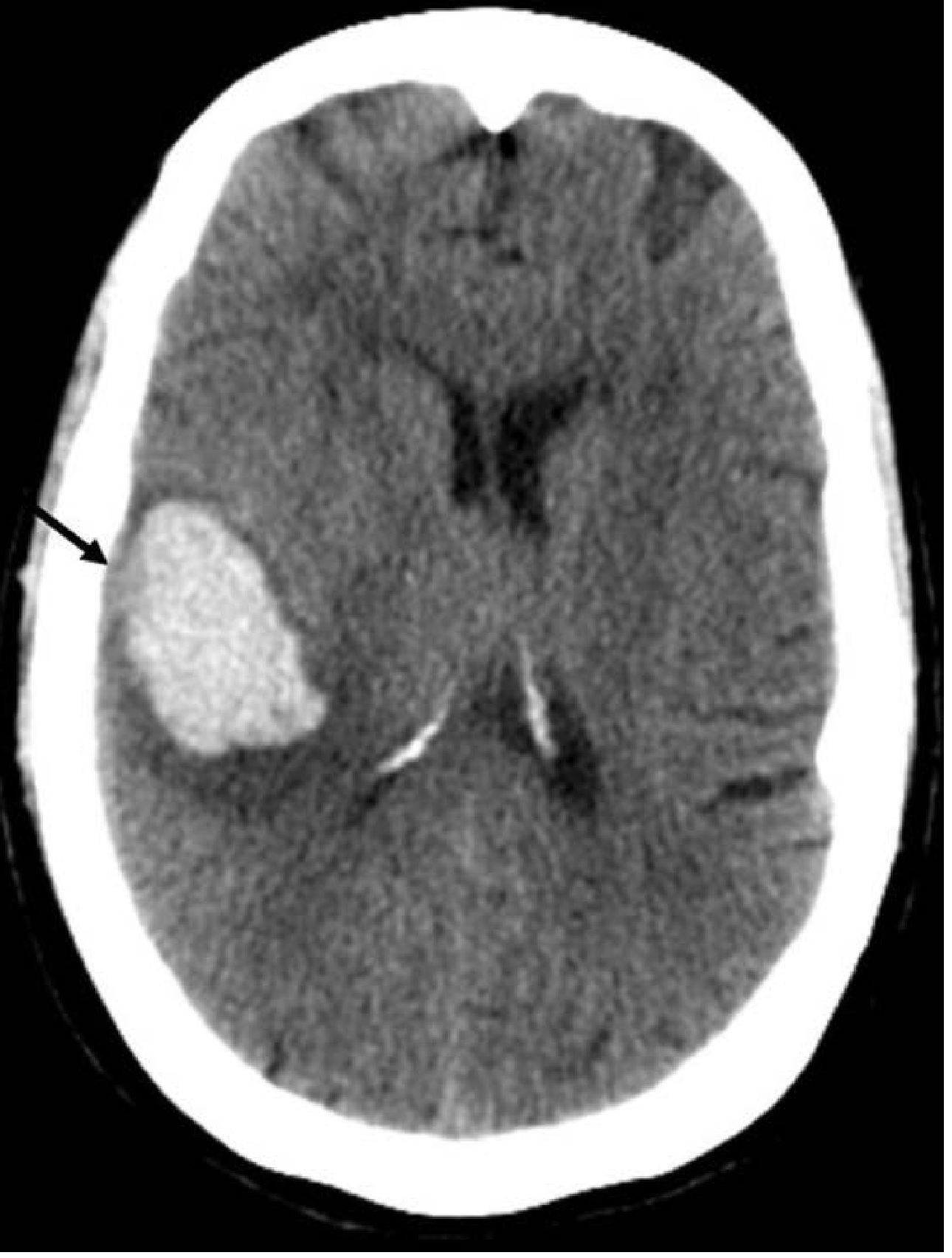
CT establishes volume, location, extension into the ventricles, and mass effect - all of which guide treatment decisions. - Tintinalli's Emergency Medicine, p. 1159
I. Spontaneous Intracerebral Hemorrhage (ICH)
ICH accounts for ~75% of hemorrhagic strokes. It carries a 30-day mortality of ~50% and a 7-day mortality of ~30%. Only 1 in 5 survivors is functionally independent at 1 year. - Tintinalli's Emergency Medicine, p. 1158
A. Immediate General Measures
All patients should be managed in a monitored critical care setting. Core priorities:
| Measure | Detail |
|---|---|
| Airway | Secure airway; intubation + neuromuscular blockade if needed for ICP |
| Head position | Elevate head of bed 30 degrees to reduce ICP |
| Temperature | Reduce hyperthermia aggressively with antipyretics; target ≤37.5°C |
| Glucose | Maintain 120-180 mg/dL (avoid hypo- or hyperglycemia >160 mg/dL) |
| Seizures | Treat if they occur; prophylactic anticonvulsants only in coma + intracranial hypertension (fosphenytoin/phenytoin 15-20 mg/kg IV load) |
| Corticosteroids | Contraindicated - do NOT give steroids for ICP in ICH |
- Tintinalli's Emergency Medicine, p. 1159; Goldman-Cecil Medicine, p. 3531
B. Blood Pressure Management
BP is typically elevated acutely due to a generalized sympathoadrenal response. Current AHA/ASA 2025 guidelines (also reflected in ESO 2025):
| SBP | Recommended Action |
|---|---|
| >220 mm Hg | Aggressive reduction with continuous IV infusion |
| 150-220 mm Hg | Acute lowering to SBP <140 mm Hg is safe and may improve functional outcome |
| SBP reduction | Should NOT exceed 70 mm Hg from baseline (risk of cerebral hypoperfusion) |
| SBP <120 mm Hg | Potentially harmful - ATACH-2 trial showed no benefit and possible harm |
Preferred IV agents: labetalol, esmolol (beta-blockers). Calcium channel blockers (e.g., nifedipine) are used less often because they can raise intracranial pressure, potentially worsening cerebral perfusion pressure. - Adams and Victor's Principles of Neurology, p. 847-848; Tintinalli's, p. 1159
C. Intracranial Pressure (ICP) Management
For large hemorrhages causing mass effect or coma:
-
Controlled hyperventilation to PaCO₂ of 25-30 mm Hg (short-term bridge)
-
Osmotic diuretics (mannitol) to dehydrate brain tissue
-
IV fluids: normal saline only (avoid hypotonic fluids)
-
Hypertonic saline as an alternative osmotic agent
-
Invasive ICP monitoring is generally indicated when aggressive ICP reduction measures are used
-
Maintain cerebral perfusion pressure (CPP) >60-70 mm Hg
-
Adams and Victor's Principles of Neurology, p. 847
D. Reversal of Anticoagulation
Anticoagulant-associated ICH has worse outcomes. Reversal should be done urgently regardless of INR value:
| Anticoagulant | Reversal Agent |
|---|---|
| Warfarin (VKA) | Vitamin K 5-10 mg IV (full effect 12-24 h) + 4-factor PCC (preferred) or FFP |
| Heparin | Protamine ~1 mg per 100 units of heparin (dose adjusted by time since last dose) |
| Direct Xa inhibitors (rivaroxaban, apixaban) | Andexanet alfa (ESO 2025 recommendation) |
| Dabigatran | Idarucizumab |
| Recombinant factor VIIa | No longer recommended outside clinical trials |
| Antiplatelet-associated ICH | Platelet transfusion not routinely recommended (ESO 2025 downgraded this) |
Fresh frozen plasma (FFP) contains variable clotting factors and requires large volume (15 mL/kg); 4-factor PCC is now preferred for VKA reversal for speed and reliability. - Tintinalli's Emergency Medicine, p. 1159-1160; ESO/EANS 2025 Guidelines
E. Surgical Treatment
Surgery remains controversial for supratentorial ICH. However, cerebellar hemorrhage is a surgical emergency:
- Cerebellar ICH >15 mL - surgical evacuation recommended (ESO 2025)
- Supratentorial ICH (30-100 mL) - decompressive surgery showed fewer patients with severe disability (mRS 5-6) at 180 days in recent trials (ESO 2025)
- Minimally invasive surgery (MIS) - increasingly favored where technically available
- Intraventricular hemorrhage (IVH) - external ventricular drainage (EVD) + intraventricular thrombolysis improves outcomes
- Hydrocephalus - EVD placement
Classic open craniotomy for deep supratentorial ICH has generally not shown consistent survival benefit in large trials, but patient selection and evolving MIS techniques are changing this landscape. - Adams and Victor's, p. 848; ESO/EANS 2025
ICH Severity Score
The ICH Score (Hemphill) predicts 30-day mortality:
| Component | Points |
|---|---|
| GCS 3-4 | 2 |
| GCS 5-12 | 1 |
| GCS 13-15 | 0 |
| ICH volume ≥30 cm³ | 1 |
| Intraventricular extension | 1 |
| Infratentorial location | 1 |
| Age ≥80 years | 1 |
30-day mortality: 0% (score 0), 13% (1), 26% (2), 72% (3), 97% (4), 100% (score ≥5) - Goldman-Cecil Medicine, p. 3547
II. Subarachnoid Hemorrhage (SAH)
SAH accounts for ~25% of hemorrhagic strokes. The most common non-traumatic cause is rupture of a saccular (berry) aneurysm at circle of Willis bifurcations. The classic presentation is a sudden, severe "thunderclap" headache, often with nausea, vomiting, loss of consciousness, and nuchal rigidity. - Goldman-Cecil Medicine, p. 3141-3158
Treatment Goals
- Limit initial brain injury
- Prevent rebleeding (most urgent in the first 24-72 hours)
- Prevent and treat vasospasm
A. Definitive Treatment of Ruptured Aneurysm
| Approach | Details |
|---|---|
| Endovascular coiling | Preferred for most aneurysms; catheter-based platinum coil packing |
| Surgical clipping | Open craniotomy with metal clip across aneurysm neck; preferred for certain anatomical locations |
The choice between clipping and coiling depends on aneurysm shape, location, neck geometry, and patient factors.
B. Vasospasm Prevention and Treatment
- Nimodipine (oral, 60 mg every 4 hours for 21 days) - standard of care; reduces morbidity from vasospasm
- Induced hypertension ("triple H therapy" - hypertension, hypervolemia, hemodilution) - used for symptomatic vasospasm, though evidence for hypervolemia alone is mixed
- Endovascular angioplasty or intra-arterial papaverine for refractory vasospasm
C. Hydrocephalus
Occurs in ~40% of cases from blood obstructing CSF outflow. Treated with EVD placement.
III. Traumatic Hemorrhage (Epidural/Subdural)
| Type | Mechanism | Treatment |
|---|---|---|
| Epidural hematoma | Arterial (middle meningeal artery tear); lens-shaped on CT | Emergency surgical evacuation if neurological deterioration or volume >30 mL |
| Acute subdural hematoma | Bridging vein tear; crescent-shaped; often elderly/anticoagulated | Surgical evacuation if >10 mm thick or midline shift >5 mm |
| Chronic subdural | Gradual accumulation; may be managed with burr holes or observation |
IV. General ICU/Secondary Prevention Measures
-
Multidisciplinary rehabilitation after the acute phase improves functional outcomes
-
Strict long-term BP control is the most important measure to prevent recurrent ICH
-
Antiplatelet therapy can be safely restarted at ~2-3 months post-bleed
-
Anticoagulants: restart timing individualized; most clinicians wait at least 10 days
-
Survivors of ICH have a 3x higher risk of subsequent ischemic stroke and 2x higher risk of MI - cardiovascular prevention is essential
-
Prophylactic anticonvulsants are not needed unless a seizure has occurred (seizure risk after ICH is lower than after ischemic stroke)
-
Goldman-Cecil Medicine, p. 3553-3555; Adams and Victor's Principles of Neurology, p. 835-848
Key References
- Adams and Victor's Principles of Neurology, 12th Ed., Chapter 33
- Goldman-Cecil Medicine, 26th Ed., Chapter 377
- Tintinalli's Emergency Medicine, Chapter 166
- Frameworks for Internal Medicine, Chapter 43
- AHA/ASA 2022 ICH Guideline (PMID: 35579034) - with 2025 updates
- ESO/EANS 2025 ICH Guideline
This is a shared conversation. Sign in to Orris to start your own chat.