
EINC & NB Assesment Lec Clinics .. teach me this very clearly according to Nelson pediatrics.. make me to understand throughly about this topic step by step with images needed everything
Reading File
Finding Sources
Finding Sources
Finding Sources
Finding Sources
Finding Sources
Finding Sources
Finding Sources
Finding Sources
I have the key sources. Now let me read the most comprehensive sections in parallel.
Reading File
Reading File
Reading File
Reading File
Reading File
Searching the Web
EINC Essential Intrapartum Newborn Care protocol Philippines WHO steps
Reading Web Page
https://thepafp.org/wp-content/uploads/2022/10/03-ESSENTIAL-…
Searching Images
Ballard score newborn gestational age assessment neuromuscular physical maturity
Loading Image
Loading Image
Loading Image
Loading Image
Reading File
Searching Images
newborn head to toe physical examination findings neonatal
Reading File
Loading Image
Here is your complete, step-by-step lecture on EINC & Newborn Assessment — structured exactly as it's taught in clinics, grounded in Nelson Pediatrics and supporting texts.
🍼 EINC & Newborn Assessment — Complete Lecture Notes
Sources: Harriet Lane Handbook (23rd ed.), Textbook of Family Medicine 9e, Morgan & Mikhail's Clinical Anesthesiology 7e, WHO/DOH EINC Protocol (Unang Yakap), PAFP EINC Module
PART 1: EINC — Essential Intrapartum and Newborn Care
What is EINC?
EINC (Essential Intrapartum and Newborn Care) is a simple, evidence-based protocol launched by the Philippines DOH (2009) as "Unang Yakap" (First Embrace), supported by the WHO. It reduces neonatal and maternal mortality by performing four core steps in a specific, time-bound sequence.
Key Principle: For the vast majority of healthy newborns, all they need are these four steps — no suction, no immediate bathing, no separation from mother.
Why EINC Matters
- ~82,000 Filipino children die annually — most deaths preventable
- The Philippines is among 42 countries accounting for 90% of global under-5 mortality
- These four core steps address the leading causes of neonatal death: hypothermia, infection, and failure to establish breastfeeding
THE FOUR CORE STEPS OF EINC
🔵 STEP 1 — Immediate and Thorough Drying (within the first 30 seconds)
Why? Prevents hypothermia — a newborn loses heat rapidly at birth due to evaporation from wet skin.
How to do it:
- Place baby on the mother's abdomen immediately after delivery
- Use a clean, dry towel — dry the face, head, trunk, and limbs thoroughly and vigorously within 30 seconds
- Discard the wet towel immediately (it becomes a cold source)
- Assess breathing while drying — if baby is not breathing → go to resuscitation
Room temperature must be 25–28°C, no air drafts
⚠️ Do NOT suction the mouth and nose of a vigorous baby with clear fluid — this is no longer recommended and can cause bradycardia.
🔵 STEP 2 — Skin-to-Skin Contact (immediately after drying, minimum 1 hour)
Why? Maintains warmth, promotes bonding, colonizes baby with mother's flora, stimulates oxytocin, initiates breastfeeding.
How to do it:
- Place the naked baby prone on the mother's bare chest/abdomen
- Cover both with a fresh, dry linen
- Put a bonnet on the baby's head
- Check for multiple births — palpate mother's abdomen for a second baby
Duration: Uninterrupted for at least 1 hour or until after the first breastfeed
✅ Skin-to-skin can restart at any time if interrupted for medical procedures.
🔵 STEP 3 — Properly-Timed Cord Clamping (1–3 minutes after birth, or when cord stops pulsating)
Why? Delayed cord clamping allows up to 80–100 mL of placental blood to transfuse into the baby — providing iron stores that prevent anemia for the first 6 months of life.
How to do it:
- Wait 1–3 minutes (or until cord pulsations stop)
- Clamp using a sterile plastic clamp at 2 cm from the umbilical base
- Apply a second clamp at 5 cm from the base
- Cut close to the plastic clamp
- Count the vessels in the cord stump — normal: 2 arteries + 1 vein
⚠️ Single umbilical artery → associated with chromosomal and anatomic anomalies → evaluate kidneys and heart
Non-Separation: Administer oxytocin 10 IU IM within 1 minute of baby's birth (to prevent postpartum hemorrhage in the mother).
🔵 STEP 4 — Non-Separation / Rooming-In (for early breastfeeding)
Why? Supports early initiation of breastfeeding, prevents hypothermia, promotes bonding.
What this means:
- Baby stays with the mother at all times
- No transfer to nursery unless medically necessary
- First breastfeed should happen during skin-to-skin (baby will root and self-attach)
- Mother is supported with positioning and latching
OTHER KEY INTRAPARTUM CARE PRACTICES (Evidence-Based)
| ✅ Recommended | ❌ NOT Recommended (Harmful) |
|---|---|
| Allow mobility during labor | Routine episiotomy |
| Companion of choice in labor | Routine shaving/enema |
| Oral fluids/light snacks | Routine uterine exploration post-delivery |
| Partograph use | Routine methergin without indication |
| IV fluids only when indicated | Suctioning vigorous newborn |
| Antenatal steroids for preterm | Ice pack on abdomen for PPH |
Routine Procedures in the First Hours
Within 0–6 Hours:
| Timing | Procedure |
|---|---|
| At birth | Thorough drying, assess breathing |
| Immediately | Skin-to-skin (at least 1 hour) |
| 1–3 min after birth | Cord clamping |
| After cord is cut | Vitamin K₁ 1 mg IM (prevents hemorrhagic disease of the newborn) |
| After 1 hour | Erythromycin eye ointment (ophthalmia neonatorum prophylaxis) |
| After 1 hour | Hepatitis B vaccine 0.5 mL IM |
| After 6 hours | BCG vaccine ID |
| After 6 hours | Bathing (optional, not before 6 hours) |
All newborns are Vitamin K–deficient at birth — breast milk is low in Vitamin K. IM administration is more effective than oral (Zipursky, 1999).
PART 2: NEWBORN ASSESSMENT (Head-to-Toe)
A. VITAL SIGNS & BIRTH WEIGHT
| Parameter | Normal Value |
|---|---|
| Heart rate | 120–160 beats/min |
| Respiratory rate | 30–60 breaths/min |
| Temperature (axillary) | 36.5–37.5°C |
| Blood pressure (MAP) | Related to gestational age and birth weight |
Birth Weight Classification:
| Category | Weight |
|---|---|
| Normal birth weight | ≥ 2500 g |
| Low birth weight (LBW) | < 2500 g |
| Very low birth weight (VLBW) | < 1500 g |
| Extremely low birth weight (ELBW) | < 1000 g |
| SGA (Small for Gestational Age) | < 10th percentile for GA |
| AGA (Appropriate for GA) | 10th–90th percentile |
| LGA (Large for Gestational Age) | > 90th percentile |
B. THE APGAR SCORE
Devised by Virginia Apgar in 1952 — assesses the newborn's physical condition immediately after birth and response to resuscitation.
The APGAR Mnemonic:
| Letter | Sign | Score 0 | Score 1 | Score 2 |
|---|---|---|---|---|
| A | Appearance (Color) | Blue/pale all over | Blue extremities, pink body (Acrocyanosis) | Completely pink |
| P | Pulse (Heart rate) | Absent | < 100 bpm | ≥ 100 bpm |
| G | Grimace (Reflex irritability) | No response | Grimace | Cough, sneeze, cry |
| A | Activity (Muscle tone) | Limp | Some flexion of extremities | Active motion |
| R | Respirations | Absent, irregular | Slow, crying | Good, strong cry |
Scoring Interpretation:
| Score | Interpretation | Action |
|---|---|---|
| 7–10 | Normal/Vigorous | Routine care, gentle stimulation |
| 4–6 | Moderate depression | Stimulate, supplemental O₂, monitor |
| 0–3 | Severe depression | Immediate resuscitation |
Assessed at: 1 minute and 5 minutes after birth
- If 5-min score < 7 → repeat every 5 minutes up to 20 minutes
- 1-min score correlates with survival
- 5-min score has limited relationship to neurological outcome
⚠️ A low Apgar score (0–3) does NOT by itself predict neurologic outcome or confirm an intrauterine hypoxic event. The Apgar score should never delay resuscitation.
C. GESTATIONAL AGE ESTIMATION — NEW BALLARD SCORE
Used when obstetric dating (ultrasound/LMP) is unavailable. Most accurate at ~24 hours of life.
The Ballard Score combines neuromuscular maturity (6 criteria) + physical maturity (6 criteria).
Neuromuscular Maturity (6 Signs):
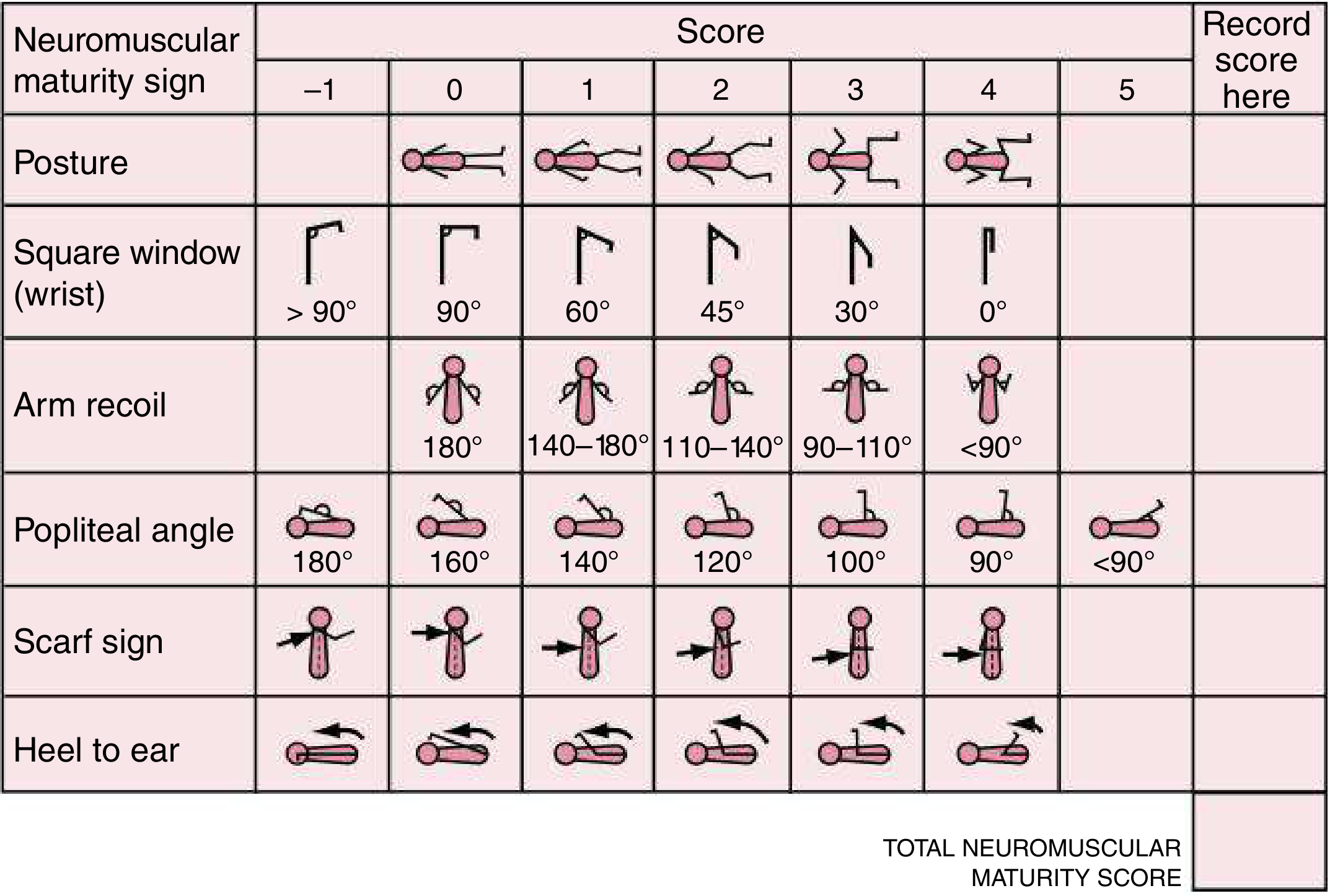
| Sign | How to Test | Key Principle |
|---|---|---|
| Posture | Observe infant at rest, supine | More flexion = more mature |
| Square Window (Wrist) | Flex hand on forearm; measure angle | Smaller angle (0°) = more mature |
| Arm Recoil | Flex forearm 5 sec → extend → release | Faster recoil (<90°) = more mature |
| Popliteal Angle | Extend leg from knee-chest position | Smaller angle = more mature |
| Scarf Sign | Pull hand across neck to opposite shoulder | Elbow not reaching midline = more mature |
| Heel to Ear | Draw foot toward head | Less extension = more mature |
Physical Maturity (6 Signs):
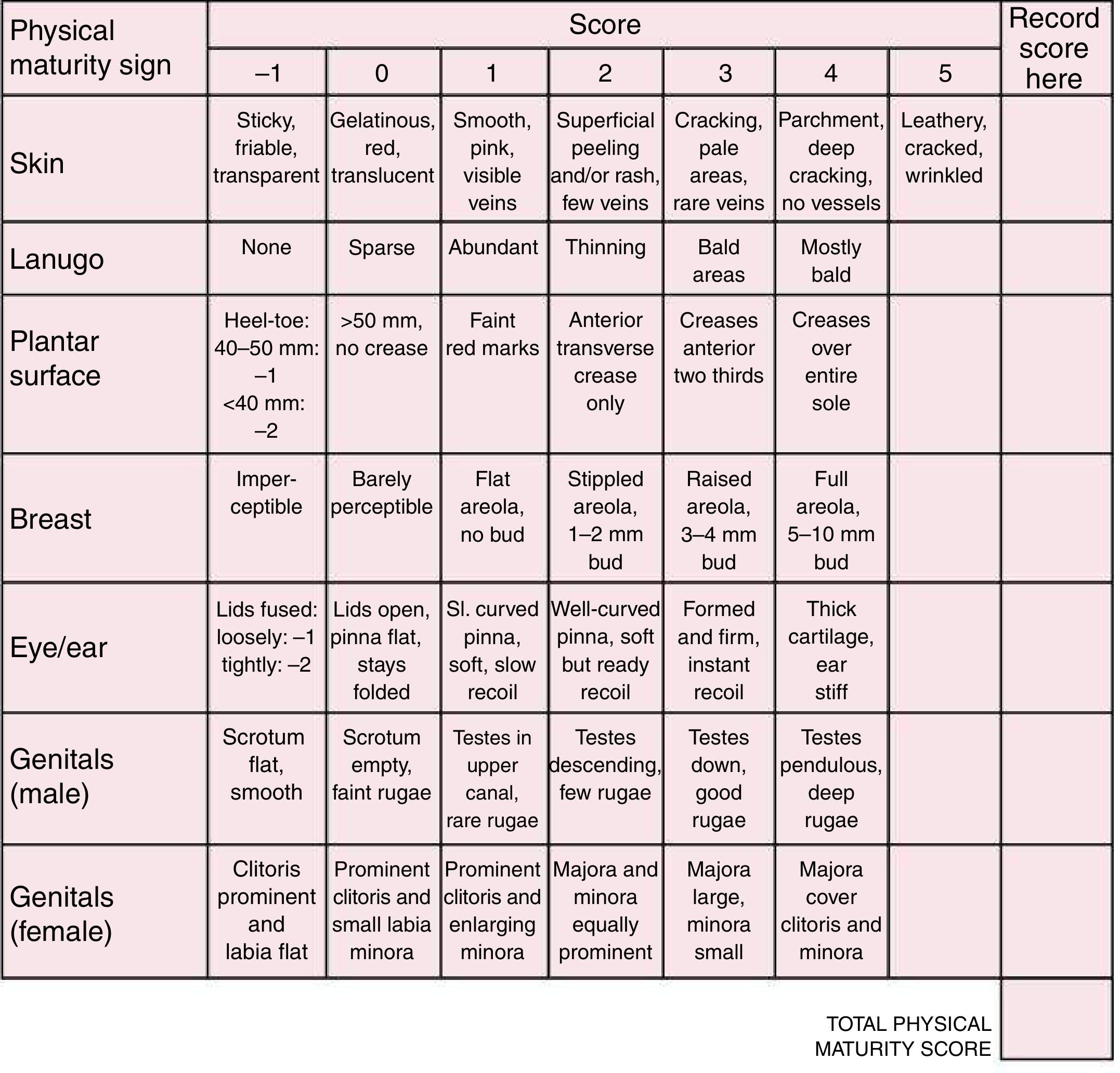
| Sign | Immature | Mature |
|---|---|---|
| Skin | Sticky, transparent, gelatinous | Leathery, cracked, wrinkled |
| Lanugo | None → sparse | Mostly bald |
| Plantar surface | Heel-toe < 40 mm, no creases | Creases over entire sole |
| Breast | Imperceptible | Full areola, 5–10 mm bud |
| Eye/Ear | Lids fused, pinna flat | Thick cartilage, instant recoil |
| Genitals (M) | Scrotum flat, no rugae | Testes pendulous, deep rugae |
| Genitals (F) | Prominent clitoris, flat labia | Majora cover clitoris and minora |
Total score → gestational age (weeks):
- Score –10 = 20 weeks | Score 0 = 24 weeks | Score 10 = 28 weeks | Score 20 = 32 weeks | Score 30 = 36 weeks | Score 40 = 40 weeks | Score 50 = 44 weeks
If there is a >1 week discrepancy between Ballard score and dates → use the earlier gestational age.
D. HEAD-TO-TOE PHYSICAL EXAMINATION
Performed within 24 hours of delivery.
1. HEAD
| Finding | Clinical Note |
|---|---|
| Caput succedaneum | Soft tissue edema, crosses suture lines, present at birth, resolves in days |
| Cephalohematoma | Subperiosteal bleed, does NOT cross suture lines, may take weeks–months to resolve |
| Molding | Overlapping of cranial bones from labor; resolves within days |
| Fontanelles | Anterior (closes 9–18 months); Posterior (closes 6–8 weeks) |
| Macrocephaly/Microcephaly | Plot OFC on growth chart |
Memory tip: Caput → Crosses suture lines, Cephalohematoma → Confined within sutures
2. EYES
- Subconjunctival hemorrhages — common, benign, from birth pressure
- Red reflex — must be present bilaterally (absent = congenital cataract, retinoblastoma)
- Eye discharge within 24–48h from prophylactic drops = chemical conjunctivitis (benign)
3. NOSE
- Newborns are obligate nasal breathers
- Pass catheter through both nostrils to rule out choanal atresia
4. MOUTH
- Epstein pearls — white cysts on hard palate midline (benign)
- Examine for cleft lip/palate
- Pass catheter to stomach to rule out esophageal atresia
5. NECK
- Examine for masses: thyroglossal duct cyst (midline), branchial cleft cyst (lateral)
- Torticollis — asymmetric neck rotation; may have SCM mass
- Clavicles — palpate for fracture (crepitus, decreased movement, pain)
6. CHEST & RESPIRATORY
- Normal: 30–60 breaths/min
- Breast engorgement (both sexes) — due to maternal estrogen; normal, resolves in weeks
- Listen for air entry bilaterally
- Grunting, nasal flaring, retractions → respiratory distress → investigate
- Transient Tachypnea of the Newborn (TTN): most common cause of tachypnea; delayed clearance of fetal lung fluid; resolves by 12–72 hours
7. CARDIOVASCULAR
- Assess capillary refill, PMI
- Heart rate: 120–160 bpm
- Auscultate along left sternal border
- Murmurs in first 24h — often transient (PDA closure, peripheral pulmonary stenosis); benign
- Concerning murmur: harsh, pansystolic, grade ≥ III/VI, abnormal S2
- Palpate femoral pulses — absent/asymmetric → suspect coarctation of the aorta
8. ABDOMEN
- Normal: soft, symmetric, slightly protuberant
- Liver: palpable 1–2 cm below RCM (normal)
- Scaphoid abdomen → diaphragmatic hernia
- Distended abdomen → obstruction, organomegaly
- Umbilical hernia: monitor; most resolve by 1–5 years
- Omphalitis: periumbilical erythema + foul discharge → treat promptly
9. GENITALIA
Female:
- Inspect labia majora, minora, clitoris, urethral orifice, vaginal opening
- Imperforate hymen — check vaginal opening
- Vaginal tags and milky/blood-tinged discharge — normal (maternal hormone withdrawal)
Male:
- Measure stretched penile length: mean = 3.5 cm at term
- Urethral meatus midline on glans
- Hypospadias = ventral displacement; Epispadias = dorsal displacement
- → Do NOT circumcise if abnormal meatus
- Palpate both testes in scrotum
- Hydrocele = fluid around testis; transilluminates; resolves by 1 year
- Inguinal hernia = non-transilluminable, reducible
10. MUSCULOSKELETAL
| Finding | Assessment |
|---|---|
| Hip dislocation (DDH) | Ortolani (relocation click), Barlow (dislocation) maneuvers |
| Fractured clavicle | Most common birth fracture; crepitus, decreased arm movement |
| Brachial plexus injury | Erb's palsy (C5–C6): arm adducted, pronated, "waiter's tip" |
| Polydactyly / Syndactyly | Document and refer |
| Clubfoot (talipes equinovarus) | Refer to orthopedics |
11. SKIN
| Finding | Description |
|---|---|
| Vernix caseosa | White, cheesy protective coating — normal |
| Lanugo | Fine downy hair — more in preterm |
| Milia | Tiny white sebaceous cysts on nose/cheeks — benign |
| Erythema toxicum | Blotchy erythematous rash with yellow/white pustules — benign, days 2–5 |
| Mongolian spots | Blue-gray hyperpigmentation, sacral/buttock area — common in Asian/dark-skinned neonates |
| Port wine stain (Nevus flammeus) | Flat, red-purple; if on V₁–V₂ distribution → Sturge-Weber syndrome |
| Strawberry hemangioma | Grows post-birth, involutes by age 5–7 |
| Harlequin sign | Half-body color change; benign vasomotor instability |
12. NEUROLOGICAL
- Primitive reflexes — assess all of these:
| Reflex | Stimulus | Normal Response | Disappears |
|---|---|---|---|
| Moro | Sudden head drop backward | Arms extend-abduct then flex-adduct (embrace) | 3–6 months |
| Rooting | Stroke cheek | Head turns toward stimulus | 3–4 months |
| Sucking | Finger in mouth | Strong sucking | 2–3 months |
| Palmar grasp | Finger in palm | Grips finger | 3–4 months |
| Plantar grasp | Pressure on ball of foot | Toes curl | 9–12 months |
| Babinski | Stroke lateral plantar | Toes fan out (extensor) | 1–2 years |
| Tonic neck (ATNR) | Head turned to one side | Fencing posture | 4–6 months |
| Stepping | Hold upright, foot on surface | Stepping movements | 2 months |
Absence of Moro reflex = severe brain damage or brachial plexus injury Asymmetric Moro = Erb's palsy or fractured clavicle
E. BIRTH TRAUMA
| Injury | Key Features |
|---|---|
| Caput succedaneum | Edema crossing suture lines; present at birth |
| Cephalohematoma | Subperiosteal; confined to one bone; jaundice risk |
| Subgaleal hematoma | Under aponeurosis; can be massive/life-threatening |
| Fractured clavicle | Crepitus + decreased arm movement on day 1; swelling on day 2 |
| Erb's palsy | C5–C6; arm adducted, pronated ("waiter's tip") |
| Klumpke's palsy | C8–T1; hand weakness; Horner's if T1 |
NEONATAL RESUSCITATION ALGORITHM
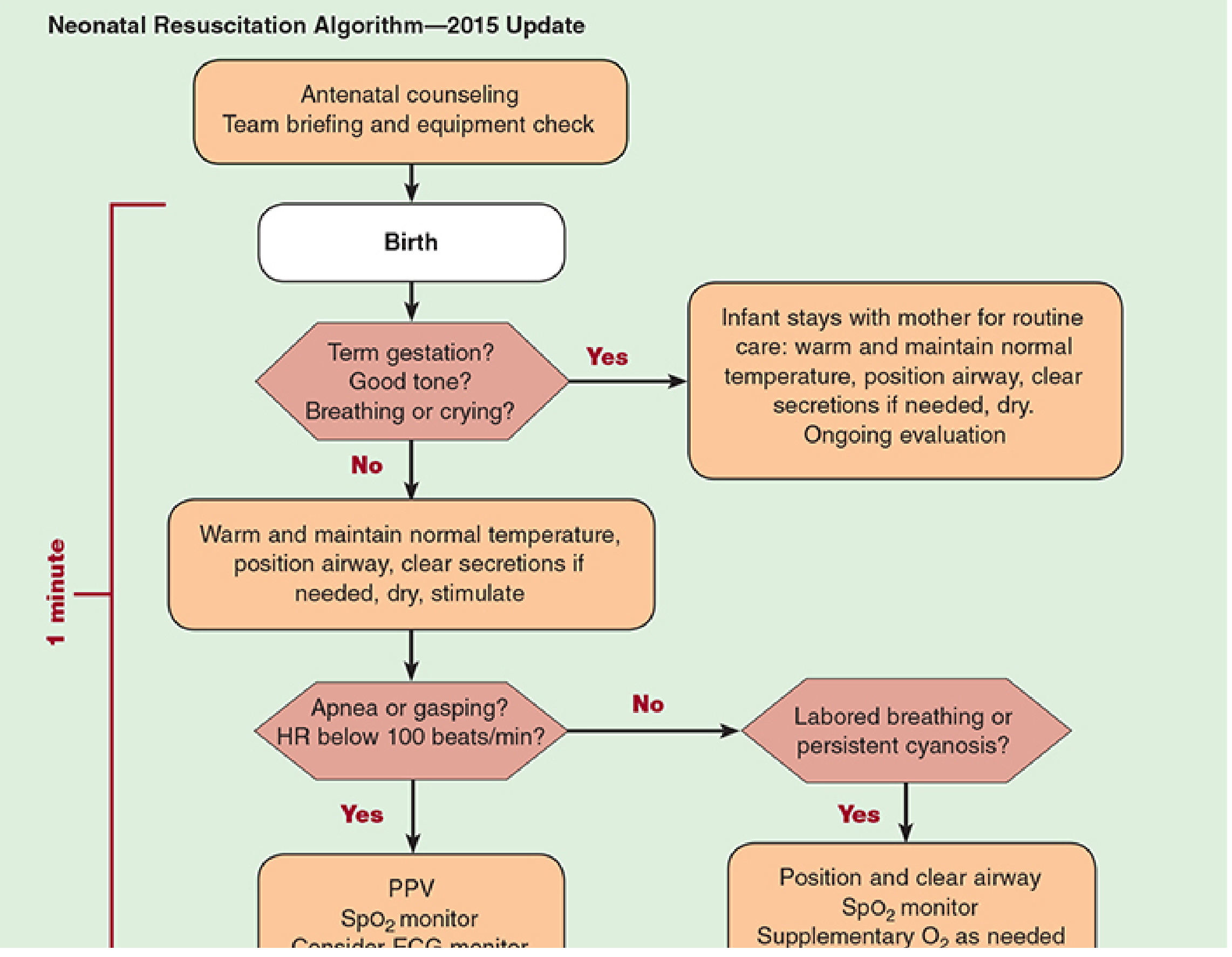
Step-by-step approach:
At birth — ask 3 questions:
- Term gestation?
- Good muscle tone?
- Breathing or crying?
→ All YES = Routine care (dry, keep warm, clear airway if needed)
→ Any NO = Begin resuscitation steps
Resuscitation sequence (within 1 minute):
- Warm, dry, stimulate
- Position airway (sniffing position), clear secretions if needed
- Assess: Apnea/gasping? HR < 100?
- YES → PPV (Positive Pressure Ventilation) + SpO₂ monitor
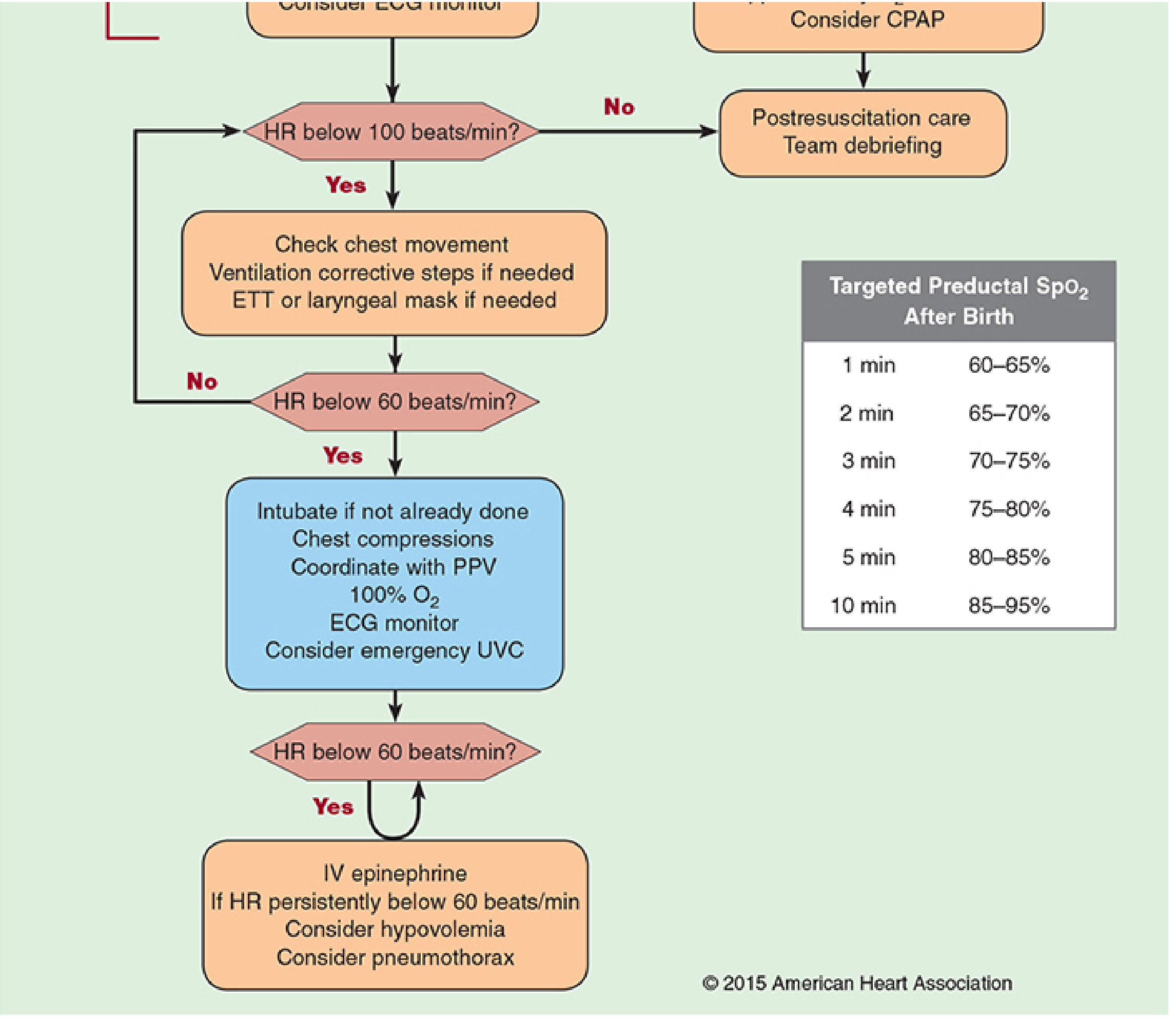
- If HR still < 100 → check chest movement, corrective steps, consider ETT/LMA
- If HR < 60 → Chest compressions (3:1 ratio) + PPV 100% O₂ + IV access (UVC)
- If HR still < 60 → IV Epinephrine + consider hypovolemia/pneumothorax
Targeted Preductal SpO₂ After Birth:
| Time | Target SpO₂ |
|---|---|
| 1 min | 60–65% |
| 2 min | 65–70% |
| 3 min | 70–75% |
| 4 min | 75–80% |
| 5 min | 80–85% |
| 10 min | 85–95% |
F. GLUCOSE SCREENING
Risk groups requiring glucose monitoring:
- LGA (infant of diabetic mother)
- SGA
- Preterm
- Post-term (> 42 weeks)
- Signs of hypoglycemia (jitteriness, poor tone, apnea)
Glucose < 45 mg/dL → feed and recheck; if persistent → D10W IV
QUICK SUMMARY TABLE — EINC vs NB Assessment
| Topic | Key Points |
|---|---|
| EINC 4 Steps | Dry → Skin-to-skin → Cord clamp 1–3 min → Non-separation |
| Room temp | 25–28°C, no drafts |
| Cord vessels | 2 arteries + 1 vein (single artery = investigate) |
| Vit K | 1 mg IM after cord cut |
| Hep B | 0.5 mL IM after 1 hour |
| BCG | ID after 6 hours |
| Bathing | After 6 hours (optional) |
| Apgar | At 1 and 5 min; 7–10 = normal; repeat q5 min if < 7 |
| Ballard Score | Best at 24h; Neuromuscular + Physical = GA |
| Single UA | Evaluate kidneys and heart |
| Red reflex | Must be present bilaterally |
| Femoral pulses | Absent = suspect coarctation |
| Moro absent | CNS damage or brachial plexus injury |
| Caput vs Cephalo | Caput crosses sutures; Cephalohematoma does not |
Sources: Harriet Lane Handbook 23e, Textbook of Family Medicine 9e, Morgan & Mikhail's Clinical Anesthesiology 7e, WHO/DOH EINC Protocol (Unang Yakap), PAFP EINC ModuleHere's what you just got — a complete, structured lecture covering everything you need for EINC & NB Assessment clinics:
What's Covered:
PART 1 — EINC (Unang Yakap Protocol)
- Why EINC exists and the public health context
- 4 Core Steps explained step-by-step with rationale:
- Immediate thorough drying (30 seconds)
- Skin-to-skin contact (≥1 hour)
- Properly-timed cord clamping (1–3 min)
- Non-separation / early breastfeeding
- Evidence-based vs. harmful practices table
- Timeline for Vit K, Hep B, BCG, eye ointment, bathing
PART 2 — Newborn Assessment
- Vital signs & birth weight classification (ELBW → LGA)
- APGAR Score — full table + mnemonic + interpretation + when to act
- New Ballard Score with both visual charts (neuromuscular + physical maturity)
- Head-to-toe exam: head (caput vs. cephalohematoma), eyes (red reflex), nose (choanal atresia), mouth, neck, chest, cardiovascular (femoral pulses, murmurs), abdomen, genitalia, MSK, skin (all common neonatal rashes), neurology (all primitive reflexes table)
- Neonatal Resuscitation Algorithm — both flowcharts with target SpO₂ table
- Birth trauma summary table
- Quick reference summary table at the end
This covers your lecture clinics thoroughly. If you want me to drill into any specific section further (e.g., just Ballard scoring, or neonatal rashes, or resuscitation steps), just ask!
EINC & NB Assesment Lec Clinics .. teach me this very clearly according to Nelson pediatrics.. make me to understand throughly about this topic step by step with images needed everything
Reading File
Your credits are exhausted. Your daily credits reset tomorrow, or you can purchase a top-up for more.
This is a shared conversation. Sign in to Orris to start your own chat.