
Treatment of mucormycosis
Reading File
Now let me search the medical library and PubMed in parallel for comprehensive coverage.
Finding Sources
Searching PubMed
mucormycosis treatment
Searching the Web
mucormycosis treatment guidelines 2025 amphotericin liposomal isavuconazole
Now let me read the most comprehensive textbook sections in parallel:
Reading File
Reading File
Finding Sources
There's a useful flowchart image and detailed treatment sections. Let me read the Goldman-Cecil and Fishman sections, and fetch the flowchart image:
Reading File
Reading File
Reading File
Let me read the surgery section and fetch the management flowchart:
Reading File
Loading Image
I now have comprehensive information to provide a detailed, well-cited answer. Let me compile it.
Treatment of Mucormycosis
Mucormycosis (caused by Mucorales - Rhizopus, Mucor, Lichtheimia, Cunninghamella) is a life-threatening angioinvasive fungal infection requiring a multimodal, urgent approach. The three equally important pillars are: antifungal therapy, surgical debridement, and reversal of underlying predisposing factors.
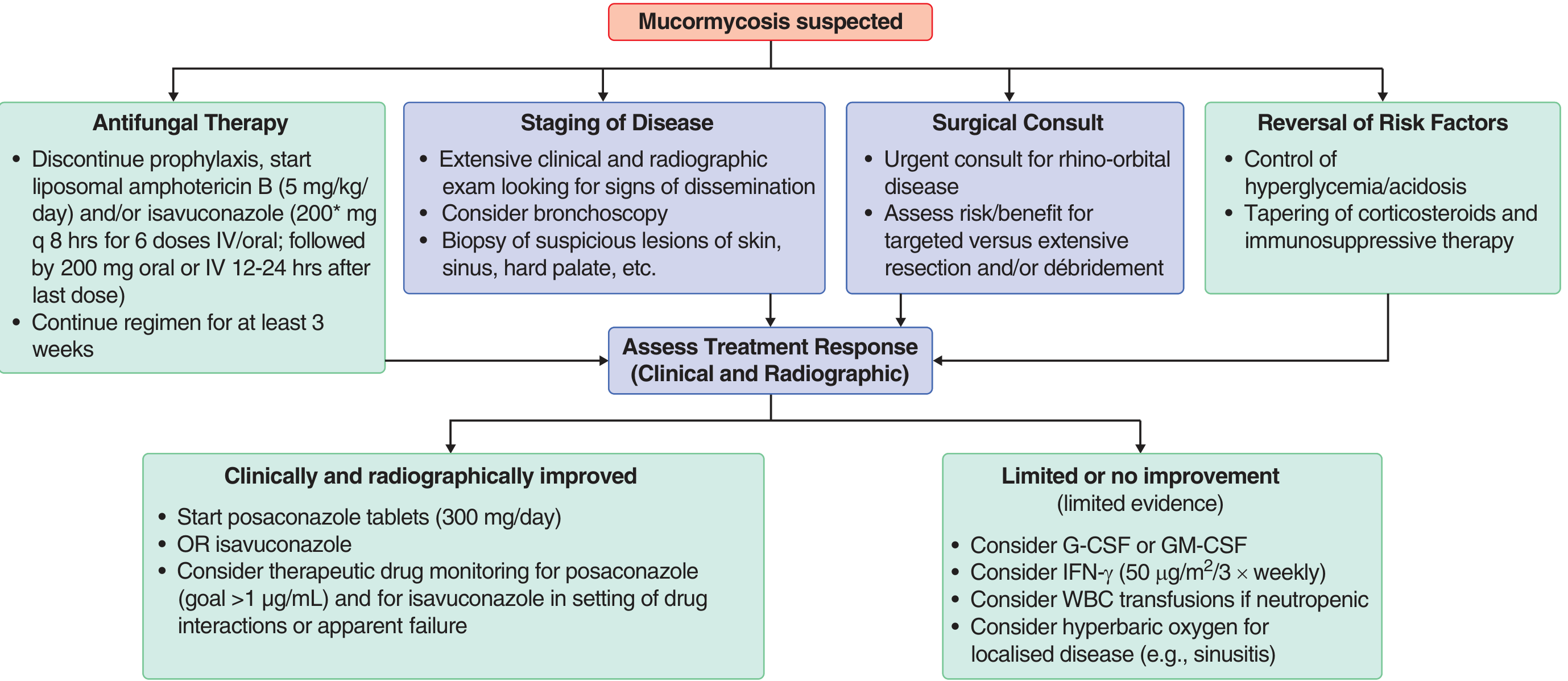
Fig. Management approach to suspected mucormycosis (Goldman-Cecil Medicine)
1. Antifungal Therapy
Drugs Active Against Mucorales
Mucorales are resistant to flucytosine, fluconazole, ketoconazole, voriconazole, and echinocandins. Active agents are:
| Agent | Role | Strength of Recommendation |
|---|---|---|
| Liposomal amphotericin B | First-line | Strongly recommended |
| Amphotericin B lipid complex | First-line (non-CNS) | Moderately recommended |
| Isavuconazole | First-line / salvage | Moderately recommended (1st line); Strongly recommended (salvage) |
| Posaconazole DR tablets/IV | First-line / salvage | Moderately recommended |
| Amphotericin B deoxycholate | Last resort (resource-limited) | Recommended against |
(ECMM-MSG-ERC Global Guidelines; Goldman-Cecil Medicine)
First-Line Treatment
Liposomal amphotericin B (LAmB) is the cornerstone:
- Dose: 5-10 mg/kg/day IV - begin at full dose on Day 1 (do not slowly escalate)
- If CNS involvement: 10 mg/kg/day from Day 1
- If SOT or pre-existing renal compromise: consider 5 mg/kg/day with close monitoring
- Monitor renal function and electrolytes (Mg²⁺, K⁺) closely; volume-load to reduce nephrotoxicity
Isavuconazole (FDA-approved for mucormycosis):
- Loading: 372 mg (= 200 mg isavuconazole) every 8 hours x 6 doses IV or oral (over 2 days)
- Maintenance: 372 mg once daily (IV or oral) starting 12-24 hours after last loading dose
- Efficacy comparable to amphotericin B in matched case-control analysis (VITAL trial)
- Advantages: oral bioavailability, less nephrotoxicity, shorter QTc effect (in contrast to other azoles)
Posaconazole (alternative first-line):
- IV or DR tablets: 300 mg twice on Day 1, then 300 mg once daily
- Oral suspension: 200 mg four times daily (less preferred due to variable bioavailability)
Key point: Delaying amphotericin B for ≥6 days after diagnosis is associated with a twofold increase in mortality - Goldman-Cecil Medicine.
Step-Down / Maintenance Therapy
Once clinical and radiographic improvement is documented:
- Switch to posaconazole DR tablets 300 mg/day or isavuconazole orally
- Therapeutic drug monitoring: posaconazole target >1 µg/mL; isavuconazole monitoring in cases of drug interactions or apparent failure
Combination Therapy
- LAmB + echinocandin (caspofungin): Potentially better in diabetic patients with rhino-orbital mucormycosis (especially with cerebral involvement), but NOT shown to be beneficial in underlying hematologic malignancy. Echinocandins lack intrinsic activity but may act synergistically via inhibiting FKS glucan synthase - Goldman-Cecil Medicine.
- LAmB + posaconazole: Being studied; definitive data not yet available.
2. Surgical Debridement
Surgery is urgent and non-negotiable in most forms:
- Rhino-orbital-cerebral (ROCM): Urgent ENT/neurosurgical consult; aggressive endoscopic or open debridement with clean margins; repeated removal of necrotic tissue; enucleation of the eye may be required if orbital involvement persists
- Pulmonary: Cardiothoracic surgery evaluation for resection; wedge resection, lobectomy, or pneumonectomy depending on extent
- Cutaneous: Debridement of all necrotic tissue; can be curative for focal lesions
- Device-related: Prompt removal of infected device
CT/MRI before surgery and intraoperative frozen section are used to guide the extent of resection - Goldman-Cecil Medicine.
3. Reversal of Underlying Predisposing Conditions
This is as important as antifungal therapy:
| Condition | Action |
|---|---|
| Diabetic ketoacidosis / hyperglycemia | Aggressive glucose and ketoacidosis control |
| Corticosteroids | Taper/discontinue as rapidly as feasible |
| Deferoxamine (iron chelation) | Discontinue - acts as siderophore promoting fungal growth |
| Immunosuppressants | Reduce or stop where possible |
| Neutropenia | Granulocyte colony-stimulating factor (G-CSF/GM-CSF) |
4. Adjunct Therapies (Limited Evidence)
- Hyperbaric oxygen (HBO): May be beneficial in diabetic patients with rhinocerebral disease; cannot be routinely recommended due to lack of rigorous trials
- Granulocyte transfusions: Consider in refractory neutropenic patients until engraftment
- IFN-γ: 50 µg/m² three times weekly in refractory cases
- Deferasirox (iron chelator substitution): Previously explored; current evidence does not support its use for mucormycosis adjunct therapy
- Topical/local amphotericin B: Aerosol or transthoracic injection as adjunct for pulmonary mucormycosis; topical amphotericin B and natamycin for cutaneous/ocular forms - Fishman's Pulmonary Diseases.
5. Duration of Therapy
There is no fixed duration. Discontinuation is guided by:
- Near-normalization of imaging
- Negative follow-up biopsy and cultures from affected site
- Recovery from immunosuppression
Minimum treatment is typically several weeks to months of IV therapy followed by oral step-down.
6. Salvage Therapy (Treatment Failure)
- Isavuconazole: Strongly supported for salvage
- Posaconazole DR tablets or IV: Strongly supported for salvage
- Re-evaluate adequacy of surgical debridement
- Consider combination antifungal therapy
- Optimize host immune reconstitution
Prognosis
| Form | Mortality |
|---|---|
| Isolated sinusitis | ~16% (potentially curable with timely surgery + antifungal) |
| Sino-orbital | ~24% |
| Rhinocerebral | ~62% |
| Pulmonary | >50% |
| Gastrointestinal | ~85% |
(Goldman-Cecil Medicine)
Recent Evidence
A 2025 systematic review on isavuconazole in mucormycosis (PMID: 39762765) confirms isavuconazole's efficacy in various mucormycosis forms whether used as primary treatment or salvage. A 2025 meta-analysis (PMID: 41355295) specifically addresses outcomes in pediatric HSCT patients, where mortality remains high and LAmB remains the mainstay.
Key sources:
- Goldman-Cecil Medicine, Ch. 312 (Mucormycosis Treatment)
- Fishman's Pulmonary Diseases and Disorders, Ch. 132 (Antifungal Treatment)
- Current Surgical Therapy 14e
- Murray & Nadel's Textbook of Respiratory Medicine
- ECMM-MSG-ERC Global Guidelines (Cornely et al., Lancet Infect Dis 2019)
This is a shared conversation. Sign in to Orris to start your own chat.