
Define Hernia refering bailey and love textbook of surgery
Reading File
Now let me search the library for Bailey & Love's textbook and the definition of hernia.
Finding Sources
Finding Sources
Found the Bailey & Love block. Now let me read it along with a broader search for the hernia definition paragraphs.
Reading File
Finding Sources
That block is about undescended testis. Let me search specifically for the hernia chapter in Bailey & Love using a broader approach.
Finding Sources
Finding Sources
The key section is "ABDOMINAL HERNIA" in block9, starting at line 1199. Let me read that section comprehensively.
Reading File
I have the core definition and the surrounding content. Let me also read the sections on causes, pathophysiology, and types of hernia for a complete picture.
Reading File
I now have all the content needed for a thorough answer. Let me also fetch the relevant image of hernia.
Loading Image
I now have all the information needed from Bailey & Love's. Here is the complete answer:
Definition of Hernia - Bailey and Love's Short Practice of Surgery (28th Edition)
The Definition
"A hernia is an abnormal protrusion of an organ or tissue through an opening in the layer that normally confines it."
- Bailey and Love's Short Practice of Surgery, 28th Edition, Chapter 64: Abdominal Hernia, p. 1080
Key Points Elaborating the Definition
General characteristics of abdominal hernia:
- There are many varieties of hernia arising through areas of weakness in the abdominal wall.
- Because the hernia "pushes" from the inside to the outside, an abdominal hernia takes with it all the coverings of the abdominal wall, although they may be thinned and attenuated.
- However, not all abdominal hernias have a peritoneal sac - for example, many epigastric hernias arise in the interstitial layers and only draw peritoneum into the protrusion as a secondary phenomenon when they become larger.
Essential Components of an Abdominal Wall Hernia
According to Bailey & Love, an abdominal wall hernia has two essential components:
- A defect in the wall - the weakness may be through fascia and muscle, or through fascia alone (e.g. epigastric hernia), or may even have a bony component (e.g. femoral hernia).
- The content - tissue that has been forced outwards through the defect.
The weakness in the wall is usually the narrowest part of the hernia, which expands into the subcutaneous fat outside the muscle.
Anatomical Causes of Abdominal Wall Herniation
Bailey & Love classifies the anatomical causes as:
- Areas of natural weakness due to absence of muscle (e.g. lumbar triangles, posterior wall of the inguinal canal)
- Natural defects that allow structures to enter or leave the abdomen (e.g. inguinal canal, oesophageal hiatus, femoral canal)
- Developmental abnormalities
- Disruptions of the abdominal wall as a result of injury
Causes of Hernia (Summary Box 64.1)
| Cause |
|---|
| Anatomical weakness |
| Developmental failures |
| Genetic weakness of collagen |
| Sharp and blunt trauma |
| Weakness due to ageing and pregnancy |
| Primary neurological and muscle diseases |
Pathophysiology of Hernia Formation
Bailey & Love emphasizes that hernia is essentially a "collagen disease":
- A normal abdominal wall has sufficient strength to resist high abdominal pressure. Many patients notice a hernia after excessive straining - but the strain merely brings the hernia to attention rather than being its actual cause.
- There is good evidence of an inherited imbalance in the types of collagen (supported by histological evidence and its association with diseases like aortic aneurysm).
- In extreme collagen disorders such as Ehlers-Danlos syndrome, long-term repair is very difficult.
- Smoking is linked to impaired collagen maturation and increases hernia risk.
- Hernias are more common in elderly patients owing to degenerative weakness of muscles and fibrous tissue.
- Incisional hernias are more common after wound complications and in patients with a high BMI.
Clinical Image from Bailey & Love
The image below (Figure 64.2 from Bailey & Love) shows divarication of the recti with a coexisting small umbilical hernia - demonstrating the clinical appearance of anterior abdominal wall herniation:
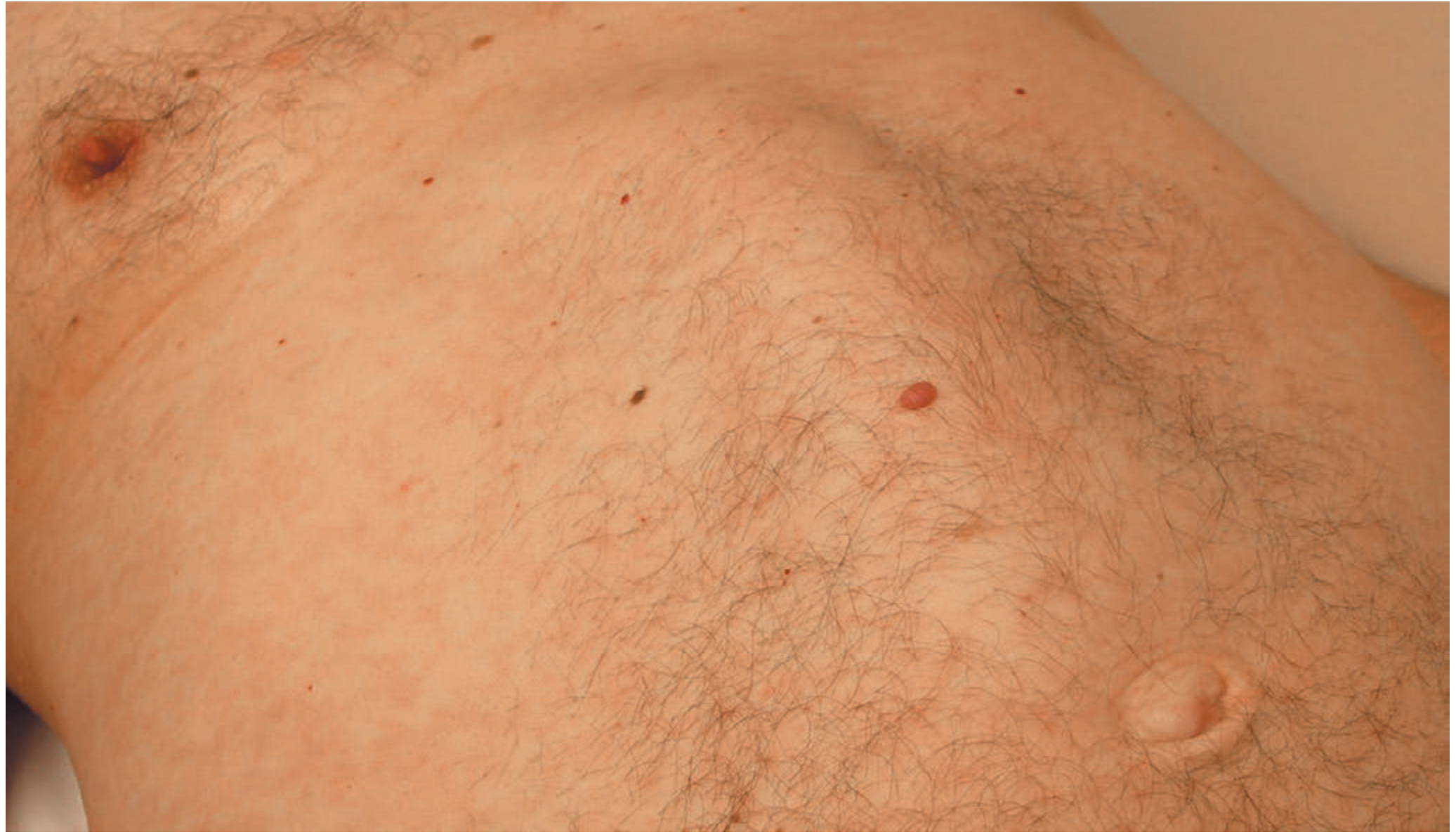
Source: Bailey and Love's Short Practice of Surgery, 28th Edition, Chapter 64 - Abdominal Hernia, p. 1080-1081.
This is a shared conversation. Sign in to Orris to start your own chat.