
Make a note on popliteal fossa
Reading File
Now let me search the library for popliteal fossa content in parallel:
Finding Sources
Finding Sources
Gray's Anatomy for Students has the most comprehensive dedicated section. Let me read it along with the THIEME Atlas content:
Reading File
Reading File
Reading File
Reading File
Now let me fetch the key anatomical diagram image and also check the Baker cyst/clinical content from the THIEME atlas:
Loading Image
Loading Image
Reading File
I now have comprehensive content to write a thorough note on the popliteal fossa. Here it is:
Popliteal Fossa
Definition
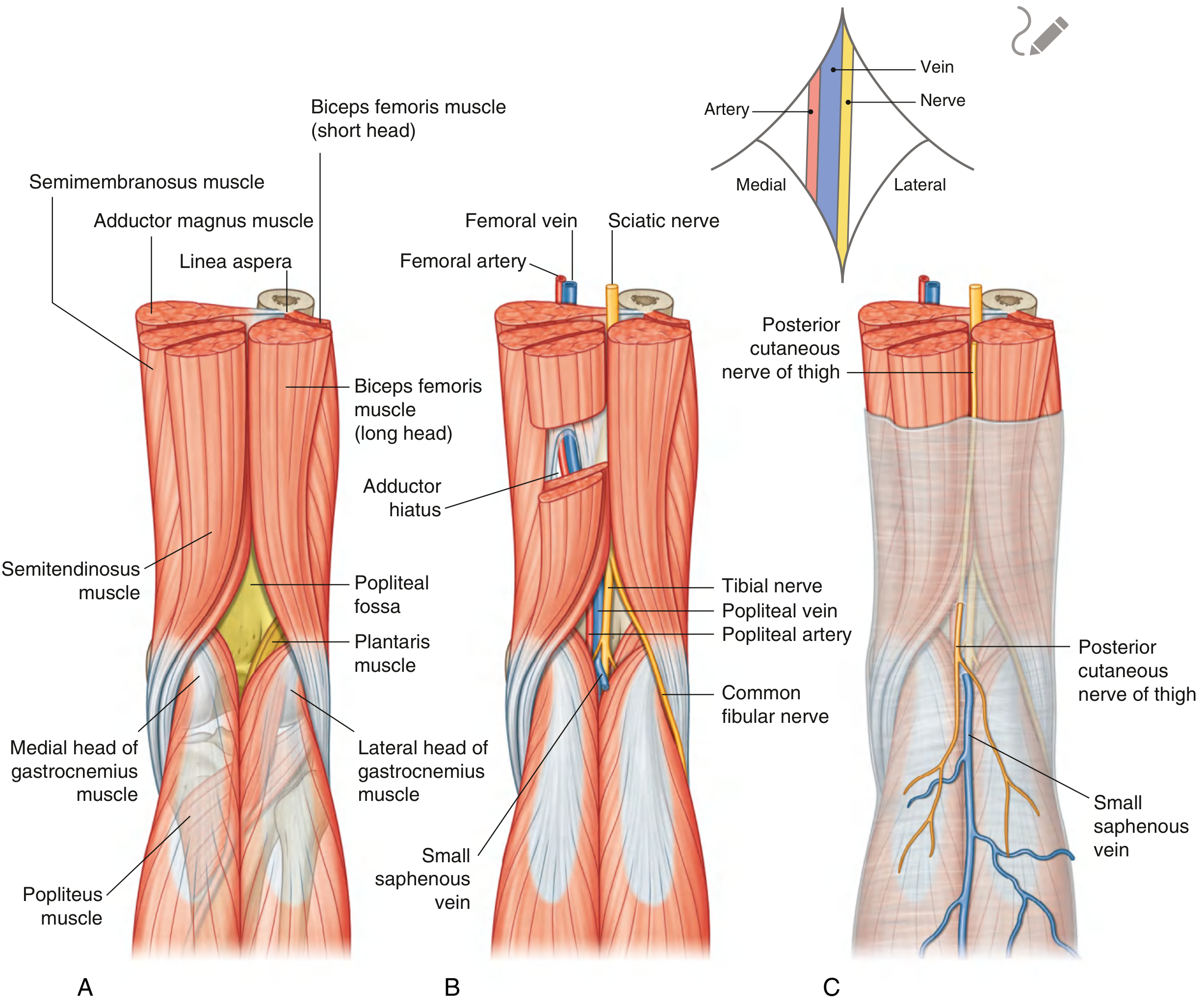
The popliteal fossa is a diamond-shaped space behind the knee joint. It is an important area of transition between the thigh and leg, forming the major route by which structures pass from one region to the other. It is formed between muscles of the posterior compartments of the thigh and leg.
Boundaries
The fossa has four margins that define the diamond shape:
Upper (Superolateral and Superomedial) Margins
| Side | Structure |
|---|---|
| Superomedial | Semitendinosus and semimembranosus muscles |
| Superolateral | Biceps femoris muscle |
Lower (Inferomedial and Inferolateral) Margins
| Side | Structure |
|---|---|
| Inferomedial | Medial head of gastrocnemius |
| Inferolateral | Lateral head of gastrocnemius + plantaris muscle |
Floor
- The capsule of the knee joint and adjacent surfaces of the femur and tibia (superiorly)
- The popliteus muscle (inferiorly)
Roof
- The deep fascia (popliteal fascia), continuous above with the fascia lata of the thigh and below with the deep fascia of the leg
- Overlying this is the superficial fascia and skin
Contents
The major neurovascular structures in the fossa, arranged from superficial to deep (back to front): nerve → vein → artery (remember: NVA, most superficial to deepest).
1. Nerves (Most Superficial)
Tibial nerve:
- Originates proximal to the fossa as the larger branch of the sciatic nerve
- Enters the region from above, directly under the margin of the biceps femoris
- Descends vertically through the fossa
- Exits deep to the margin of the plantaris muscle to enter the posterior compartment of the leg
Common fibular (peroneal) nerve:
- The smaller branch of the sciatic nerve
- Enters the fossa from above alongside the tibial nerve
- Follows the biceps femoris tendon over the lower lateral margin of the popliteal fossa
- Swings around the neck of the fibula and enters the lateral compartment of the leg
- Clinically important: the head of the fibula is a useful landmark to identify it
2. Popliteal Vein
- Lies deep to the tibial nerve, superficial to the popliteal artery
- Travels with the popliteal artery
- Exits the fossa superiorly through the adductor hiatus to become the femoral vein
3. Popliteal Artery (Deepest)
- The continuation of the femoral artery, which passes posteriorly through the adductor hiatus in the adductor magnus muscle to enter the fossa
- Appears on the upper medial side under the margin of the semimembranosus
- Descends obliquely through the fossa alongside the tibial nerve
- Ends just lateral to the midline by dividing into the anterior and posterior tibial arteries (at the lower border of popliteus)
- It is the deepest structure in the fossa - therefore, it is difficult to palpate; however, a pulse can usually be detected by deep palpation near the midline
Branches of the popliteal artery within the fossa:
- Muscular branches to adjacent muscles
- Paired sural arteries - supply the two heads of gastrocnemius
- Geniculate arteries that contribute to the arterial anastomosis (rete) around the knee:
- Superior medial and superior lateral genicular arteries
- Middle genicular artery - pierces the joint capsule to supply the cruciate ligaments
- Inferior medial and inferior lateral genicular arteries
Structures in the Roof (Superficial Fascia)
Small saphenous vein:
- Ascends in superficial fascia on the back of the leg from the lateral side of the dorsal venous arch of the foot
- At the back of the knee, it penetrates the deep fascia (roof of the popliteal fossa) to join the popliteal vein
Posterior cutaneous nerve of the thigh:
- Descends through the thigh superficial to the hamstrings
- Passes through the roof of the popliteal fossa
- Continues inferiorly with the small saphenous vein to innervate skin on the upper half of the back of the leg
Surface Anatomy & Palpation
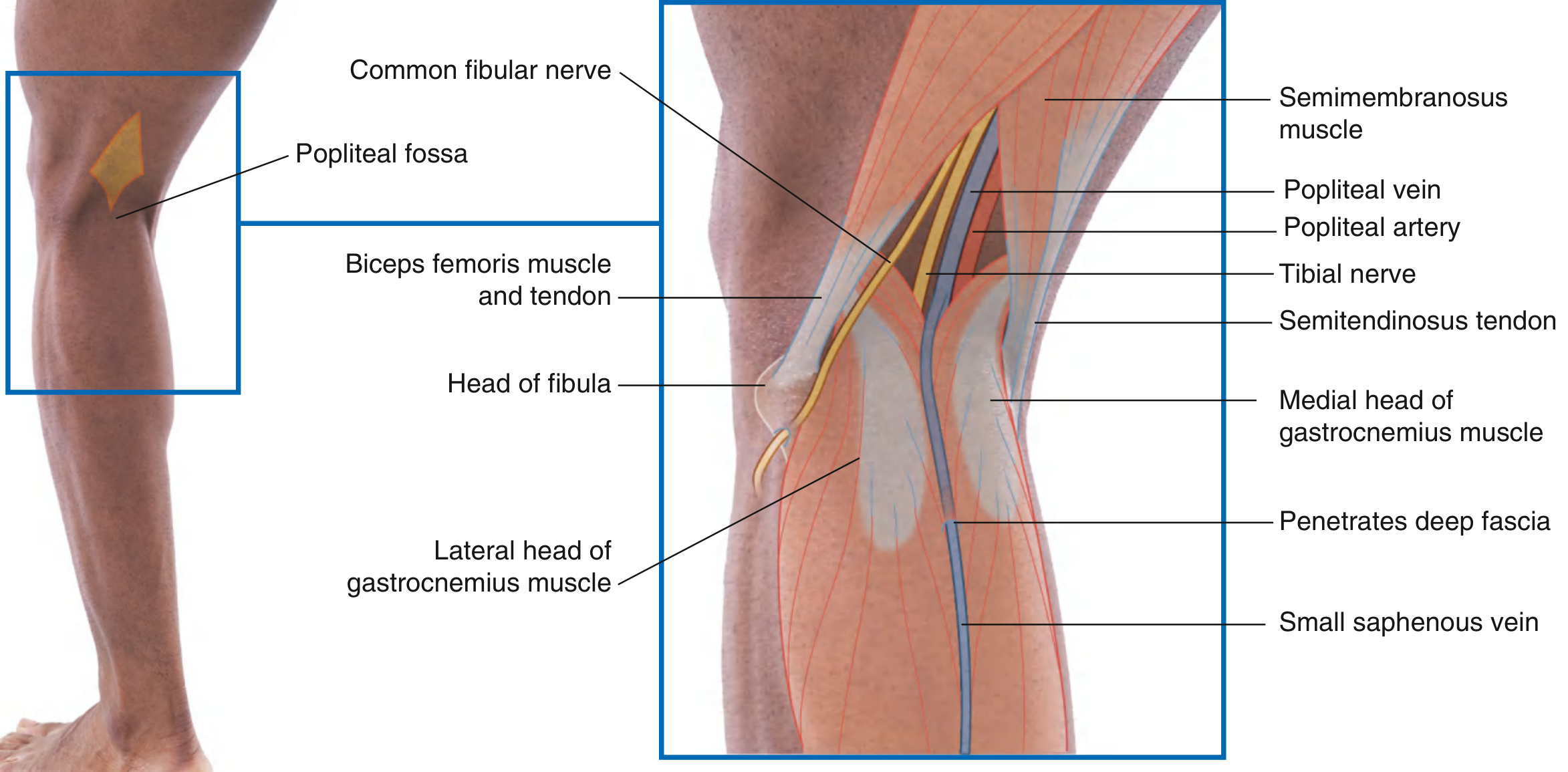
- The tendons of biceps femoris (laterally) and semitendinosus (medially) are palpable and often visible, marking the upper angles of the diamond
- The head of the fibula on the lateral side of the knee is a reliable landmark for identifying the biceps femoris tendon and the common fibular nerve
- The popliteal artery pulse is sought by deep palpation just medial to the midline of the fossa, with the knee slightly flexed
Clinical Correlates
Baker's Cyst (Popliteal Synovial Cyst)
- An enlarged, synovial fluid-filled sac formed by fusion of the semimembranosus bursa with the subtendinous bursa deep to the medial gastrocnemius
- Located in the medial popliteal fossa at the level of the medial posterior femoral condyle
- Commonly secondary to chronic joint inflammation (e.g., rheumatoid arthritis, osteoarthritis) causing increased synovial fluid production; excess fluid flows from the joint through a channel into the fused bursa
- Presents as painful swelling in the back of the knee
- On MRI (T2-weighted), it appears as a bright high-signal area communicating with the joint space
Popliteal Artery Aneurysm
- The artery is considered aneurysmal when its diameter exceeds 7 mm
- Most commonly associated with aneurysms in other large vessels (femoral artery, thoracic/abdominal aorta) - therefore the entire arterial tree must be investigated when one is found
- Tends to thrombose rather than rupture; complications are mainly distal embolization and lower limb ischemia (can lead to amputation in severe cases)
- Diagnosis: Ultrasound with duplex Doppler - demonstrates dilation, confirms/rules out thrombus, and distinguishes from synovial cysts
- Treatment: Surgical repair due to high thromboembolic risk
Common Fibular Nerve Injury
- The nerve is vulnerable as it winds around the neck of the fibula
- Can be damaged by fractures of the fibular neck, prolonged pressure (e.g., crossing legs), or surgical positioning
- Results in foot drop (loss of dorsiflexion and eversion)
Popliteal Nerve Blocks
- The tibial and common fibular nerves can be targeted in the popliteal fossa for regional anesthesia of the lower leg and foot
- Approach from the tibial nerve in the popliteal fossa is also used surgically for nerve repair
Summary Table
| Feature | Detail |
|---|---|
| Shape | Diamond-shaped |
| Superomedial boundary | Semitendinosus + Semimembranosus |
| Superolateral boundary | Biceps femoris |
| Inferomedial boundary | Medial head of gastrocnemius |
| Inferolateral boundary | Lateral head of gastrocnemius + Plantaris |
| Floor | Knee joint capsule + femur/tibia + Popliteus |
| Roof | Deep fascia (popliteal fascia) |
| Deepest content | Popliteal artery |
| Most superficial content | Common fibular & tibial nerves |
| Vein in roof | Small saphenous vein |
| Artery termination | Divides into anterior and posterior tibial arteries |
Sources: Gray's Anatomy for Students, p. 720-722; General Anatomy and Musculoskeletal System - THIEME Atlas of Anatomy, p. 463, 586
This is a shared conversation. Sign in to Orris to start your own chat.