
Circle of willis
The Circle of Willis is an arterial anastomotic ring at the base of the brain formed by the junction of the internal carotid and vertebrobasilar systems. It connects the anterior and posterior circulations and provides collateral flow if one vessel is occluded. Key components include the anterior communicating artery (AComm), bilateral anterior cerebral arteries (ACA), internal carotid arteries (ICA), posterior communicating arteries (PComm), and posterior cerebral arteries (PCA).
Searching sources...
Reading File
Searching the Web
Circle of Willis anatomy components clinical significance
Finding Sources
Searching PubMed
"circle of Willis" anatomy variants
Reading File
Reading File
Reading File
Loading Image
Loading Image
Finding Sources
Now I have rich textbook content and two excellent diagrams. Here is the full answer:
Circle of Willis
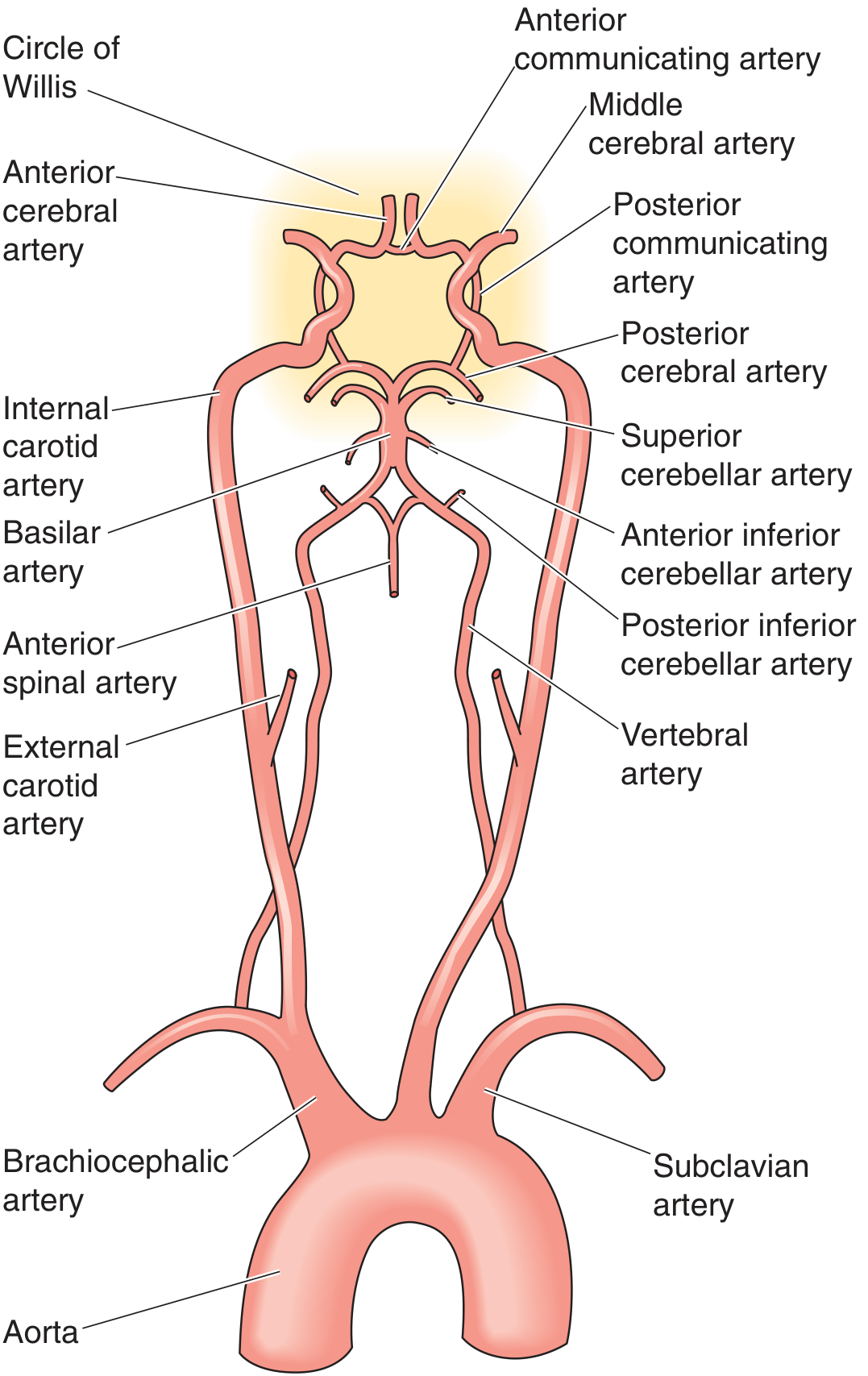
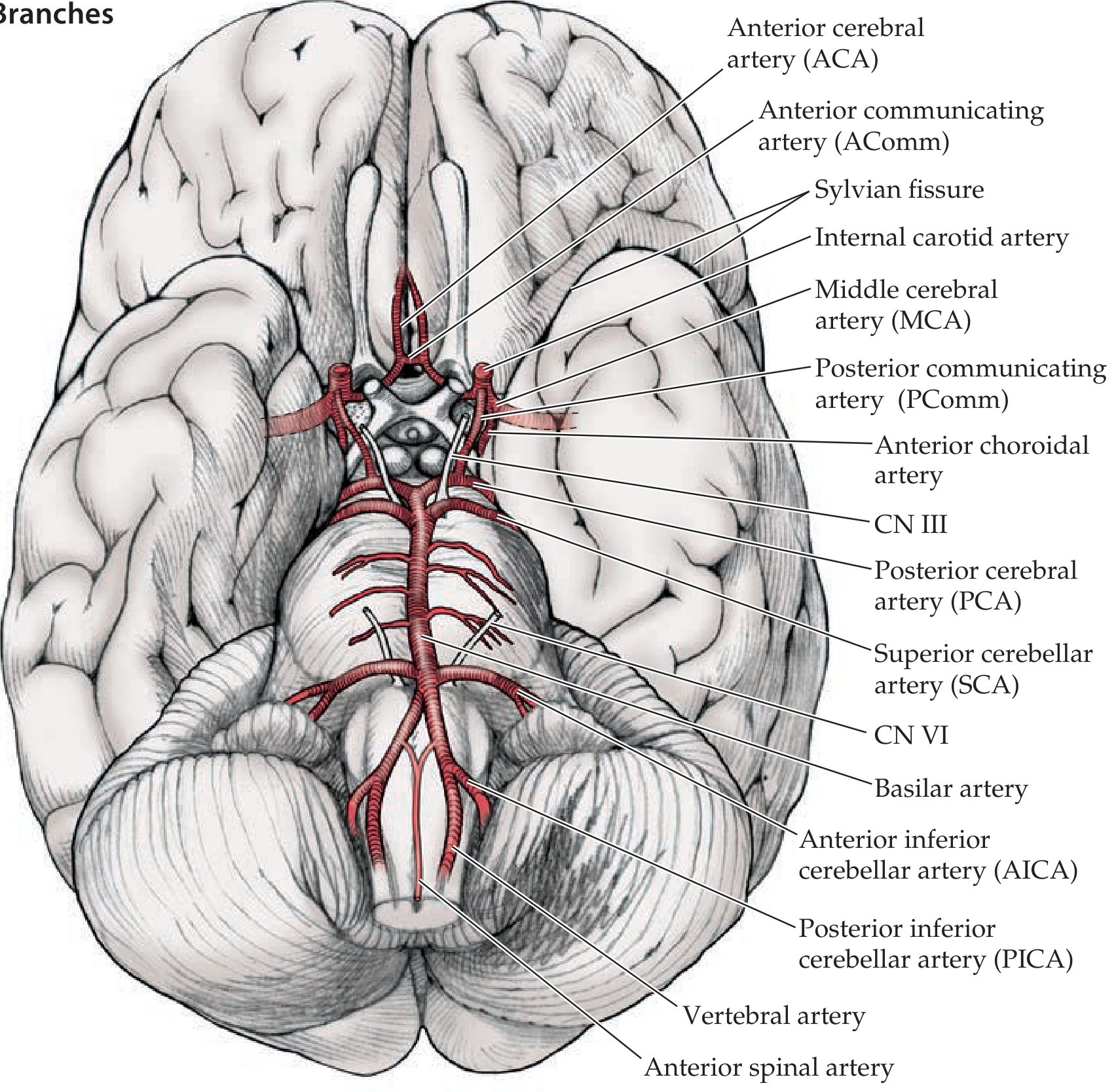
The circle of Willis (circulus arteriosus cerebri) is an anastomotic arterial ring at the base of the brain that unites the anterior circulation (from the internal carotid arteries) and the posterior circulation (from the vertebrobasilar system). It gives rise to all major cerebral arteries.
Formation
- The internal carotid arteries (ICA) ascend and enter the cranium, each bifurcating into the anterior cerebral artery (ACA) and middle cerebral artery (MCA)
- The vertebral arteries, arising from the subclavian arteries, ascend through the cervical transverse foramina, enter the foramen magnum, and unite to form the basilar artery
- The basilar artery terminates by dividing into the two posterior cerebral arteries (PCA)
Components (the ring itself)
| Segment | Contribution |
|---|---|
| Anterior communicating artery (AComm) | Bridges the two ACAs anteriorly |
| Bilateral ACAs (A1 segment) | Anterior limbs of the ring |
| Bilateral ICAs (terminal segment) | Lateral sides of the ring |
| Bilateral posterior communicating arteries (PComm) | Connect ICA to PCA; link anterior and posterior circulations |
| Bilateral PCAs (P1 segment) | Posterior limbs of the ring |
The MCA is not part of the ring itself - it arises directly from the ICA just before the ring begins.
Function
The primary purpose is collateral flow protection. If one major inflow vessel (e.g., an ICA) becomes stenosed or occluded, blood can redistribute through the communicating arteries to maintain perfusion to the affected territory. Three main collateral sources exist:
- The circle of Willis - connects carotid and vertebrobasilar systems
- Extracranial-intracranial anastomoses - branches of the external carotid artery anastomosing with intracranial branches
- Leptomeningeal (pial) collaterals - terminal branches of ACA/MCA/PCA anastomosing over the cortical surface
However, global cerebral hypoperfusion from carotid disease is rare precisely because of this abundant collateral network.
Anatomical Variants
A complete, full-caliber circle of Willis is found in only approximately 34% of individuals (Neuroanatomy through Clinical Cases, 3rd Ed.). Autopsy studies confirm the majority of specimens have anatomic anomalies. Common variants include:
- Hypoplastic or absent PComm - most common variant; reduces posterior-anterior collateral capacity
- Hypoplastic A1 segment of ACA
- Fetal-type PCA - the PCA arises predominantly from the ICA rather than the basilar artery (occurs in ~20-30%)
- Duplicated or fenestrated vessels
Clinical Significance
1. Berry (Saccular) Aneurysms
The circle of Willis is the most common site for intracranial saccular aneurysms, which form at arterial bifurcations due to hemodynamic stress on vessel walls. Common sites:
- AComm - most common overall
- PComm origin from ICA - classically causes CN III (oculomotor) palsy from aneurysmal compression
- MCA bifurcation
- Basilar tip
Rupture causes subarachnoid hemorrhage (SAH) - the "worst headache of life."
2. Stroke and TIA
The presence and patency of the circle of Willis determines stroke severity after vessel occlusion. A well-developed ring can compensate for ICA occlusion; a hypoplastic ring cannot, increasing infarct risk.
3. Carotid Endarterectomy Planning
During carotid cross-clamping, brain perfusion depends entirely on collateral flow from an intact circle of Willis. Preoperative assessment of circle completeness is therefore important for surgical planning.
4. Watershed Infarcts
Between the terminal territories of ACA, MCA, and PCA lie watershed (border zone) zones - these are vulnerable when perfusion pressure drops, since the circle cannot fully compensate for global hypoperfusion.
Sources: Neuroanatomy through Clinical Cases, 3rd Ed. | Medical Physiology (Boron & Boulpaep) | Localization in Clinical Neurology, 8th Ed. | Schwartz's Principles of Surgery, 11th Ed.
This is a shared conversation. Sign in to Orris to start your own chat.