
Gello
Hello! How can I help you today?
Can you call me Dr. Sohil
Of course, Dr. Sohil! How can I help you today?
I wwe asking as my exams are coming for 2nd year mbbs so can you give me some important topics from microbiology
Based on my knowledge, here are the high-yield microbiology topics for 2nd year MBBS exams:
**Searching sources...
**
Reading File
Searching the Web
2nd year MBBS microbiology important topics exam 2025
Finding Sources
Reading Web Page
https://www.medboundhub.com/t/important-topics-of-microbiolo…
Here is a well-organized list of the most important microbiology topics for your 2nd year MBBS exams, Dr. Sohil, based on standard university exam patterns and the textbooks in our library (Jawetz, Murray's Medical Microbiology, Sherris & Ryan):
General Microbiology (Start Here - Foundation of Everything)
- Bacterial cell structure - cell wall, capsule, flagella, pili, spores
- Gram staining (mechanism, examples of Gram +ve and -ve organisms)
- Sterilization & disinfection - autoclave, hot air oven, UV radiation, antiseptics vs disinfectants
- Culture media - types (selective, differential, enriched), common examples (Blood agar, MacConkey, CLED, LJ medium)
- Bacterial growth curve
- Bacterial genetics - plasmids, transduction, transformation, conjugation
- Antimicrobial resistance mechanisms
Bacteriology (High Yield)
| Organism | Key Points to Know |
|---|---|
| Staphylococcus aureus | Virulence factors, coagulase, MRSA, toxins (TSST, exfoliatin), food poisoning |
| Streptococcus | Classification (Lancefield), Strep pyogenes (rheumatic fever, PSGN), Strep pneumoniae |
| Mycobacterium tuberculosis | ZN staining, pathogenesis, Ghon complex, lab diagnosis, BCG |
| Mycobacterium leprae | Types, Ridley-Jopling classification, lepromin test |
| Salmonella typhi | Widal test, pathogenesis, Vi antigen, rose spots |
| Vibrio cholerae | Rice-water stools, cholera toxin, El Tor biotype, TCBS medium |
| Clostridium | C. tetani (tetanospasmin), C. perfringens (gas gangrene), C. difficile (pseudomembranous colitis), C. botulinum |
| Neisseria meningitidis & gonorrhoeae | Lab diagnosis, Thayer-Martin medium, antigenic variation |
| E. coli | EPEC, ETEC, EHEC, EIEC - clinical scenarios |
| Klebsiella pneumoniae | Capsule, currant jelly sputum |
| Corynebacterium diphtheriae | Diphtheria toxin, Schick test, Tellurite medium, pseudomembrane |
| Helicobacter pylori | Urease test, peptic ulcer, CLO test |
| Treponema pallidum | Syphilis stages, VDRL vs TPHA, congenital syphilis |
| Leptospira | Weil's disease, dark-field microscopy |
| Rickettsia | Weil-Felix reaction, typhus vs spotted fever |
Virology (Very Important)
- HIV/AIDS - pathogenesis, CD4 count, lab diagnosis (ELISA, Western blot), opportunistic infections, HAART
- Hepatitis viruses - serological markers of HBV (HBsAg, anti-HBc, HBeAg), HCV, HAV, HDV, HEV; window period
- Herpes viruses - HSV 1 & 2, VZV, EBV (infectious mononucleosis), CMV
- Influenza - antigenic drift vs shift, H and N antigens
- Rabies - Negri bodies, vaccine schedule, post-exposure prophylaxis
- Dengue - serotypes, NS1 antigen, hemorrhagic fever
- Poliovirus - types, Sabin vs Salk vaccine, lab diagnosis
- Measles, Mumps, Rubella - complications, vaccines
- COVID-19 - basic virology (for MCQs)
Mycology
- Candida albicans - germ tube test, pseudohyphae, oral thrush
- Cryptococcus neoformans - India ink preparation, meningitis in immunocompromised
- Aspergillus - fungal ball, invasive aspergillosis
- Dermatophytes - Tinea infections, KOH preparation
- Histoplasma, Blastomyces, Coccidioides - dimorphic fungi
- Mucor/Rhizopus - mucormycosis, rhinocerebral form
Parasitology
- Plasmodium - life cycle, types of malaria, thick & thin smear, Schuffner's dots, treatment
- Entamoeba histolytica - amebic dysentery vs liver abscess, cyst vs trophozoite
- Giardia lamblia - trophozoite (falling leaf motility), cysts in stool
- Leishmania - visceral (kala-azar), cutaneous, Aldehyde test, lab diagnosis
- Toxoplasma gondii - congenital toxoplasmosis, immunocompromised, Sabin-Feldman dye test
- Ascaris lumbricoides - life cycle, Loeffler syndrome
- Taenia - T. solium (cysticercosis/neurocysticercosis) vs T. saginata
- Wuchereria bancrofti - filariasis, nocturnal periodicity, microfilariae
- Echinococcus - hydatid cyst, Casoni test
Immunology
- Hypersensitivity reactions - Types I-IV with examples (anaphylaxis, serum sickness, contact dermatitis, tuberculin test)
- Complement system - classical vs alternate pathway, C3b opsonization, MAC
- Vaccines - live attenuated vs killed, adjuvants, herd immunity
- Antigen-antibody reactions - agglutination, precipitation, ELISA, immunofluorescence
- Innate vs Adaptive immunity
- T cell and B cell - development, function, CD markers
- MHC (HLA) - Class I vs Class II, disease associations
Practical / Lab Diagnosis (Very Important for Viva & Theory)
- Gram staining procedure
- ZN staining (acid-fast)
- Dark field microscopy
- India ink preparation
- KOH preparation
- Widal test interpretation
- ELISA principle
- Antimicrobial susceptibility testing (Kirby-Bauer disc diffusion)
High-Yield Short Note Topics
- Biofilm formation
- Quorum sensing
- Prions
- Superantigens
- Endotoxin vs Exotoxin
- Koch's postulates
- Normal flora of body sites
Quick exam tip, Dr. Sohil: Focus especially on HIV, TB, Hepatitis B serology, Hypersensitivity types, Malaria life cycle, and Staphylococcus/Streptococcus - these appear in almost every university exam. Good luck with your preparations!
Find recent research on antibiotic resistance in MBBS curriculum
Antibiotic resistance (AMR) is a growing global health crisis, and its inclusion in medical education is increasingly recognized as essential. Let me search for recent research on this topic.
Searching sources...
Searching PubMed
antibiotic resistance medical education curriculum
Searching the Web
antibiotic resistance MBBS curriculum medical students education 2024 2025
Finding Sources
Searching PubMed
antimicrobial stewardship medical students knowledge attitudes
Reading Article
PMID: 39146948
Finding Sources
Reading Article
PMID: 39468598
Reading Article
PMID: 38500088
Reading File
Here is a thorough summary of recent research on antibiotic resistance in the MBBS curriculum, Dr. Sohil:
Recent Research on Antibiotic Resistance in Medical Education
1. What Medical Students Know (and Don't Know) About AMR
A 2024 scoping review of 144 studies across 5 health disciplines globally (Alzard et al., BMC Med Educ, 2024 - PMID: 39468598) found three major recurring gaps:
- Students are more familiar with the term AMR than with Antimicrobial Stewardship (AMS) - meaning they understand resistance exists but don't know how to act on it clinically
- Inappropriate antibiotic use is recognized as the main driver of AMR, but students lack practical skills to prevent it
- There is a strong need for more training in appropriate prescribing within undergraduate curricula
- India and Pakistan together account for 25% of all AMR education studies globally - making this directly relevant to MBBS students in South Asia
A 2024 cross-sectional study from Palestine (Abuawad et al., BMC Med Educ, 2024 - PMID: 38500088) found:
- Clinical-phase students had significantly higher AMR knowledge (mean 89.7) than pre-clinical students (mean 74.0)
- Knowledge of AMS specifically was low even among clinical students (mean 63.4/100)
- This suggests the MBBS curriculum teaches resistance mechanisms well, but stewardship practices remain undertaught
2. WHO's Global AMR Research Priorities (2024)
The WHO published its global AMR research agenda targeting 40 research priorities by 2030 (Bertagnolio et al., Lancet Microbe, 2024 - PMID: 39146948). Directly relevant to your MBBS curriculum:
- Awareness and education are listed as a core priority area
- Emphasis on understanding AMR epidemiology, burden, and drivers - all topics in the 2nd year MBBS syllabus
- Prevention, diagnosis, and treatment of resistant infections are identified as priority research areas
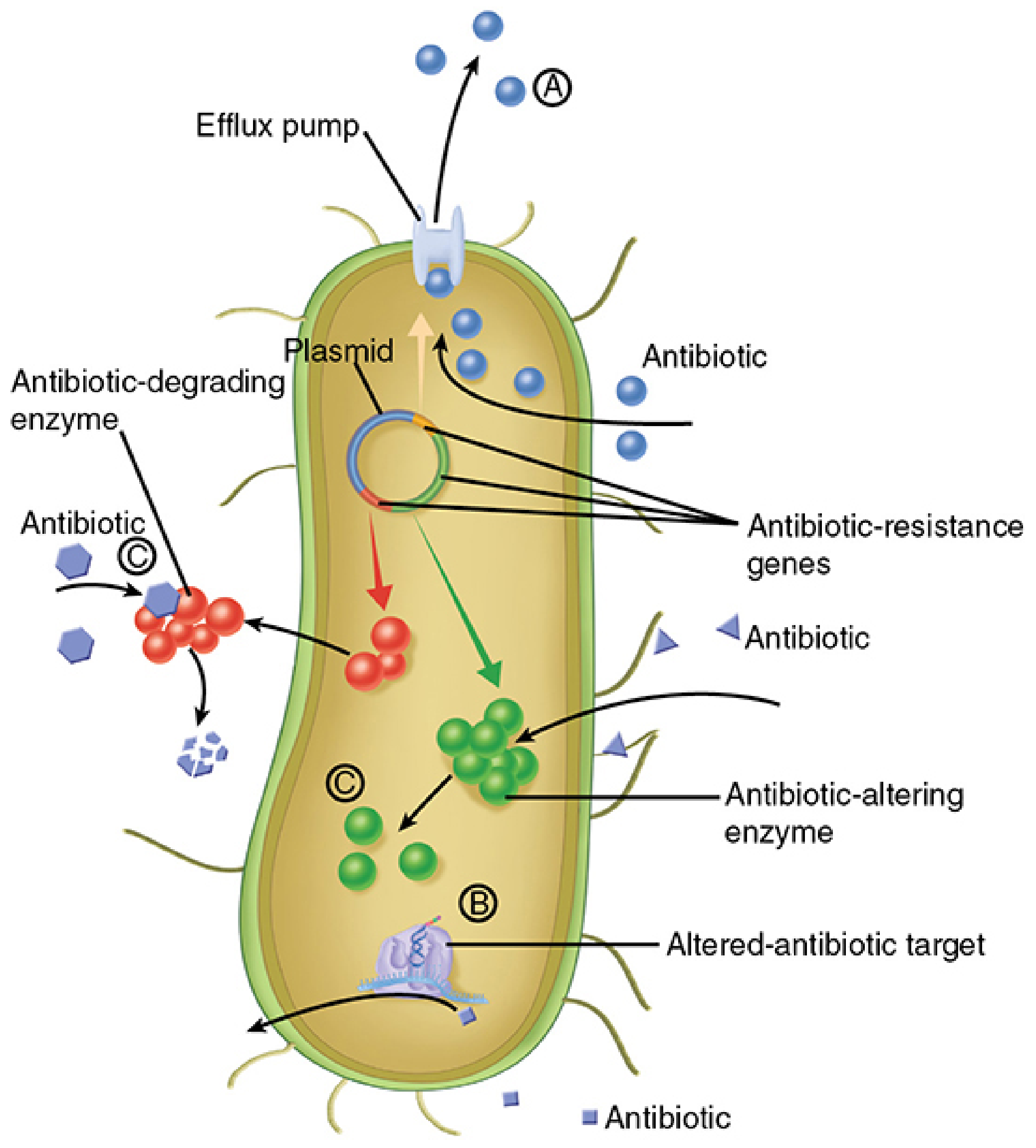
3. AMR Mechanisms - What Your Textbooks Say (Sherris & Ryan, 8th Ed.)
The three core mechanisms you must know for exams:
| Mechanism | Example |
|---|---|
| Exclusion - Outer membrane impermeability or efflux pumps push the drug back out | Carbapenem resistance in P. aeruginosa (porin loss); tetracycline efflux |
| Target alteration - Drug can no longer bind its site | PBP2a in MRSA; mutated DNA gyrase in fluoroquinolone resistance |
| Enzymatic inactivation - Enzymes destroy or modify the antibiotic | Beta-lactamases (ESBL, KPC, MBL), aminoglycoside-modifying enzymes |
4. High-Yield AMR Topics for Your MBBS Exam
Based on current research trends and NMC CBME curriculum:
Resistance Mechanisms (must know for theory & viva):
- Beta-lactamases: ESBL, AmpC, KPC (Klebsiella Pneumoniae Carbapenemase), MBL (NDM-1 - New Delhi Metallo-beta-lactamase)
- MRSA - mecA gene, altered PBP2a
- Vancomycin-resistant Enterococcus (VRE)
- Multidrug-resistant TB (MDR-TB), XDR-TB
- Fluoroquinolone resistance (gyrase mutation)
Genetic Transfer of Resistance:
- Plasmid-mediated resistance (most clinically important)
- Transposons ("jumping genes")
- Integrons
- Horizontal gene transfer via conjugation
Antimicrobial Stewardship (increasingly asked in exams):
- Definition and principles of AMS
- Antibiogram and its use
- Kirby-Bauer disc diffusion, MIC, MBC
- De-escalation of therapy
- Carbapenem-sparing strategies
ESKAPE Pathogens (WHO priority pathogens - MCQ favorite):
- E - Enterococcus faecium
- S - Staphylococcus aureus (MRSA)
- K - Klebsiella pneumoniae (ESBL/KPC)
- A - Acinetobacter baumannii
- P - Pseudomonas aeruginosa
- E - Enterobacter spp.
5. New Developments Relevant to MBBS (2024-2026)
- NDM-1 (New Delhi Metallo-beta-lactamase) - A carbapenemase first identified in India, now a global threat. Often appears in exam questions on carbapenem resistance
- Colistin resistance (mcr-1 gene, plasmid-mediated) - Resistance to the "last resort" antibiotic
- WHO Fungal Priority Pathogens List - Candida auris (multidrug-resistant fungus) is an emerging exam topic
- AI in AMR detection - Increasingly relevant for MCQs on future diagnostics
Key Papers to Know (for SBQ/discussion questions)
| PMID | Paper | Relevance |
|---|---|---|
| 39468598 | Alzard et al., 2024 - Global AMR knowledge in health students | Shows curriculum gaps in AMS education |
| 38500088 | Abuawad et al., 2024 - Medical students' AMR knowledge | Clinical students know more; stewardship gaps remain |
| 39146948 | WHO, Lancet Microbe 2024 - Global AMR research priorities | WHO's 40 priority areas including education |
| 38003976 | Zahari et al., 2023 - Resistance in S. pneumoniae | Beta-lactam, macrolide, fluoroquinolone mechanisms |
Bottom line for your exams, Dr. Sohil: AMR is no longer just a bacteriology topic - it now spans mechanisms, genetics, clinical stewardship, and global health policy. Examiners increasingly frame AMR questions as clinical scenarios (e.g., "patient not responding to treatment - what resistance mechanism is likely?"). Knowing the ESKAPE organisms and the three resistance mechanisms cold will serve you very well.
This is a shared conversation. Sign in to Orris to start your own chat.