
Pharmacological actions of loop diuretics
I'll start by reading the medical library skill, then search for loop diuretics content in parallel.
Reading File
Now let me search the library and PubMed in parallel:
Finding Sources
Finding Sources
Searching PubMed
"loop diuretics" AND pharmacology
Good results. Now let me read the most relevant blocks in parallel - the pharmacology-focused textbook sections:
Reading File
Reading File
Reading File
Excellent - I now have rich content from two major textbooks. Let me also pull from the Comprehensive Clinical Nephrology block which likely has more detail on pharmacology, and also check Goldman-Cecil:
Reading File
Finding Sources
I have very rich content. Let me read the Guyton block for the physiology context, and also search for adverse effects and specific drug properties:
Reading File
Finding Sources
Now let me get the Goodman & Gilman section on loop diuretics which will be the most pharmacologically complete, and fetch the Guyton diagram:
Finding Sources
Loading Image
Now let me read the Goodman & Gilman sections on loop diuretics - the most authoritative pharmacology textbook:
Reading File
Reading File
I now have comprehensive content from multiple authoritative textbooks. Let me compile the full answer:
Pharmacological Actions of Loop Diuretics
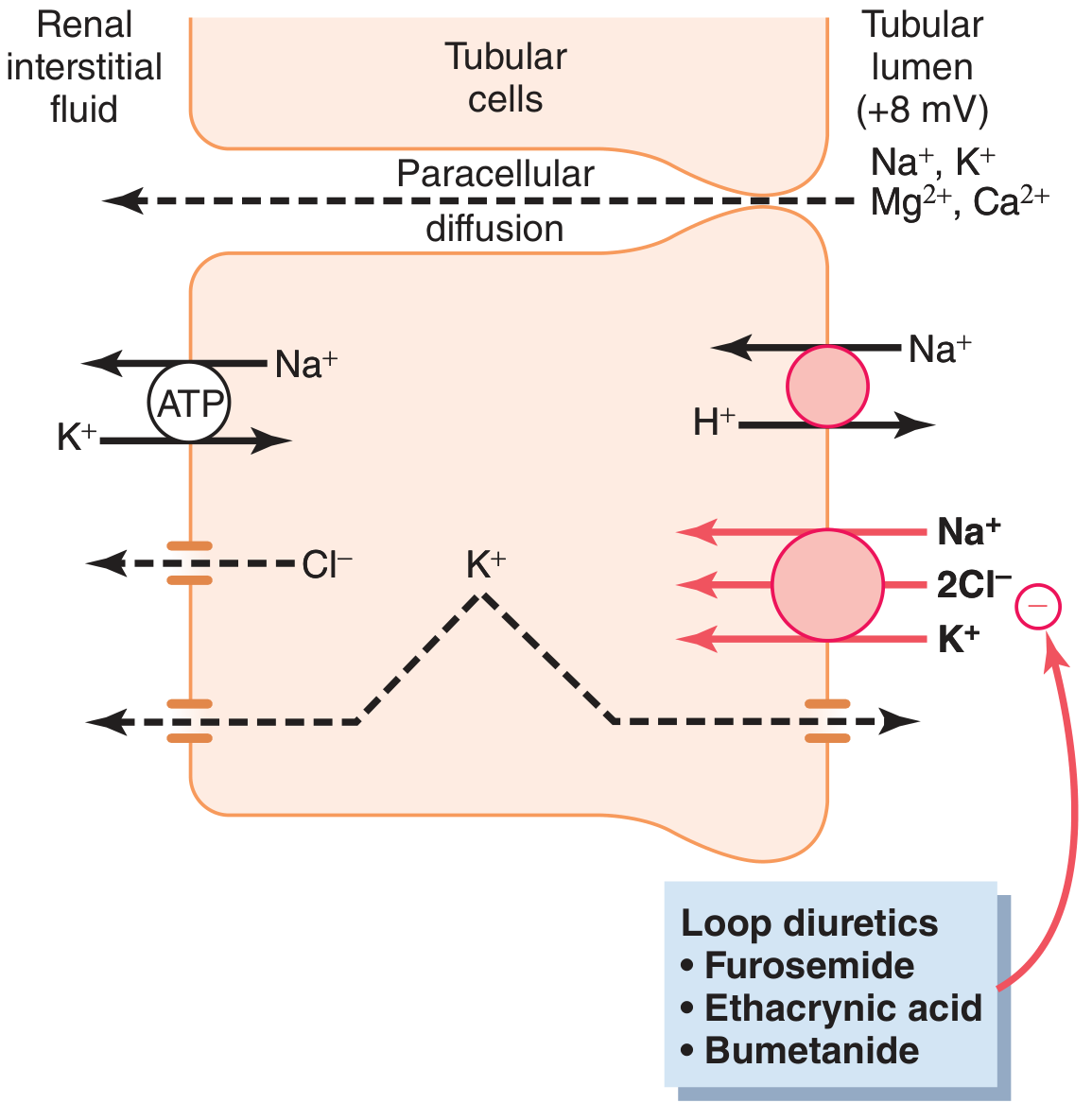
Figure: Na⁺-K⁺-2Cl⁻ (NKCC2) co-transporter in the thick ascending limb of Henle. Loop diuretics (furosemide, ethacrynic acid, bumetanide) block this transporter. Source: Guyton & Hall Textbook of Medical Physiology
1. Primary Mechanism - Inhibition of NKCC2
Loop diuretics act at the luminal (apical) membrane of the thick ascending limb of the loop of Henle (TAL). They compete with chloride ion to bind and inhibit the Na⁺-K⁺-2Cl⁻ cotransporter (NKCC2), also called the Na⁺-K⁺-2Cl⁻ symporter. This transporter normally mediates the coupled entry of 1 Na⁺, 1 K⁺, and 2 Cl⁻ from the tubular lumen into the epithelial cell, driven by the electrochemical gradient maintained by basolateral Na⁺-K⁺-ATPase.
Why they are "high-ceiling" diuretics:
- The TAL normally reabsorbs about 25% of the filtered Na⁺ load
- Downstream nephron segments (distal tubule, collecting duct) lack the capacity to compensate for such a large flood of unabsorbed solute
- Compare: proximal tubule diuretics (e.g., carbonic anhydrase inhibitors) have limited efficacy because the TAL can rescue unabsorbed material
- Result: loop diuretics produce the largest natriuresis of any class
(Goodman & Gilman's, Braunwald's Heart Disease)
2. Effects on Specific Electrolytes and Water
Sodium and Chloride
- Massive increase in Na⁺ and Cl⁻ excretion (natriuresis and chloruresis) - the primary therapeutic effect
- Urine NaCl excretion can reach 20-25% of filtered load
Potassium (Hypokalemia)
- Increased Na⁺ delivery to distal tubule and collecting duct stimulates ENaC-mediated Na⁺ reabsorption in exchange for K⁺ secretion
- Elevated aldosterone levels (activated by volume contraction) further amplify K⁺ wasting
- Net result: hypokalemia - the most common electrolyte adverse effect
Calcium (Hypercalciuria)
- Normally, the lumen-positive electrical potential (+8 mV) in the TAL - generated by the NKCC2/K⁺ backleak mechanism - drives paracellular reabsorption of Ca²⁺ and Mg²⁺
- Loop diuretics abolish this lumen-positive potential by blocking NKCC2, eliminating the driving force for paracellular Ca²⁺ reabsorption
- Result: ~30% increase in fractional calcium excretion (hypercalciuria); used therapeutically in hypercalcemia
Magnesium
- Same paracellular mechanism as calcium
- Result: magnesuria and hypomagnesemia with prolonged use
Uric Acid
- Brief initial increase in uric acid excretion, followed by a more long-lived decrease (hyperuricemia), due to competition for organic anion transporters and volume contraction-driven urate reabsorption
(NKF Primer on Kidney Diseases, 8e; Guyton & Hall)
3. Effects on Water Handling
The TAL is virtually impermeable to water - solute reabsorption here normally creates the hypertonic medullary interstitium that drives water reabsorption in the collecting duct. Loop diuretics:
- Prevent the build-up of the medullary concentration gradient
- Reduce the driving force for water reabsorption in the collecting duct, even in the presence of antidiuretic hormone (ADH/AVP)
- Decrease both free water excretion (during water loading) and free water absorption (during dehydration)
- Produce urine that is nearly isotonic with plasma (isosthenuria)
4. Hemodynamic / Cardiovascular Effects
Beyond diuresis, loop diuretics exert direct cardiovascular effects:
| Effect | Mechanism |
|---|---|
| Venodilation (rapid, within minutes of IV) | Stimulation of vasodilatory prostaglandin E₂ (PGE₂) synthesis in the kidney; furosemide 0.5-1.0 mg/kg IV reduces right atrial and pulmonary capillary wedge pressure within minutes - before significant diuresis occurs |
| Transient rise in systemic vascular resistance | Direct stimulation of renin secretion by macula densa cells → activation of the renin-angiotensin system (RAS) |
| Reduced preload | Decreased venous return due to venodilation + volume depletion |
| Renal blood flow redistribution | Angiotensin II stimulation + augmented PGE₂ shifts renal blood flow from inner to outer cortex |
| GFR typically maintained | Loop diuretics inhibit the tubuloglomerular feedback (TGF) mechanism (which is itself NKCC2-mediated in macula densa cells), so unlike thiazides, they do not reduce GFR in normal subjects |
The venodilatory effect is blocked by indomethacin and other NSAIDs (which also blunt the diuretic effect).
(Braunwald's Heart Disease; NKF Primer 8e)
5. Prostaglandin Synthesis
Loop agents stimulate renal prostaglandin synthesis, particularly the vasodilatory PGE₂. This contributes to:
- Venodilation (see above)
- Natriuresis augmentation
- Redistribution of renal blood flow
This is why NSAIDs blunt the effect of loop diuretics - by inhibiting prostaglandin synthesis (COX inhibition), NSAIDs reduce both the venodilatory and natriuretic effects.
6. Drug Delivery to Site of Action
Loop diuretics are highly protein-bound (mainly to albumin). They therefore cannot be filtered at the glomerulus in significant amounts. Instead, they reach their luminal site of action via:
- Proximal tubule secretion via organic anion transporters (OAT1, OAT2) at the basolateral membrane
- Also via MDR1 (multidrug resistance protein 1) in the proximal tubule
Factors impairing drug delivery:
- Elevated endogenous organic acids (e.g., in CKD - uremic acids compete for OAT)
- NSAIDs, salicylates (compete for OAT)
- Hypoalbuminemia (reduced protein binding alters pharmacokinetics)
- Fatty acids in uremia displace loop diuretics from albumin
The natriuretic response follows a sigmoidal dose-response curve related to diuretic excretion rate (i.e., drug delivery to the TAL).
7. Individual Drug Pharmacokinetics
| Drug | Oral Bioavailability | Half-life | Elimination | Notes |
|---|---|---|---|---|
| Furosemide | ~40-70% (variable: 12-112%) | ~1.5 h | ~65% renal, ~35% metabolized | Most widely used; variable absorption is a key limitation; t₁/₂ increases to >24 h in renal failure |
| Bumetanide | ~80% | ~0.8 h | ~62% renal, ~38% metabolized | 40x more potent than furosemide by weight; more consistent absorption |
| Torsemide | ~80% (consistent) | ~3.5 h | ~20% renal, ~80% hepatic | Longest acting; preferred in chronic HF and CKD due to consistent absorption and longer duration |
| Ethacrynic acid | ~100% | ~1 h | ~67% renal | Only non-sulfonamide loop diuretic; preferred in sulfa allergy; more ototoxic |
(Goodman & Gilman's The Pharmacological Basis of Therapeutics)
8. Adverse Effects (from Pharmacological Actions)
| Adverse Effect | Mechanism |
|---|---|
| Hypokalemia | Increased distal Na⁺ delivery → enhanced K⁺ secretion; secondary hyperaldosteronism |
| Hypomagnesemia | Loss of paracellular driving force for Mg²⁺ reabsorption in TAL |
| Hypocalcemia (with chronic use) | Calciuria |
| Metabolic alkalosis | Contraction alkalosis; H⁺ secreted in exchange for Na⁺ distally |
| Hyperuricemia | Volume contraction → urate reabsorption; OAT competition |
| Ototoxicity | Endolymph ion transport disruption (NKCC1 in stria vascularis); reversible or irreversible; risk with high doses, rapid IV infusion, or combined aminoglycosides |
| Hyperglycemia | Hypokalemia impairs insulin secretion |
| Prerenal azotemia | Excess volume depletion |
Summary
Loop diuretics are the most potent diuretics available. Their central action is NKCC2 inhibition in the TAL, producing massive natriuresis, chloruresis, kaliuresis, calciuria, and magnesuria. Beyond the kidney, they act as venodilators via PGE₂ stimulation, making them effective in acute pulmonary edema even before diuresis begins. Their efficacy is modulated by protein binding, tubular secretion kinetics, and prostaglandin synthesis.
Sources:
- Goodman & Gilman's The Pharmacological Basis of Therapeutics (mechanism, pharmacokinetics)
- Braunwald's Heart Disease, 2-Vol Set (cardiovascular effects, hemodynamics)
- NKF Primer on Kidney Diseases, 8e (electrolyte effects, dose-response)
- Guyton & Hall Textbook of Medical Physiology (NKCC2 physiology, paracellular transport)
Recent evidence note: A 2026 systematic review/meta-analysis (PMID 42115365) comparing loop diuretics in chronic heart failure found differential outcomes among agents (furosemide vs. torsemide vs. bumetanide), reinforcing the clinical relevance of their pharmacokinetic differences described above.
Just point wise pharmacological actions
Pharmacological Actions of Loop Diuretics
1. Primary Mechanism
- Inhibit the Na⁺-K⁺-2Cl⁻ cotransporter (NKCC2) on the luminal membrane of the thick ascending limb (TAL) of the loop of Henle
- Compete with Cl⁻ for binding to NKCC2
- Block reabsorption of ~25% of filtered Na⁺ load → most potent diuretic class ("high-ceiling")
2. Diuresis and Natriuresis
- Produce the largest Na⁺ and Cl⁻ excretion of any diuretic class
- Can excrete up to 20-25% of filtered Na⁺
- Dose-response follows a sigmoidal curve
3. Effect on Water Excretion
- TAL is impermeable to water → loop diuretics destroy the medullary concentration gradient
- Reduces water reabsorption in collecting duct even in presence of ADH
- Produces isotonic (dilute) urine (isosthenuria)
4. Potassium Wasting
- Increased Na⁺ delivery to distal tubule → enhanced K⁺ secretion via ENaC/K⁺ exchange
- Volume contraction activates aldosterone → further K⁺ loss
- Result: hypokalemia
5. Calcium Excretion (Calciuria)
- Normally, the lumen-positive potential (+8 mV) in TAL drives paracellular Ca²⁺ reabsorption
- NKCC2 blockade abolishes this potential → Ca²⁺ reabsorption lost
- Result: ~30% increase in fractional Ca²⁺ excretion (used therapeutically in hypercalcemia)
6. Magnesium Excretion
- Same paracellular mechanism as calcium
- Result: magnesuria → hypomagnesemia with chronic use
7. Uric Acid
- Brief initial increase in uric acid excretion
- Followed by net hyperuricemia (volume contraction drives urate reabsorption; OAT competition)
8. Venodilation (Cardiovascular)
- Stimulate renal prostaglandin E₂ (PGE₂) synthesis
- PGE₂ causes venodilation → reduces preload
- IV furosemide reduces pulmonary capillary wedge pressure within minutes, before diuresis begins
- This effect is blocked by NSAIDs (COX inhibition)
9. Transient Increase in Systemic Vascular Resistance
- Loop diuretics directly stimulate renin secretion from macula densa cells
- Activates RAS → transient ↑ angiotensin II → ↑ afterload
10. Renal Blood Flow Redistribution
- Angiotensin II + PGE₂ shift renal blood flow from inner to outer cortex
- GFR typically maintained (loop diuretics inhibit the NKCC2-mediated tubuloglomerular feedback mechanism)
11. Prostaglandin Synthesis
- Stimulate renal PGE₂ (vasodilatory)
- Explains why NSAIDs blunt both natriuretic and venodilatory effects
12. Acid-Base
- Cause metabolic alkalosis (contraction alkalosis + distal H⁺ secretion in exchange for Na⁺)
13. Glucose
- Hypokalemia impairs insulin secretion → hyperglycemia/glucose intolerance
14. Drug Delivery Mechanism
- Highly protein-bound → reach tubular lumen via OAT1/OAT2-mediated proximal tubule secretion, not filtration
- NSAIDs, salicylates, uremic acids compete for OAT → reduce drug delivery → diuretic resistance
This is a shared conversation. Sign in to Orris to start your own chat.