
Why is ART not given first in case of HIV - TB co infection
Reading File
Finding Sources
Finding Sources
Searching PubMed
"HIV" AND "tuberculosis" AND "antiretroviral therapy timing"
Finding Sources
Finding Sources
Searching PubMed
"tuberculosis" AND "HIV" AND "antiretroviral" AND "timing"
Finding Sources
Finding Sources
Reading File
Finding Sources
Finding Sources
Finding Sources
Searching the Web
why ART not given first in HIV TB coinfection IRIS drug interactions guidelines
Reading File
I now have comprehensive information from both the textbooks and current literature. Here is a complete answer:
Why ART Is Not Started First in HIV-TB Co-infection
The key principle is: anti-TB treatment (ATT) is initiated first, and ART is introduced after a strategic delay — not because ART is unimportant, but because starting it simultaneously or first creates several serious problems.
1. Immune Reconstitution Inflammatory Syndrome (IRIS) — The Most Important Reason
When ART is started, the damaged immune system rapidly recovers. This sudden immunological restoration triggers a paradoxical hyperinflammatory response against Mycobacterium tuberculosis antigens already present in the body — called TB-IRIS (Paradoxical IRIS).
What happens in TB-IRIS:
- Paradoxical worsening or exacerbation of pulmonary, lymph node, or meningeal TB infection despite effective treatment
- Fever, enlarging lymph nodes, new infiltrates, CNS involvement
- Occurs in 8–51% of HIV-TB co-infected patients started on ART
- Overall mortality ~2%, but CNS-IRIS (tuberculous meningitis) carries much higher mortality
Why is TB-IRIS so dangerous?
- The immune system, previously suppressed by HIV, suddenly "sees" TB antigens it couldn't mount a response to before — it overreacts massively
- TB-IRIS risk is highest when CD4 count is very low (<100 cells/mm³) and when a large burden of M. tuberculosis antigens is present
"The immune reconstitution inflammatory syndrome (IRIS) can be a serious complication of starting antiretroviral therapy, especially when patients have mycobacterial or endemic fungal diseases. In these instances, antiretroviral therapy is usually delayed for several weeks." — Goldman-Cecil Medicine, International Edition
2. Drug-Drug Interactions (DDIs)
TB treatment relies heavily on rifampicin (rifampin), a potent inducer of hepatic cytochrome P450 enzymes (CYP3A4) and P-glycoprotein. This causes major interactions with most ART drugs:
| ART Drug Class | Interaction with Rifampicin |
|---|---|
| Protease inhibitors (e.g., lopinavir, atazanavir) | Plasma levels reduced by 75–90% → treatment failure |
| NNRTIs (e.g., nevirapine) | Plasma levels markedly reduced → subtherapeutic |
| NNRTIs (efavirenz) | Reduced ~25%, but still used with dose adjustment |
| INSTIs (dolutegravir) | Reduced; requires dose doubling (50 mg BD instead of once daily) |
Starting ART first (when ATT hasn't yet been initiated) is pharmacologically dangerous because the moment rifampicin is added, ART levels drop unpredictably, risking:
- Subtherapeutic ART levels → HIV virologic failure
- Drug resistance selection
3. Overlapping Drug Toxicities
Both ATT and ART share similar toxicity profiles, making it difficult to identify the culprit if both are started simultaneously:
- Hepatotoxicity: Isoniazid, pyrazinamide, rifampicin (ATT) + NNRTIs, some NRTIs (ART)
- Peripheral neuropathy: Isoniazid + stavudine/didanosine
- GI toxicity: Both regimens together are poorly tolerated
Staggering initiation allows attribution of adverse effects to one regimen.
4. Pill Burden & Adherence
Simultaneous initiation means patients face 10–20 pills/day across two multidrug regimens. High pill burden is a proven risk factor for non-adherence, which can lead to drug resistance for both HIV and TB.
What Is the Current Recommended Timing?
| CD4 Count | When to Start ART |
|---|---|
| < 50 cells/mm³ | Within 2 weeks of starting ATT (high risk of AIDS-defining illness outweighs IRIS risk) |
| ≥ 50 cells/mm³ | Within 8 weeks of starting ATT (delay to reduce IRIS risk) |
| TB meningitis | Delay ART until ≥ 4–8 weeks after ATT initiation (CNS-IRIS is life-threatening) |
This is based on landmark trials (SAPIT, CAMELIA, SAPiT), which showed a 56% relative reduction in mortality when ART was started within 4 weeks of ATT versus deferring until TB treatment completion — but also higher IRIS rates with earlier start.
Summary
ART is not given first (or simultaneously) because:
- TB-IRIS — sudden immune recovery triggers a dangerous inflammatory flare against TB antigens
- Drug-drug interactions — rifampicin dramatically lowers plasma levels of most ART drugs
- Overlapping toxicities — hepatotoxicity and neuropathy are additive and confound management
- Pill burden — reduces adherence to both life-saving regimens
The strategy is always ATT first → stabilize TB → introduce ART at the appropriate window (2 weeks for CD4 <50; 8 weeks for CD4 ≥50), balancing the mortality benefit of ART against the risk of IRIS.
— Goldman-Cecil Medicine, p. 3720–3721
Wouldn't the increased inflammatory response result in containment of mycobacterium tuberculosis by formation of granulomas which will eventually heal. Shouldn't this be a good thing?
Finding Sources
Finding Sources
Finding Sources
Finding Sources
Finding Sources
Finding Sources
Reading File
Finding Sources
Loading Image
Finding Sources
Finding Sources
Finding Sources
This is an excellent conceptual question. Here is the full answer:
Your Reasoning Is Partially Right — But Here's Why It Breaks Down
You're correct that granuloma formation is the normal, protective immune response to TB. In an immunocompetent person, TH1 cells secrete IFN-γ → activate macrophages → wall off bacilli in granulomas → contain infection. That's healthy.
But TB-IRIS is not that controlled, orderly granuloma formation. It's something fundamentally different — and here's why it goes wrong.
The Critical Distinction: TB-IRIS Is Not Granuloma Formation
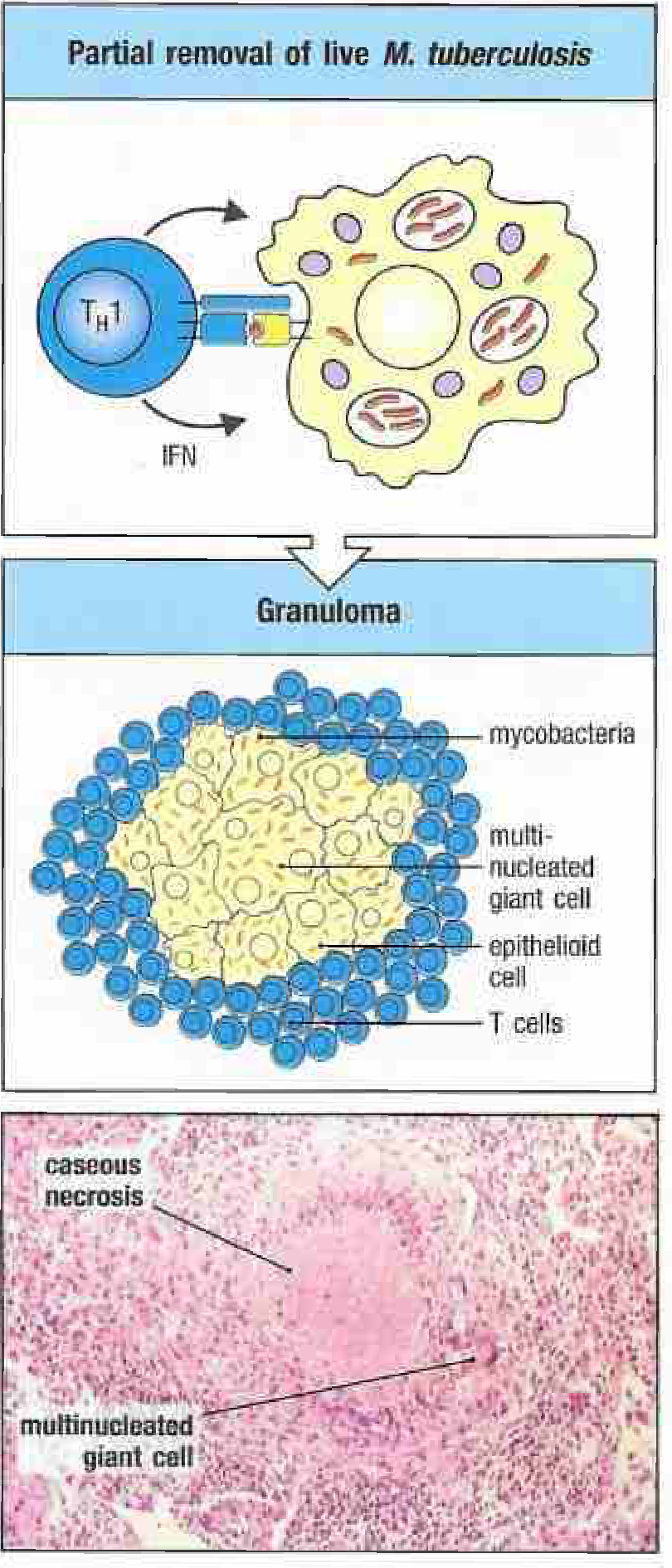
Janeway's Immunobiology, 10e — Normal granuloma formation in TB
Reason 1: The Bacteria Are Already Dying — There's Nothing Left to "Contain"
In TB-IRIS, the patient is already on effective anti-TB drugs. By the time ART is started (2–8 weeks in), rifampicin and isoniazid have already begun killing mycobacteria. So when the immune system suddenly reconstitutes, it isn't encountering live, replicating bacteria that need walling off.
Instead, it encounters:
- Dead mycobacterial antigens (cell wall fragments, tuberculoproteins)
- Already-forming or formed granulomas that now get hit with a cytokine storm
- Residual antigen depots in lymph nodes, lungs, meninges
The immune response has nothing productive to do — the bacteria are being killed by drugs — but it fires anyway at maximum intensity. This is immunopathology, not immunoprotection.
Reason 2: Granuloma Formation Is a Balanced, Regulated Process — TB-IRIS Is Unregulated
Normal granuloma = controlled, calibrated TH1 response:
- Macrophages fuse → epithelioid cells + multinucleated giant cells
- Tight walling off of organisms
- Central caseous necrosis stays contained within the fibrous capsule
- The process eventually fibroses and calcifies (Ghon focus) → healed
TB-IRIS = dysregulated, explosive cytokine release:
- Sudden massive surge of TNF-α, IL-6, IL-12, IFN-γ
- This is not organized granuloma formation — it's a flood of pro-inflammatory cytokines directed at antigen that's already being cleared
- The immune response overshoots what is needed
Reason 3: The Sites Where IRIS Hits Are Dangerous
Even if you accepted some tissue inflammation as a trade-off, the problem is where IRIS strikes:
| Location | Consequence |
|---|---|
| CNS / meninges (TB meningitis) | Cerebral edema, raised intracranial pressure, herniation, death |
| Lymph nodes | Massive enlargement, suppuration, abscess formation, fistulae |
| Lungs | Consolidation, respiratory failure, ARDS |
| Pericardium | Pericardial effusion, tamponade |
In the brain, there is no room for swelling. A "healing" inflammatory response in a meningitis patient becomes fatal herniation. This is why TB meningitis + IRIS has the highest mortality of all IRIS subtypes.
Reason 4: The Granuloma Itself Can Become Destructive When Overdriven
This is the key pathological insight: granulomas in TB are a double-edged sword. The same immune response that contains bacteria also causes tissue destruction:
- Caseous necrosis within the granuloma is host tissue death, caused by activated macrophage enzymes (reactive oxygen species, proteases)
- If the inflammatory drive is excessive (as in IRIS), the necrotic center liquefies and the granuloma breaks down → cavity formation
- A ruptured cavity releases bacilli into airways → bronchogenic spread of TB to new lung segments
- In lymph nodes: colliquative necrosis → abscess → fistula to skin
So paradoxically, too much inflammation causes the very destruction that liberates bacteria, the opposite of containment.
Reason 5: The Granuloma Already Existed — IRIS Just Makes It Worse
In most TB-IRIS cases, the patient already had granulomas from their TB infection before ART was started. The IRIS response doesn't build new protective granulomas — it inflames existing ones that are already fibrosed or partially healed. This causes:
- Enlarging lymph nodes that were shrinking
- Re-appearing pulmonary infiltrates that were resolving
- Returning fever and constitutional symptoms that had improved
This is the classic "paradoxical reaction" — a patient who was getting better on ATT suddenly gets worse after ART starts.
Summary
| Normal Granuloma Response | TB-IRIS | |
|---|---|---|
| Trigger | Live, replicating M. tuberculosis | Dead/dying bacilli + residual antigens |
| Regulation | Calibrated, resolves appropriately | Unregulated cytokine storm |
| Location matters? | Yes, but organism is the threat | Yes, and the host response IS the threat |
| Outcome | Containment → fibrosis → healing | Tissue destruction, abscess, CNS herniation |
| Bacteria killed? | Partially | Already being killed by ATT |
Your intuition is correct for an immunocompetent person encountering TB for the first time. But in TB-IRIS, the immune system is reconstituting into a situation where the battle is already won pharmacologically — and its explosive response simply damages the host without any corresponding benefit.
This is a shared conversation. Sign in to Orris to start your own chat.