
Changes in lung volumes with obstructive and restrictive disorders
Reading File
Finding Sources
Finding Sources
Reading File
Reading File
Reading File
Loading Image
Reading File
Reading File
Reading File
I now have comprehensive information. Let me compile the full answer.
Lung Volumes in Obstructive vs. Restrictive Disorders
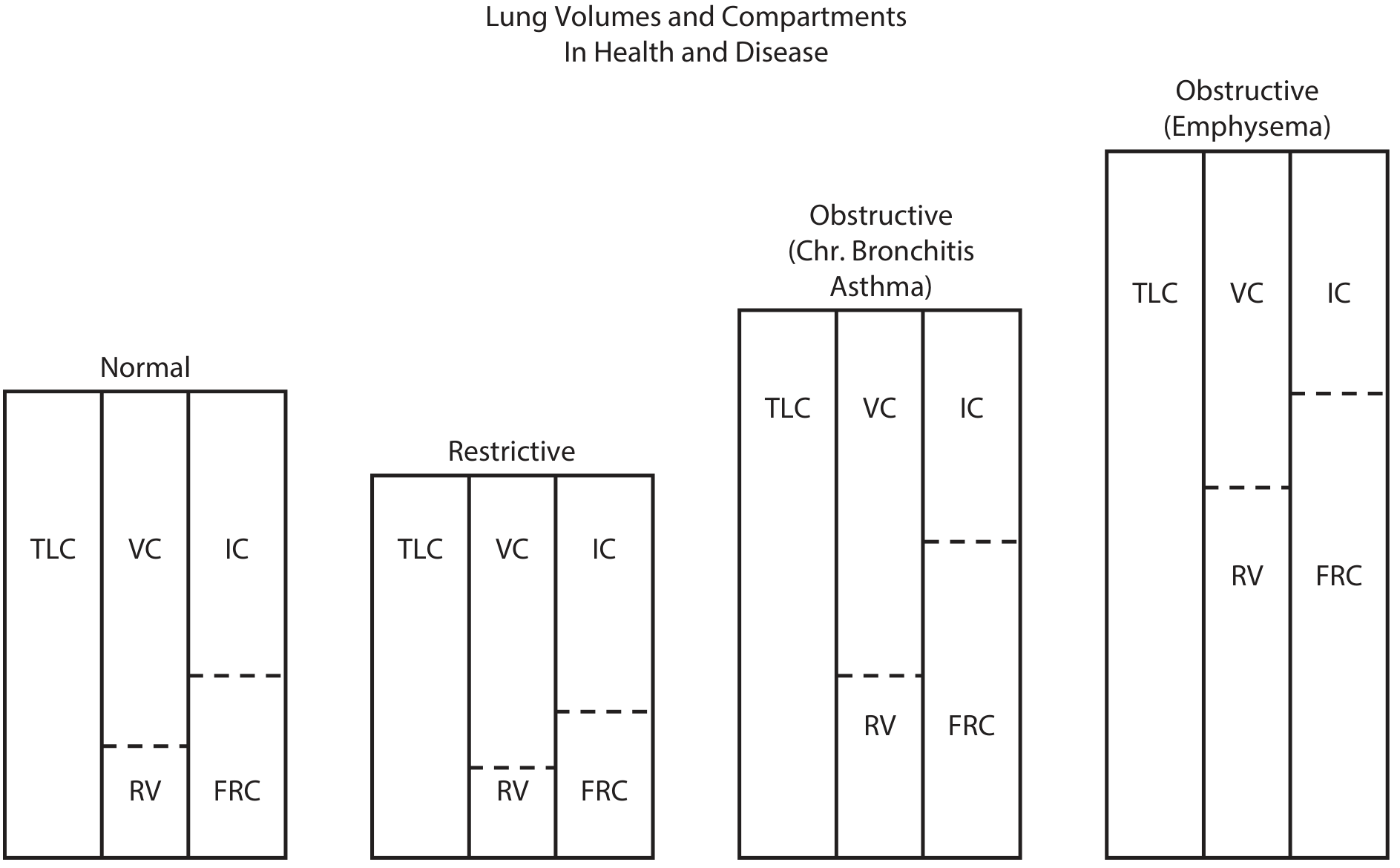
Figure: Lung compartments in normal health and in restrictive and obstructive diseases. TLC and RV are largest in emphysema. - KJ Lee's Essential Otolaryngology, p. 169
Background: Key Lung Volumes
| Abbreviation | Definition |
|---|---|
| TLC | Total lung capacity - volume at maximal inspiration |
| RV | Residual volume - volume remaining after maximal expiration |
| FRC | Functional residual capacity - volume after passive expiration |
| VC / FVC | Vital capacity / forced vital capacity |
| IC | Inspiratory capacity (TLC - FRC) |
| FEV1 | Forced expiratory volume in 1 second |
Obstructive Disorders
Mechanism: Narrowing of airways (upper airway down to bronchioles <2 mm) reduces maximal airflow relative to maximal lung volume. Air trapping occurs because airways collapse during expiration before full emptying.
Changes in lung volumes:
| Parameter | Change | Reason |
|---|---|---|
| TLC | Normal or increased | Air trapping; loss of elastic recoil (emphysema) pushes outward equilibrium |
| RV | Increased | Air trapped behind prematurely closing airways |
| FRC | Increased | New equilibrium point shifted outward |
| FVC / VC | Normal or decreased | Air trapping reduces volume available for exhalation |
| FEV1 | Decreased | Hallmark of obstruction |
| FEV1/FVC ratio | Decreased (<0.70 or below LLN) | Primary diagnostic criterion |
| RV/TLC ratio | Increased | Reflects hyperinflation and air trapping |
Disease-specific nuance:
- Emphysema: TLC and RV are markedly elevated due to destruction of alveolar walls and loss of elastic recoil. DLCO is reduced.
- Chronic bronchitis / Asthma: TLC may be normal or mildly elevated; RV and FRC are elevated. DLCO is normal (distinguishes from emphysema).
Examples: COPD, asthma, bronchiectasis, cystic fibrosis, bronchiolitis.
- Murray & Nadel's Textbook of Respiratory Medicine, p. 759
Restrictive Disorders
Mechanism: Diseases of the lung parenchyma, chest wall, pleura, or neuromuscular apparatus that reduce lung volumes. The lung is smaller overall - it cannot expand fully.
Changes in lung volumes:
| Parameter | Change | Reason |
|---|---|---|
| TLC | Decreased | Primary criterion for restriction; lung cannot fully inflate |
| RV | Decreased | Proportional reduction in all volumes |
| FRC | Decreased | New equilibrium shifted inward |
| VC / FVC | Decreased | Lung cannot expand fully |
| FEV1 | Decreased | Due to smaller overall volume |
| FEV1/FVC ratio | Normal or increased | Both decrease proportionally; ratio preserved or elevated |
| IC | Decreased | Reduced inspiratory range |
The hallmark is a proportional decrease in all lung volumes, with TLC below the lower limit of normal being the definitive diagnostic criterion.
Examples:
-
Parenchymal: Idiopathic pulmonary fibrosis (IPF), sarcoidosis, asbestosis, eosinophilic pneumonia, congestive heart failure
-
Extra-parenchymal: Obesity, kyphoscoliosis, ankylosing spondylitis, neuromuscular diseases (Guillain-Barre, ALS, muscular dystrophy, myasthenia gravis), diaphragmatic paralysis, pleural disease, lung resection
-
Murray & Nadel's Textbook of Respiratory Medicine, p. 760; Fishman's Pulmonary Diseases and Disorders, p. 602
Side-by-Side Comparison
| Parameter | Normal | Obstructive | Restrictive |
|---|---|---|---|
| TLC | Normal | Normal / ↑↑ (emphysema) | ↓↓ |
| VC / FVC | Normal | Normal / ↓ | ↓ |
| RV | Normal | ↑↑ | ↓ |
| FRC | Normal | ↑ | ↓ |
| IC | Normal | Normal / ↓ | ↓ |
| FEV1 | Normal | ↓↓ | ↓ |
| FEV1/FVC | Normal (>0.70) | ↓ (<0.70) | Normal or ↑ |
| DLCO | Normal | ↓ (emphysema) / Normal (asthma, CB) | ↓ (parenchymal) |
Mixed Pattern
A combined obstructive-restrictive pattern occurs when pathologic processes simultaneously reduce lung volumes and cause airway narrowing - TLC is low AND FEV1/FVC is reduced. Examples include bronchiectasis, cystic fibrosis, sarcoidosis, and hypersensitivity pneumonitis. - Fishman's Pulmonary Diseases, p. 602
Diagnostic Algorithm (ATS/ERS)
- Check FEV1/FVC ratio:
- If below LLN (lower limit of normal) → obstructive
- If normal → proceed to step 2
- Check VC:
- If VC below LLN → check TLC
- Check TLC:
- TLC below LLN → restrictive
- TLC normal → "nonspecific" pattern (not truly restrictive)
- If both FEV1/FVC ↓ and TLC ↓ → mixed obstructive-restrictive pattern
This is a shared conversation. Sign in to Orris to start your own chat.