
Significance of lipid water coefficient in general anaesthesia
The lipid-water partition coefficient (also called the oil:gas or lipid solubility) is central to understanding how inhaled anaesthetics work. In brief: the more lipid-soluble an agent, the lower the dose (MAC) needed to produce anaesthesia - this is the Meyer-Overton correlation. Agents dissolve into lipid membranes of neurons and disrupt ion channel function proportionally to their lipid solubility.
Searching sources...
Reading File
Now I'll search the medical library for relevant content on this topic, running parallel queries:
Finding Sources
Finding Sources
Finding Sources
Found the key section in Barash. Now reading the full Meyer-Overton Rule section and related content:
Reading File
Finding Sources
Excellent - the full Barash text was returned. Let me continue reading for more content:
Reading File
Finding Sources
Now let me read the core Meyer-Overton section and the Katzung pharmacology section on partition coefficients:
Reading File
Reading File
Reading File
Excellent content gathered. Let me fetch the Meyer-Overton graph image and read a bit more from Lippincott on uptake:
Loading Image
Reading File
I now have comprehensive content from multiple authoritative sources. Let me compile the full, detailed answer.
Significance of the Lipid-Water Coefficient in General Anaesthesia
1. Definition
The lipid-water (oil/gas) partition coefficient expresses the ratio of the concentration of an anaesthetic dissolved in a lipid (olive oil) phase to its concentration in the gas phase at equilibrium, at 37°C. It is a direct measure of the lipophilicity of an inhalational anaesthetic agent.
A high oil/gas coefficient = high lipid solubility = high potency (low MAC).
2. The Meyer-Overton Rule (Historical & Core Significance)
Over 100 years ago, Meyer and Overton independently observed that the potency of gases as anaesthetics was strongly correlated with their solubility in olive oil. This relationship - the Meyer-Overton Rule - holds across an extraordinary range of potencies: the correlation between lipid solubility and MAC extends over a 70,000-fold difference in anesthetic potency (log-log scale).
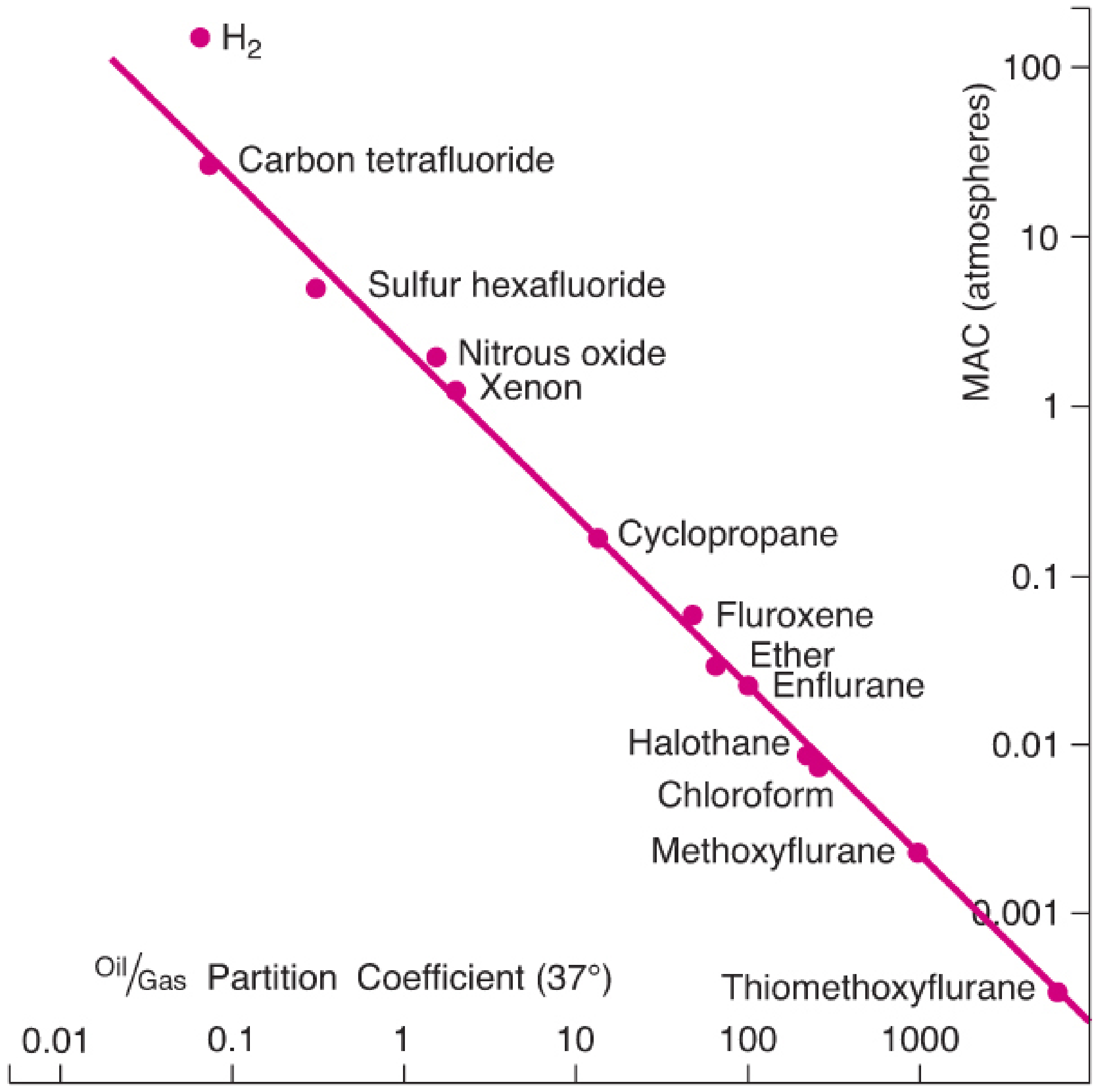
Figure: The Meyer-Overton rule. Linear relationship (log-log scale) between oil/gas partition coefficient and anaesthetic potency (MAC) across structurally unrelated compounds. - Barash Clinical Anesthesia, 9e, p.662
Key implication: Since so many structurally unrelated compounds obey this rule, it suggested that all anaesthetics likely act at the same molecular site - a site whose relevant property is hydrophobicity.
3. Significance for Anaesthetic Potency (MAC)
- The more lipid-soluble an anaesthetic, the lower the MAC (less concentration needed) - i.e., greater potency.
- The inverse of MAC is therefore an index of lipid solubility and potency.
- Nitrous oxide has low lipid solubility and very high MAC (>100%) - it cannot produce surgical anaesthesia alone.
- Halothane has high lipid solubility (oil/gas ~224) and low MAC (0.75%).
| Agent | Blood:Gas Partition Coefficient | Oil/Gas (Lipid Solubility) | MAC (%) |
|---|---|---|---|
| Desflurane | 0.42 | ~19 | 6-7 |
| Nitrous oxide | 0.47 | ~1.4 | >100 |
| Sevoflurane | 0.69 | ~47 | 2.0 |
| Isoflurane | 1.40 | ~91 | 1.40 |
| Enflurane | 1.80 | ~96 | 1.7 |
| Halothane | 2.30 | ~224 | 0.75 |
- Katzung's Basic and Clinical Pharmacology, 16e, Table 25-1, p.696
4. Significance for Speed of Induction and Recovery (Blood:Gas Coefficient)
The blood:gas partition coefficient is a related but distinct concept - it determines speed of induction and recovery, not potency.
- Low blood:gas coefficient (e.g., desflurane, N₂O): little anesthetic dissolves in blood → equilibrium between inspired gas and arterial blood is achieved quickly → rapid induction and recovery.
- High blood:gas coefficient (e.g., halothane, isoflurane): more drug dissolves in blood (which acts as an inactive reservoir) → more molecules are needed to raise arterial partial pressure → slower induction and recovery.
"When an anesthetic gas with low blood solubility diffuses from the alveoli into the circulation, little anesthetic dissolves in the blood. Therefore, equilibrium between the inspired anesthetic and arterial blood occurs rapidly." - Lippincott Pharmacology, p.670
Solubility ranking (blood): isoflurane > sevoflurane > nitrous oxide > desflurane.
5. Mechanism: Lipid Theory vs. Protein Theory
The Meyer-Overton correlation originally supported the lipid theory of anaesthesia: anaesthetics dissolve into the lipid bilayer, causing physicochemical changes in membrane structure that alter the function of embedded membrane proteins (ion channels).
However, current evidence strongly supports the protein (hydrophobic pocket) theory:
- Anaesthetics bind to hydrophobic pockets on proteins (particularly GABA-A receptor transmembrane domains).
- Anesthetic-protein interactions account for the Meyer-Overton rule AND its exceptions.
- Photoaffinity-labeling shows propofol, etomidate, barbiturates, and neurosteroids all bind to hydrophobic pockets between transmembrane domain (TMD) subunits of GABA-A receptors.
- Cryo-EM structures now confirm 3D anesthetic-binding sites on GABA-A receptor subunits.
"Strong evidence demonstrates that anesthetics can bind to hydrophobic pockets on proteins and that anesthetic-protein interactions can account for the Meyer-Overton rule and deviations from it." - Barash, 9e, p.670
6. Exceptions to the Meyer-Overton Rule (Critical Significance)
The lipid theory is imperfect. Key exceptions reveal that size, shape, and stereochemistry also matter:
- Non-immobilizers / convulsants: Certain polyhalogenated ethers, barbiturates, and neurosteroids are predicted by lipid solubility to be anaesthetics but instead cause convulsions or have no anaesthetic effect (though some cause amnesia).
- Cutoff effect: In homologous series (n-alkanes, n-alkanols, perfluoroalkanes), very long-chain members lose anaesthetic activity despite increasing lipid solubility - suggesting a size limit to the hydrophobic binding site.
- Stereoisomers (enantiomers): Mirror-image compounds have identical physical/solubility properties but differ in anaesthetic potency (e.g., ketamine, etomidate, isoflurane enantiomers). This proves a specific, shaped receptor binding site, not just bulk lipid dissolution.
- Barash Clinical Anesthesia, 9e, p.663
7. IV Agents and Lipid Solubility
For intravenous agents (propofol, thiopentone), lipid solubility also determines:
- Speed of CNS entry: High lipid solubility allows rapid diffusion across the blood-brain barrier, explaining the rapid onset of propofol and thiopentone.
- Redistribution: Highly lipophilic drugs redistribute quickly from the brain to muscle/fat, terminating their effect (context-sensitive half-life).
"Their rapid onset of action relates to their high lipid solubility, which allows them to diffuse rapidly into the lipid-rich CNS." - Scott-Brown's Otorhinolaryngology, p.103
8. Summary Table
| Property | Determined By | Clinical Impact |
|---|---|---|
| Potency (MAC) | Oil/gas partition coefficient | High lipid solubility = low MAC = potent agent |
| Speed of induction/recovery | Blood:gas partition coefficient | Low blood solubility = fast onset and offset |
| Mechanism | Hydrophobic pocket binding on GABA-A/proteins | Lipid-like environment required for binding |
| BBB penetration (IV agents) | Lipid solubility | Determines speed of induction for IV agents |
Sources:
- Barash, Cullen, and Stoelting's Clinical Anesthesia, 9e, pp. 660-670 (Meyer-Overton Rule, lipid vs protein theories, exceptions)
- Katzung's Basic and Clinical Pharmacology, 16e, Table 25-1, p. 696-697 (partition coefficient table, uptake)
- Lippincott Illustrated Reviews Pharmacology, pp. 668-671 (MAC, blood:gas coefficient, tissue compartments)
- Scott-Brown's Otorhinolaryngology, p. 103 (IV agent lipid solubility and CNS penetration)
This is a shared conversation. Sign in to Orris to start your own chat.