
Aluminium phosphide poisoning for md emergency medicine final exam
Reading File
Now let me search the medical library and PubMed simultaneously for comprehensive AlP poisoning content.
Finding Sources
Finding Sources
Searching PubMed
"aluminium phosphide" poisoning management
Good. Now let me read both textbook sections in full simultaneously, plus get the PubMed abstract.
Reading File
Reading File
Reading Article
PMID: 42454906
Good. Let me read the full management and investigation sections from the Dikshit textbook, and also search for the clinical/EM-focused treatment content.
Reading File
Finding Sources
Excellent - found the most comprehensive source: "The Essentials of Forensic Medicine and Toxicology 36th edition (latest 2026)". Let me read that in full alongside Rosen's EM section.
Reading File
Reading File
Reading File
Reading File
Now I also want the earlier part of this section (introduction/medicolegal) and the stomach image.
Reading File
Loading Image
I now have comprehensive data from multiple authoritative sources. Let me compile the complete MD Emergency Medicine exam answer.
Aluminium Phosphide (ALP) Poisoning - MD Emergency Medicine Final Exam
Overview / Medicolegal Importance
Aluminium phosphide (ALP) is a solid fumigant pesticide, insecticide, and rodenticide widely used for grain preservation. It is sold under trade names: Celphos, Alphos, Quickphos, Phostoxin, Phosphotex, Fumigran. It is cheap, easily available, and highly lethal - often called "the agent of sure death."
- Tablet composition: 3 g grey-green tablet; 56% active ingredient; mixed with urea and ammonium carbonate
- Each tablet releases: 1 g of phosphine (PH3) gas
- India: Highly prevalent in Haryana, Punjab, UP, Rajasthan - common suicidal and homicidal agent (used in dowry deaths in rural areas)
- Medicolegal significance: Suicidal >> Accidental > Homicidal
Chemical Reaction - Mechanism of Gas Liberation
ALP + 3H₂O → Al(OH)₃ + PH₃ (Phosphine)
- Reaction is accelerated by HCl in the stomach
- On ingestion, contact with gastric juice liberates phosphine gas rapidly
- On inhalation, direct pulmonary absorption occurs
Mechanism of Toxicity
Phosphine is a systemic cellular poison:
- Inhibits cytochrome c oxidase (Complex IV of the mitochondrial electron transport chain) - the primary mechanism
- Blocks oxidative phosphorylation → cellular hypoxia
- Generates reactive oxygen species (ROS) - free radical injury to cell membranes
- Inhibits catalase and other antioxidant enzymes
- Affects all organs - heart, lung, liver, kidney, CNS
Key point for exam: Phosphine toxicity = mitochondrial cytochrome oxidase inhibition + oxidative stress
Toxicokinetics
| Parameter | Detail |
|---|---|
| Fatal dose | 1-3 g (1-3 tablets); 1-2 g lethal |
| Inhalation fatal conc. | 400-600 ppm within 1 hour; >0.3 ppm causes severe illness |
| Fatal period | 6-12 hours; majority of deaths within 24 hours |
| Absorption | Rapid from GIT by simple diffusion; also from lungs after inhalation |
| Metabolism | Metabolized in liver; phosphine slowly released (prolonging symptoms) |
| Excretion | Oxidized to oxyacids → excreted as hypophosphite in urine; also excreted unchanged through lungs |
Clinical Features
By Severity
Mild (inhalation):
- Mucous membrane irritation
- Dizziness, fatigue, headache
- Tightness in chest, nausea, vomiting, diarrhea
Moderate:
- Ataxia, numbness, paresthesia
- Tremors, diplopia
- Jaundice, muscular weakness, incoordination, paralysis
Severe (ingestion - systemic):
| System | Features |
|---|---|
| GIT | Nausea, vomiting, diarrhea, retrosternal/epigastric burning pain |
| CVS | Hypotension, cardiogenic shock (most common cause of death), arrhythmias, myocarditis, pericarditis, acute CCF |
| Respiratory | Cough, dyspnea, cyanosis, pulmonary edema, ARDS, respiratory failure |
| CNS | Headache, restlessness, excitement, agitation, convulsions, acute hypoxic encephalopathy, coma |
| Renal | Oliguria, acute renal failure |
| Hepatic | Jaundice, hepatitis, hepatomegaly |
| Metabolic | Metabolic acidosis, hypocalcemia (tetany), hypomagnesemia |
Pathognomonic feature: Garlicky/fishy odour from breath and vomitus
ECG abnormalities: Sinus tachycardia, bradycardia, heart block, various arrhythmias
Major complications:
- Pericarditis
- Acute massive GI bleeding
- ARDS
- Acute CCF
Mortality: Extremely high - 35% to 100% (one of the highest among poisonings). Cardiogenic shock is the most common cause of death.
Investigations
Bedside/Clinical Chemical Tests
Test 1 - Silver Nitrate Breath Test (most important):
- Filter paper impregnated with 0.1 N silver nitrate used as a face mask
- Patient breathes in and out for 5-10 minutes
- Paper turns BLACK if phosphine is present (AgNO₃ reduced to metallic Ag by PH₃)
Test 2 - Gastric Aspirate Test:
- Mix 5 mL gastric aspirate + 15 mL water in a flask
- Cover mouth with AgNO₃-impregnated filter paper
- Heat at 50°C for 15-20 minutes
- Paper turns black = phosphine confirmed
Laboratory Workup (for management)
- ABG (metabolic acidosis, hypoxia)
- Serum electrolytes (hypomagnesemia, hypocalcemia, hypokalemia)
- Serum bicarbonate
- ECG / cardiac monitoring
- LFT, RFT
- CBC, coagulation profile
Management
A. Decontamination
No specific antidote exists for ALP poisoning.
Gastric lavage:
- Done after endotracheal intubation (to protect airway)
- Lavage with potassium permanganate (oxidizes phosphine to nontoxic phosphate) - repeat 2-3 times
- Alternatively: 3-5% sodium bicarbonate, 1% copper sulphate, or mineral oil
- Controversy: Recent studies suggest gastric lavage may worsen outcome (more moisture = more phosphine release); some advocate against it
- Activated charcoal: 100 g orally mixed with sorbitol (NOT water - water accelerates PH₃ release) - 240 mL per 30 g charcoal
- Antacids: Reduce GI symptoms and absorption
- Liquid paraffin: Given to aid excretion of ALP and phosphine from gut
B. Antiarrhythmic / Cardiac
Magnesium sulphate - cornerstone of treatment:
- Reduces organ toxicity
- Corrects hypomagnesemia and arrhythmias
- Dose (Dikshit): 3 g IV bolus → 6 g over 24 hours for 5-7 days
- Dose (Essentials FMT 2026): 1 g initial → repeated for next 2 hours → 1-1.5 g every 6 hours for 5-7 days as continuous IV infusion
- Calcium salts IV for hypocalcemia/tetany
C. Shock Management
- IV fluids: 4-6 liters during first 3-6 hours; 50% as normal saline
- Low-dose dopamine: 4-6 mcg/kg/min (inotropic support)
- IV hydrocortisone: 400 mg every 4-6 hours - highly effective; reduces dopamine requirement
- Steroids also combat pulmonary edema
D. Metabolic Acidosis
- IV sodium bicarbonate 50 mEq every 15 minutes until arterial bicarbonate >15 mmol/L
E. Respiratory Support
- Oxygen supplementation
- Endotracheal intubation and mechanical ventilation for respiratory failure/ARDS
F. Renal Support
- Peritoneal dialysis or hemodialysis for renal failure (also useful for metabolic acidosis)
G. Antioxidant Therapy (Emerging / Evidence-Based)
Per 2026 review in Xenobiotica (PMID 42454906) and Rosen's Emergency Medicine:
- N-acetylcysteine (NAC) IV - limited but beneficial evidence
- Vitamin E - antioxidant
- Melatonin - antioxidant
- Magnesium - antioxidant + anti-arrhythmic
- Rationale: Phosphine causes massive ROS generation; antioxidant therapy addresses this mechanism
H. Antibiotics
For secondary infections
Summary of Treatment Protocol (Exam Mnemonic: "No GMLADS")
| Letter | Step |
|---|---|
| N | No specific antidote |
| G | Gastric lavage (KMnO₄, post-intubation) + activated charcoal in sorbitol |
| M | Magnesium sulphate (anti-arrhythmic, organ-protective) |
| L | Liquid paraffin + IV fluids for shock |
| A | Antioxidants (NAC, Vit E, melatonin) |
| D | Dopamine (low-dose) + steroids (hydrocortisone) |
| S | Sodium bicarbonate (acidosis), Supportive O₂/ventilation |
Postmortem Appearances
- Garlic-like odour at mouth, nostrils, gastric contents (pathognomonic)
- Blood-stained froth at mouth and nostrils
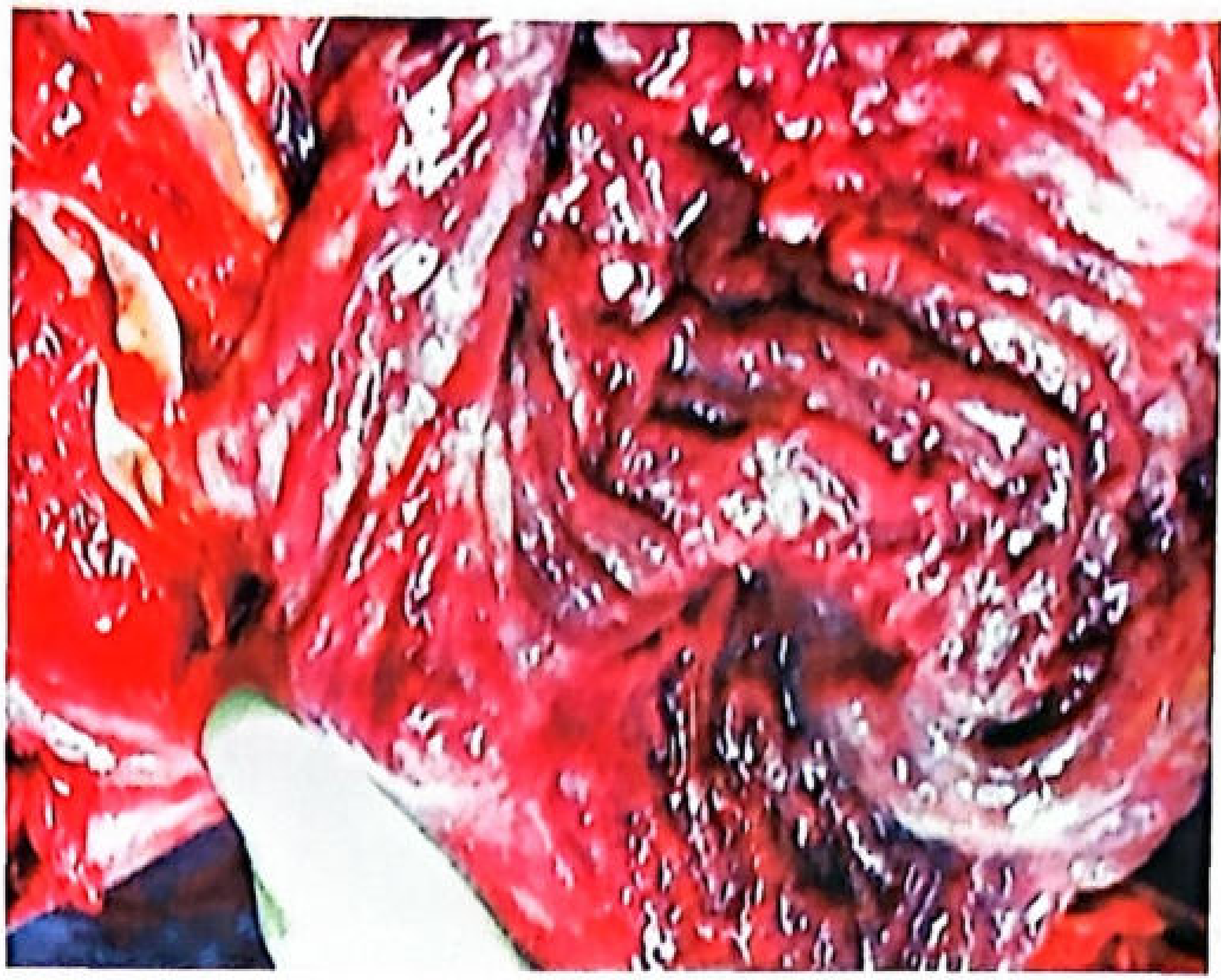
- Congested mucous membrane of lower esophagus, stomach, and duodenum (see image below)
- Decreasing congestion in small intestine (gradient)
- Lungs, liver, spleen, kidneys, brain - all congested
- Centrizonal hemorrhagic necrosis of liver
Histopathology
| Organ | Finding |
|---|---|
| Stomach | Congestion, edema, leucocytic infiltration, sloughing of gastric mucosa |
| Lungs | Congestion, edema, desquamation of respiratory epithelium, thickened alveoli, lymphocytic infiltration |
| Kidneys | Congestion, necrosis, tubular degeneration and regeneration |
| Adrenals | Congestion, hemorrhage, necrosis, lipid depletion in cortex |
| Heart | Congestion, edema, fragmentation of fibers, focal necrosis, leucocytic infiltration |
| Brain | Congestion, edema |
High-Yield Exam Points Summary
| Fact | Value |
|---|---|
| Trade names | Celphos, Alphos, Quickphos, Phostoxin, Phosphotex |
| Chemical reaction | ALP + 3H₂O → Al(OH)₃ + PH₃ |
| Fatal dose | 1-3 tablets (1-3 g) |
| Fatal period | 6-12 hours (most deaths in 24 hrs) |
| Odour | Garlicky/fishy |
| Primary mechanism | Cytochrome oxidase inhibition + ROS generation |
| Most common cause of death | Cardiogenic shock |
| Specific antidote | NONE |
| Chemical test | 0.1 N silver nitrate paper - turns BLACK |
| Gastric lavage solution | KMnO₄ (oxidizes to phosphate) |
| Charcoal mixed in | Sorbitol (NOT water) |
| Key antiarrhythmic | Magnesium sulphate |
| Inotrope of choice | Dopamine (low-dose 4-6 mcg/kg/min) |
| Steroid dose | Hydrocortisone 400 mg q4-6h |
| Postmortem odour | Garlic at mouth/nostrils/stomach |
| Liver finding | Centrizonal hemorrhagic necrosis |
| Mortality | 35-100% |
Sources: The Essentials of Forensic Medicine and Toxicology, 36th ed. (2026); P C Dikshit Textbook of Forensic Medicine and Toxicology; Rosen's Emergency Medicine, 9th ed.; Aghebat-Bekheir et al., Xenobiotica 2026 (PMID 42454906) - most recent review confirming antioxidant therapy and supportive care as mainstay.
This is a shared conversation. Sign in to Orris to start your own chat.