
Swiss cheese appearance of cornea
Reading File
The "Swiss cheese appearance" of the cornea refers to multiple round/oval stromal vacuoles or lacunae giving a holey pattern, classically associated with corneal macular dystrophy or Schnyder crystalline dystrophy, but most prominently linked to Big Bubble technique complications or posterior polymorphous dystrophy. Let me search the textbook library for the definitive answer.
Searching sources...
Finding Sources
Finding Sources
Both queries point to the same passage. Let me read the full context and also search for more information.
Reading File
Finding Sources
I have the definitive answer. Let me also fetch the clinical image.
Loading Image
Reading File
Excellent - I now have the complete picture. Here is the full answer:
Swiss Cheese Appearance of the Cornea = Band Keratopathy
The "Swiss cheese appearance" of the cornea is a classic sign of band keratopathy. It describes the lucid (clear) spaces present within an anterior corneal calcium plaque, which interrupt the white opaque deposit and give it a holey, Swiss cheese-like look.
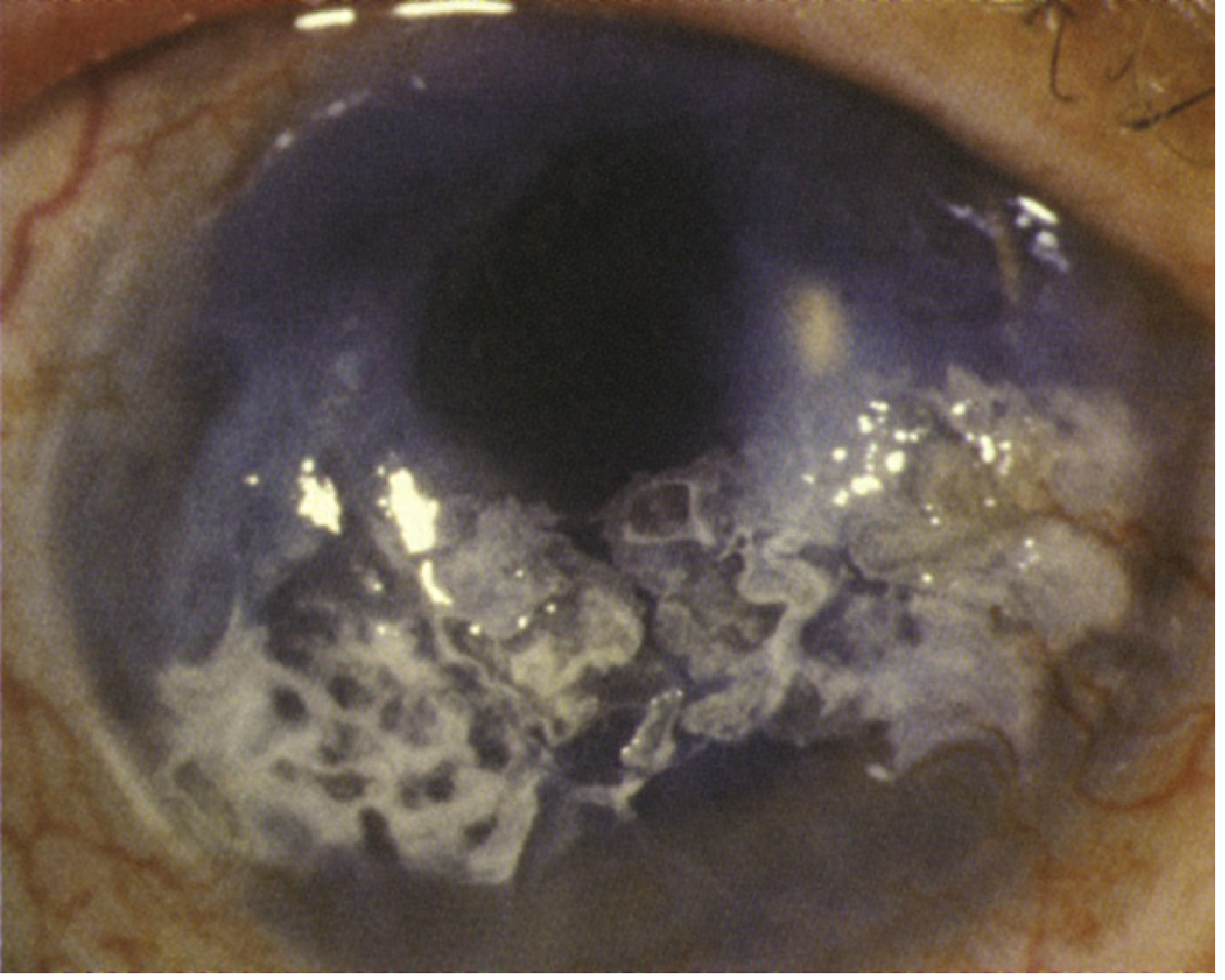
Figure: Band keratopathy. Note the white interpalpebral calcium plaque with dark lucid spaces creating the Swiss cheese pattern.
What Is Band Keratopathy?
Band keratopathy is a deposition of calcium (hydroxyapatite crystals) at the level of Bowman's membrane, in the superficial anterior corneal stroma. It is located within the interpalpebral fissure (horizontally across the cornea, between the eyelid apertures), and is characteristically separated from the limbus by a clear margin of cornea.
Key Signs (from The Wills Eye Manual)
| Feature | Description |
|---|---|
| Location | Interpalpebral zone, starting at 3 o'clock and 9 o'clock positions |
| Layer affected | Bowman's membrane |
| Appearance | White/gray chalky plaque with lucid (clear) holes = Swiss cheese |
| Limbal sparing | Band separated from limbus by a clear zone |
Causes
More Common:
- Chronic uveitis (especially juvenile idiopathic arthritis / JIA)
- Interstitial keratitis
- Corneal edema
- Trauma / phthisis bulbi
- Long-standing glaucoma
- Dry eye
- Post ocular surgery (especially retinal detachment repair with silicone oil)
- Idiopathic
Less Common (systemic causes of hypercalcemia/hyperphosphatemia):
- Hyperparathyroidism
- Renal failure
- Sarcoidosis
- Multiple myeloma
- Paget disease of bone
- Vitamin D excess
- Gout (hyperuricemia)
- Long-term exposure to mercury fumes
Workup
- History: chronic eye disease, prior surgery, systemic disease, environmental exposures
- Slit lamp examination
- If no obvious ocular cause: serum calcium, albumin, magnesium, phosphate, BUN, creatinine, and uric acid (if gout suspected)
Treatment
Mild (foreign body sensation):
- Preservative-free artificial tears 4-6x/day
- Lubricating ointment at bedtime
- Antibiotic ointment if epithelial defects overlie the calcium
- Bandage soft contact lens for comfort
Severe (vision obstruction, intractable irritation, cosmetic concern):
- Chelation with disodium EDTA 3-4% - the definitive treatment
- Topical anesthesia + lid speculum
- Debride epithelium overlying calcium with sterile blade
- Apply EDTA-soaked sponge until calcium clears (10-60 minutes)
- Irrigate with saline, apply antibiotic ointment + cycloplegic
- Consider bandage contact lens and systemic analgesics
In summary: Swiss cheese appearance of the cornea = band keratopathy, due to calcific deposits at Bowman's membrane with lucid (clear) spaces interrupting the plaque. - The Wills Eye Manual, p. 195-197
This is a shared conversation. Sign in to Orris to start your own chat.