
ECG
I can help with ECG (electrocardiography)! This is a broad topic. Let me find out what you need.
Asking for Preferences
What aspect of ECG are you interested in?
Reading File
Now let me search for comprehensive ECG basics content in parallel:
Finding Sources
Finding Sources
Searching Images
ECG electrocardiogram normal waves P QRS T interpretation
Finding Sources
Finding Sources
Searching Images
ECG leads placement 12 lead diagram
Good — I found strong sources. Let me now read the key textbook sections in parallel:
Reading File
Reading File
Reading File
Reading File
Loading Image
Loading Image
Reading File
I now have comprehensive content from Harrison's, Guyton, and Medical Physiology. Let me compile the complete ECG basics guide:
ECG Basics & Interpretation
What is an ECG?
When a cardiac impulse travels through the heart, electrical current spreads to the body's surface. Electrodes placed on the skin detect these potentials, and the recording is the electrocardiogram (ECG). — Guyton and Hall Textbook of Medical Physiology
The Cardiac Conduction System
The heartbeat originates in the sinoatrial (SA) node, which has spontaneous automaticity. From there, the impulse travels:
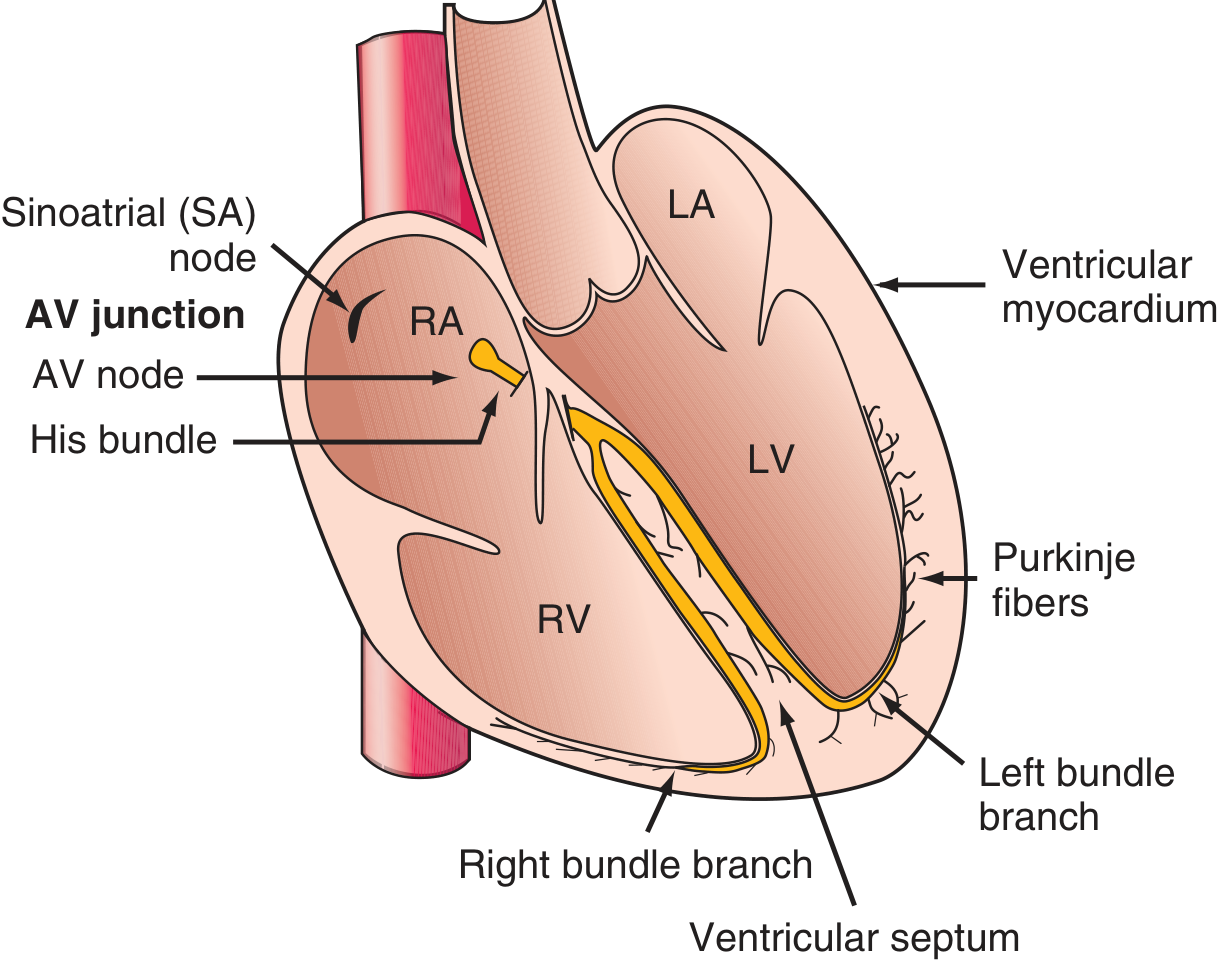
SA node → Atria → AV node → Bundle of His → Right & Left bundle branches → Purkinje fibers → Ventricular myocardium
The left bundle branch subdivides into left anterior and left posterior fascicles. Depolarization spreads endocardium → epicardium, triggering synchronized ventricular contraction. — Harrison's Principles of Internal Medicine, 22E
ECG Waveforms & What They Mean
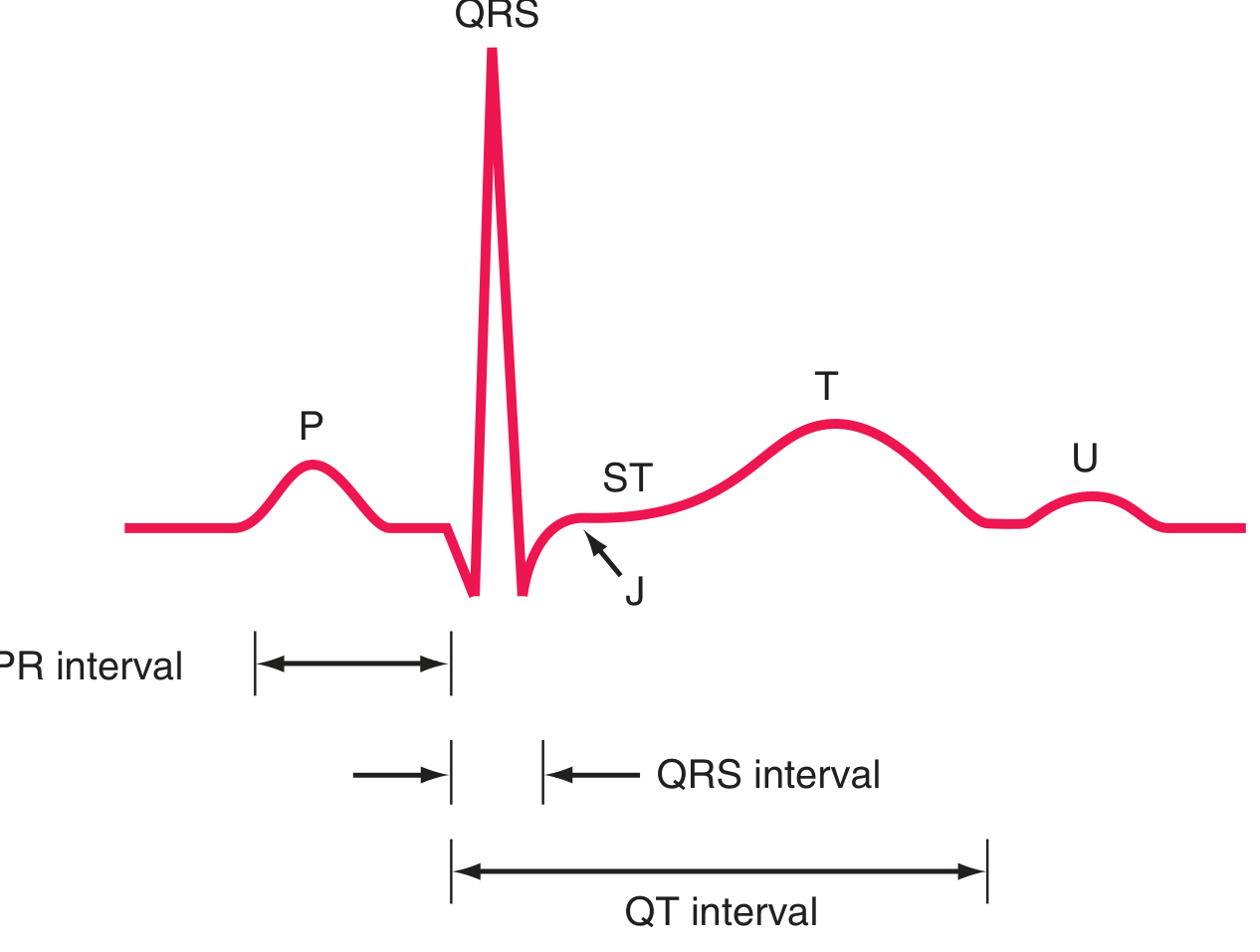
| Wave/Complex | Represents | Normal |
|---|---|---|
| P wave | Atrial depolarization | Small, upright; positive in II, negative in aVR |
| PR interval | Atrial→ventricular conduction (AV node delay) | 120–200 ms (3–5 small boxes) |
| QRS complex | Ventricular depolarization | < 120 ms |
| ST segment | Isoelectric phase (plateau of action potential) | At baseline |
| T wave | Ventricular repolarization | Concordant with QRS in most leads |
| QT interval | Total ventricular depolarization + repolarization | QTc ≤ 460 ms (♀), ≤ 450 ms (♂) |
| U wave | Follows T wave; same polarity | Small; often due to Purkinje repolarization |
| J point | Junction of QRS end and ST segment start | At baseline |
The Q wave is the initial negative deflection; R wave is the first positive; S wave is the negative wave following R. Uppercase letters (Q, R, S) = large amplitude; lowercase (q, r, s) = small amplitude. — Medical Physiology (Boron & Boulpaep)
Depolarization vs. Repolarization
- P wave, QRS complex = depolarization waves (Na⁺ influx, phase 0 of action potential)
- T wave = repolarization wave (phase 3 of action potential)
- Atrial repolarization is buried within the QRS and usually invisible (occasionally seen in pericarditis or AV block)
- Factors slowing phase 0 (↓Na⁺ influx — hyperkalemia, flecainide) → widen QRS
- Factors prolonging phase 2/3 (amiodarone, hypocalcemia) → prolong QT
- Factors shortening repolarization (hypercalcemia, digoxin) → shorten QT — Harrison's
The 12 Leads
The 12-lead ECG is recorded from 6 limb leads (frontal plane) and 6 precordial leads (horizontal plane):
Limb Leads (Frontal Plane)
| Lead | Type | View |
|---|---|---|
| I | Bipolar | Left arm (+ pole) vs. right arm |
| II | Bipolar | Left leg vs. right arm (most useful rhythm lead) |
| III | Bipolar | Left leg vs. left arm |
| aVR | Augmented unipolar | Right arm (global negative in normal) |
| aVL | Augmented unipolar | Left arm (lateral view) |
| aVF | Augmented unipolar | Left foot (inferior view) |
Precordial Leads (Horizontal Plane)
| Lead | Position |
|---|---|
| V1 | 4th intercostal space, right sternal border |
| V2 | 4th intercostal space, left sternal border |
| V3 | Between V2 and V4 |
| V4 | 5th intercostal space, midclavicular line |
| V5 | Anterior axillary line (same horizontal level as V4) |
| V6 | Midaxillary line (same horizontal level) |
Each lead is analogous to a different camera angle looking at the same cardiac electrical event. A wave of depolarization toward a lead's positive pole = upright deflection; away = negative deflection. — Harrison's
Paper Speed & Calibration
- Standard speed: 25 mm/s
- 1 small box (1 mm) = 40 ms (0.04 s)
- 5 small boxes (1 large box) = 200 ms (0.20 s)
- Amplitude: 1 mV = 10 mm at standard calibration
- Heart rate = 300 ÷ number of large boxes between R waves (or 1500 ÷ small boxes)
A Systematic Approach to Reading Any ECG
| Step | What to Assess | Normal |
|---|---|---|
| 1. Rate | Count R–R intervals | 60–100 bpm |
| 2. Rhythm | Regular? P before every QRS? | Sinus rhythm |
| 3. P wave | Morphology, axis | Upright II, inverted aVR |
| 4. PR interval | Duration | 120–200 ms |
| 5. QRS duration | Wide or narrow? | < 120 ms |
| 6. QRS axis | Direction in I and aVF | −30° to +90° |
| 7. ST segment | Elevation or depression? | Isoelectric |
| 8. T waves | Upright? Inverted? Peaked? | Concordant with QRS |
| 9. QT interval | Rate-corrected QTc | ≤ 450 ms (♂), ≤ 460 ms (♀) |
| 10. R-wave progression | V1 → V6 transition | rS → RS → qR by V3–V4 |
Normal ECG Example
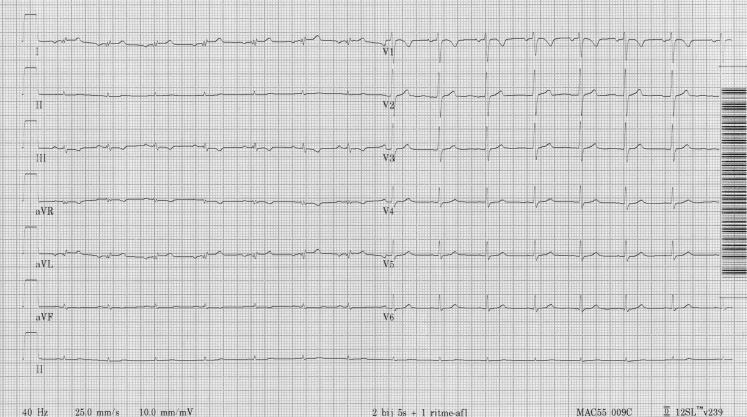
This tracing shows normal sinus rhythm: regular rate ~60–100 bpm, upright P waves preceding each narrow QRS, isoelectric ST segments, concordant T waves, and normal R-wave progression V1–V6.
Sources: Harrison's Principles of Internal Medicine 22E | Guyton and Hall Textbook of Medical Physiology | Medical Physiology (Boron & Boulpaep)
Want to go deeper on any specific area? For example: axis deviation, bundle branch blocks, ST changes (ischemia/infarction), arrhythmia recognition, or electrolyte effects on the ECG?
This is a shared conversation. Sign in to Orris to start your own chat.