
Teapot deformity of stomach
Reading File
Now let me search the medical library and web in parallel.
Finding Sources
Finding Sources
Searching the Web
teapot deformity stomach radiology gastric
Let me search more specifically for the teapot deformity and read the relevant textbook sections.
Finding Sources
Finding Sources
Searching the Web
teapot deformity stomach peptic ulcer scarring radiology sign
Reading File
Reading Web Page
https://appliedradiology.com/articles/part-1-classic-signs-i…
Reading File
Finding Sources
Finding Sources
Searching the Web
"teapot deformity" OR "teapot stomach" gastric barium meal ulcer
Excellent - I found the key primary source. Now let me fetch the relevant image from the textbook and get more detail from the Springer article.
Loading Image
Reading Web Page
https://link.springer.com/article/10.1007/s12664-010-0068-2
I now have all the information needed to provide a thorough answer. Let me also fetch the barium meal image from the Springer article.
Loading Image
Here is a complete answer on the teapot deformity of the stomach:
Teapot Deformity of the Stomach
Definition
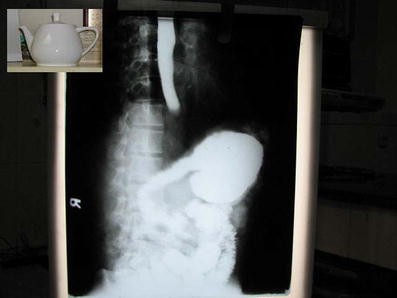
The "teapot" (or "tea pot") deformity is a distinctive gastric shape seen on barium meal examination, where the stomach takes on the silhouette of a teapot. It is a chronic, cicatricial (scarring) deformity resulting from healed peptic ulcer disease affecting the lesser curvature.
Mechanism / Pathogenesis
The deformity develops through a specific sequence:
- Ulceration and destruction of the lesser curvature (typically a gastric ulcer at the angular incisura or antrum)
- As the ulcer heals, fibrosis and scar tissue contract the lesser curvature
- This progressive shrinkage of the lesser curve causes it to shorten dramatically
- The greater curvature, being uninvolved, remains relatively intact and forms a rounded, dependent pouch
- The net result is a stomach with a short, concave lesser curve acting as the "spout" side, and a rounded, dilated greater-curve pouch acting as the "body" of the teapot - visually resembling the shape of a teapot
The pyloric opening, displaced and eccentrically placed, corresponds to the teapot's "spout."
As noted in a published case report in the Indian Journal of Gastroenterology: "The deformity occurs due to the ulceration and destruction of the lesser curve. When the ulcer heals there is shrinkage of the lesser curve leading to 'tea pot' stomach."
Radiology
- Diagnosed on barium meal (upper GI series)
- The stomach shows a rounded, dilated dependent pouch (greater curvature) alongside a contracted, foreshortened lesser curvature
- The pyloric opening appears eccentrically placed
- The first part of the duodenum is often also deformed (given the common association with chronic ulcer disease)
Here is the classic barium meal appearance (inset shows an actual teapot for comparison):
Clinical Presentation
The reported case (Kundukulam, 2010) was a 46-year-old male with:
- Dyspepsia and intermittent vomiting for 2 months
- No history of stale-food vomitus (distinguishing from pyloric obstruction with gastric stasis)
- Normal abdominal ultrasonography
- Endoscopy: deformed stomach with eccentrically placed pylorus and deformed first part of duodenum
Comparison with Related Deformities
| Deformity | Cause | Affected Part | Shape |
|---|---|---|---|
| Teapot stomach | Healed lesser-curve ulcer with scar shrinkage | Lesser curvature (contracted) | Teapot silhouette |
| Hourglass stomach | Healed mid-body ulcer - retraction of both walls | Mid-stomach (circumferential) | Two pouches joined by a narrow waist |
| Leather bottle (linitis plastica) | Scirrhous gastric carcinoma | Entire stomach wall | Narrow, rigid, non-distensible tube |
| Ram's horn | Crohn's disease antral involvement | Antrum | Conical tubular narrowing |
The hourglass and teapot deformities share the same underlying process (healed gastric ulcer with fibrosis) but differ in location: hourglass results from a lesser-curve ulcer in the body/mid-stomach with retraction of the opposite (greater curve) wall as well, whereas the teapot deformity is more specifically attributed to shrinkage of the lesser curve resulting in a rounded greater-curve pouch - (S Das, Manual on Clinical Surgery, 13th ed.; Sleisenger & Fordtran's GI and Liver Disease).
Key Teaching Points
- Teapot deformity = chronic peptic ulcer disease complication (healed gastric ulcer)
- Seen on barium meal, not typically on CT as a named sign
- The lesser curvature contracts/shortens; the greater curvature forms a rounded pouch
- Endoscopy shows eccentric pylorus and deformed stomach
- Clinically may present with dyspepsia and vomiting; no absolute gastric outlet obstruction in mild cases
- Described in literature but reported cases are rare (the 2010 Kundukulam paper was the first formally published case report)
This is a shared conversation. Sign in to Orris to start your own chat.