

Explain for neet pg exam
Behavioral Conditioning - NEET PG Psychiatry
PART 1: BEHAVIORAL CONDITIONING
Classical Conditioning (Pavlov's)
| Feature | Details |
|---|---|
| Also called | Respondent conditioning |
| Response type | Involuntary (reflexive) |
| Learning mechanism | Learning by association |
| Key figure | Ivan Pavlov (dog salivation experiment) |
| Core principle | A neutral stimulus is repeatedly paired with one that elicits a reflexive response, until the neutral stimulus alone produces the response |
- Food (Unconditioned Stimulus) → Salivation (Unconditioned Response)
- Bell (Neutral Stimulus) + Food → repeated pairings
- Bell alone → Salivation (now a Conditioned Response)
Operant Conditioning (Skinner's)
| Feature | Details |
|---|---|
| Also called | Instrumental conditioning |
| Response type | Voluntary |
| Learning mechanism | Learning by consequences |
| Key figure | B.F. Skinner (pigeon/rat in Skinner's box) |
| Core principle | Behavior is shaped by its consequences - reward increases it, punishment decreases it |
THE FOUR QUADRANTS - Most Tested Concept
| Add something (+) | Remove something (-) | |
|---|---|---|
| Increases behavior | Positive Reinforcement | Negative Reinforcement |
| Decreases behavior | Positive Punishment | Negative Punishment |
Reinforcement = Increases behavior (↑)
-
Positive Reinforcement - Add a pleasant stimulus after a desired behavior → behavior increases
- Example: Giving a lion a treat after it performs a trick (image in your notes)
- Mnemonics: "Incentive +" as shown in your notes
-
Negative Reinforcement - Remove an unpleasant stimulus after a desired behavior → behavior increases
- Example: Taking away a painful stimulus when the patient cooperates
- Key trap: "Negative" does NOT mean punishment - it still increases behavior
- Example: Wearing a seatbelt removes the annoying seatbelt alarm → you wear seatbelt more
Punishment = Decreases behavior (↓)
-
Positive Punishment - Add an unpleasant stimulus after undesired behavior → behavior decreases
- Example: Scolding a child for misbehaving (the image of police/motorcycle in your notes)
-
Negative Punishment - Remove a pleasant stimulus after undesired behavior → behavior decreases
- Example: Taking away pocket money (removing reward) → decreases the behavior
- Also called Response Cost or Time-Out from positive reinforcement
NEET PG Trap: Negative reinforcement is often confused with punishment. Remember: ALL reinforcement (positive and negative) increases behavior. All punishment decreases behavior.
Schedules of Reinforcement (High Yield)
| Schedule | Description | Key Feature |
|---|---|---|
| Fixed Ratio | Reward after fixed number of responses | Rapid response, brief pause after reward |
| Variable Ratio | Reward after variable number of responses | Most resistant to extinction (e.g., gambling) |
| Fixed Interval | Reward after fixed time interval | Scallop pattern of responding |
| Variable Interval | Reward after variable time intervals | Steady, consistent responding |
PART 2: MINI-MENTAL STATE EXAMINATION (MMSE)
Overview
- Total score: 30 points
- Score < 24 = Cognitive Decline (as shown in your image)
- Takes about 5-10 minutes to administer
- Assesses: Orientation, Registration, Attention, Recall, Language, Visuospatial
MMSE Domains (NEET PG Scoring)
| Domain | Question | Max Score |
|---|---|---|
| Orientation - Time | Year, season, month, date, day | 5 |
| Orientation - Place | Country, state, city, building, floor | 5 |
| Registration (Naming) | Name 3 objects (Ball, Car, Man / Apple, Penny, Table) | 3 |
| Attention/Concentration | Spell WORLD backwards (D-L-R-O-W) | 5 |
| Recall (Recent Memory) | Recall the 3 objects after a delay | 3 |
| Naming | Name a wrist watch, pencil | 2 |
| Repetition | "No ifs, ands, or buts" | 1 |
| Comprehension | Read "CLOSE YOUR EYES" and do it | 1 |
| Command | Take paper, fold in half, put on floor (3-step command) | 3 |
| Language/Writing | Write a complete sentence (must contain a verb) | 1 |
| Visuospatial/Copying | Copy the interlocking pentagons design | 1 |
| TOTAL | 30 |
Remember: The 3-step command is: Take the paper in your right/left hand, fold it in half, put it on the floor - scores 3 points (1 per action).
Cutoff Scores (Approximate)
| Score | Interpretation |
|---|---|
| 24-30 | Normal / No cognitive impairment |
| 18-23 | Mild cognitive impairment |
| 10-17 | Moderate cognitive impairment |
| < 10 | Severe cognitive impairment |
PART 3: LEVELS OF CONSCIOUSNESS (MSE)
| Level | Description |
|---|---|
| Alert | Fully awake, responsive |
| Lethargy = Somnolence | Drowsy, slow responses; easily aroused |
| Oneroid | Dream-like state with hallucinations |
| Obtundation | Reduced alertness, needs strong stimulation |
| Stupor = Akinetic Mutism | Unresponsive except to vigorous/painful stimuli; no movement or speech |
| Coma | Unarousable; no response even to pain |
NEET PG High Yield: Lethargy = Somnolence (same thing). Stupor = Akinetic Mutism. These paired definitions are frequently tested.
QUICK MNEMONICS FOR EXAM DAY
- Reinforcement = increases behavior
- Positive = add stimulus
- Negative = remove stimulus
1
What would you like me to explain?
Flash card summary
NEET PG Psychiatry flashcard set with dark medical theme. Create a clean, organized flashcard summary with the following sections clearly laid out: CARD 1 - BEHAVIORAL CONDITIONING Title: "Behavioral Conditioning" - Classical (Pavlov's): Involuntary | Learning by Association | Neutral stimulus paired with reflex stimulus - Operant (Skinner's): Voluntary | Learning by Consequences CARD 2 - THE 4 QUADRANTS (most tested) Title: "Operant Conditioning - 4 Quadrants" Table with 4 boxes: - Positive Reinforcement: ADD pleasant → behavior INCREASES ↑ - Negative Reinforcement: REMOVE unpleasant → behavior INCREASES ↑ - Positive Punishment: ADD unpleasant → behavior DECREASES ↓ - Negative Punishment: REMOVE pleasant → behavior DECREASES ↓ KEY: All Reinforcement = ↑ behavior | All Punishment = ↓ behavior CARD 3 - MMSE Title: "MMSE - Total 30 points | <24 = Cognitive Decline" - Orientation Time (5) + Place (5) - Registration/Naming (3) - Attention - WORLD backwards (5) - Recall (3) - Language/Naming/Repetition/Comprehension/Command/Writing/Visuospatial (9) CARD 4 - LEVELS OF CONSCIOUSNESS Alert → Lethargy=Somnolence → Oneroid (dream-like) → Obtundation → Stupor=Akinetic Mutism → Coma CARD 5 - EXTINCTION Discontinuation of reinforcement → eventually eliminates behavior Use a dark navy/teal background, white and yellow text, color-coded boxes for each card, bold headings. Medical education style.
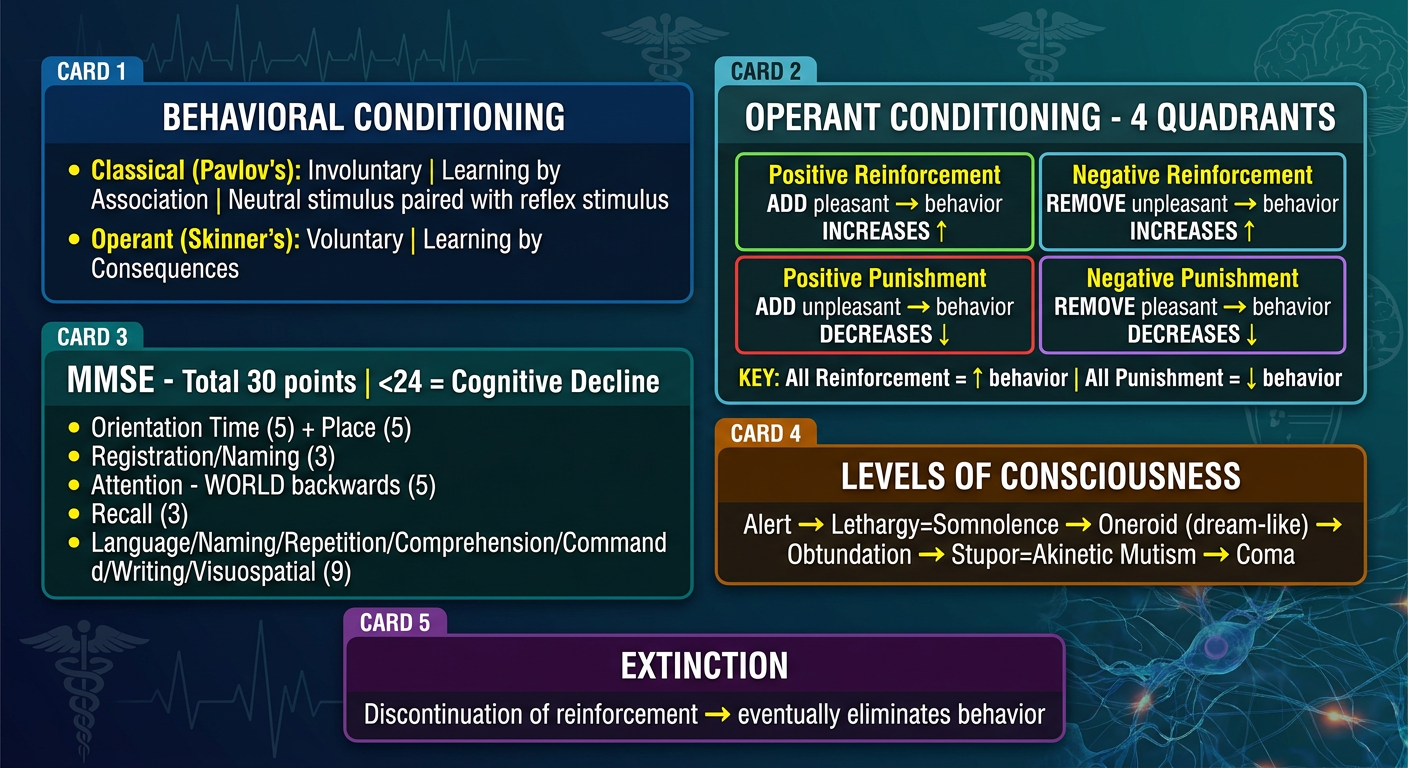
🃏 CARD 1 - Conditioning Types
| Classical (Pavlov) | Operant (Skinner) | |
|---|---|---|
| Response | Involuntary | Voluntary |
| Learning | By Association | By Consequences |
| Example | Dog salivation | Pigeon in box |
🃏 CARD 2 - 4 Quadrants (Most Tested!)
| Add (+) | Remove (-) | |
|---|---|---|
| ↑ Behavior | Positive Reinforcement | Negative Reinforcement |
| ↓ Behavior | Positive Punishment | Negative Punishment |
All Reinforcement = ↑ | All Punishment = ↓
🃏 CARD 3 - MMSE (Total = 30)
- Orientation: Time(5) + Place(5) = 10
- Registration (3) + Recall (3) = 6
- Attention/WORLD backwards = 5
- Language + Command + Visuospatial = 9
- < 24 = Cognitive Decline
🃏 CARD 4 - Consciousness Levels
🃏 CARD 5 - Extinction

Explain for neet pg exam view
Mental State Examination (MSE) - NEET PG Psychiatry
PART 1: PERCEPTION
Hallucination vs Illusion - The Core Distinction
| Feature | Hallucination | Illusion |
|---|---|---|
| External stimulus | No stimulus present | Stimulus IS present (but misperceived) |
| Definition | False sensory perception with NO external stimulus | Misinterpretation of a REAL external stimulus |
| Example | Hearing voices in a silent room | Seeing a rope and thinking it's a snake |
NEET PG Key: Hallucination = no stimulus. Illusion = stimulus + misperception.
True Hallucination vs Pseudohallucination
| True Hallucination | Pseudohallucination | |
|---|---|---|
| Perceived as | Outer - exists in external world | Inner - within the mind |
| Quality | Objective - as real as real objects | Subjective - recognized as unreal |
| Insight | No insight | Partial insight present |
| Example | Schizophrenia | Grief-related visions, vivid imagery |
Types of Hallucinations by Modality (High Yield!)
| Type | Association | Notes |
|---|---|---|
| Auditory | Schizophrenia (most common in psychiatry) | Most common hallucination overall in psychiatric disorders |
| Visual | Psychosis, Medical illness (delirium, drugs) | Organic causes common |
| Tactile (Haptic) | Cocaine abuse → "Magnan bugs" / formication | Sensation of insects crawling under skin |
| Olfactory/Gustatory | Temporal lobe epilepsy | Uncinate fits - smell of burning rubber |
Special Types of Hallucination (Very Frequently Tested!)
- Stimulus in one sense → Perception in a different sense
- Associated with: LSD use
- Example: Hearing music and seeing colors (sound → visual perception)
- Synesthesia definition from Kaplan & Sadock: "Stimulation of one sensory modality is perceived as sensation in a different modality, as when a sound produces a sensation of color"
- Stimulus in one sense → Perception in the same sense
- Example: Hearing a voice whenever a tap runs (sound triggers auditory hallucination)
- The real stimulus and the hallucination are both in the same modality
NEET PG Trap: Reflex/Synesthesia = DIFFERENT sense. Functional = SAME sense. This distinction is repeatedly tested!
Hypnagogic vs Hypnopompic Hallucinations
| Timing | Significance | |
|---|---|---|
| Hypnagogic | While falling asleep | NOT pathological (normal) |
| Hypnopompic | While waking up | NOT pathological (normal) |
| Both occur in | Narcolepsy (pathological) | High-yield association |
PART 2: MSE - COGNITIVE DOMAINS
Orientation
- Time, Place, Person (in order of loss in delirium/dementia)
- Lost first in Delirium = Orientation (especially time)
- Order of loss: Time → Place → Person
Attention
- Tested by: Digit Span Test
- Normal forward digit span: 7 ± 2
- Backward digit span: 5 ± 2
Memory - The 3 Types
| Memory Type | Test | Time Frame |
|---|---|---|
| Immediate | Digit span test | Seconds |
| Recent (Short-term) | 3-item recall after delay | Minutes to hours (24 hr recall) |
| Remote (Long-term) | Past history, Personal history | Years |
Key: In Alzheimer's dementia - Recent memory is lost first. Remote memory is preserved until late.
Concentration
- Serial 7 subtraction: 100 - 7 = 93, 86, 79, 72, 65...
- WORLD backwards: D-L-R-O-W (also used in MMSE)
PART 3: INSIGHT - GRADES (Most Tested in NEET PG!)
| Grade | Description | Clinical Meaning |
|---|---|---|
| 1 | Complete denial | Patient denies any illness |
| 2 | Slight awareness | Acknowledges illness but blames others |
| 3 | Awareness + Blames on others | "I'm sick because of what others did to me" |
| 4 | Intellectual insight | Knows they are ill but cannot apply this knowledge emotionally |
| 5 | True emotional insight | Full understanding; can use insight to change behavior |
Grade 4 vs 5: Grade 4 = knows they are ill (intellectual), Grade 5 = truly understands and changes behavior (emotional). Schizophrenia patients often have Grade 1-2 insight.
- Proverb testing: "A rolling stone gathers no moss"
- Similarity assessment: "How are apple and orange alike?" (both fruits)
PART 4: JUDGEMENT
- Personal: "What would you do if you found a fire in the building?"
- Social: "How do you behave in a meeting/public place?"
- Future planning: Ability to make realistic plans
Judgement involves: analytical thinking + social/ethical action + depth of understanding (Kaplan & Sadock)
PART 5: MOOD vs AFFECT (top of image)
| Mood | Affect | |
|---|---|---|
| Definition | Subjective feeling state (what patient reports) | Objective emotional expression (what examiner observes) |
| Duration | Over a period of time | Cross-sectional - observed in the moment |
| Reported by | Patient | Examiner |
| Examples | Depressed, Anxious, Elated | Blunted, Flat, Labile |
- Labile = rapidly shifting emotional expression
- Flat = no emotional expression at all (seen in schizophrenia)
- Blunted = markedly reduced but not absent
NEET PG RAPID FIRE SUMMARY
| Topic | Key Fact |
|---|---|
| Most common hallucination in psychiatry | Auditory |
| Tactile hallucination + cocaine | Magnan bugs / Formication |
| Temporal lobe epilepsy | Olfactory/Gustatory hallucination |
| Synesthesia/Reflex hallucination | LSD - different sense |
| Functional hallucination | Same sense triggered |
| Memory lost first in dementia | Recent memory |
| Insight Grade 1 | Complete denial |
| Insight Grade 5 | True emotional insight |
| Mood = reported by | Patient (over time) |
| Affect = observed by | Examiner (cross-sectional) |
| Hypnagogic | Falling asleep |
| Hypnopompic | Waking up |