
Fibroid and polyp difference in easy and understandable language
Both fibroids and polyps are abnormal growths inside or on the uterus, but they differ in tissue origin, behavior, and symptoms. Fibroids are made of muscle tissue and can grow quite large, while polyps are soft overgrowths of the uterine lining and tend to be smaller.
Searching sources...
Reading File
Finding Sources
Finding Sources
Finding Sources
Finding Sources
Reading File
Reading File
Finding Sources
Finding Sources
Reading File
Now I have solid textbook content from Robbins Pathology, Berek & Novak's Gynecology, and Grainger & Allison's Radiology. Let me fetch the ultrasound image showing both a polyp and fibroid for the user.
Loading Image
Here is a clear, easy-to-understand breakdown of fibroids vs. polyps, sourced from Robbins Pathology, Berek & Novak's Gynecology, and Grainger & Allison's Diagnostic Radiology.
Fibroids vs. Polyps - What's the Difference?
Think of it this way: both are lumps inside or on the uterus, but they are made of completely different stuff and behave differently.
🔴 Fibroid (also called Leiomyoma or Myoma)
What is it made of?
A fibroid is a lump made of muscle - the same type of muscle that makes up the wall of the uterus. It grows from inside the uterine wall itself.
What does it look like?
- Round, firm, and gray-white in appearance
- Has a distinctive "whorled" (twisted rope) pattern when cut open
- Can be tiny (the size of a pea) or enormous (filling the whole pelvis)
- Usually there are multiple fibroids, not just one
Where does it sit?
Fibroids can be in three places:
| Location | Simple name | Where |
|---|---|---|
| Intramural | "Inside the wall" | Deep in the uterine muscle |
| Submucosal | "Under the lining" | Bulging into the uterine cavity |
| Subserosal | "Under the outer coat" | Bulging outward from the uterus |
Symptoms:
- Heavy or prolonged periods
- Pressure sensation - feeling like you need to pee all the time (fibroid pressing the bladder)
- Pelvic pain or cramping, especially if the fibroid loses its blood supply
- Can cause difficulty getting pregnant or keeping a pregnancy
Is it dangerous?
No - fibroids are almost always benign (not cancer). Turning into cancer (leiomyosarcoma) is extremely rare.
"Uterine leiomyoma (commonly called fibroid) is perhaps the most common tumor in females. They are benign smooth muscle neoplasms." - Robbins & Cotran Pathologic Basis of Disease
🟡 Polyp (Endometrial Polyp)
What is it made of?
A polyp is a lump made of the lining of the uterus (the endometrium - the soft tissue that sheds every month during a period). It is essentially an overgrowth of that inner lining.
What does it look like?
- Soft, fleshy, and finger-like or grape-like
- Usually smaller than fibroids
- Often attached by a stalk (like a mushroom on a stem)
- Can be single or multiple
Where does it sit?
Polyps grow inside the uterine cavity - they project inward from the lining. Occasionally, one can grow so long it pokes through the cervix into the vagina.
Symptoms:
- Irregular bleeding between periods
- Heavy periods
- Bleeding after menopause (this is a red flag that needs investigation)
- Sometimes no symptoms at all
Is it dangerous?
Most polyps are benign, but they have a slightly higher chance of becoming cancerous compared to fibroids - especially in postmenopausal women. This is why doctors usually remove and test them.
Side-by-Side Comparison Table
| Feature | Fibroid | Polyp |
|---|---|---|
| Made of | Uterine muscle (smooth muscle) | Uterine lining (endometrium) |
| Consistency | Hard, firm | Soft, fleshy |
| Size | Often large (cm to many cm) | Usually small (mm to 1-2 cm) |
| Shape | Round, whorled | Finger/grape-like, on a stalk |
| Location | In the uterine wall | Inside the uterine cavity |
| Main symptom | Heavy periods + pressure | Irregular/between-period bleeding |
| Cancer risk | Extremely rare | Low but higher than fibroids |
| Who gets it | Women of reproductive age | Any age, more common near menopause |
| Diagnosis | Ultrasound, MRI | Ultrasound, hysteroscopy |
| Treatment | Medication or surgery (myomectomy) | Usually surgical removal (hysteroscopy) |
How Doctors Tell Them Apart on Ultrasound
The image below shows a sonohysterogram (ultrasound with fluid injected into the uterus). The fluid (dark area) separates the walls and lets the doctor see the polyp clearly as a distinct lump (*), while the fibroid (+) sits separately:
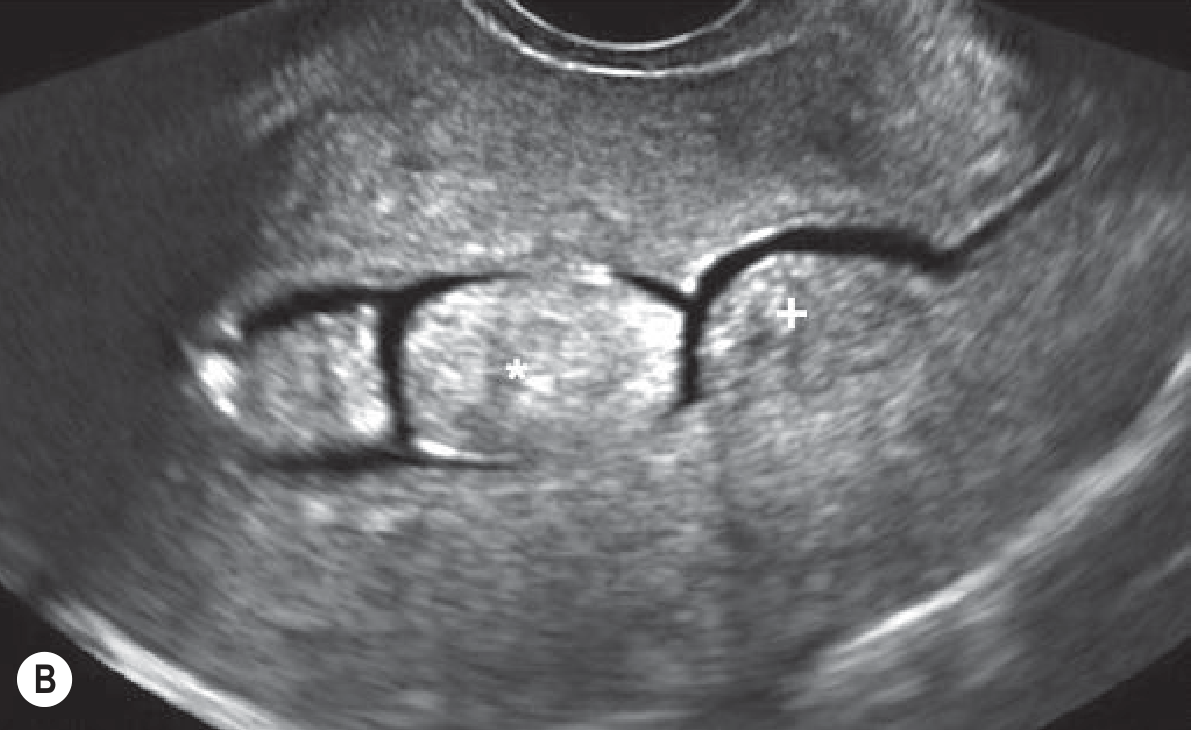
Sonohysterography: the polyp (*) is surrounded by fluid, allowing it to be told apart from a fibroid (+). - Grainger & Allison's Diagnostic Radiology
The Simple Summary
Fibroid = muscle lump, grows IN the uterine wall, hard and firm, often big. Polyp = lining lump, grows INTO the uterine cavity, soft and small, on a stalk.
Both are benign most of the time, but both need medical attention because they cause bleeding problems and can affect fertility. A polyp is more likely to be sent for biopsy because of its (small) cancer potential.
This is a shared conversation. Sign in to Orris to start your own chat.