
Ecg
I can help with ECG! Could you be more specific about what you need?
Asking for Preferences
What would you like to know about ECG?
Which disease or condition are you interested in?
Asking for Preferences
Which condition's ECG findings do you want to explore?
Reading File
Finding Sources
Searching Images
ECG findings myocardial infarction ST elevation Q waves
Finding Sources
Loading Image
Finding Sources
Loading Image
Finding Sources
Loading Image
Reading File
Reading File
Reading File
Reading File
Loading Image
Loading Image
Here is a comprehensive guide to ECG findings in Myocardial Infarction (MI), drawing from Harrison's Principles of Internal Medicine (2025), Guyton & Hall, and clinical ECG image libraries.
ECG Findings in Myocardial Infarction
Overview
The ECG is central to the diagnosis of acute and chronic ischemic heart disease. Ischemia exerts complex time-dependent effects on myocardial electrical properties, producing characteristic changes in the ST segment, T waves, and QRS complex.
1. Pathophysiology: Current of Injury
Severe acute ischemia lowers the resting membrane potential and shortens the action potential duration, creating a voltage gradient between normal and ischemic zones. This generates "currents of injury" seen as ST-segment deviation:
- Transmural (epicardial) ischemia → ST vector directed outward → ST elevation in overlying leads
- Subendocardial ischemia → ST vector directed inward → ST depression in overlying leads (with ST elevation in aVR)
2. Temporal Evolution of ECG Changes
This is the classic progression of STEMI:
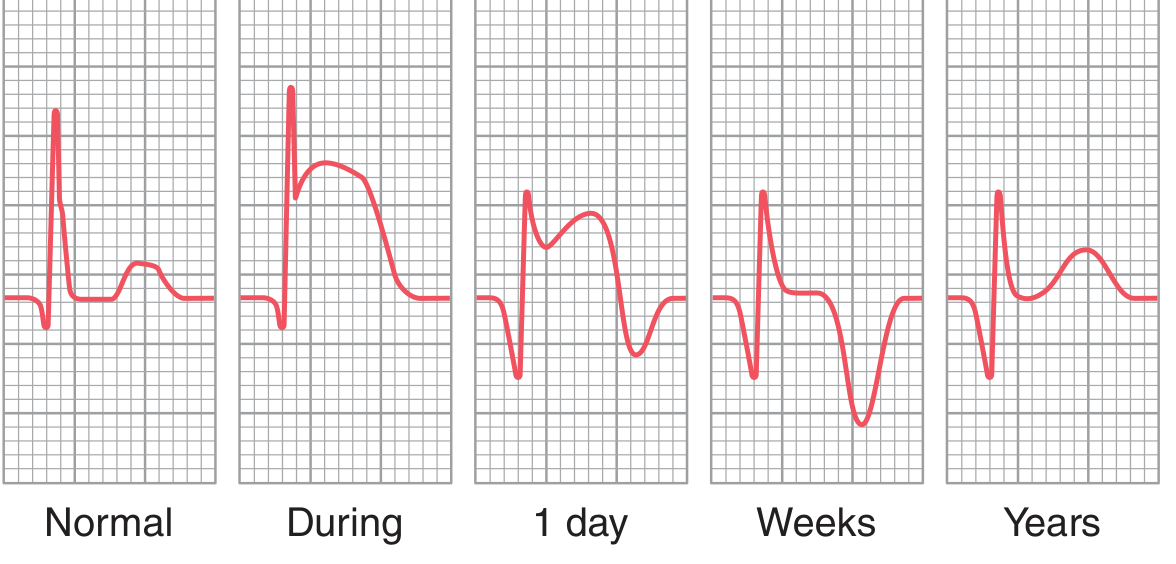
| Phase | Timing | ECG Change |
|---|---|---|
| Hyperacute | Minutes | Tall, broad, peaked T waves ("hyperacute T waves") |
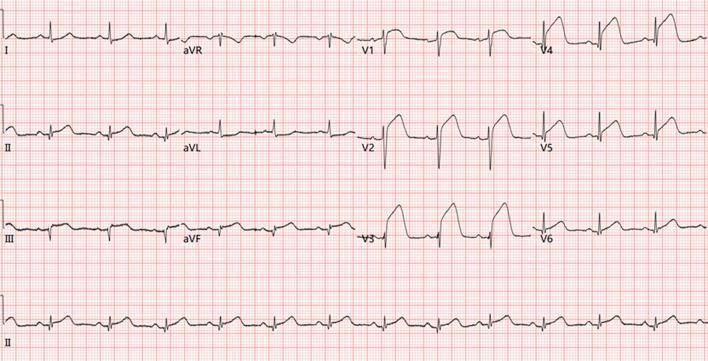
| Acute | Hours | ST elevation (convex/tombstone morphology) |
| Evolving | Hours–days | T-wave inversion; Q waves begin to appear |
| Chronic/Old | Weeks–years | Pathological Q waves persist; ST normalizes |
3. The Three Key Signs
A. ST-Segment Elevation (STEMI)
- ≥1 mm in ≥2 contiguous limb leads
- ≥2 mm in ≥2 contiguous precordial leads (V1–V6)
- Convex ("tombstone") morphology in severe cases
B. Pathological Q Waves
- Width ≥40 ms (1 small square) or depth ≥25% of the R wave
- Represent electrically silent necrotic myocardium — the dead tissue produces no electrical signal, so the opposite wall's depolarization dominates (away from the necrotic lead = Q wave)
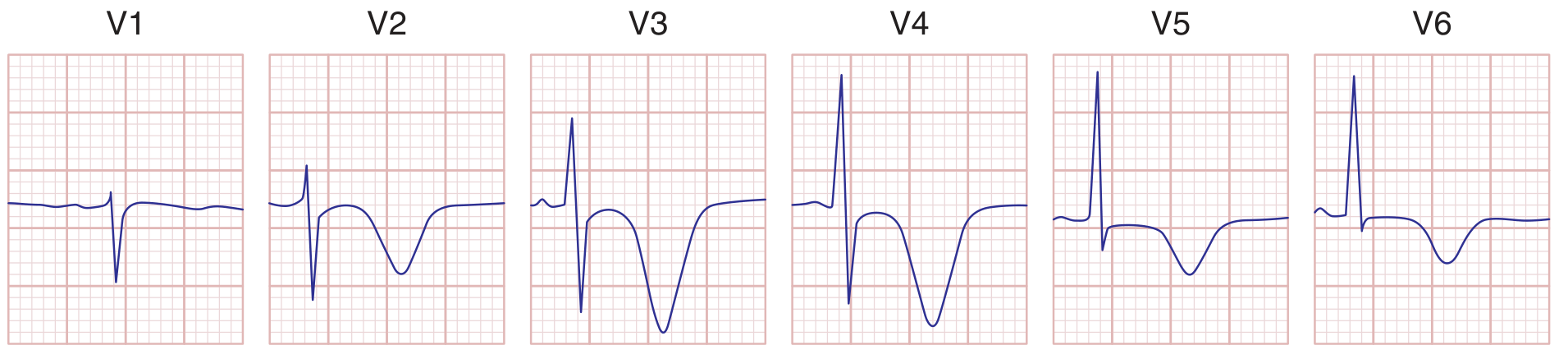
C. T-Wave Inversion
- Develops after ST elevation begins to resolve
- Deep symmetrical T-wave inversions in V1–V4 with minimal ST elevation = Wellens' sign (critical LAD stenosis)
4. Localizing the Infarct by Lead
| Territory | Culprit Artery | Leads with Changes |
|---|---|---|
| Anterior | LAD | V1–V4 |
| Anteroseptal | LAD (proximal) | V1–V3 |
| Lateral | LCx or diagonal | I, aVL, V5–V6 |
| Inferior | RCA (or LCx) | II, III, aVF |
| Posterior | RCA or LCx | Tall R wave in V1–V2; reciprocal ST depression V1–V3 |
| Right ventricular | Proximal RCA | ST elevation in right-sided leads (V3R–V4R) |
5. Reciprocal Changes
Reciprocal ST depression appears in leads electrically opposite to the infarcted territory. These are an important clue and increase diagnostic confidence:
- Inferior STEMI (ST ↑ in II, III, aVF) → reciprocal ST ↓ in I, aVL
- Anterior STEMI → reciprocal ST ↓ in II, III, aVF
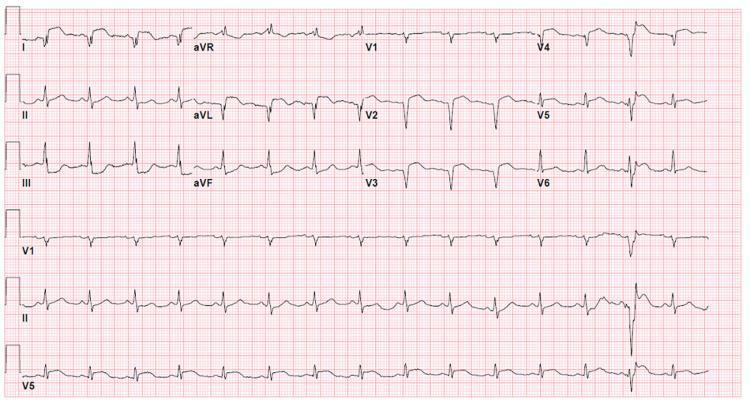
- Lateral STEMI → reciprocal ST ↓ in inferior leads
6. STEMI vs NSTEMI Classification
| Feature | STEMI | NSTEMI |
|---|---|---|
| ST elevation | Present (≥2 contiguous leads) | Absent |
| Q waves | Often develop | May or may not |
| Coronary occlusion | Usually total | Usually partial |
| Reperfusion urgency | Immediate (PCI/thrombolysis) | Risk-stratified |
| Troponin | Elevated | Elevated |
Note: Q-wave MI vs. non-Q-wave MI has been replaced by STEMI/NSTEMI in modern classification, as ECG-pathologic correlations are imperfect. MRI studies show Q wave development depends more on volume of infarcted tissue than transmurality. — Harrison's, 2025
7. Real 12-Lead Examples
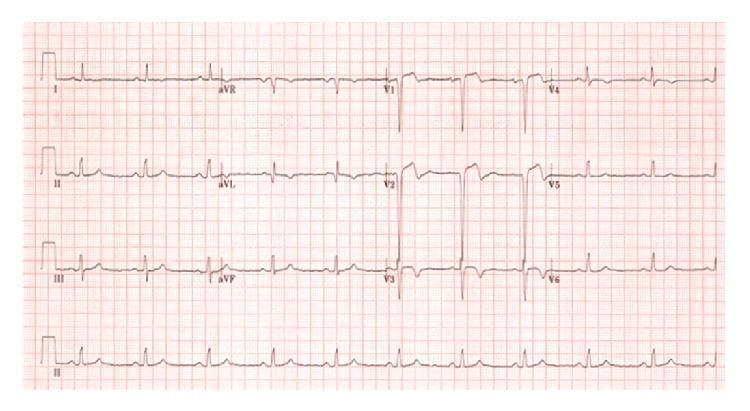
Massive STEMI — anterior + inferior involvement with tombstoning:
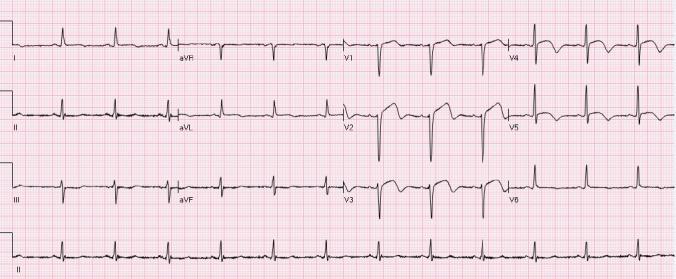
Acute lateral STEMI with reciprocal changes:
8. Important Limitations
The ECG has significant limitations:
- A single normal ECG does not exclude acute MI
- LBBB, ventricular pacing, and WPW can mask or mimic ischemic changes (Sgarbossa criteria help with LBBB)
- Posterior MI produces no Q waves in conventional leads — diagnosed by tall R in V1–V2 and reciprocal ST depression
- ST elevation can persist weeks after Q-wave MI → suggests ventricular wall motion disorder (not necessarily aneurysm)
Sources: Harrison's Principles of Internal Medicine 22E (2025), Ch. 247 & 286; Guyton and Hall Textbook of Medical Physiology, Ch. 12
Yes
Could you clarify what you mean by "Yes"? Are you:
- Confirming the information was helpful and want to continue on a related topic?
- Asking me to go deeper into a specific section (e.g., STEMI localization, Wellens' sign, LBBB masking)?
- Moving on to a different ECG topic?
Show me with ecg strip
Searching Images
ECG strip ST elevation myocardial infarction STEMI anterior inferior
Searching Images
ECG strip pathological Q wave T wave inversion myocardial infarction evolution
Loading Image
Loading Image
Loading Image
Loading Image
Loading Image
Here are real ECG strips showing each key MI pattern:
🫀 ECG Strips: MI Findings
1. Inferolateral STEMI (Acute Phase)
ST elevation in II, III, aVF + V4–V6 (green circles) with reciprocal ST depression in I, aVL, V2–V3 (yellow arrows)
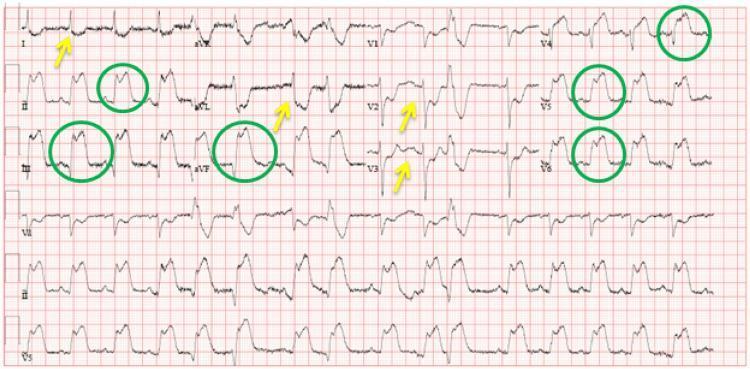
What to see: Convex ST elevation inferolaterally + reciprocal depression anteriorly. Culprit: RCA or LCx
2. Inferior STEMI (Acute Phase)
ST elevation in II, III, aVF with reciprocal ST depression in V1–V6 and aVL
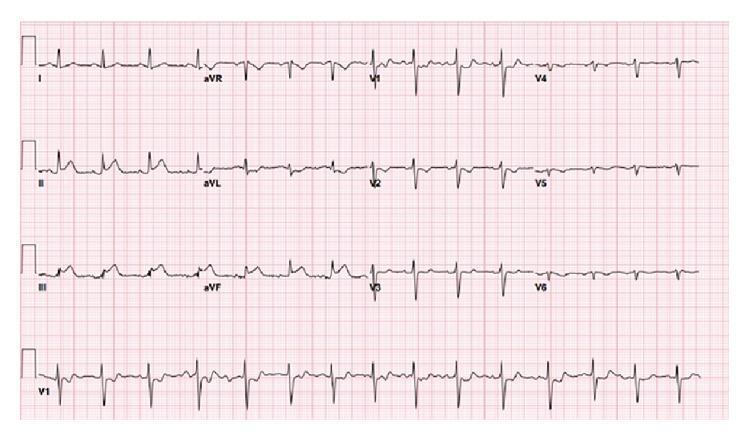
What to see: Classic inferior ST elevation + anterior reciprocal depression. Culprit: RCA
3. Anterior STEMI (LAD Occlusion)
Tombstone ST elevation V1–V6 with reciprocal ST depression in II, III, aVF
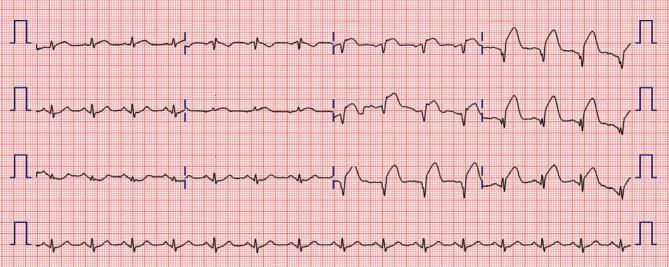
What to see: Extensive precordial tombstoning — highest risk pattern. Culprit: proximal LAD
4. Post-Reperfusion / Evolving MI (Subacute Phase — 12 hrs post-PCI)
Pathological Q waves in II, III, aVF + deep symmetrical T-wave inversions V2–V6
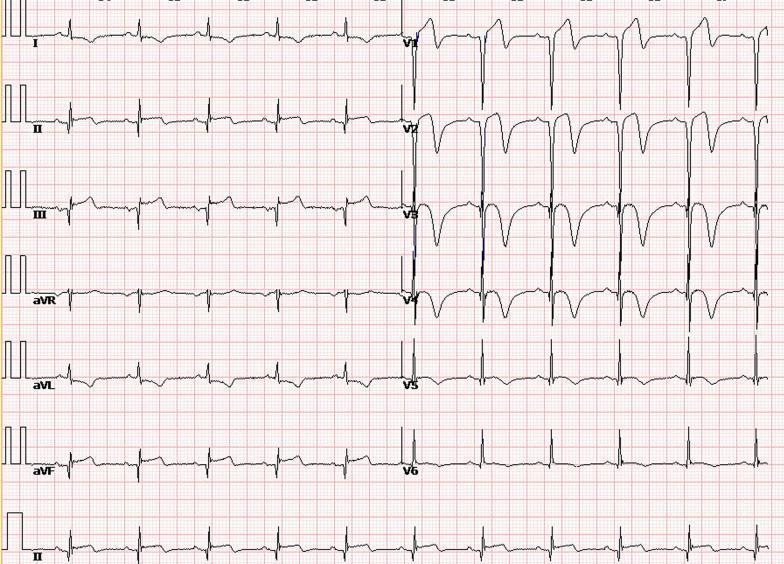
What to see: ST elevation has resolved → now shows Q waves (necrosis) + T inversions (reperfusion/evolving). This is the subacute phase.
5. Old/Subacute Inferior MI with Posterior Extension
Q waves + T inversions in II, III, aVF; tall R wave + ST depression in V1–V3 (posterior MI pattern)
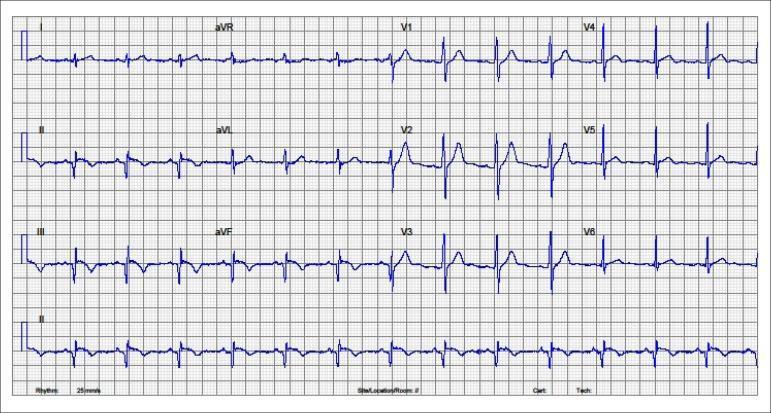
What to see: Posterior MI is a "silent" territory — no Q waves in standard leads; instead look for tall R + ST ↓ in V1–V3 as a reciprocal mirror image.
Quick Summary Table
| ECG Strip | Territory | Key Finding | Culprit Artery |
|---|---|---|---|
| Strip 1 | Inferolateral | ST ↑ II/III/aVF/V4–V6 + reciprocal ↓ I/aVL | RCA or LCx |
| Strip 2 | Inferior | ST ↑ II/III/aVF + widespread reciprocal ↓ | RCA |
| Strip 3 | Anterior | Tombstone ST ↑ V1–V6 | Proximal LAD |
| Strip 4 | Evolving (post-PCI) | Q waves + deep T inversions | Any |
| Strip 5 | Inferior + Posterior | Q waves + tall R/ST ↓ in V1–V3 | RCA |
This is a shared conversation. Sign in to Orris to start your own chat.