
Malaria
Reading File
The query is broad - "Malaria" could mean many things. Let me clarify before proceeding.
Asking for Preferences
What aspect of malaria are you looking for?
The user skipped - I'll provide a comprehensive overview covering all major aspects of malaria. Let me search the medical library and recent literature in parallel.
Finding Sources
Searching PubMed
"malaria"[MeSH Terms] AND treatment
Searching the Web
malaria overview pathophysiology clinical features treatment 2025
Good results. Robbins & Kumar Basic Pathology is the best primary source. Let me read the malaria section from there, and also pull from the Respiratory Medicine textbook and Emergency Medicine textbook in parallel.
Reading File
Reading File
Excellent content retrieved. Let me now read the remaining sections from Robbins (treatment/morphology) and also fetch the life cycle diagram image.
Reading File
Reading File
Loading Image
I now have comprehensive content from the textbooks along with the life cycle diagram. Let me also read the morphology/complications section from Robbins that I may have missed.
Reading File
I now have comprehensive, well-sourced content. Let me compile the full answer.
Malaria
Overview
Malaria is a protozoan disease caused by Plasmodium species, transmitted through the bite of female Anopheles mosquitoes. It remains one of the most serious infectious diseases globally - the WHO estimated over 200 million cases and more than 600,000 deaths in 2020, with the vast majority occurring in sub-Saharan Africa, primarily in children. - Robbins & Kumar Basic Pathology
Causative Species
Five Plasmodium species infect humans:
| Species | Fever Cycle | Severity | Notes |
|---|---|---|---|
| P. falciparum | Every 48 hrs (tertian) | Most severe - high fatality | Responsible for cerebral malaria; near-universal chloroquine resistance |
| P. vivax | Every 48 hrs (tertian) | Mild-moderate | Has liver hypnozoites; infects only reticulocytes |
| P. ovale | Every 48 hrs | Mild | Has liver hypnozoites |
| P. malariae | Every 72 hrs (quartan) | Mild | Associated with nephrotic syndrome |
| P. knowlesi | Every 24 hrs | Virulent - can be fatal | Simian malaria (Southeast Asia); morphologically resembles P. malariae |
All humans are the only natural reservoir. - Murray & Nadel's Respiratory Medicine
Life Cycle & Pathogenesis
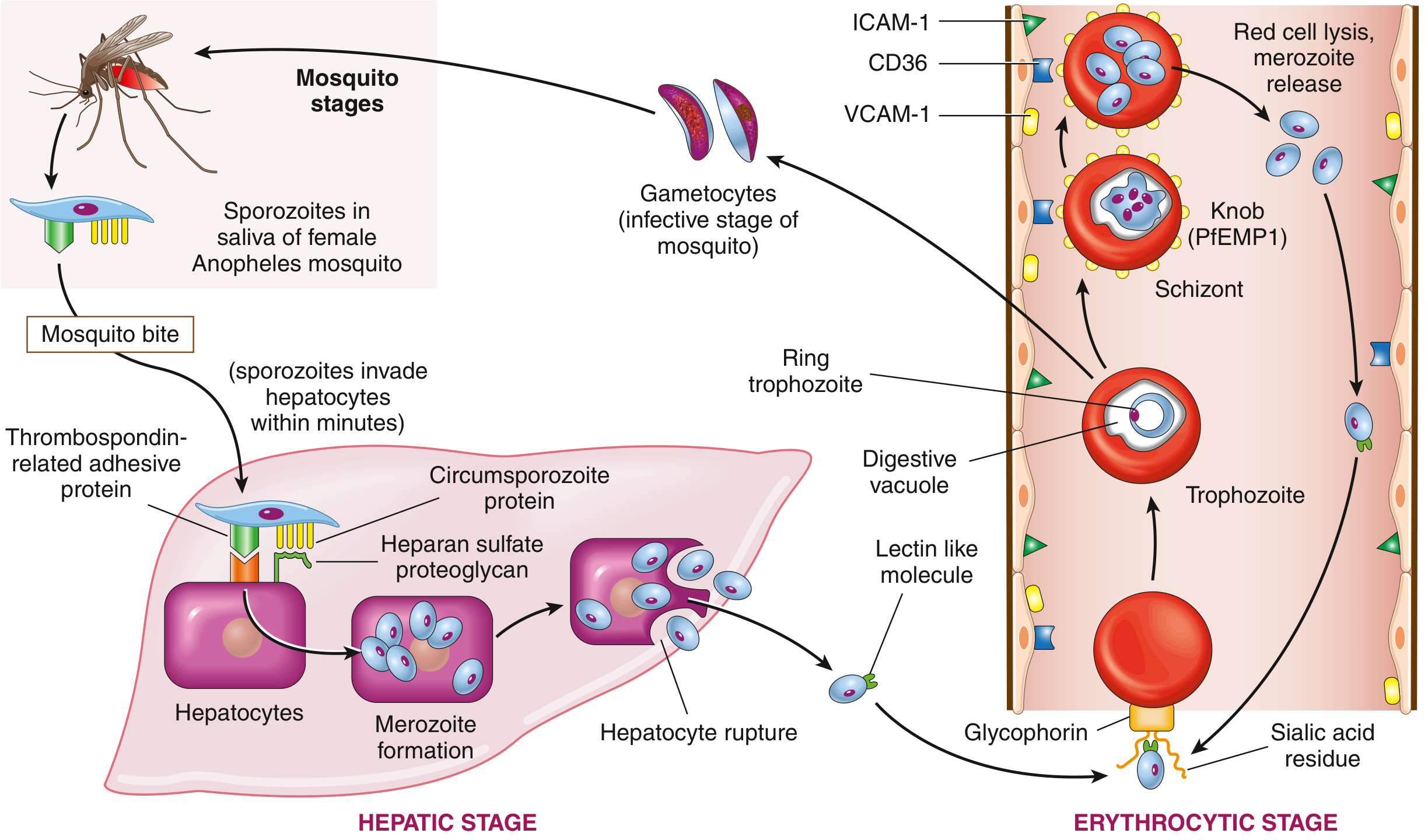
Hepatic (pre-erythrocytic) stage - clinically silent:
- Infected Anopheles mosquito injects sporozoites into the bloodstream
- Two surface proteins - thrombospondin-related adhesive protein and circumsporozoite protein - bind heparan sulfate proteoglycans on hepatocytes
- Sporozoites enter hepatocytes and differentiate into merozoites (incubation: 1-4 weeks)
- Infected hepatocytes rupture, releasing merozoites into blood
- In P. vivax and P. ovale, some sporozoites remain dormant as hypnozoites in the liver (responsible for relapses months to years later)
Erythrocytic stage - causes clinical disease:
- A lectin-like molecule on merozoites binds sialidated glycophorin on red cells, allowing entry into a digestive vacuole
- Intraerythrocytic organisms become trophozoites, then differentiate into:
- Gametocytes - restart the cycle in the mosquito
- Schizonts - express PfEMP1 (Plasmodium falciparum erythrocyte membrane protein 1) as knob-like extensions on the RBC surface
- PfEMP1 binds ICAM-1, VCAM-1, and CD36 on endothelium, causing parasitized RBCs to sequester in capillary beds - this is the key mechanism of severe disease
- Schizonts eventually lyse RBCs, releasing merozoites in "showers," causing paroxysmal fever
- Robbins & Kumar Basic Pathology
Morphology & Pathological Changes
- Hemolytic anemia - destruction of infected (and uninfected) RBCs
- Hematin (malarial pigment) - brown pigment derived from hemoglobin degradation; deposits in spleen, liver, lymph nodes, bone marrow
- Splenomegaly - often massive, due to hyperplasia of mononuclear phagocytes; occasional hepatomegaly
- Cerebral malaria - small brain vessels engorged and occluded by PfEMP1-adherent parasitized RBCs - Robbins & Kumar Basic Pathology
Clinical Features
Classic presentation:
- Episodic shaking chills and fever coinciding with merozoite release ("malarial paroxysm")
- Every 24 hrs: P. knowlesi
- Every 48 hrs: P. vivax, P. ovale, P. falciparum
- Every 72 hrs: P. malariae
- Note: periodic fever is unreliable, especially in P. falciparum
- Hemolytic anemia (universal)
- Headache, myalgia, malaise, nausea
Features of severe malaria (P. falciparum):
- Cerebral malaria - convulsions, coma, rapid deterioration (death within days-weeks)
- Blackwater fever - massive intravascular hemolysis, hemoglobinemia, hemoglobinuria, jaundice, renal failure
- Thrombocytopenia
- Acute kidney injury
- Acute lung injury / ARDS - diffuse bilateral opacities on CXR; can occur even after several days of treatment; noncardiogenic pulmonary edema
- Multiorgan failure (especially in non-immune patients)
- Hypoglycemia
High-risk groups: children, pregnant women, non-immune travelers - Murray & Nadel's Respiratory Medicine
Genetic Protection
Malaria has exerted profound evolutionary selective pressure on humans. Erythrocyte defects most prevalent in malaria-endemic regions include:
-
Sickle cell trait (HbAS) - protects against severe falciparum malaria
-
Thalassemia
-
G6PD deficiency
-
Pyruvate kinase deficiency
-
Murray & Nadel's Respiratory Medicine
Diagnosis
| Method | Notes |
|---|---|
| Thick blood smear (gold standard) | Detects presence of parasites; repeat after 8 hours if initial smear negative |
| Thin blood smear | Species identification by morphology |
| Rapid Diagnostic Test (RDT) | Point-of-care antigen detection; available for P. falciparum and P. vivax; antigen can persist after infection, reducing specificity |
| PCR | Reference labs only; not commercially available |
-
Only ring forms of P. falciparum are seen in peripheral blood (mature forms sequester in microvasculature)
-
Parasitemia >10% = sign of severe disease
-
P. vivax parasitemias are lower (infects reticulocytes only)
-
Murray & Nadel's Respiratory Medicine
Treatment
Uncomplicated malaria:
- P. vivax, P. ovale, P. malariae, P. knowlesi: Chloroquine (still effective)
- P. falciparum: Artemisinin-based Combination Therapy (ACT) - P. falciparum is nearly universally chloroquine-resistant
- P. vivax / P. ovale: Add primaquine (after checking G6PD status) to eliminate liver hypnozoites and prevent relapse
Severe malaria:
- IV artesunate - treatment of choice (as of 2019 in the US, available via CDC Malaria Hotline: 855-856-4713)
- IV quinine is still used outside the US
- Artesunate resistance is an emerging problem, particularly in Southeast Asia (manifested by slower parasite clearance)
Supportive care:
-
Careful fluid balance (prevent pulmonary edema)
-
Correction of hypoglycemia
-
Oxygenation support
-
Antibiotics if concurrent bacterial sepsis
-
Exchange transfusion is no longer recommended (insufficient evidence)
-
Murray & Nadel's Respiratory Medicine
Prevention
- Insecticide-treated bed nets (ITNs)
- Antimalarial prophylaxis for travelers (options: atovaquone-proguanil, doxycycline, mefloquine, chloroquine in sensitive areas)
- Larval control - removal of stagnant water (mosquito breeding sites)
- RTS,S/AS01 vaccine (Mosquirix) - contains sporozoite antigens; partial protection; approved by WHO for use in children in sub-Saharan Africa; expected to prevent thousands of fatal cerebral malaria cases
- A history of prophylaxis does not rule out malaria; subtherapeutic levels or resistant organisms can still cause disease - Robbins & Kumar Basic Pathology
Key Summary Points
| Feature | P. falciparum | P. vivax / P. ovale | P. malariae | P. knowlesi |
|---|---|---|---|---|
| Fever cycle | 48 hrs | 48 hrs | 72 hrs | 24 hrs |
| Relapse from hypnozoites | No | Yes | No | No |
| Chloroquine sensitivity | Resistant | Sensitive | Sensitive | Sensitive |
| Key complication | Cerebral malaria, ARDS | Relapsing fever | Nephrotic syndrome | Severe disease |
| Treatment | ACT + IV artesunate (severe) | Chloroquine + primaquine | Chloroquine | Chloroquine |
This is a shared conversation. Sign in to Orris to start your own chat.