
Dental abscess rdiology interpretation
Reading File
Now let me search the library for dental abscess radiology content in parallel:
Finding Sources
Finding Sources
Finding Sources
Searching Images
dental abscess periapical radiograph radiolucency
Good. Now let me get more detailed content from the textbooks and fetch the best images:
Finding Sources
Finding Sources
Loading Image
Loading Image
Let me get the full textbook content and fetch more images:
Reading File
Reading File
Loading Image
Loading Image
Now let me fetch the key textbook radiograph images from Tintinalli's and search for additional content on CBCT and advanced imaging:
Loading Image
Loading Image
Finding Sources
Finding Sources
I now have comprehensive content. Let me compile a thorough, well-illustrated answer.
Dental Abscess — Radiology Interpretation
Pathogenesis & Radiological Background
A dental (odontogenic) abscess typically begins with bacterial invasion from dental caries → pulp → periapical tissues. The radiological changes reflect progressive bone destruction driven by infection.
Radiographic Modalities
| Modality | Role |
|---|---|
| Intraoral periapical (IOPA) | First-line; best detail of root apex and periapical bone |
| Bitewing | Detects interproximal caries and bone height; poor apex visualization |
| Panoramic (OPG/Panorex) | Surveys all teeth; poor sensitivity for early periapical disease |
| CBCT | Gold standard for 3D extent, cortical perforation, proximity to vital structures |
| CT (soft tissue) | Evaluates spread into deep fascial spaces (Ludwig's angina, cellulitis) |
A panorex is not typically useful for periradicular periodontitis but can be important in identifying other painful osseous pathology. — Tintinalli's Emergency Medicine
Stage-by-Stage Radiographic Features
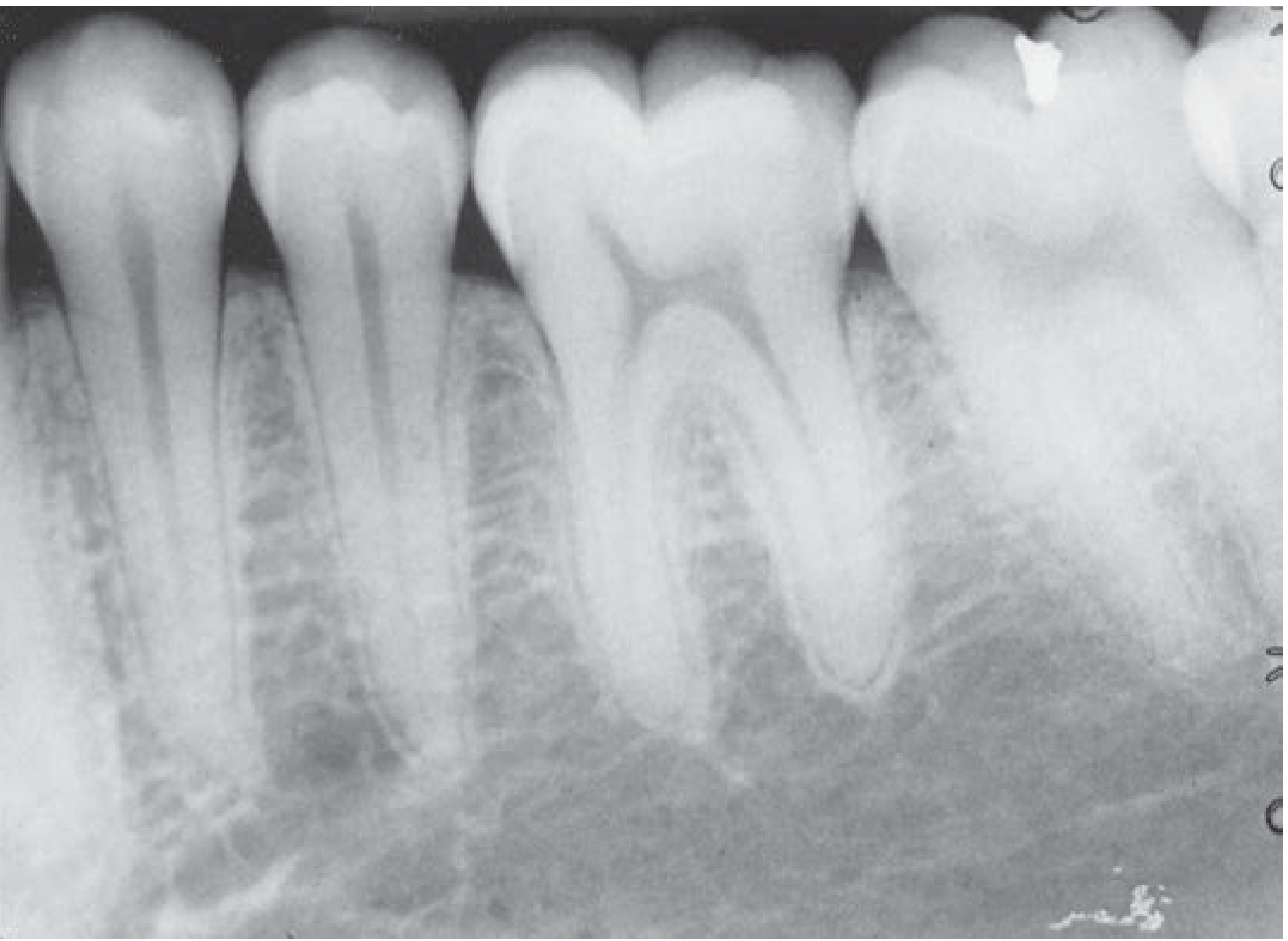
1. Normal Anatomy (Reference)
Before recognizing pathology, understand the normal landmarks:
- Lamina dura: thin radiopaque line lining the tooth socket — intact, sharp, and continuous
- Periodontal ligament (PDL) space: thin, uniform radiolucent line (0.2–0.3 mm) around the root
- Trabecular bone: normal honeycomb pattern
2. Early Periradicular Periodontitis (Acute)
The earliest radiographic signs are subtle and may be absent in acute abscess (pus can form before bone is destroyed):
- Slight widening of the PDL space at the apex
- Thinning or loss of lamina dura at the root tip
- May appear completely normal in the first 48–72 hours
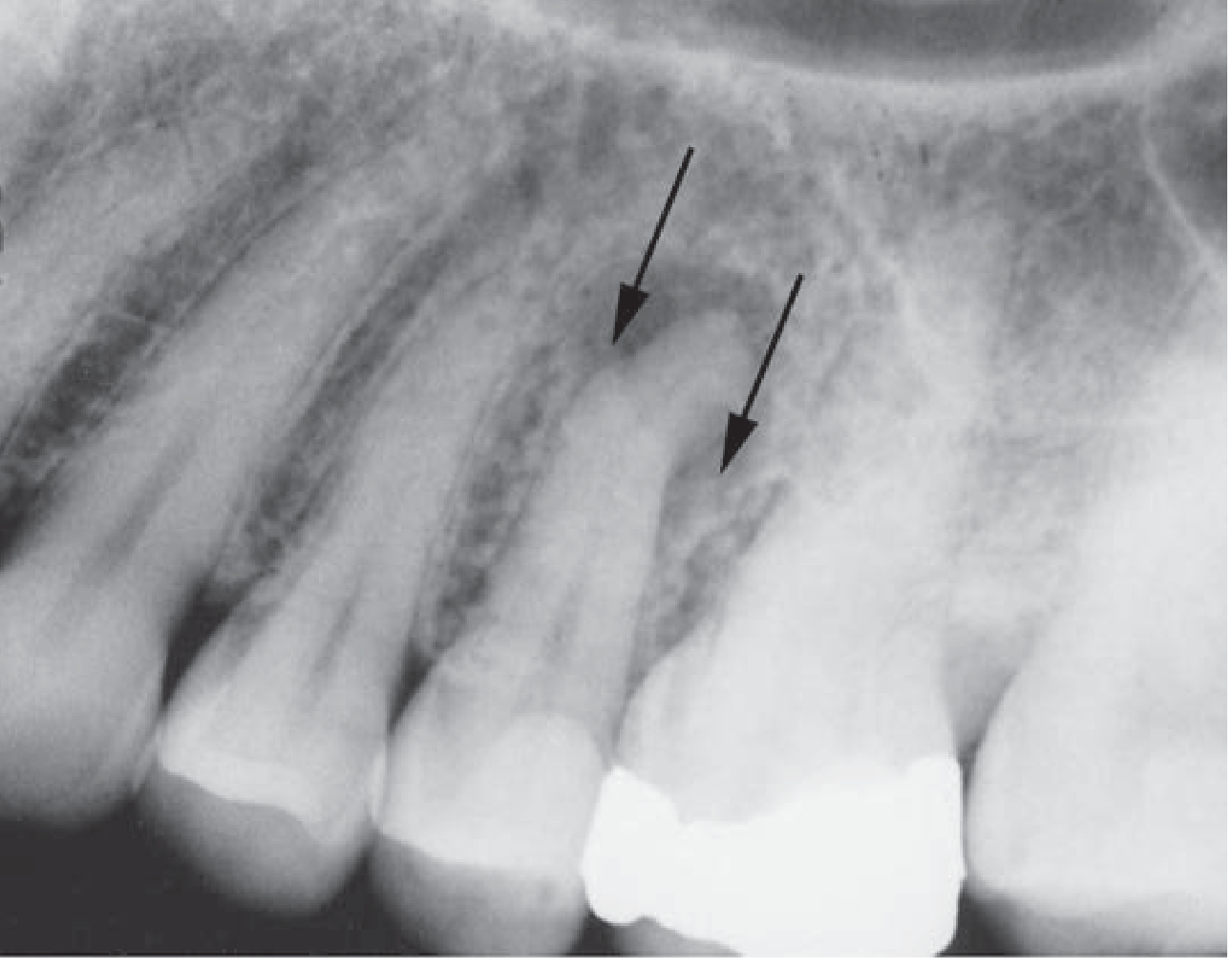
3. Established Periapical Abscess / Granuloma / Cyst
As infection progresses and becomes chronic, a well-defined lesion develops:
| Feature | Abscess | Granuloma | Radicular Cyst |
|---|---|---|---|
| Shape | Diffuse/irregular | Round/oval | Round, well-defined |
| Borders | Ill-defined, non-corticated | Well-defined | Corticated (white border) |
| Size | Variable | Usually <1 cm | Often >1 cm |
| Location | Root apex | Root apex | Root apex |
| Density | Radiolucent | Radiolucent | Radiolucent |
All three are radiographically indistinguishable in many cases — clinical context, symptoms, and histopathology are needed for definitive differentiation. — Tintinalli's Emergency Medicine
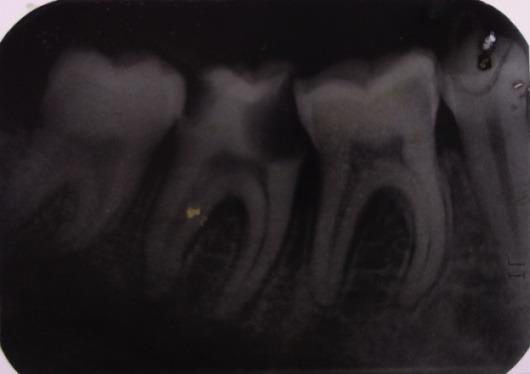
4. Example: Mandibular Molar with Periapical Pathology
5. Example: Anterior Teeth — Chronic Periapical Abscess
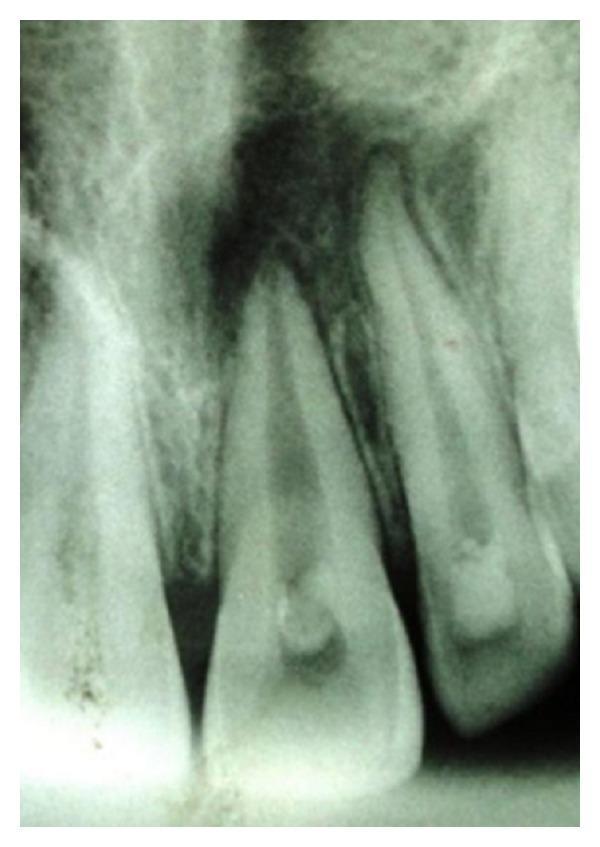
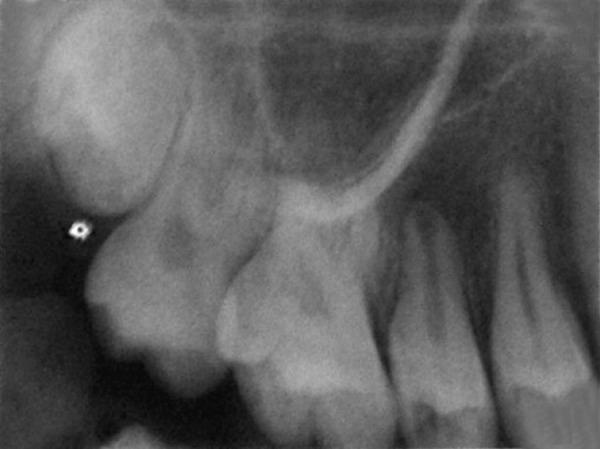
6. Sinus Tract (Parulis) — Pathognomonic Sign
A gutta-percha point inserted into a sinus tract and then radiographed traces the tract directly to the offending root apex — this is a pathognomonic finding confirming the source tooth.
Key Radiographic Signs — Summary
| Sign | Significance |
|---|---|
| Widened PDL space at apex | Earliest indicator of periapical disease |
| Loss/interruption of lamina dura | Bone resorption at socket wall |
| Periapical radiolucency | Established periapical pathology (abscess, granuloma, or cyst) |
| Ill-defined radiolucency | Favors active/acute abscess |
| Well-corticated radiolucency | Favors cyst (chronic process) |
| Furcation radiolucency | Advanced infection; pulp floor perforation |
| Cortical bone destruction | Spreading abscess; may indicate osteomyelitis |
| Gutta-percha tracing to apex | Confirms source tooth via sinus tract |
Complications to Look For on Radiographs
As stated in Harrison's Principles of Internal Medicine 22E: "A periapical abscess can erode into the alveolar bone, producing osteomyelitis; penetrate and drain through the gingivae, producing a parulis (gum-boil); or track along deep fascial planes, producing virulent cellulitis (Ludwig's angina)."
On radiograph/CT look for:
- Diffuse bone destruction or "moth-eaten" pattern → osteomyelitis
- Cortical perforation → soft tissue extension (best seen on CBCT or CT)
- Maxillary sinus haziness/mucosal thickening → odontogenic sinusitis (upper premolars/molars)
- Mandibular canal proximity → inferior alveolar nerve involvement
Practical Tip: Acute vs. Chronic
- Acute abscess: May show no radiographic changes or only minimal PDL widening. Clinical signs (pain, swelling, fever) drive diagnosis.
- Chronic abscess/granuloma: Well-established periapical radiolucency; patient may be asymptomatic (incidental finding on routine radiograph).
Sources: Tintinalli's Emergency Medicine, Ch. 245; Harrison's Principles of Internal Medicine 22E, Ch. 304.
This is a shared conversation. Sign in to Orris to start your own chat.