
brainstem all physiology according to guyton and hall book
Reading File
Finding Sources
Finding Sources
Finding Sources
Finding Sources
Finding Sources
Reading File
Reading File
Reading File
Finding Sources
Finding Sources
Reading File
Finding Sources
Finding Sources
Finding Sources
Reading File
Reading File
I now have comprehensive content from Guyton & Hall covering all the major brainstem physiology topics. Let me compile the complete answer.
Brainstem Physiology — Guyton & Hall Textbook of Medical Physiology
1. Overview of the Brainstem
The brainstem consists of the medulla oblongata, pons, and mesencephalon (midbrain). It functions as:
- An extension of the spinal cord — containing motor and sensory nuclei for the face and head
- An independent master center for vital functions:
- Control of respiration
- Control of the cardiovascular system
- Partial control of gastrointestinal function
- Control of stereotyped body movements
- Control of equilibrium
- Control of eye movements
- A relay station ("way station") for command signals from higher neural centers
— Guyton & Hall, Chapter 56
2. Motor Control by the Brainstem
Reticular Nuclei — Support Against Gravity
The reticular nuclei are divided into two antagonistic groups (Fig. 56.7):
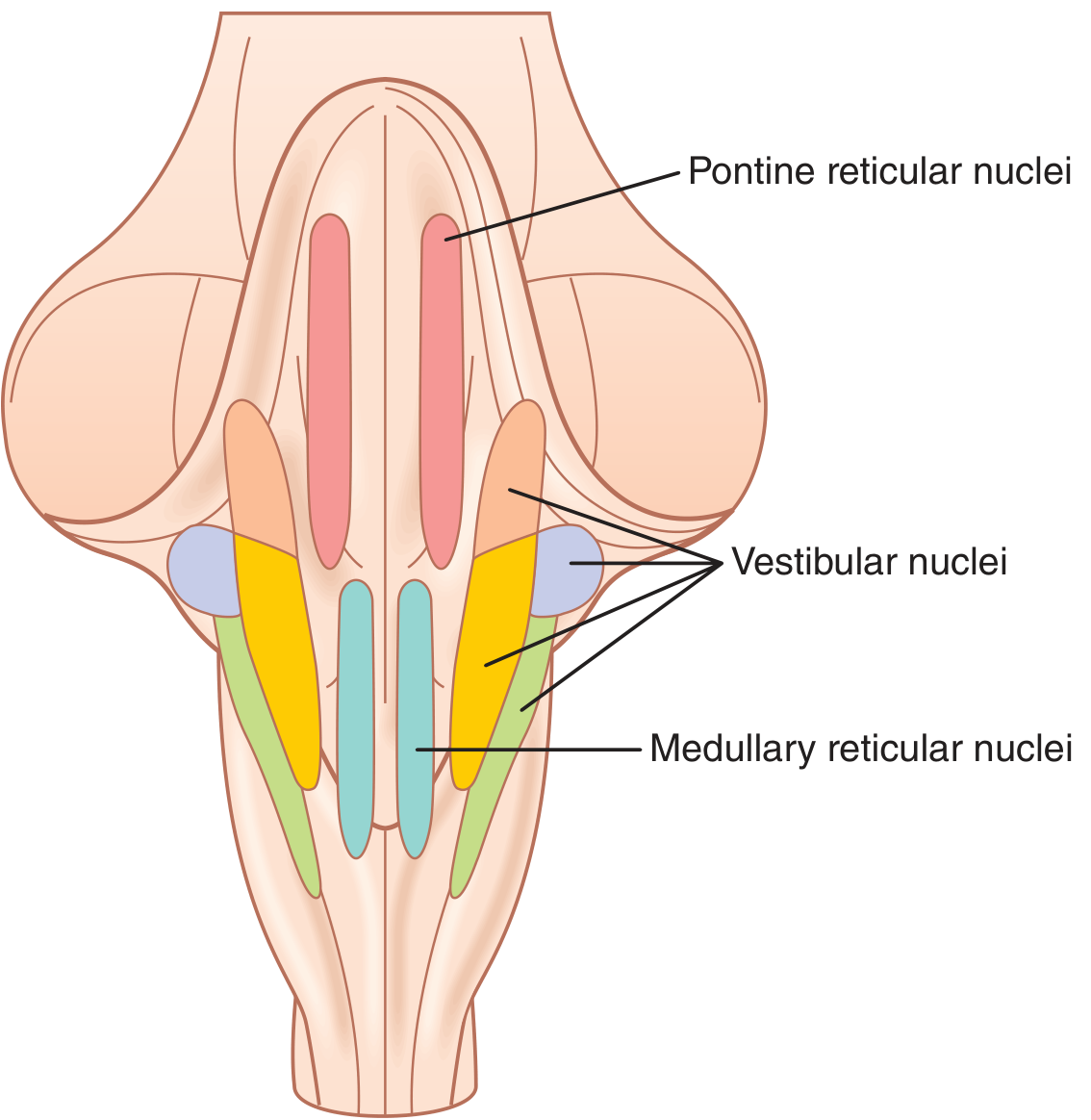
Pontine Reticular Nuclei (located slightly posteriorly and laterally in the pons, extending into the mesencephalon):
- Have high natural excitability
- Receive strong excitatory signals from vestibular nuclei and deep cerebellar nuclei
- Transmit excitatory signals via the pontine reticulospinal tract (anterior column of cord) → medial anterior motor neurons → axial muscles (vertebral column + limb extensors)
- Function: antigravity support
Medullary Reticular Nuclei (extend through the medulla, ventrally and medially near midline):
- Transmit inhibitory signals via the medullary reticulospinal tract (lateral column) → same antigravity muscles
- Function: relax antigravity muscles
This pontine-medullary antagonism allows fine-tuned postural control.
Vestibular Nuclei
The vestibular nuclei work in concert with reticular nuclei:
- Lateral vestibulospinal tract → strongly excites antigravity muscles (extensor tone)
- Medial vestibulospinal tract → controls neck and upper body posture
- When the reticular system is damaged, excitation from vestibular nuclei produces decerebrate rigidity (extreme antigravity muscle contraction)
A Reticular Inhibitory Area in the Lower Brainstem
Located medially and ventrally in the medulla — this area can inhibit the upper brainstem reticular facilitatory area by exciting serotonergic neurons, which release serotonin at key brain sites, dampening overall brain excitability. (Chapter 59)
3. Control of Equilibrium
The vestibular apparatus detects head orientation and transmits signals to:
- Vestibular nuclei in the brainstem
- Cerebellum (flocculonodular lobe = vestibulocerebellum)
Role of brainstem in equilibrium:
- Signals from vestibular nuclei travel upward via the medial longitudinal fasciculus → cause corrective eye movements (vestibulo-ocular reflex) so eyes remain fixed on objects during head rotation
- Signals also pass via reticular tracts to the parietal cortex (deep in sylvian fissure) to inform the psyche about body equilibrium status
- The vestibulocerebellum functions in association with the brainstem and spinal cord to control equilibrium and postural movements
4. Stereotyped Movements Controlled by the Brainstem
Anencephalic babies (with no brain structures above the mesencephalon) demonstrate that the brainstem alone can integrate:
- Suckling and swallowing
- Extrusion of unpleasant food
- Hand-to-mouth movements
- Yawning and stretching
- Crying
- Tracking objects with eyes and head
- Sitting-posture responses
This confirms the brainstem as the integration center for basic stereotyped motor functions.
5. Respiratory Center (Medulla + Pons)
The respiratory center is composed of bilaterally distributed neuron groups in the medulla and pons:
Dorsal Respiratory Group (DRG)
- Located in the dorsal medulla (nucleus tractus solitarius, NTS)
- Mainly drives INSPIRATION
- Generates the basic rhythm of respiration (repetitive inspiratory burst discharges)
- Receives sensory input from peripheral chemoreceptors, baroreceptors, and lung receptors via vagus and glossopharyngeal nerves
- The pre-Bötzinger complex (rostral ventral respiratory group) contains spontaneously firing pacemaker neurons → projects to DRG and VRG → is the key respiratory central pattern generator
Ventral Respiratory Group (VRG)
- Located in the ventrolateral medulla
- Contains both inspiratory and expiratory neurons
- Quiescent during quiet breathing; activated when increased ventilatory demand is needed (forceful expiration or heavy exercise)
Pneumotaxic Center
- Located dorsally in the superior pons
- Limits duration of inspiration → increases respiratory rate
- Signals transmitted continuously to the DRG to switch off the inspiratory ramp signal
- Stronger signals = shorter inspiration = higher respiratory rate
- In its absence, breathing becomes slow and deep (apneusis)
Control of Respiratory Center Activity
| Stimulus | Mechanism | Effect |
|---|---|---|
| ↑ CO₂ / ↑ H⁺ | Direct stimulation of central chemoreceptors near medullary surface | ↑ rate and depth of breathing |
| ↓ O₂ | Peripheral chemoreceptors (carotid/aortic bodies) → NTS → DRG | ↑ ventilation |
| Lung stretch (Hering-Breuer reflex) | Pulmonary stretch receptors → vagus → NTS | Terminate inspiration when lungs over-inflated |
| Cerebral cortex/hypothalamus | Higher center override | Voluntary breath-holding, emotional breathing changes |
6. Vasomotor Center (Cardiovascular Control)
Located bilaterally in the reticular substance of the medulla and lower third of the pons, the vasomotor center regulates blood pressure and flow.
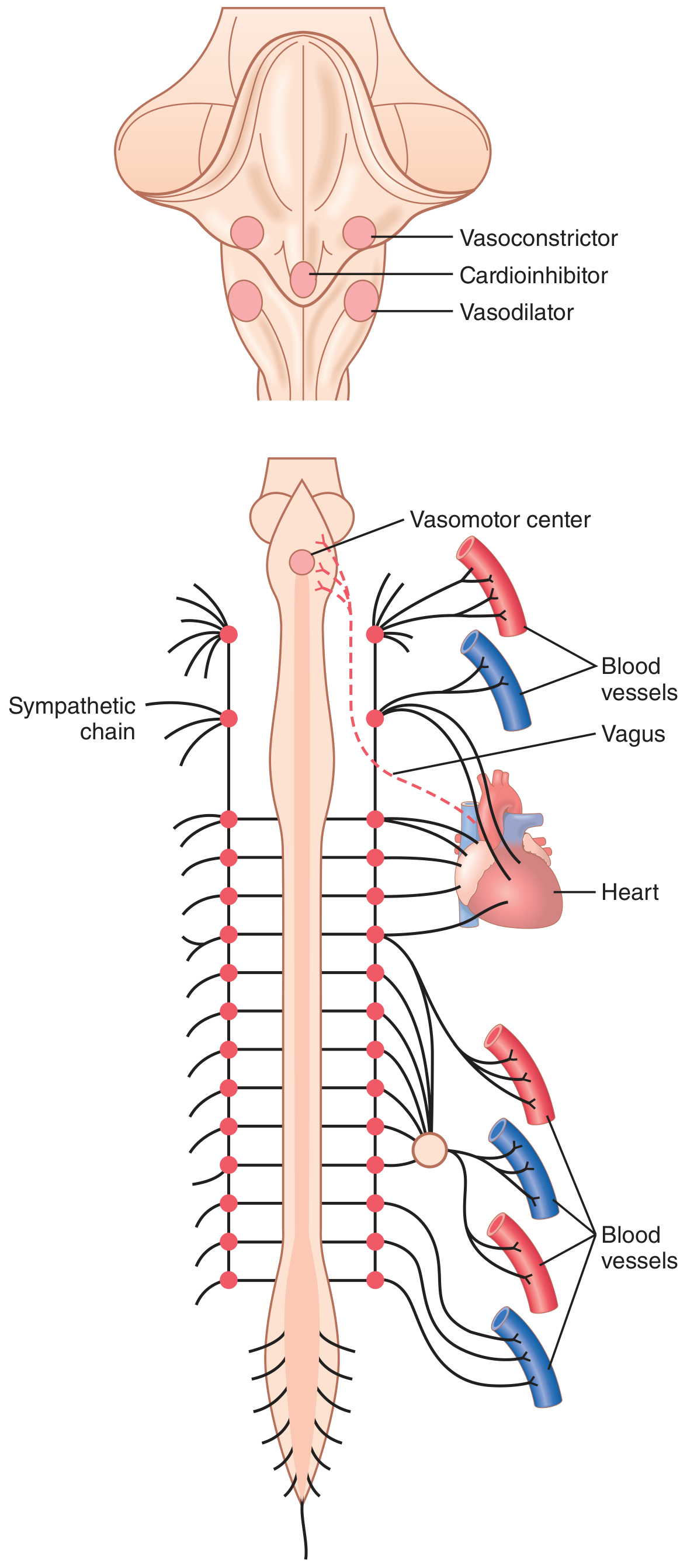
It has three functional areas:
-
Vasoconstrictor area — bilaterally in the anterolateral upper medulla
- Neurons project to all spinal cord levels → excite preganglionic sympathetic vasoconstrictor neurons → vasoconstriction of arteries and veins
-
Vasodilator area — bilaterally in the anterolateral lower medulla
- Projects upward to the vasoconstrictor area → inhibits it → causes vasodilation
-
Sensory area — bilaterally in the nucleus tractus solitarius (posterolateral medulla and lower pons)
- Receives input from baroreceptors, chemoreceptors (via vagus and glossopharyngeal nerves)
- Modulates the vasoconstrictor and vasodilator areas via baroreceptor reflex
Transmission: The vasomotor center transmits:
- Parasympathetic impulses through the vagus nerve to the heart
- Sympathetic impulses through the spinal cord to all arteries, arterioles, and veins
CO₂/Ischemia response: When blood flow to the brainstem vasomotor center is reduced (ischemia) or CO₂ rises locally, the center becomes extremely active — producing intense sympathetic vasoconstriction (CNS ischemic response) to restore blood pressure.
Respiratory-cardiovascular coupling: Breathing signals from the medullary respiratory center spill into the vasomotor center each cycle → causing respiratory waves in arterial pressure (pressure rises during inspiration, falls during expiration).
7. Brainstem and Sleep/Arousal (Reticular Activating System)
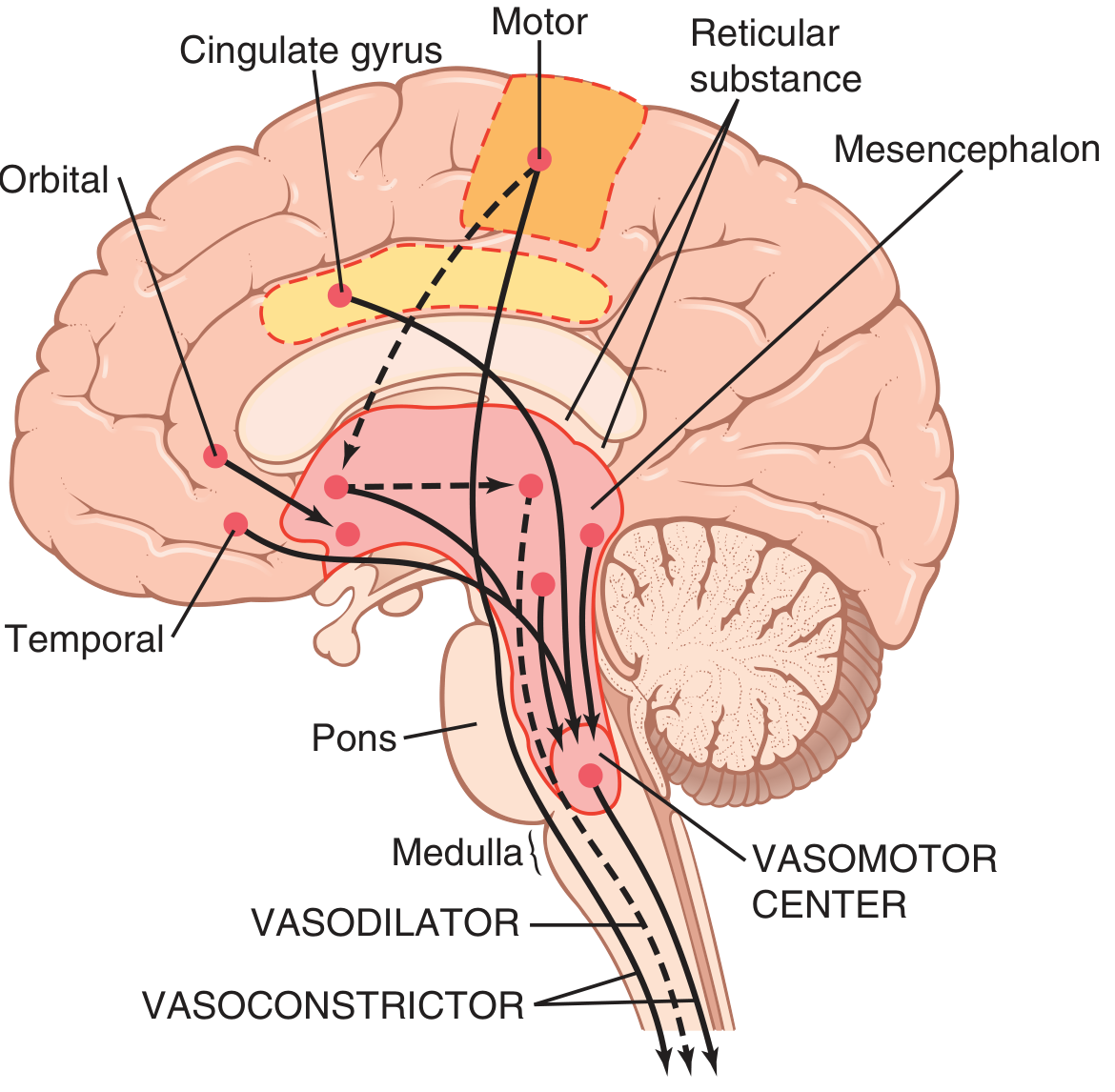
Bulboreticular Facilitatory Area (Excitatory)
- Located in the upper brainstem reticular formation (pons and mesencephalon)
- Sends continuous excitatory signals to the cerebral cortex → maintains wakefulness and arousal
- Also receives feedback from the cerebral cortex (positive feedback loop): cortical activity → signals to brainstem excitatory area → more cortical excitation → sustains the awake mind
Reticular Inhibitory Area
- Located medially and ventrally in the medulla
- Inhibits the facilitatory area by exciting serotonergic neurons → serotonin secretion at key brain sites → inhibition → promotes sleep
Neurohormonal Systems Originating in the Brainstem
| System | Origin | Neurotransmitter | Effect |
|---|---|---|---|
| Norepinephrine | Locus ceruleus (pons-mesencephalon junction) | Norepinephrine | Widespread excitation; promotes wakefulness, attention |
| Dopamine | Ventral tegmental area / substantia nigra | Dopamine | Excitatory in some areas, inhibitory in others; mainly to basal ganglia |
| Serotonin | Raphe nuclei (midline brainstem) | Serotonin | Generally inhibitory; promotes sleep, dampens pain |
| Acetylcholine | Brainstem tegmentum | Acetylcholine | REM sleep generation; cortical arousal |
The locus ceruleus norepinephrine system spreads to virtually every area of the brain. The serotonin and dopamine systems are directed to more specific regions.
8. Brainstem Control of Autonomic Functions (Higher Regulation)
Higher brain centers (hypothalamus, limbic system, cerebral cortex) influence brainstem autonomic centers — modifying cardiovascular, respiratory, and gastrointestinal function in response to emotional, behavioral, or homeostatic demands. The brainstem autonomic centers (vasomotor, respiratory, vomiting, etc.) serve as the final common pathway for these higher commands.
Summary Table
| Function | Brainstem Region | Key Structures |
|---|---|---|
| Respiration — rhythm generation | Medulla | DRG (NTS), VRG, pre-Bötzinger complex |
| Respiration — rate control | Pons | Pneumotaxic center |
| Blood pressure — vasoconstriction | Medulla (anterolateral upper) | Vasoconstrictor area |
| Blood pressure — vasodilation | Medulla (anterolateral lower) | Vasodilator area |
| Blood pressure — sensory relay | Medulla/lower pons | NTS sensory area |
| Antigravity support | Pons | Pontine reticular nuclei |
| Muscle relaxation | Medulla | Medullary reticular nuclei |
| Equilibrium | Medulla/pons | Vestibular nuclei + MLF |
| Eye movements | Midbrain/pons | PPRF, MLF, CN III/IV/VI nuclei |
| Arousal/wakefulness | Pons-midbrain | Bulboreticular facilitatory area |
| Sleep/inhibition | Medulla | Reticular inhibitory area, raphe nuclei |
| Norepinephrine arousal | Pons-midbrain junction | Locus ceruleus |
| Serotonin modulation | Midline brainstem | Raphe nuclei |
| Stereotyped movements | Mesencephalon + medulla | Brain stem nuclei (subconscious motor) |
Source: Guyton and Hall Textbook of Medical Physiology (ISBN 9780443111013), Chapters 42, 56, 59
This is a shared conversation. Sign in to Orris to start your own chat.