
Gynecomastia features
Reading File
Finding Sources
Searching PubMed
gynecomastia
Harrison's has the most comprehensive section. Let me read it alongside Robbins (pathology) and Schwartz (surgery).
Reading File
Reading File
Reading File
Let me get the rest of the Harrison's section and the Schwartz drug table.
Reading File
Reading File
I have enough comprehensive content. Let me also fetch the diagnostic flowchart image from Harrison's.
Loading Image
Here is a comprehensive overview of gynecomastia features:
Gynecomastia
Definition
Enlargement of the male breast glandular tissue resulting from excess estrogen action, usually due to an increased estrogen/androgen ratio. True gynecomastia involves glandular tissue >4 cm in diameter, often tender, and should be distinguished from pseudogynecomastia (excess adipose tissue/lipomastia).
- Glandular tissue = firmer, contains fibrous-like cords
- Adipose tissue = softer, diffuse
Physiologic Phases (Normal Occurrence)
| Phase | Mechanism |
|---|---|
| Neonatal | Transplacental transfer of maternal/placental estrogens |
| Pubertal (ages 12–15) | High estrogen-to-androgen ratio in early puberty; often unilateral |
| Senescent (men 50–70) | Age-related testosterone decline + increased aromatase activity in adipose tissue; usually bilateral |
Prevalence increases with age and BMI (adipose tissue aromatase activity).
Pathophysiology
Core mechanism: ↑ estrogen / ↓ androgen ratio
Estrogen Excess
- Gonadal tumors: Leydig cell tumors, Sertoli cell tumors (isolated or in Peutz-Jeghers / Carney complex), granulosa-theca cell tumors
- hCG-secreting tumors: Testicular germ cell tumors (choriocarcinoma, seminoma, embryonal carcinoma) — stimulate Leydig cell estrogen synthesis
- Non-testicular tumors: Adrenal cortical neoplasms, lung carcinoma, hepatocellular carcinoma
- Liver disease: Cirrhosis impairs estrogen catabolism → androstenedione shunted to aromatase at peripheral sites
- Hyperthyroidism: Elevated SHBG → increased free estradiol/free testosterone ratio
- Obesity: Increased aromatization of androgen precursors to estrogens
- Inherited aromatase excess (CYP19 mutation/chromosomal rearrangement): Pre-pubertal/peripubertal gynecomastia, advanced bone age, short stature, hypogonadotropic hypogonadism
Androgen Deficiency
- Primary testicular failure: Klinefelter syndrome (47,XXY) — classic association; also Reifenstein syndrome, Rosewater-Gwinup-Hamwi syndrome, Kallmann syndrome
- Secondary testicular failure: Trauma, orchitis, cryptorchidism
- Androgen insensitivity disorders
- Androgen deprivation therapy (GnRH analogues ± AR blockers for prostate cancer): causes painful breast enlargement
- Renal failure (any cause)
- Refeeding gynecomastia: Resumption of pituitary gonadotropin secretion after pituitary shutdown following starvation/malnourishment
Drug-Induced Causes
| Mechanism | Drugs |
|---|---|
| Direct estrogenic activity | Oral contraceptives, phytoestrogens, digitalis, anabolic steroids |
| Inhibit androgen synthesis | GnRH agonists, ketoconazole |
| Inhibit androgen action (AR blocker) | Spironolactone, enzalutamide, bicalutamide, cimetidine |
| Enhance estrogen synthesis | hCG |
| Uncertain mechanism | Imatinib, antiretroviral drugs (HIV), phenytoin, alcohol, marijuana, heroin |
Histopathology (Robbins)
- Subareolar button-like enlargement, unilateral or bilateral
- Microscopically: dense collagenous connective tissue + epithelial hyperplasia of duct lining
- Lobule formation almost never seen (distinguishes from female breast hypertrophy)
Grading (Schwartz's Surgery)
| Grade | Features |
|---|---|
| I | Mild enlargement, no skin redundancy |
| IIa | Moderate enlargement, no skin redundancy |
| IIb | Moderate enlargement with skin redundancy |
| III | Marked enlargement with skin redundancy and ptosis |
Clinical Features
- Subareolar, disc-like, rubbery or firm mass — often tender
- May be unilateral or bilateral
- Nipple retraction, skin dimpling, or hard/fixed tissue → red flags for malignancy
- In Klinefelter syndrome: small testes, azoospermia, hypergonadotropic hypogonadism — increased risk of male breast cancer
Evaluation
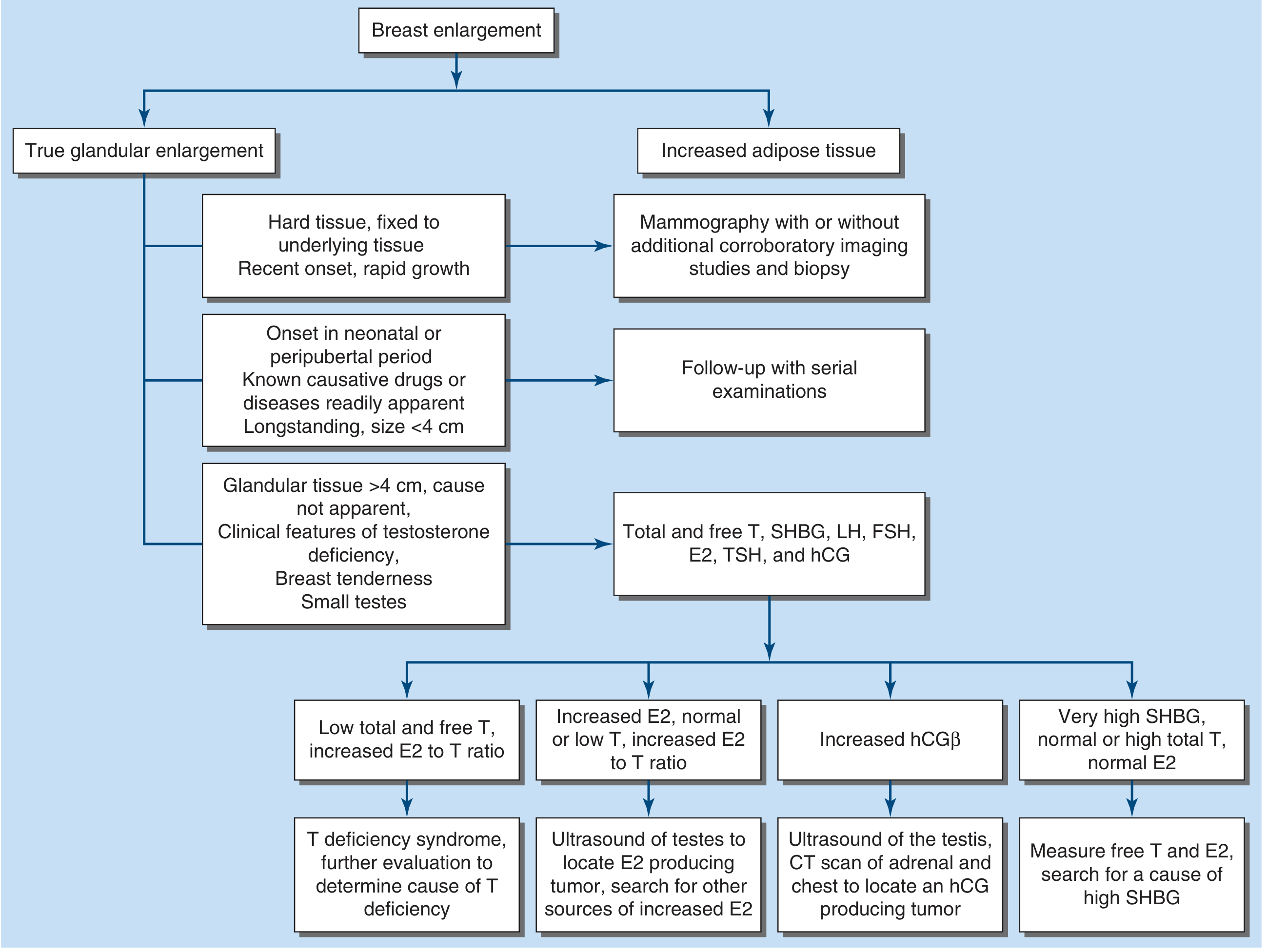
Workup for glandular tissue >4 cm with unclear cause:
- Total/free testosterone, SHBG, LH, FSH, E2 (17β-estradiol), TSH, β-hCG
- Markedly elevated E2 + suppressed LH → search for estrogen-secreting testicular/adrenal tumor
- Elevated hCG → testicular USS + CT chest/abdomen for hCG-producing tumor
- Very small testes → karyotype to exclude Klinefelter syndrome
- Liver function tests
Treatment
| Scenario | Management |
|---|---|
| Cause identified and corrected early | Breast tissue usually regresses over months |
| Long-standing gynecomastia | Surgery most effective |
| Painful gynecomastia (medical) | Tamoxifen 20 mg/day — reduces pain and size in >50%; raloxifene also used |
| Early proliferative phase | Aromatase inhibitors (anastrozole) — effective early; not better than placebo for established gynecomastia |
| Prostate cancer + ADT | Tamoxifen for prevention and treatment of breast enlargement/pain |
| Indications for surgery | Severe psychological distress, continued growth, failure of medical therapy, suspected malignancy |
Cancer Risk
- The relative risk of breast cancer is increased in men with gynecomastia, but the absolute risk remains small.
- Klinefelter syndrome carries a meaningfully higher breast cancer risk than gynecomastia from other causes.
Sources: Harrison's Principles of Internal Medicine 22E, p. 3159–3160; Robbins, Cotran & Kumar Pathologic Basis of Disease; Schwartz's Principles of Surgery 11E
Female mei hai
I'm not sure what you mean by "Female mei hai." Could you clarify?
Asking for Preferences
What did you mean by 'Female mei hai'?
This is a shared conversation. Sign in to Orris to start your own chat.