
*For 3rd Year PGs Today ‘s Write up*:- Recent heavy rainfall has resulted in urban flooding in Ahmedabad ,Gujarat As a District Health Officer, discuss: 1. The public health impact of floods. 2. The role of the District Health Administration during the prevention, preparedness, response, and recovery phases of disaster management. 3. The role relevant National Health Programs in flood management. 4. The importance of intersectoral coordination, community participation, and risk communication during flood emergencies. Make flow chart to easy understanding effective
District Health Officer role flood disaster management India public health response NDMA
https://nihfw.ac.in/Doc/Background%20Document%20DHO.pdf
*For 3rd Year PGs Today ‘s Write up*:- Recent heavy rainfall has resulted in urban flooding in Ahmedabad ,Gujarat As a District Health Officer, discuss: 1. The public health impact of floods. 2. The role of the District Health Administration during the prevention, preparedness, response, and recovery phases of disaster management. 3. The role relevant National Health Programs in flood management. 4. The importance of intersectoral coordination, community participation, and risk communication during flood emergencies. With flow chart to easy understanding and effective
District Health Officer flood disaster management India public health national health programs NDMA 2024
https://nidm.gov.in/journal/PDF/Journal/NIDMJOURNAL_JanJun20…
A detailed medical public health flowchart titled "PUBLIC HEALTH IMPACT OF URBAN FLOODS - Ahmedabad, Gujarat" showing a structured hierarchical flowchart. At the top: "URBAN FLOODING" box. Below it branches into 5 main categories in colored boxes: 1) DIRECT HEALTH IMPACTS (red) - drowning deaths, trauma/injuries, electrocution, snake bites; 2) WATERBORNE DISEASES (blue) - cholera, typhoid, hepatitis A, leptospirosis, dysentery; 3) VECTOR-BORNE DISEASES (green) - malaria, dengue, chikungunya, Japanese encephalitis; 4) MENTAL HEALTH (purple) - PTSD, anxiety, depression, grief; 5) INDIRECT IMPACTS (orange) - disruption of health services, food insecurity, malnutrition, displacement, lack of shelter. At the bottom a summary box: "VULNERABLE GROUPS AT HIGHEST RISK: Children, Elderly, Pregnant Women, Disabled, Urban Poor". Clean professional medical education style with clear arrows, white background.
A professional medical public health flowchart titled "ROLE OF DISTRICT HEALTH OFFICER IN DISASTER MANAGEMENT - 4 Phases" showing a horizontal timeline with 4 main phases connected by arrows. Each phase is in a distinct colored box. Phase 1 - PREVENTION (green box): Hazard mapping, Vulnerability assessment, Health facility audit, Safe water systems, IEC activities. Phase 2 - PREPAREDNESS (blue box): District Health Action Plan, Pre-positioning medicines/ORS/chlorine tablets, Training of health workers, Mock drills, Early warning system, Rapid Response Teams. Phase 3 - RESPONSE (red/orange box): Activation of Emergency Operations Centre, Rapid Health Assessment, Mobile Medical Teams, Disease surveillance, Water quality testing, Mass casualty management, Triage, Relief camps setup. Phase 4 - RECOVERY/REHABILITATION (purple box): Restoration of health services, Outbreak investigation, Psychosocial support, Long-term surveillance, Damage assessment. At the bottom: DM Act 2005 - NDMA > SDMA > DDMA hierarchy. Clean white background, professional medical education style, clear arrows between phases.
A professional medical public health flowchart titled "NATIONAL HEALTH PROGRAMMES IN FLOOD MANAGEMENT" showing a central box "FLOOD DISASTER" with spokes radiating to 6 program boxes: 1) NVBDCP - National Vector Borne Disease Control Programme (green): Malaria rapid testing, Indoor residual spraying, Larviciding, Dengue surveillance; 2) IDSP - Integrated Disease Surveillance Programme (blue): S & P forms reporting, Outbreak alert system, Rapid Response Teams, Weekly epidemiological reports; 3) NIDDCP - Iodine Deficiency (orange): Salt quality monitoring; 4) NHM - National Health Mission (red): Mobile Medical Units, ASHAs/ANMs activated, Free medicines/ORS, Relief camp health posts; 5) RNTCP/NTP - TB Programme (purple): Uninterrupted DOTS during displacement; 6) NLEP - Leprosy Programme (teal): Wound care surveillance. Bottom box: "IHIP - Integrated Health Information Platform - Real-time disease surveillance and reporting during floods". Clean white background, professional style, arrows from each program back to "FLOOD RESPONSE" at the center.
A professional medical public health flowchart titled "INTERSECTORAL COORDINATION, COMMUNITY PARTICIPATION & RISK COMMUNICATION IN FLOOD EMERGENCIES" with three main sections. Section A - INTERSECTORAL COORDINATION (blue): Central box "DHO/DDMA" connected to: Municipal Corporation (AMCSS/AMC - drainage, water supply), PWD (roads, infrastructure), Police/NDRF/SDRF (rescue), Revenue Dept (relief camps), School Dept (shelters), NGOs/Private hospitals, Gujarat Power Corp (electricity shutdown). Section B - COMMUNITY PARTICIPATION (green): ASHA workers, Anganwadi workers, Local volunteers, Self-help groups, Community leaders/panchayat, Aapda Mitra volunteers. Section C - RISK COMMUNICATION (orange): Multi-channel communication pyramid showing at top: Official Press Conference, then: SMS/WhatsApp alerts, Radio (community radio), Social media (Twitter/Facebook), Door-to-door by ASHAs, Helpline numbers (1070 flood, 104 health). Bottom footer: "Key Message - Right information, Right time, Right channel = Saves Lives". White background, professional medical education infographic style.
🌊 Urban Flooding in Ahmedabad, Gujarat
Write-up for 3rd Year PGs | Perspective: District Health Officer (DHO)
INTRODUCTION
1. PUBLIC HEALTH IMPACT OF FLOODS
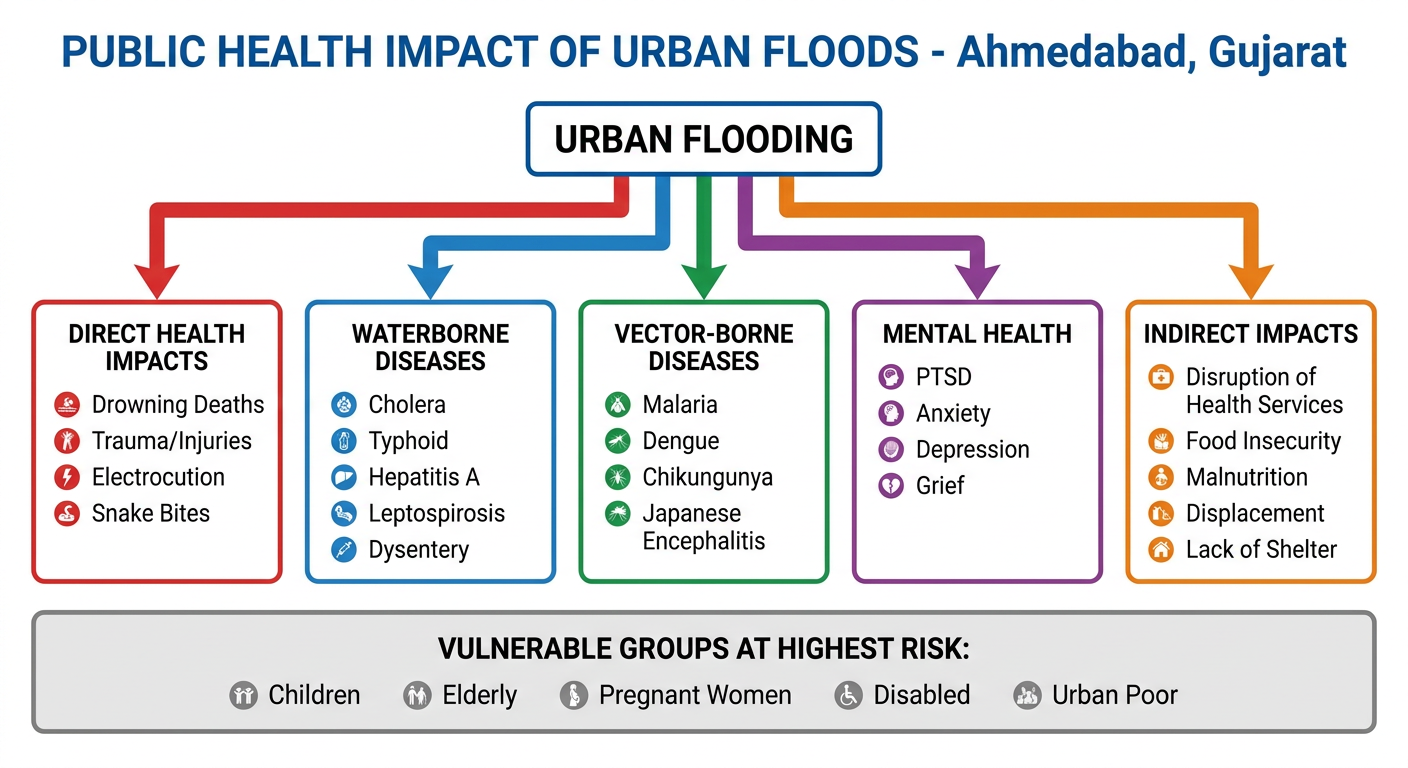
A. Direct / Immediate Health Impacts
| Category | Examples |
|---|---|
| Deaths | Drowning (most common cause of flood mortality), electrocution |
| Injuries | Trauma from debris, fractures, lacerations, snake bites |
| Hypothermia | Prolonged water exposure, especially in children and elderly |
B. Waterborne and Foodborne Diseases (Most significant post-flood threat)
- Cholera - El Tor biotype; explosive outbreaks in flooded urban slums
- Typhoid and Paratyphoid Fever - contaminated water/food
- Hepatitis A & E - feco-oral route; Hepatitis E especially dangerous in pregnancy
- Acute Diarrhoeal Diseases (ADD) - major cause of post-flood morbidity
- Leptospirosis - zoonotic; enters through skin abrasions from floodwater contaminated with rat urine; highly relevant in urban Ahmedabad
- Bacillary and Amoebic Dysentery
C. Vector-Borne Diseases (Delayed - 2-4 weeks post-flood)
- Malaria (P. vivax dominant in Gujarat) - Anopheles mosquito
- Dengue and Chikungunya - Aedes aegypti breeding in stored/stagnant water
- Japanese Encephalitis - Culex mosquito; paddy fields/periurban areas
- Filariasis - Culex quinquefasciatus in urban drains
D. Skin and Wound Infections
- Cellulitis, wound infections, tinea infections from prolonged water contact
- Scabies outbreaks in overcrowded relief camps
E. Respiratory Illnesses
- ARI, pneumonia - from overcrowding in relief camps, dampness, and hypothermia
F. Non-Communicable Disease Aggravation
- Disruption of antihypertensive, antidiabetic, anticonvulsant, and antiretroviral medications
- Stress-induced cardiac events
G. Mental Health Impacts
- Acute stress reactions, Post-Traumatic Stress Disorder (PTSD)
- Complicated grief, depression, anxiety
- Suicidal ideation in survivors who lost family/livelihoods
H. Indirect / Structural Health Impacts
- Disruption of health infrastructure: PHCs, CHCs, hospitals inundated - services halted
- Breakdown of water supply and sewerage systems - Park's PSM emphasizes this causes enormous rehabilitation costs beyond health costs
- Food insecurity and malnutrition - crop damage, market disruption
- Displacement - relief camps with inadequate sanitation create secondary disease clusters
Vulnerable Groups (Highest Priority)
Children under 5 years | Pregnant and lactating women | Elderly (>60 years) | Persons with disabilities | Urban poor/slum dwellers | Those on long-term medications
2. ROLE OF DISTRICT HEALTH ADMINISTRATION - 4 PHASES
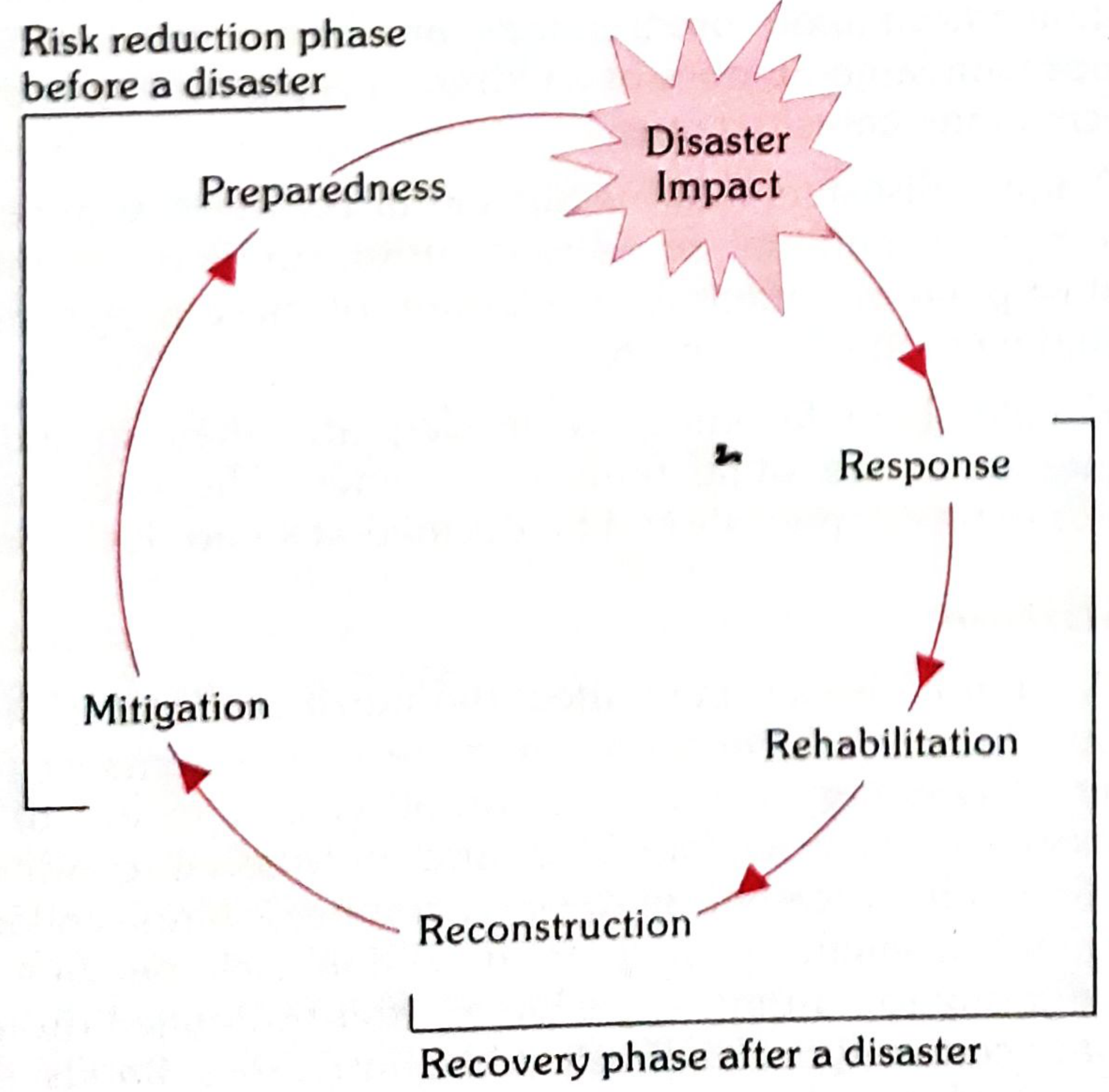
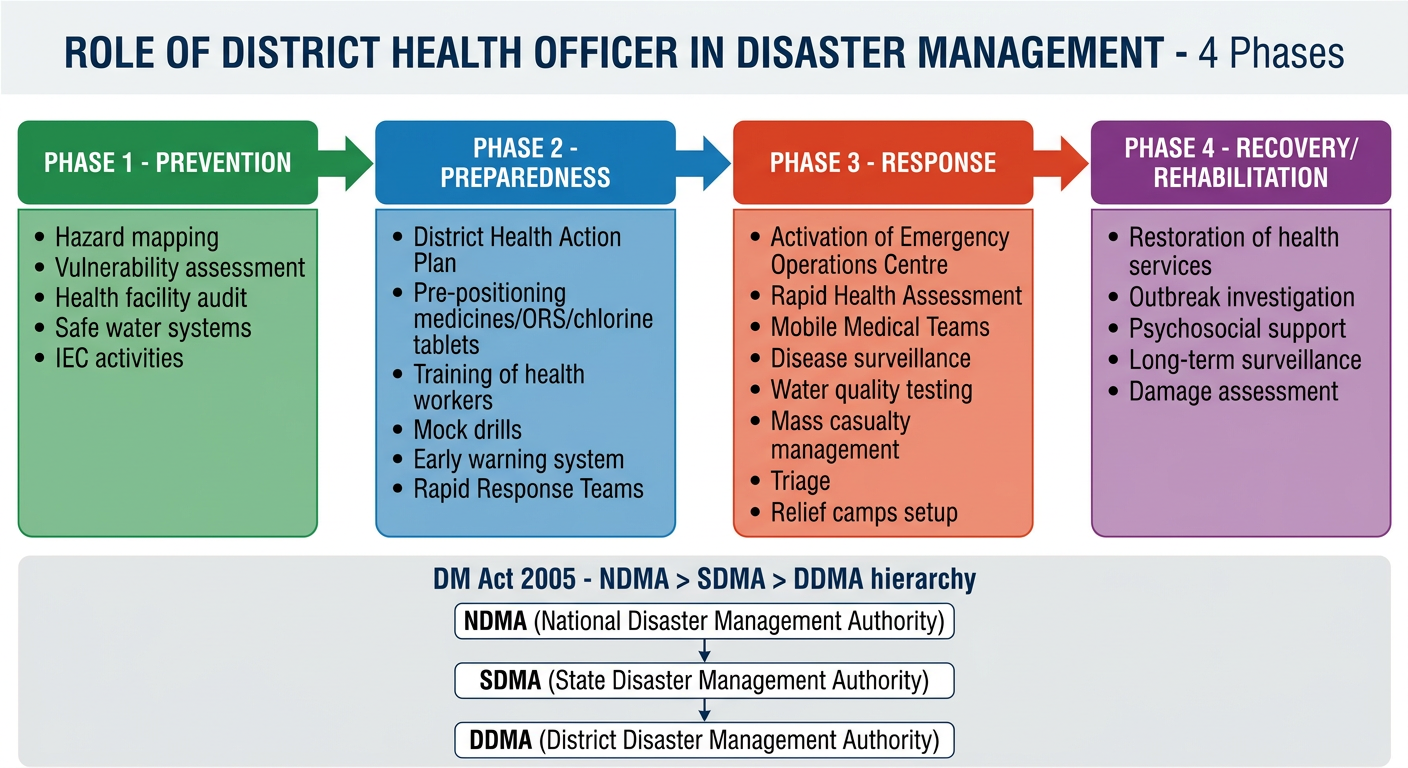
PHASE 1: PREVENTION (Pre-Disaster)
- Conduct health hazard vulnerability mapping - identify flood-prone wards, slum clusters, areas at risk of water contamination
- Ensure structural flood-proofing of PHCs, CHCs, district hospitals - locate facilities on higher ground where possible
- Safe water supply protection - coordinate with municipal body to protect overhead tanks and tube wells from contamination
- Immunization drives - ensure high coverage for Hepatitis A, Typhoid, and routine immunization before monsoon season
- IEC (Information, Education, Communication) activities - pre-monsoon health awareness campaigns
- Maintain updated disease baseline data for each ward to enable rapid outbreak detection
PHASE 2: PREPAREDNESS (Pre-Disaster)
- District Health Action Plan (DHAP) for floods - prepare and update annually with DDMA
- Pre-positioning of health supplies at strategic locations:
- ORS packets, Water purification tablets (chlorine/halazone)
- IV fluids, essential drugs (antibiotics, anti-malarials, antivenoms)
- Rapid Diagnostic Test (RDT) kits for malaria, dengue NS1 antigen kits
- Rapid Response Teams (RRTs) - constitute, train, equip; each team: 1 doctor + 1 paramedic + 1 lab technician
- Mobile Medical Units (MMUs) - list, check, fuel, equip
- Early Warning System linkage with IMD (India Meteorological Department) and GSDMA
- Mock drills / tabletop exercises - test response mechanisms as per Park's PSM
- Training of health workers: ASHA, ANM, MO - flood-specific protocols (triage, water testing, outbreak reporting)
- Identify and equip designated flood relief camps with health posts
- Communication network - establish flood-proof communication (satellite phones, HAM radio as backup)
- Hospital disaster plans - all hospitals nominate a nodal flood officer; stock up resuscitation equipment: suction, laryngoscope, pulse oximeter, defibrillator, CPAP; contingency plan for additional beds (NDMA Guidelines)
PHASE 3: RESPONSE (During and Immediately After Flood)
- Activate District Emergency Operations Centre (DEOC) - 24x7 staffing
- Deploy Mobile Medical Teams to flood-affected areas and relief camps
- Emergency treatment at flood sites: triage, first-aid, stabilization, referral
- Triage - rapidly classify injured by severity and survival likelihood; principle: maximum benefit to maximum people (Park's PSM)
- Priority: immediately life-threatening injuries
- Rapid Health Assessment (RHA) - within 24-48 hrs; assess number affected, mortality, morbidity, disruption of water/sanitation/health services
- Disease surveillance activation:
- Daily S (syndromic) & P (presumptive) form reporting via IDSP
- Outbreak alert threshold monitoring (e.g., 2x baseline cases = alert)
- Water quality testing - chlorination of relief camp water supply (residual chlorine 0.5 mg/L)
- Environmental sanitation in relief camps - 1 toilet per 20 persons, safe disposal of dead bodies and animal carcasses
- Vector control - fogging, larviciding, bed-net distribution
- Safe food supply - inspect relief camp food; condemn contaminated food
- Mass casualty management - coordinate with district hospital for surge capacity
- Psychosocial first-aid - trained counsellors deployed at relief camps
- Dead body management - dignified, safe disposal; prevent epidemic myth (WHO: dead bodies from natural disasters rarely cause epidemics)
PHASE 4: RECOVERY / REHABILITATION (Post-Flood)
- Gradual restoration of health services - PHCs, Sub-centres repaired and reopened
- Active outbreak surveillance - continued IDSP reporting for 8-12 weeks post-flood
- Investigation of any outbreaks - deploy Rapid Response Team, implement control measures
- Safe water declaration - test water sources before declaring safe for consumption
- Nutritional rehabilitation - survey and address malnutrition, especially SAM in children
- Mental health support - long-term PTSD counselling, grief support
- Damage and loss assessment - report health infrastructure damage to state
- Health camp organization - screen returning population for infections, chronic disease medication review
- Lessons-learned review - document gaps for improving next disaster plan
3. ROLE OF NATIONAL HEALTH PROGRAMMES IN FLOOD MANAGEMENT
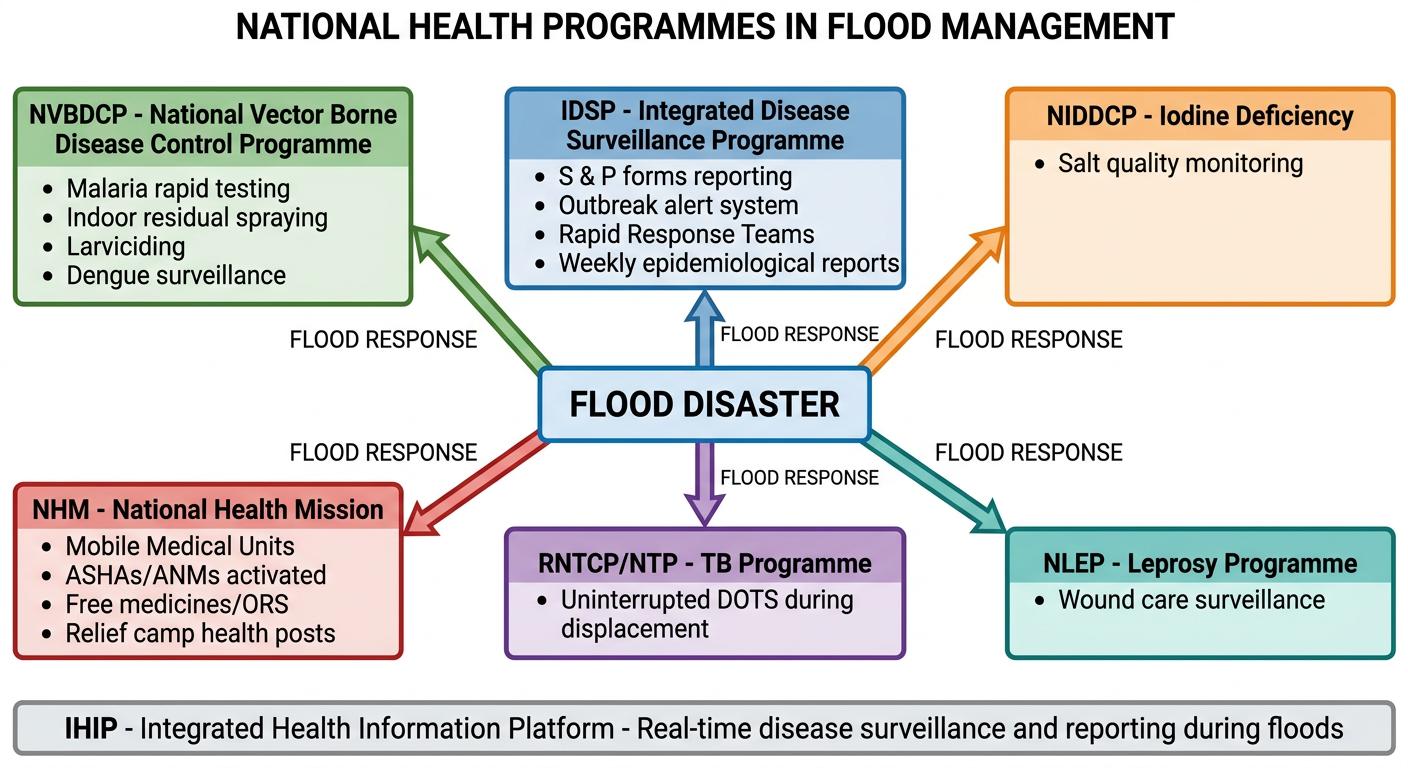
1. IDSP - Integrated Disease Surveillance Programme (Most Critical)
- Real-time outbreak detection during and after floods
- Weekly reporting via S forms (syndromic - by community informants), P forms (presumptive - by clinicians), L forms (lab-confirmed)
- Rapid Response Teams (RRT) dispatch for outbreak investigation
- IHIP (Integrated Health Information Platform) - digital real-time dashboard
- DHO role: Ensure daily reporting from all health facilities and relief camps; lower the alert threshold during flood response
2. NVBDCP - National Vector Borne Disease Control Programme
- Malaria: Active surveillance (Mass Blood Surveys in high-risk areas), RDT testing, ACT/CQ treatment, IRS (Indoor Residual Spraying) with DDT/Malathion, Long-Lasting Insecticidal Nets (LLINs) distribution
- Dengue/Chikungunya: Source reduction drives, Temephos larviciding, fogging with pyrethroid
- Anti-larval operations in stagnant floodwater
- DHO role: Coordinate with district malaria officer; intensify entomological surveillance
3. NHM - National Health Mission
- Mobile Medical Units (MMUs) - deployed to marooned/inaccessible areas
- ASHAs and ANMs - first-line community responders; conduct household visits, distribute ORS, chlorine tablets, refer cases
- Janani Suraksha Yojana - ensure pregnant women in relief camps get institutional delivery
- Free drugs and diagnostics - JSSK and free drug scheme supplies continue at relief camps
- DHO role: Activate NHM machinery; deploy MMUs; ensure salary continuity of frontline workers
4. RNTCP / NTP - National TB Programme
- Displaced TB patients may miss DOTS therapy - leads to drug resistance
- DHO role: Identify TB patients in affected areas; arrange uninterrupted DOTS supply at relief camps; prioritize treatment continuity
- Coordinate with private practitioners for treatment records
5. NLEP - National Leprosy Eradication Programme
- Flood-related wounds + poor sanitation = increased wound infection risk
- Ensure MDT (Multi Drug Therapy) continuation for leprosy patients
- Wound care in post-flood camps
6. National Mental Health Programme (NMHP)
- Psychological First Aid (PFA) immediately post-flood
- Screen for PTSD, depression, acute stress disorders at relief camps
- Activate district mental health team
- Train ASHAs in basic psychological support
7. National Programme for Prevention & Control of Cancer, Diabetes, CVD & Stroke (NPCDCS)
- Ensure continuity of antihypertensive, antidiabetic, anticoagulant medications for chronic disease patients in relief camps
- Blood pressure and blood glucose monitoring camps
8. National Drinking Water and Sanitation Programme (Jal Jeevan Mission)
- Emergency water quality testing
- Rapid repair of broken pipelines and contaminated sources
- Chlorination and water purification at community level
4. INTERSECTORAL COORDINATION, COMMUNITY PARTICIPATION & RISK COMMUNICATION
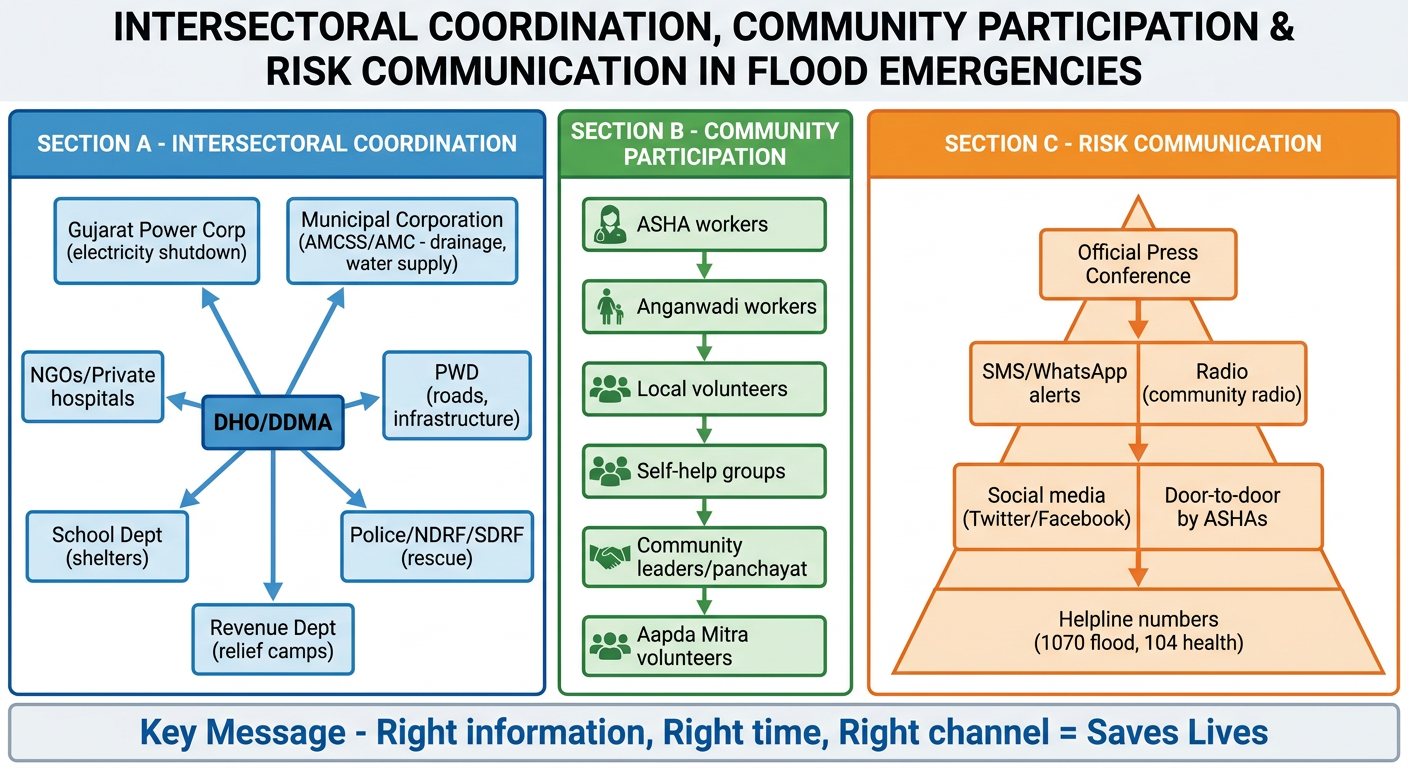
A. INTERSECTORAL COORDINATION
| Department/Agency | Specific Role in Flood Response |
|---|---|
| Ahmedabad Municipal Corporation (AMC) | Drainage, water supply safety, solid waste management, shelter in schools |
| Gujarat Power Distribution Corp (GETCO/DGVCL) | Electricity shut-off in flooded areas to prevent electrocution |
| Public Works Department (PWD) | Road clearance, bridge safety assessment |
| Police/Home Department | Crowd control, law and order at relief camps |
| NDRF / SDRF | Search, rescue, body recovery |
| Revenue Department (Collector's office) | Relief fund disbursement, camp management |
| Department of Education | Schools as shelter/relief camps |
| Women & Child Development | Anganwadi workers for nutrition surveillance; pregnant women identification |
| Animal Husbandry | Dead animal carcass disposal; zoonotic disease control (leptospirosis) |
| Agriculture Department | Food security, crop loss assessment |
| NGOs / Red Cross / Voluntary organizations | Relief distribution, psychosocial support, manpower |
| Private Hospitals / Medical Colleges | Surge capacity; specialist services |
| IMD (India Met Dept) | Real-time weather forecasts; early warnings |
B. COMMUNITY PARTICIPATION
- Community members have the most to lose and are first on scene when external help is delayed
- Local knowledge of hazards ensures genuine needs are met
- Resources are most efficiently pooled at community level
- ASHAs (Accredited Social Health Activists) - household surveys, ORS distribution, referral, birth/death reporting from flood-affected areas
- ANMs (Auxiliary Nurse Midwives) - skilled birth attendants at relief camps; immunization; ANC follow-up
- Anganwadi Workers (AWW) - nutritional surveillance; identify SAM/MAM children; supplement distribution
- Aapda Mitra Volunteers - trained community first responders under NDMA scheme
- Self-Help Groups (SHGs) - food preparation, distribution, psychological support for women
- Community leaders and religious heads - communicate health messages; mobilize community; counter misinformation
- Ward-level Health Committees - NHM-established; activated for camp monitoring
- Household emergency kits (water purification tabs, ORS, torch, first-aid)
- Community evacuation routes and rally points
- Village/Ward-level DM committees with trained first-aid volunteers
C. RISK COMMUNICATION
- Early warning - communicate before the disaster escalates
- Accurate - based on verified data; avoid rumour
- Clear and simple - use local language (Gujarati); avoid jargon
- Actionable - tell people exactly what to do
- Two-way - enable community feedback and questions
- Consistent - one spokesperson for official communication (DHO/DDMA)
- Credible - use trusted voices (doctors, religious leaders, elected representatives)
| Channel | Message Type |
|---|---|
| Press conference (Official) | Official case counts, boil water advisory, evacuation zones |
| Doordarshan / All India Radio | Mass community messages, do's and don'ts |
| SMS alerts (NDMA's Common Alert Protocol) | Evacuation warnings, emergency numbers |
| WhatsApp/Social media | Health tips, dos and don'ts; counter misinformation |
| IVR Calls and Helplines | Flood Helpline: 1070; Health Helpline: 104 |
| Community mobilizers (ASHA/ANM) | Door-to-door in relief camps |
| Loudspeaker/Miking in areas | Real-time local instructions |
- Boil or chlorinate all drinking water
- Do not wade through floodwater (electrocution, leptospirosis risk)
- Visit nearest health camp for diarrhea, fever, wound
- Take children to immunization camp
- Do not eat food that has been in contact with floodwater
- Contact helpline 104 for health emergencies
- Official daily media briefing by DHO
- Rapid fact-checking and correction of social media rumours
- Community mobilization via trusted local leaders
SUMMARY TABLE: DHO AT A GLANCE
| Dimension | Key Action |
|---|---|
| Legal framework | DM Act 2005 - NDMA > GSDMA > DDMA |
| Main health threats | Waterborne diseases > Vector-borne diseases > Trauma |
| Top priority disease | Diarrhea / Cholera - safe water is the #1 intervention |
| First action at disaster | Rapid Health Assessment + activate DEOC |
| Surveillance system | IDSP - daily S/P/L forms; IHIP platform |
| Key national programme | IDSP (surveillance), NVBDCP (vectors), NHM (delivery) |
| Communication principle | Early, accurate, actionable, consistent |
| Vulnerable priority | Children, pregnant women, elderly, disabled, urban poor |
| Legal tool for response | Epidemic Diseases Act 1897 + DM Act 2005 |
CONCLUSION
Generate a Word document summary with these flowcharts for student distribution
ls -la /tmp/workspace/ 2>/dev/null || mkdir -p /tmp/workspace && ls -la /tmp/workspace/
mkdir -p /tmp/workspace/flood-writeup && cd /tmp/workspace/flood-writeup && python3 -c " import urllib.request images = { 'flood_impact.png': 'https://cdn.orris.care/image-gen/7f0debbd09de42b899ac68e7cfdf4141.png', 'dho_phases.png': 'https://cdn.orris.care/image-gen/1a63523952f24f8997b4af8fddc9001e.png', 'national_programs.png': 'https://cdn.orris.care/image-gen/f5893104638a4b53b3d181dc895e2419.png', 'intersectoral.png': 'https://cdn.orris.care/image-gen/267865268cee492b9b997eb8ed661f6c.png', 'disaster_cycle.png': 'https://cdn.orris.care/cdss_images/927a02d075d87317513d2e146a0d96b4ad5d1339f58a7248220182135f360ee4.png', } for fname, url in images.items(): urllib.request.urlretrieve(url, fname) print(f'Downloaded {fname}') print('All images downloaded.') "
~/flood-writeup/build_doc.py
from docx import Document
from docx.shared import Pt, Inches, RGBColor, Cm
from docx.enum.text import WD_ALIGN_PARAGRAPH
from docx.enum.table import WD_TABLE_ALIGNMENT, WD_ALIGN_VERTICAL
from docx.oxml.ns import qn
from docx.oxml import OxmlElement
import copy

doc = Document()

# ── Page margins ──────────────────────────────────────────────────────────────
for section in doc.sections:
    section.top_margin    = Cm(2)
    section.bottom_margin = Cm(2)
    section.left_margin   = Cm(2.5)
    section.right_margin  = Cm(2.5)

# ── Default body style ────────────────────────────────────────────────────────
normal = doc.styles["Normal"]
normal.font.name = "Arial"
normal.font.size = Pt(11)

# ── Helper: coloured heading paragraph ────────────────────────────────────────
def add_coloured_heading(doc, text, level=1, r=31, g=97, b=141):
    p = doc.add_heading(text, level=level)
    p.alignment = WD_ALIGN_PARAGRAPH.LEFT
    for run in p.runs:
        run.font.color.rgb = RGBColor(r, g, b)
        run.font.name = "Arial"
    return p

def add_section_box(doc, title, color_rgb=(31, 97, 141)):
    """Add a visually distinct section header."""
    p = doc.add_paragraph()
    p.alignment = WD_ALIGN_PARAGRAPH.CENTER
    run = p.add_run(f"  {title}  ")
    run.font.name = "Arial"
    run.font.size = Pt(13)
    run.font.bold = True
    run.font.color.rgb = RGBColor(255, 255, 255)
    # shade paragraph
    pPr = p._p.get_or_add_pPr()
    shd = OxmlElement("w:shd")
    hex_color = "{:02X}{:02X}{:02X}".format(*color_rgb)
    shd.set(qn("w:val"), "clear")
    shd.set(qn("w:color"), "auto")
    shd.set(qn("w:fill"), hex_color)
    pPr.append(shd)
    p.paragraph_format.space_before = Pt(6)
    p.paragraph_format.space_after  = Pt(4)
    return p

def add_body(doc, text, bold=False, italic=False, size=11, indent=0):
    p = doc.add_paragraph()
    p.paragraph_format.left_indent = Cm(indent)
    p.paragraph_format.space_after = Pt(3)
    run = p.add_run(text)
    run.font.name = "Arial"
    run.font.size = Pt(size)
    run.font.bold = bold
    run.font.italic = italic
    return p

def add_bullet(doc, text, level=0):
    p = doc.add_paragraph(style="List Bullet")
    p.paragraph_format.left_indent  = Cm(0.5 + level * 0.5)
    p.paragraph_format.space_after  = Pt(2)
    run = p.add_run(text)
    run.font.name = "Arial"
    run.font.size = Pt(10.5)
    return p

def add_image_centred(doc, path, width_inches=6.0, caption=None):
    p = doc.add_paragraph()
    p.alignment = WD_ALIGN_PARAGRAPH.CENTER
    run = p.add_run()
    run.add_picture(path, width=Inches(width_inches))
    if caption:
        cp = doc.add_paragraph(caption)
        cp.alignment = WD_ALIGN_PARAGRAPH.CENTER
        cp.paragraph_format.space_after = Pt(8)
        for run in cp.runs:
            run.font.name = "Arial"
            run.font.size  = Pt(9)
            run.font.italic = True
            run.font.color.rgb = RGBColor(100, 100, 100)
    return p

def add_simple_table(doc, headers, rows, col_widths=None):
    table = doc.add_table(rows=1 + len(rows), cols=len(headers))
    table.style = "Table Grid"
    table.alignment = WD_TABLE_ALIGNMENT.CENTER
    # header row
    hrow = table.rows[0]
    for i, h in enumerate(headers):
        cell = hrow.cells[i]
        cell.text = h
        for para in cell.paragraphs:
            for run in para.runs:
                run.font.bold = True
                run.font.name = "Arial"
                run.font.size = Pt(10)
                run.font.color.rgb = RGBColor(255, 255, 255)
        tcPr = cell._tc.get_or_add_tcPr()
        shd = OxmlElement("w:shd")
        shd.set(qn("w:val"), "clear")
        shd.set(qn("w:color"), "auto")
        shd.set(qn("w:fill"), "1F618D")
        tcPr.append(shd)
    # data rows
    for ri, row_data in enumerate(rows):
        drow = table.rows[ri + 1]
        fill = "D6EAF8" if ri % 2 == 0 else "FFFFFF"
        for ci, cell_text in enumerate(row_data):
            cell = drow.cells[ci]
            cell.text = cell_text
            for para in cell.paragraphs:
                for run in para.runs:
                    run.font.name = "Arial"
                    run.font.size = Pt(10)
            tcPr = cell._tc.get_or_add_tcPr()
            shd = OxmlElement("w:shd")
            shd.set(qn("w:val"), "clear")
            shd.set(qn("w:color"), "auto")
            shd.set(qn("w:fill"), fill)
            tcPr.append(shd)
    if col_widths:
        for ri2, row in enumerate(table.rows):
            for ci2, cell in enumerate(row.cells):
                cell.width = Inches(col_widths[ci2])
    doc.add_paragraph()
    return table

# ══════════════════════════════════════════════════════════════════════════════
#  COVER / HEADER
# ══════════════════════════════════════════════════════════════════════════════
p = doc.add_paragraph()
p.alignment = WD_ALIGN_PARAGRAPH.CENTER
run = p.add_run("3rd YEAR POSTGRADUATE WRITE-UP")
run.font.name = "Arial"
run.font.size = Pt(10)
run.font.color.rgb = RGBColor(120, 120, 120)

title = doc.add_heading("", level=0)
title.alignment = WD_ALIGN_PARAGRAPH.CENTER
run = title.add_run("Urban Flooding in Ahmedabad, Gujarat")
run.font.name = "Arial"
run.font.color.rgb = RGBColor(31, 97, 141)

sub = doc.add_paragraph()
sub.alignment = WD_ALIGN_PARAGRAPH.CENTER
run = sub.add_run("Public Health Management — Role of District Health Officer")
run.font.name = "Arial"
run.font.size = Pt(13)
run.font.bold = True
run.font.color.rgb = RGBColor(52, 73, 94)

date_p = doc.add_paragraph()
date_p.alignment = WD_ALIGN_PARAGRAPH.CENTER
run = date_p.add_run("Date: 24th July 2026  |  Subject: Community Medicine / Preventive & Social Medicine")
run.font.name = "Arial"
run.font.size = Pt(10)
run.font.italic = True
run.font.color.rgb = RGBColor(150, 150, 150)

doc.add_paragraph()

# Disaster cycle image (small, centred)
add_image_centred(doc, "/tmp/workspace/flood-writeup/disaster_cycle.png",
                  width_inches=3.5,
                  caption="Fig. 1 — Disaster Management Cycle (Source: Park's Textbook of Preventive & Social Medicine)")

doc.add_page_break()

# ══════════════════════════════════════════════════════════════════════════════
#  INTRODUCTION
# ══════════════════════════════════════════════════════════════════════════════
add_coloured_heading(doc, "INTRODUCTION", level=1)
add_body(doc,
    "Urban flooding following heavy monsoon rainfall in Ahmedabad represents a complex public health emergency. "
    "As the District Health Officer (DHO), I function within the legal framework of the Disaster Management Act, 2005, "
    "under the District Disaster Management Authority (DDMA) — headed by the District Magistrate/Collector. "
    "The DDMA operates under the guidance of the NDMA (National) and GSDMA — Gujarat State Disaster Management Authority. "
    "The DHO serves as the nodal health officer for all health-sector activities in this framework."
)

# ══════════════════════════════════════════════════════════════════════════════
#  SECTION 1 — PUBLIC HEALTH IMPACT
# ══════════════════════════════════════════════════════════════════════════════
doc.add_page_break()
add_section_box(doc, "1. PUBLIC HEALTH IMPACT OF FLOODS", color_rgb=(192, 57, 43))
doc.add_paragraph()

add_image_centred(doc, "/tmp/workspace/flood-writeup/flood_impact.png",
                  width_inches=6.2,
                  caption="Flowchart 1 — Public Health Impact of Urban Floods")

add_coloured_heading(doc, "A. Direct / Immediate Health Impacts", level=2, r=192, g=57, b=43)
add_simple_table(doc,
    ["Impact", "Examples"],
    [
        ["Deaths", "Drowning (most common), electrocution"],
        ["Injuries", "Trauma from debris, fractures, lacerations, snake bites"],
        ["Hypothermia", "Prolonged water exposure — highest risk in children & elderly"],
    ],
    col_widths=[2.5, 4.0]
)

add_coloured_heading(doc, "B. Waterborne & Foodborne Diseases (Most Significant Post-Flood Threat)", level=2, r=192, g=57, b=43)
for item in [
    "Cholera — explosive outbreaks in flooded urban slums; El Tor biotype",
    "Typhoid & Paratyphoid Fever — contaminated water/food",
    "Hepatitis A & E — feco-oral; Hepatitis E especially dangerous in pregnancy",
    "Acute Diarrhoeal Diseases (ADD) — major cause of post-flood morbidity",
    "Leptospirosis — zoonotic; enters through skin abrasions from rat-urine contaminated floodwater",
    "Bacillary & Amoebic Dysentery",
]:
    add_bullet(doc, item)

add_coloured_heading(doc, "C. Vector-Borne Diseases (Delayed — 2–4 weeks post-flood)", level=2, r=192, g=57, b=43)
for item in [
    "Malaria (P. vivax dominant in Gujarat) — Anopheles mosquito",
    "Dengue & Chikungunya — Aedes aegypti breeding in stored/stagnant water",
    "Japanese Encephalitis — Culex mosquito; peri-urban areas",
    "Filariasis — Culex quinquefasciatus in urban drains",
]:
    add_bullet(doc, item)

add_coloured_heading(doc, "D. Other Impacts", level=2, r=192, g=57, b=43)
for item in [
    "Skin & Wound Infections — cellulitis, tinea; scabies outbreaks in crowded relief camps",
    "Respiratory Illnesses — ARI, pneumonia from overcrowding and dampness",
    "NCD Aggravation — missed antihypertensives, antidiabetics, anticonvulsants, ARVs",
    "Mental Health — PTSD, acute stress disorder, depression, grief reactions, suicidal ideation",
    "Disruption of health infrastructure — PHCs, CHCs, hospitals inundated",
    "Food insecurity & malnutrition — crop damage, market disruption",
]:
    add_bullet(doc, item)

add_coloured_heading(doc, "Vulnerable Priority Groups", level=2, r=192, g=57, b=43)
add_body(doc,
    "Children <5 years  |  Pregnant & lactating women  |  Elderly (>60 years)  |  "
    "Persons with disabilities  |  Urban poor / slum dwellers  |  Patients on long-term medications",
    bold=True
)

# ══════════════════════════════════════════════════════════════════════════════
#  SECTION 2 — 4 PHASES
# ══════════════════════════════════════════════════════════════════════════════
doc.add_page_break()
add_section_box(doc, "2. ROLE OF DISTRICT HEALTH ADMINISTRATION — 4 PHASES", color_rgb=(31, 97, 141))
doc.add_paragraph()

add_image_centred(doc, "/tmp/workspace/flood-writeup/dho_phases.png",
                  width_inches=6.2,
                  caption="Flowchart 2 — DHO Role Across 4 Phases of Disaster Management")

# Phase 1
add_coloured_heading(doc, "PHASE 1: PREVENTION (Pre-Disaster)", level=2, r=39, g=174, b=96)
for item in [
    "Health hazard vulnerability mapping — identify flood-prone wards, slum clusters",
    "Flood-proofing of PHCs, CHCs, district hospitals — locate on higher ground",
    "Safe water supply protection — coordinate with municipal body",
    "Immunization drives — Hepatitis A, Typhoid before monsoon season",
    "IEC (Information, Education, Communication) — pre-monsoon health awareness campaigns",
    "Maintain disease baseline data for each ward (IDSP)",
]:
    add_bullet(doc, item)

# Phase 2
add_coloured_heading(doc, "PHASE 2: PREPAREDNESS (Pre-Disaster)", level=2, r=41, g=128, b=185)
for item in [
    "District Health Action Plan (DHAP) for floods — prepare and update annually with DDMA",
    "Pre-position health supplies: ORS, chlorine/halazone tablets, IV fluids, RDT kits, antibiotics, antivenoms",
    "Constitute and train Rapid Response Teams (RRT): 1 doctor + 1 paramedic + 1 lab technician",
    "Equip Mobile Medical Units (MMUs) — fuel, stock, check",
    "Early Warning System linkage with IMD and GSDMA",
    "Mock drills / tabletop exercises to test response mechanisms",
    "Train ASHAs, ANMs, Medical Officers in flood-specific protocols",
    "Designate and equip flood relief camps with health posts",
    "Establish flood-proof communication (satellite phones, HAM radio)",
    "Hospital Disaster Plans: nominate nodal officer; stock resuscitation equipment; contingency bed plans",
]:
    add_bullet(doc, item)

# Phase 3
add_coloured_heading(doc, "PHASE 3: RESPONSE (During & Immediately After Flood)", level=2, r=192, g=57, b=43)
for item in [
    "Activate District Emergency Operations Centre (DEOC) — 24×7 staffing",
    "Deploy Mobile Medical Teams to flood-affected areas and relief camps",
    "Triage — classify injured by severity & survival likelihood (maximum benefit to maximum people)",
    "Rapid Health Assessment (RHA) — within 24–48 hrs: mortality, morbidity, service disruption",
    "Disease surveillance: daily IDSP S/P/L forms; lower alert threshold; activate IHIP",
    "Water quality testing — chlorination (residual chlorine 0.5 mg/L at point of use)",
    "Environmental sanitation — 1 toilet per 20 persons; safe disposal of dead bodies/carcasses",
    "Vector control — fogging, larviciding, bed-net distribution",
    "Safe food supply — inspect relief camp food; condemn contaminated items",
    "Mass casualty management — coordinate surge capacity with district hospital",
    "Psychosocial first-aid — trained counsellors at relief camps",
]:
    add_bullet(doc, item)

# Phase 4
add_coloured_heading(doc, "PHASE 4: RECOVERY / REHABILITATION (Post-Flood)", level=2, r=142, g=68, b=173)
for item in [
    "Gradual restoration of health services — PHCs, sub-centres repaired and reopened",
    "Active outbreak surveillance — continued IDSP reporting for 8–12 weeks post-flood",
    "Outbreak investigation — deploy RRT; implement control measures",
    "Safe water declaration — test all sources before declaring safe",
    "Nutritional rehabilitation — SAM/MAM survey and management (especially children)",
    "Mental health support — long-term PTSD counselling, grief support programmes",
    "Damage and loss assessment — report to state for reconstruction funding",
    "Lessons-learned review — document gaps to improve next disaster plan",
]:
    add_bullet(doc, item)

# ══════════════════════════════════════════════════════════════════════════════
#  SECTION 3 — NATIONAL HEALTH PROGRAMMES
# ══════════════════════════════════════════════════════════════════════════════
doc.add_page_break()
add_section_box(doc, "3. ROLE OF NATIONAL HEALTH PROGRAMMES IN FLOOD MANAGEMENT", color_rgb=(30, 132, 73))
doc.add_paragraph()

add_image_centred(doc, "/tmp/workspace/flood-writeup/national_programs.png",
                  width_inches=6.2,
                  caption="Flowchart 3 — National Health Programmes Activated During Flood Response")

programmes = [
    ("IDSP — Integrated Disease Surveillance Programme (Most Critical)", [
        "Real-time outbreak detection via IHIP (Integrated Health Information Platform)",
        "Daily S forms (syndromic), P forms (presumptive), L forms (lab-confirmed)",
        "Rapid Response Team (RRT) dispatch for outbreak investigation",
        "DHO action: ensure daily reporting from ALL health facilities and relief camps",
    ]),
    ("NVBDCP — National Vector Borne Disease Control Programme", [
        "Malaria: Mass Blood Surveys, RDT testing, ACT/CQ treatment, IRS (DDT/Malathion), LLIN distribution",
        "Dengue/Chikungunya: source reduction drives, Temephos larviciding, pyrethroid fogging",
        "Anti-larval operations in all stagnant floodwater pools",
    ]),
    ("NHM — National Health Mission", [
        "Mobile Medical Units (MMUs) deployed to marooned/inaccessible areas",
        "ASHAs and ANMs: household visits, ORS distribution, chlorine tablets, referral",
        "Janani Suraksha Yojana — ensure institutional delivery for pregnant women in camps",
        "Free drugs and diagnostics (JSSK / Free Drug Scheme) continue at relief camps",
    ]),
    ("RNTCP / NTP — National TB Programme", [
        "Identify TB patients in affected areas; arrange uninterrupted DOTS supply at camps",
        "Missed treatment → drug resistance; highest priority continuity",
        "Coordinate with private practitioners for treatment records",
    ]),
    ("NLEP — National Leprosy Eradication Programme", [
        "Ensure MDT (Multi Drug Therapy) continuation for leprosy patients",
        "Wound care surveillance and management in post-flood camps",
    ]),
    ("NMHP — National Mental Health Programme", [
        "Psychological First Aid (PFA) immediately post-flood",
        "Screen for PTSD, depression, acute stress at relief camps",
        "Train ASHAs in basic psychological support",
    ]),
    ("NPCDCS — Non-Communicable Diseases Programme", [
        "Continuity of antihypertensives, antidiabetics, anticoagulants for displaced patients",
        "BP and blood glucose monitoring camps in affected areas",
    ]),
    ("Jal Jeevan Mission — National Drinking Water Programme", [
        "Emergency water quality testing across all sources",
        "Rapid repair of broken pipelines; community-level chlorination",
    ]),
]

for prog_name, bullets in programmes:
    add_coloured_heading(doc, prog_name, level=2, r=30, g=132, b=73)
    for b in bullets:
        add_bullet(doc, b)

# ══════════════════════════════════════════════════════════════════════════════
#  SECTION 4 — INTERSECTORAL / COMMUNITY / RISK COMM
# ══════════════════════════════════════════════════════════════════════════════
doc.add_page_break()
add_section_box(doc, "4. INTERSECTORAL COORDINATION, COMMUNITY PARTICIPATION & RISK COMMUNICATION", color_rgb=(125, 60, 152))
doc.add_paragraph()

add_image_centred(doc, "/tmp/workspace/flood-writeup/intersectoral.png",
                  width_inches=6.2,
                  caption="Flowchart 4 — Intersectoral Coordination, Community Participation & Risk Communication")

# 4A
add_coloured_heading(doc, "A. Intersectoral Coordination", level=2, r=41, g=128, b=185)
add_body(doc,
    "Disaster preparedness is an on-going multisectoral activity forming an integral part of the national "
    "disaster management system (Park's PSM). The DHO does not act in isolation — all health actions must be "
    "synchronised with the Incident Command System (ICS) under the DDMA."
)
add_simple_table(doc,
    ["Department / Agency", "Role in Flood Response"],
    [
        ["Ahmedabad Municipal Corporation (AMC)", "Drainage, water supply safety, solid waste, shelter in schools"],
        ["Gujarat Power Corp (GETCO/DGVCL)", "Electricity shut-off in flooded areas to prevent electrocution"],
        ["Public Works Dept (PWD)", "Road clearance, bridge safety assessment"],
        ["Police / Home Department", "Crowd control, law and order at relief camps"],
        ["NDRF / SDRF", "Search, rescue, body recovery"],
        ["Revenue Department (Collector)", "Relief fund disbursement, camp management"],
        ["Department of Education", "Schools as shelter / relief camps"],
        ["Women & Child Development", "AWW for nutrition surveillance; identify pregnant women"],
        ["Animal Husbandry", "Dead carcass disposal; zoonotic disease (leptospirosis) control"],
        ["Agriculture Department", "Food security, crop loss assessment"],
        ["NGOs / Red Cross", "Relief distribution, psychosocial support, manpower"],
        ["Private Hospitals / Medical Colleges", "Surge capacity; specialist services"],
        ["IMD (Met Department)", "Real-time weather forecasts and early warnings"],
    ],
    col_widths=[2.8, 3.7]
)

# 4B
add_coloured_heading(doc, "B. Community Participation", level=2, r=39, g=174, b=96)
add_body(doc,
    "\"The community is the first responder of any kind of disaster and public health emergency.\" "
    "— NIDM Journal of Disaster & Development, 2022"
)
for item in [
    "ASHAs — household surveys, ORS distribution, referral, birth/death reporting",
    "ANMs — skilled birth attendants at relief camps; immunization; ANC follow-up",
    "Anganwadi Workers (AWW) — nutritional surveillance; identify SAM/MAM children",
    "Aapda Mitra Volunteers — NDMA-trained community first responders",
    "Self-Help Groups (SHGs) — food preparation, distribution, psychosocial support for women",
    "Community and religious leaders — communicate health messages; mobilise community; counter misinformation",
    "Ward-level Health Committees (NHM) — activated for camp monitoring",
]:
    add_bullet(doc, item)

# 4C
add_coloured_heading(doc, "C. Risk Communication", level=2, r=192, g=57, b=43)
add_body(doc,
    "Effective risk communication is one of the 8 core capacities under IHR 2005 and "
    "\"an essential requirement for prompt medical response\" (NDMA Flood Guidelines)."
)
add_coloured_heading(doc, "Principles:", level=3, r=100, g=100, b=100)
for item in [
    "Early warning — communicate before the disaster escalates",
    "Accurate — based on verified data; avoid rumour",
    "Clear and simple — use local language (Gujarati); avoid jargon",
    "Actionable — tell people exactly what to do",
    "Two-way — enable community feedback",
    "Consistent — one official spokesperson (DHO/DDMA)",
    "Credible — use trusted voices (doctors, religious leaders, elected representatives)",
]:
    add_bullet(doc, item)

add_coloured_heading(doc, "Communication Channels:", level=3, r=100, g=100, b=100)
add_simple_table(doc,
    ["Channel", "Message Type"],
    [
        ["Press Conference (Official)", "Case counts, boil-water advisory, evacuation zones"],
        ["Doordarshan / All India Radio", "Community messages, do's and don'ts"],
        ["SMS alerts (NDMA Common Alert Protocol)", "Evacuation warnings, emergency numbers"],
        ["WhatsApp / Social media", "Health tips; counter misinformation"],
        ["Helplines: 1070 (Flood) / 104 (Health)", "Queries, emergency referral"],
        ["ASHAs / ANMs door-to-door", "Camp-level direct messaging"],
        ["Loudspeaker / Miking in areas", "Real-time local instructions"],
    ],
    col_widths=[3.0, 3.5]
)

# ══════════════════════════════════════════════════════════════════════════════
#  SUMMARY TABLE
# ══════════════════════════════════════════════════════════════════════════════
doc.add_page_break()
add_section_box(doc, "QUICK SUMMARY — DHO AT A GLANCE", color_rgb=(52, 73, 94))
doc.add_paragraph()
add_simple_table(doc,
    ["Dimension", "Key Action"],
    [
        ["Legal framework", "DM Act 2005 — NDMA > GSDMA > DDMA"],
        ["Main health threats", "Waterborne diseases > Vector-borne diseases > Trauma"],
        ["Top priority disease", "Diarrhoea / Cholera — safe water is the #1 intervention"],
        ["First action at disaster", "Rapid Health Assessment + Activate DEOC"],
        ["Surveillance system", "IDSP — daily S/P/L forms; IHIP platform"],
        ["Key national programme", "IDSP (surveillance), NVBDCP (vectors), NHM (delivery)"],
        ["Communication principle", "Early, accurate, actionable, consistent"],
        ["Vulnerable priority", "Children, pregnant women, elderly, disabled, urban poor"],
        ["Legal tools", "Epidemic Diseases Act 1897 + DM Act 2005"],
    ],
    col_widths=[2.8, 3.7]
)

# ══════════════════════════════════════════════════════════════════════════════
#  FOOTER / REFERENCES
# ══════════════════════════════════════════════════════════════════════════════
doc.add_paragraph()
add_coloured_heading(doc, "REFERENCES", level=2, r=100, g=100, b=100)
for ref in [
    "Park K. Park's Textbook of Preventive and Social Medicine. 26th ed. M/S Banarsidas Bhanot Publishers; 2023.",
    "NDMA. National Disaster Management Guidelines — Management of Floods. New Delhi: NDMA, Govt. of India.",
    "NIHFW. Training Course on Management of Public Health Emergencies for District Health Officers. New Delhi: NIHFW.",
    "Sharma R, Thapa R, Parkash S, et al. Public Health Emergency and Disaster Management. Disaster & Development. 2022;11(1).",
    "NDMA. Annual Report 2024–25. New Delhi: National Disaster Management Authority.",
    "Disaster Management Act, 2005. Ministry of Home Affairs, Govt. of India.",
    "International Health Regulations (IHR), 2005. World Health Organization.",
]:
    add_bullet(doc, ref)

# ── Save ──────────────────────────────────────────────────────────────────────
out = "/tmp/workspace/flood-writeup/Flood_Disaster_Public_Health_DHO_Writeup.docx"
doc.save(out)
print(f"Saved: {out}")
cd /tmp/workspace/flood-writeup && python3 build_doc.py 2>&1
python3 -c " from docx import Document doc = Document('/tmp/workspace/flood-writeup/Flood_Disaster_Public_Health_DHO_Writeup.docx') count = 0 imgs = 0 for para in doc.paragraphs: if para.text.strip(): count += 1 for rel in doc.part.rels.values(): if 'image' in rel.reltype: imgs += 1 print(f'Paragraphs with text: {count}') print(f'Embedded images: {imgs}') import os size = os.path.getsize('/tmp/workspace/flood-writeup/Flood_Disaster_Public_Health_DHO_Writeup.docx') print(f'File size: {size/1024:.1f} KB') "
Flood Disaster Public Health DHO Writeup
Word Document · DOCX
| Section | Content |
|---|---|
| Cover Page | Title, date, subject, disaster cycle diagram (Park's PSM) |
| Introduction | Legal framework - DM Act 2005, NDMA/GSDMA/DDMA hierarchy |
| Section 1 | Public health impact - with Flowchart 1, colour-coded tables (waterborne, vector-borne, mental health, indirect impacts) |
| Section 2 | DHO role in all 4 phases - with Flowchart 2, detailed bullet points per phase |
| Section 3 | 8 National Health Programmes - with Flowchart 3 (IDSP, NVBDCP, NHM, NTP, NLEP, NMHP, NPCDCS, JJM) |
| Section 4 | Intersectoral coordination, community participation, risk communication - with Flowchart 4, department-wise tables |
| Summary Table | Quick-reference DHO at a Glance |
| References | 7 authoritative references (Park's, NDMA, NIHFW, NIDM, IHR 2005) |