
Ckd ke bare m
Reading File
CKD (Chronic Kidney Disease) ek aisi condition hai jisme kidneys ki function धीरे-धीरे kharab hoti hai. Main causes hain - diabetes, hypertension, aur glomerulonephritis. GFR ke basis par isko 5 stages mein classify kiya jaata hai.
Searching sources...
Finding Sources
Searching PubMed
"chronic kidney disease"[MeSH Terms] AND management
Reading File
Finding Sources
Reading File
Loading Image
Finding Sources
Finding Sources
Reading File
Ab main aapko CKD ke baare mein ek comprehensive jawab deta hun - Hindi mein, textbooks se information ke saath.
Chronic Kidney Disease (CKD) - Comprehensive Overview
Paribhasha (Definition)
CKD matlab hai kidney damage ya kidney function ka 3 mahine ya usse zyada samay tak kharab rehna. Kidney damage ke markers mein shaamil hain - abnormal blood/urine tests, ya imaging mein koi badlaav. Primary measure hai GFR (Glomerular Filtration Rate).
- Textbook of Family Medicine 9e
CKD ke Stages (KDIGO Classification)
| Stage | Description | GFR (mL/min/1.73 m²) |
|---|---|---|
| G1 | Normal ya high (kidney damage present) | ≥90 |
| G2 | Mildly decreased | 60-89 |
| G3a | Mildly to moderately decreased | 45-59 |
| G3b | Moderately to severely decreased | 30-44 |
| G4 | Severely decreased | 15-29 |
| G5 | Kidney failure | <15 |
Aur saath mein Albuminuria categories bhi prognosis mein role play karti hain (A1, A2, A3):
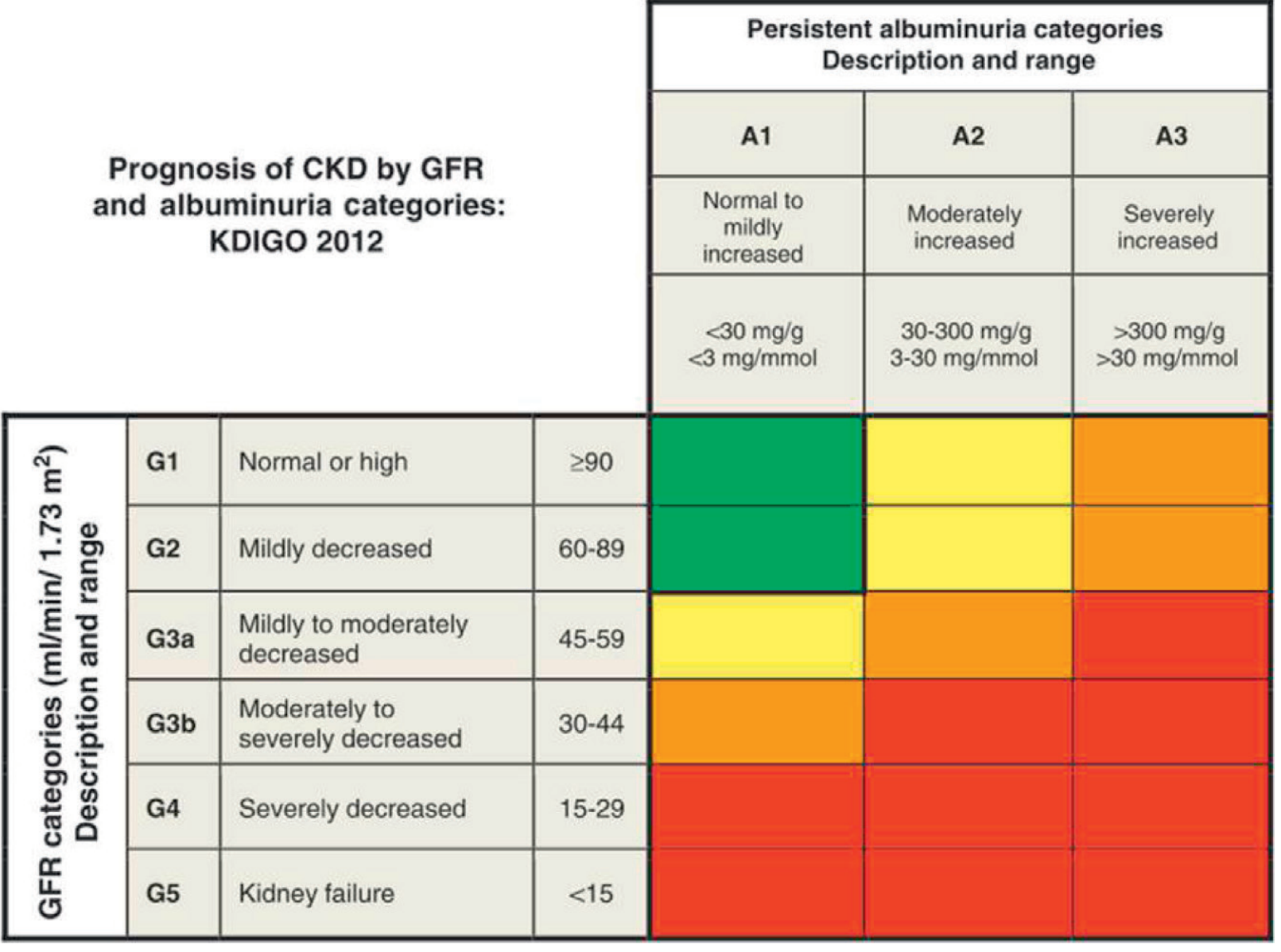
(Green = low risk, Yellow = moderate, Orange = high, Red = very high risk)
Main Causes (Etiology)
- Diabetes mellitus (Diabetic nephropathy) - sabse common
- Hypertension - dusra sabse bada cause
- Glomerulonephritis
- Polycystic kidney disease
- Recurrent UTIs / obstructive uropathy
Complications (Kya Kya Hota Hai)
| Complication | Mechanism |
|---|---|
| Anemia | Erythropoietin (EPO) production kam hoti hai kidneys mein - isliye red blood cells kam bante hain |
| Secondary Hyperparathyroidism | Phosphate retention + Vitamin D kam - PTH badh jaata hai |
| Metabolic Bone Disease (Renal Osteodystrophy) | Calcium-phosphate imbalance |
| Metabolic Acidosis | Acid excretion kam hoti hai |
| Hypertension | RAAS activation + fluid retention |
| Hyperkalemia | Potassium excretion fail hoti hai |
| Uremia | Toxic waste products blood mein accumulate hote hain |
| Cardiovascular Disease | CKD ka sabse common cause of death |
Workup (Jaanch)
CKD diagnosis hone par:
- Complete urinalysis
- Renal ultrasonography
- Serum creatinine + electrolytes
- Albumin-to-creatinine ratio
- Blood glucose (diabetes rule out/in)
- Blood pressure assessment
GFR calculate karne ke formulas:
- Cockcroft-Gault:
CCr = (140 - Age) × Weight / 72 × SCr(×0.85 if female) - MDRD equation (zyada accurate)
Treatment / Management
Stage 1-2: Risk Factor Control
- Diabetes control - HbA1C target
- BP control - target <130/80 mmHg
- Proteinuria kam karna
BP aur Renoprotective Drugs
- ACE inhibitors (jaise Ramipril, Enalapril) - diabetes + hypertension + proteinuria mein first choice
- Type 1 DM mein nephropathy progression rokta hai
- CV events bhi kam karta hai
- ARBs (jaise Losartan, Valsartan) - agar ACE inhibitor tolerate na ho
- ACE inhibitor + ARB ek saath mat do - isse AKI aur hyperkalemia ka risk badh jaata hai
- SGLT-2 inhibitors (jaise Empagliflozin) - emerging evidence - nephropathy progression rokne mein helpful
Stage 3: Monitor Complications
- Anemia check karo - EPO therapy ya iron supplements
- Bone disease check karo - Vitamin D, phosphate binders
- Nutrition assessment
- Neuropathy screening
Stage 4: Dialysis Ki Taiyari
- Nephrologist referral zaruri (GFR <30 par refer karo)
- AV fistula banana shuru karo dialysis ke liye
Stage 5: Renal Replacement Therapy
- Hemodialysis ya Peritoneal Dialysis
- Kidney Transplantation - best long-term option
- Uremia ke signs monitor karo
Nephrologist Ko Kab Refer Karen?
- GFR < 30 mL/min/1.73 m²
- Kidney disease ka cause unclear ho
- Anemia (refractory)
- Secondary hyperparathyroidism
- Metabolic bone disease
- Electrolyte abnormalities
Key Points Summary
- CKD = kidney damage 3 mahine se zyada
- Sabse common causes = Diabetes + Hypertension
- Stages G1-G5 (GFR based) + A1-A3 (albuminuria based)
- ACE inhibitor / ARB = cornerstone of treatment
- Stage 4-5 mein dialysis ya transplant ki zarurat padti hai
- Anemia, bone disease, CV disease - main complications
Sources: Textbook of Family Medicine 9e; Symptom to Diagnosis 4th Ed; Brenner & Rector's The Kidney; Comprehensive Clinical Nephrology 7th Ed
This is a shared conversation. Sign in to Orris to start your own chat.