
Course of ureter in prlvis
The ureter in the pelvis runs from the pelvic brim (where it crosses the bifurcation of the common iliac artery) down to the bladder. In females it passes under the uterine artery ("water under the bridge"), and in males it passes under the vas deferens.
Searching sources...
Reading File
Finding Sources
Finding Sources
Good results. Let me read the most relevant anatomy sections - the Color Atlas and Campbell-Walsh sections on pelvic ureter.
Reading File
Reading File
Reading File
Excellent - rich content from multiple textbooks. Let me fetch the anatomical diagram from Berek & Novak's Gynecology:
Loading Image
Reading File
I now have comprehensive, well-sourced information. Here is the complete answer:
Course of the Ureter in the Pelvis
Entry into the Pelvis
The ureter enters the lesser (true) pelvis by crossing the bifurcation of the common iliac artery (or sometimes the origin of the external iliac artery), anterior to the sacroiliac joint. This crossing point is the second site of constriction of the ureter (the first being the pelviureteric junction, the third being the intramural/intravesical portion).
- Fischer's Mastery of Surgery, p. 7629
General Course in the Pelvis
Once inside the pelvis, the ureter runs:
-
Retroperitoneally, just deep to the parietal peritoneum
-
Along the lateral wall of the pelvis, anterior to the internal iliac vessels, in extraperitoneal fatty tissue
-
At the level of the ischial spine, it curves anteromedially, superior to levator ani, to enter the bladder
-
Campbell-Walsh-Wein Urology, p. 2549
In the FEMALE (Clinically important)
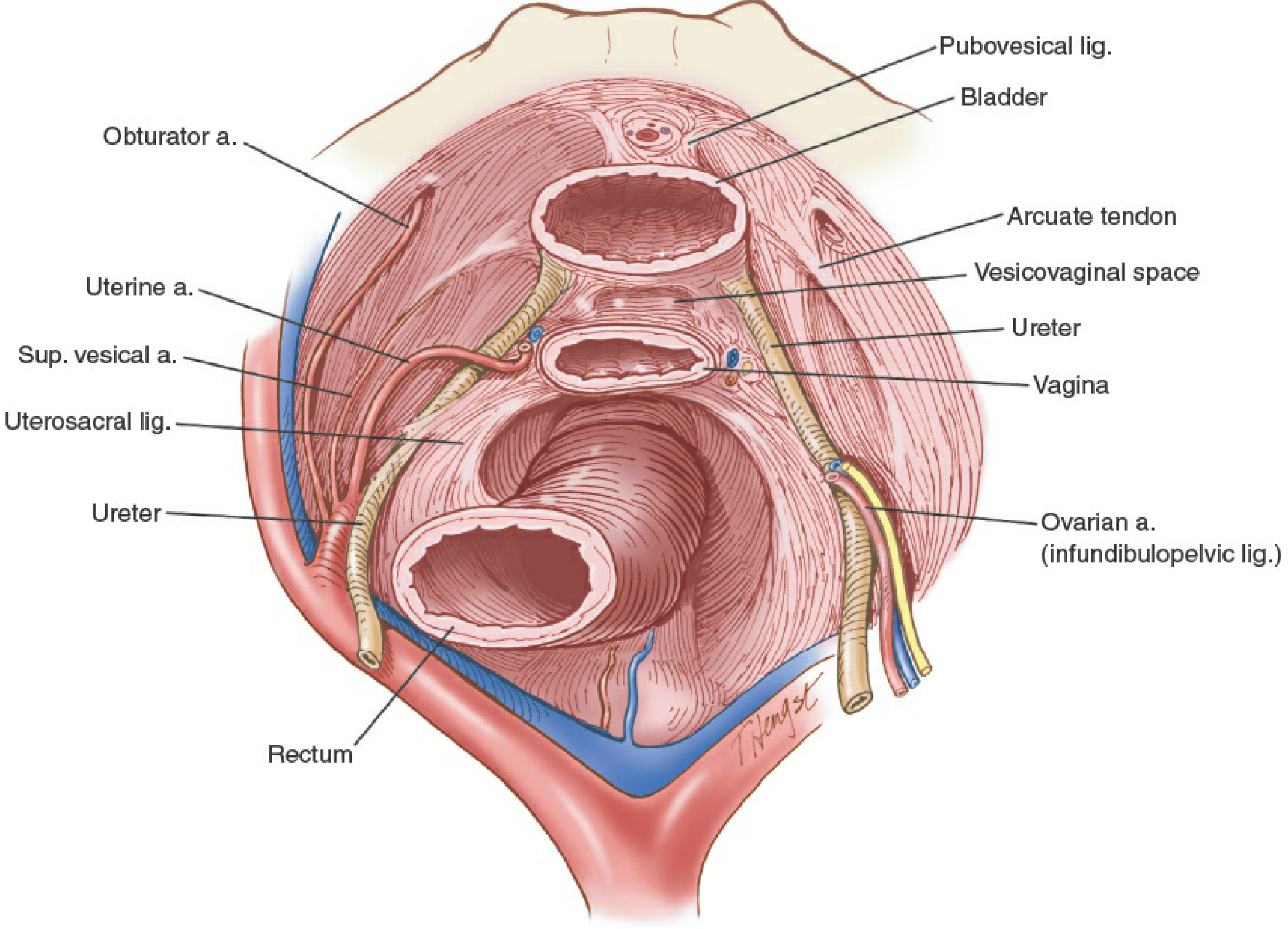
The pelvic ureter has 4 key relationships in the female (from Berek & Novak's Gynecology):
- Ovarian vessels - cross over the ureter as it approaches the pelvic brim; they lie lateral to the ureter as it enters the pelvis
- Broad ligament - as it descends into the pelvis, the ureter runs within the broad ligament just lateral to the uterosacral ligament, separating it from the mesosalpinx, mesovarium, and ovarian fossa
- Uterine artery - at the approximate level of the ischial spine, the ureter passes under the uterine artery in the base of the broad ligament (cardinal ligament) - the classic "water under the bridge" relationship. The ureter lies 2-3 cm lateral to the cervix at this point
- Anterior vaginal wall - the ureter turns medially to cross the anterior upper vagina as it enters the bladder wall
- Berek & Novak's Gynecology, p. 207
- Color Atlas of Human Anatomy Vol. 2, p. 408
The ureter is most vulnerable at point 3 (under the uterine artery). About 75% of all iatrogenic ureteral injuries are from gynecologic procedures; 91% occur at the level of the pelvic ureter. The risk is highest with laparoscopic hysterectomy.
In the MALE
-
The ureter runs beneath the peritoneum along the lateral pelvic wall
-
The only structure passing between the pelvic ureter and peritoneum is the ductus (vas) deferens
-
The ductus deferens crosses over the ureter within the ureteric fold of peritoneum - the ureter lies posterolateral to the vas deferens
-
The ureter then reaches the posterolateral wall of the bladder, just superior to the seminal vesicle, entering the posterosuperior angle of the bladder
-
Color Atlas of Human Anatomy Vol. 2, p. 408
-
Campbell-Walsh-Wein Urology, p. 2549
Intravesical (Intramural) Part
- The ureter passes obliquely through the bladder wall in an inferomedial direction, ~2 cm long
- This forms the third constriction of the ureter
- The internal pressure of the filling bladder collapses this passage, creating a valvular mechanism that prevents vesicoureteric reflux
Summary Table: 3 Constrictions of the Ureter
| Site | Level |
|---|---|
| Pelviureteric junction (PUJ) | Exit from renal pelvis |
| Pelvic brim | Crossing common iliac bifurcation |
| Intramural/intravesical | Passage through bladder wall |
These are the classic sites where urinary calculi get lodged.
This is a shared conversation. Sign in to Orris to start your own chat.