

create a flow chart for lymphatic drainage of the oral cavity with one illustrated diagram.
Anatomical diagram of lymphatic drainage of the oral cavity. Show a clean, labeled medical illustration of the head and neck in sagittal/lateral view with color-coded regions: tongue (anterior 2/3 and posterior), lips, cheeks, gingiva/teeth, and hard palate. Draw arrows showing lymphatic flow from each oral region to the corresponding lymph nodes: submental nodes (from tip of tongue, central lower lip), submandibular nodes (from cheeks, upper teeth/lip/gingiva), preauricular nodes (from lateral anterior tongue + lateral lower lip), lower deep cervical nodes (from medial anterior 2/3 tongue), superior deep cervical nodes (from posterior tongue), superficial cervical nodes (from parotid gland). Then show convergence to deep cervical chain, jugular lymphatic trunk, and finally internal jugular / brachiocephalic vein. Use soft medical illustration style, white background, clear labels, directional arrows.
Lymphatic Drainage of the Oral Cavity - Flow Chart
Illustrated Diagram
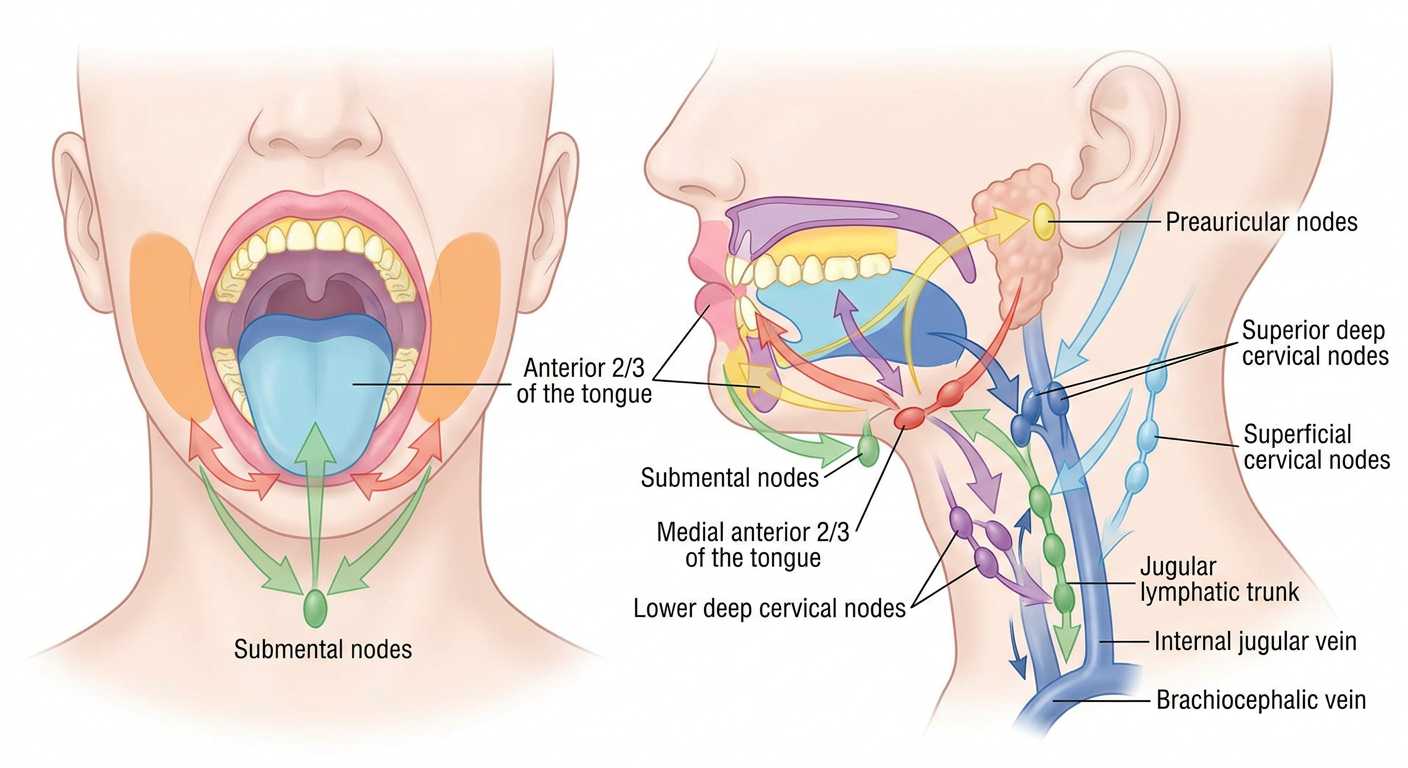
FLOWCHART: Lymphatic Drainage of the Oral Cavity
╔══════════════════════════════════════════════════════════════════════════════════╗
║                         ORAL CAVITY REGIONS                                     ║
╚══════════════════════════════════════════════════════════════════════════════════╝
                                    │
     ┌──────────────────────────────┼──────────────────────────────┐
     │                              │                              │
     ▼                              ▼                              ▼

┌────────────────────┐    ┌──────────────────────┐    ┌──────────────────────┐
│  TIP OF TONGUE     │    │  UPPER TEETH / LIP   │    │  CHEEKS              │
│  Central Lower     │    │  Gingiva + Lateral   │    │                      │
│  Gingiva & Lip     │    │  Lower Lip +         │    │                      │
│                    │    │  Lateral Anterior    │    │                      │
│                    │    │  Tongue              │    │                      │
└────────┬───────────┘    └──────────┬───────────┘    └──────────┬───────────┘
         │                           │                            │
         ▼                           ▼                            │
  ┌─────────────────┐   ┌────────────────────────┐               │
  │  SUBMENTAL      │   │ CHEEKS PREAURICULAR    │               │
  │  LYMPH NODES    │   │ LYMPH NODES            │               │
  └────────┬────────┘   └──────────┬─────────────┘               │
           │                       │                              │
           │                       ▼                              ▼
           │            ┌──────────────────────────────────────────────┐
           │            │         SUBMANDIBULAR LYMPH NODES            │
           │            └──────────────────────┬───────────────────────┘
           │                                   │
           └──────────────────┐                │
                              │                │
     ┌────────────────────────┼────────────────┘
     │                        │
     ▼                        ▼

┌──────────────────┐    ┌──────────────────────┐
│ MEDIAL ANTERIOR  │    │  POSTERIOR TONGUE    │
│ 2/3 of TONGUE    │    │                      │
└────────┬─────────┘    └──────────┬───────────┘
         │                         │
         ▼                         ▼
┌──────────────────────┐  ┌────────────────────────────┐
│ LOWER DEEP CERVICAL  │  │  SUPERIOR DEEP CERVICAL    │
│  LYMPH NODES         │  │  LYMPH NODES               │
└──────────┬───────────┘  └──────────────┬─────────────┘
           │                             │
           │      ┌──────────────────────┤
           │      │                      │
     ┌─────┘      │              ┌───────┘
     │            │              │
     ▼            │              ▼
     │     ┌──────────────────────────┐
     │     │  PAROTID GLANDS          │
     │     └──────────┬───────────────┘
     │                ▼
     │     ┌────────────────────────────────────┐
     │     │  SUPERFICIAL CERVICAL LYMPH NODES  │
     │     └──────────┬─────────────────────────┘
     │                │
     │     ┌──────────────────┐
     │     │ SUBMANDIBULAR    │
     │     │ GLANDS           │
     │     └──────┬───────────┘
     │            │
     ▼            ▼
╔═══════════════════════════════════╗
║    DEEP CERVICAL LYMPH CHAIN      ║
╚═══════════════════════════════════╝
                  │
                  ▼
╔═══════════════════════════════════╗
║    JUGULAR LYMPHATIC TRUNK        ║
╚═══════════════════════════════════╝
                  │
                  ▼
╔═══════════════════════════════════╗
║    INTERNAL JUGULAR VEIN  /       ║
║    BRACHIOCEPHALIC VEIN           ║
╚═══════════════════════════════════╝
Summary Table
| Oral Region | First-Order Lymph Nodes | Second-Order / Final Drainage |
|---|---|---|
| Tip of tongue, central lower gingiva & lip | Submental nodes | Deep cervical chain |
| Upper teeth, lip, gingiva + lateral lower lip | Cheeks Preauricular nodes → Submandibular nodes | Deep cervical chain |
| Cheeks | Submandibular nodes | Deep cervical chain |
| Medial, anterior 2/3 of tongue | Lower deep cervical nodes | Jugular lymphatic trunk |
| Posterior tongue | Superior deep cervical nodes | Jugular lymphatic trunk |
| Parotid glands | Superficial cervical nodes | Superior deep cervical nodes |
| Submandibular glands | Deep cervical lymph nodes | Jugular lymphatic trunk |
Key Clinical Points
- Midline structures (tip of tongue, central lower lip) drain bilaterally - first to submental nodes on both sides.
- Lateral structures (lateral tongue, cheeks) typically drain ipsilaterally to submandibular and preauricular nodes.
- Hard palate drains to upper cervical lymphatics and lateral retropharyngeal nodes (Cummings Otolaryngology, p. 1945).
- Skip metastases can occur - lymph from any oral region may bypass first-order nodes and drain directly into the deep cervical chain.
- All lymphatic drainage from the head and neck ultimately enters the venous circulation at the Internal Jugular or Brachiocephalic vein via the jugular lymphatic trunk.
- In oral cavity cancers, the most common first-echelon nodes involved are Level I (submental + submandibular) and Level II (upper deep cervical) nodes.
INNERVATION FOR oral cavity
innervation oral cavity trigeminal nerve tongue palate diagram
Innervation of the Oral Cavity
1. SENSORY INNERVATION (General Sensation)
Trigeminal Nerve (CN V) - the primary sensory nerve
| Region | Nerve | Branch |
|---|---|---|
| Upper teeth, upper gingiva, hard palate | CN V2 (Maxillary) | Greater palatine, lesser palatine, nasopalatine, superior alveolar nerves |
| Lower teeth, lower gingiva, floor of mouth | CN V3 (Mandibular) | Inferior alveolar nerve |
| Anterior 2/3 of tongue (general sensation) | CN V3 | Lingual nerve |
| Buccal mucosa / cheek | CN V3 | Buccal nerve |
| Lips (upper) | CN V2 | Infraorbital nerve |
| Lips (lower) | CN V3 | Mental nerve (terminal branch of inferior alveolar) |
Hard Palate - specific nerves (CN V2 branches):
- Greater palatine nerve - posterior hard palate mucosa
- Lesser palatine nerve - soft palate
- Nasopalatine nerve - anterior hard palate (transmits through incisive foramen)
Posterior 1/3 of tongue (general sensation):
- CN IX (Glossopharyngeal) - touch, pain, temperature
- CN X (Vagus, internal laryngeal branch) - most posterior base of tongue near epiglottis
Gray's Anatomy for Students: "The upper parts of the cavity, including the palate and the upper teeth, are innervated by branches of the maxillary nerve [V2]. The lower parts, including the teeth and oral part of the tongue, are innervated by branches of the mandibular nerve [V3]."
2. TASTE INNERVATION (Special Sensory)
ANTERIOR 2/3 TONGUE
Taste buds (fungiform + foliate papillae)
         │
         ▼
   Lingual nerve (CN V3) ──carries taste fibers from──▶ Chorda tympani (CN VII)
         │
         ▼
   Geniculate ganglion
         │
         ▼
   Nervus intermedius → Nucleus solitarius (brainstem)

─────────────────────────────────────────────────────────

POSTERIOR 1/3 TONGUE + CIRCUMVALLATE PAPILLAE
Taste buds + mucosa of vallecula + epiglottis
         │
         ▼
   CN IX (Glossopharyngeal) → Nucleus solitarius

─────────────────────────────────────────────────────────

SOFT PALATE
         │
         ▼
   Greater petrosal nerve (CN VII) → Pterygopalatine ganglion → Palatine nerves
KJ Lee's Essential Otolaryngology: Anterior 2/3 taste pathway: "Papillae → Afferent fibers → lingual nerve → chorda tympani (branch of facial nerve) → geniculate ganglion → intermediary nerve → nucleus solitarius."
3. MOTOR INNERVATION
Tongue muscles
| Muscle | Nerve |
|---|---|
| All intrinsic tongue muscles | CN XII (Hypoglossal) |
| All extrinsic tongue muscles (genioglossus, hyoglossus, styloglossus) | CN XII |
| Palatoglossus (exception) | CN X (Vagus) via pharyngeal plexus |
Soft palate muscles
| Muscle | Nerve |
|---|---|
| Levator veli palatini | CN X (Vagus) via pharyngeal plexus |
| Palatopharyngeus | CN X |
| Palatoglossus | CN X |
| Musculus uvulae | CN X |
| Tensor veli palatini (exception) | CN V3 (Mandibular nerve) |
Floor of mouth
| Muscle | Nerve |
|---|---|
| Mylohyoid | CN V3 (Nerve to mylohyoid) |
| Anterior belly of digastric | CN V3 (Nerve to mylohyoid) |
| Geniohyoid | C1 via CN XII |
Gray's Anatomy for Students: "All muscles of the tongue are innervated by the hypoglossal nerve [XII], except the palatoglossus, which is innervated by the vagus nerve [X]. All muscles of the soft palate are innervated by the vagus nerve [X], except for the tensor veli palatini, which is innervated by a branch from the mandibular nerve [V3]."
4. AUTONOMIC INNERVATION (Salivary Glands)
Parasympathetic innervation diagram:
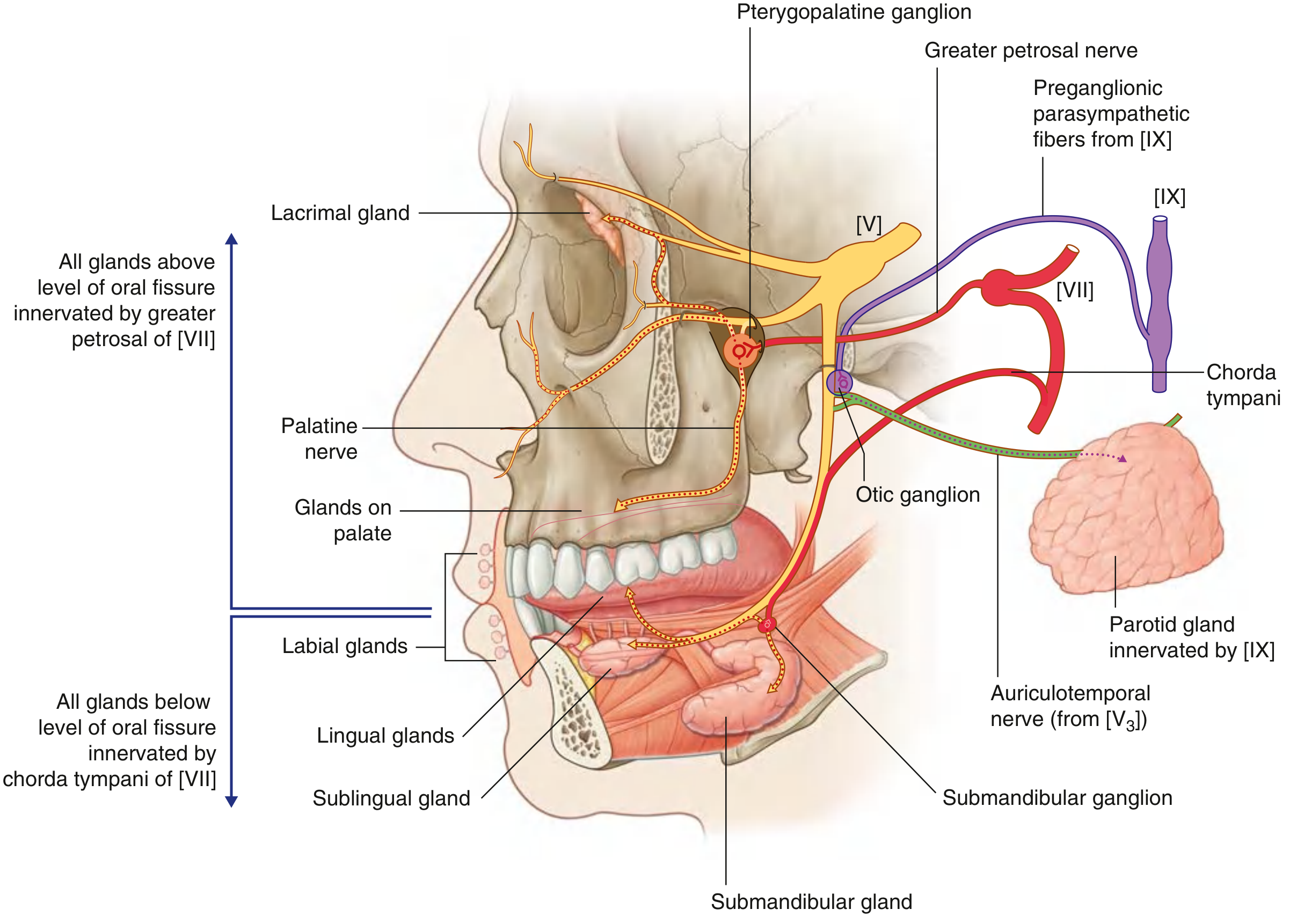
- Greater petrosal nerve (CN VII branch) → Pterygopalatine ganglion → Postganglionic fibers travel with CN V2 (palatine nerves) to target glands
- Chorda tympani (CN VII branch) → joins lingual nerve (CN V3) in infratemporal fossa → Submandibular ganglion → Postganglionic fibers to submandibular and sublingual glands
- CN IX (Glossopharyngeal) → Otic ganglion → Postganglionic fibers travel with auriculotemporal nerve (CN V3) to parotid
Sympathetic innervation:
- Origin: Spinal cord T1
- Synapse: Superior cervical sympathetic ganglion
- Distribution: Postganglionic fibers travel along blood vessels and branches of CN V to reach glands
QUICK REFERENCE SUMMARY
| Function | Nerve | Region |
|---|---|---|
| General sensation - upper oral cavity | CN V2 (Maxillary) | Palate, upper teeth, upper lip |
| General sensation - lower oral cavity | CN V3 (Mandibular) | Floor of mouth, lower teeth, lower lip |
| General sensation - ant. 2/3 tongue | CN V3 (Lingual nerve) | Oral tongue |
| General sensation - post. 1/3 tongue | CN IX | Tongue base |
| Taste - ant. 2/3 tongue | CN VII (Chorda tympani via lingual nerve) | Fungiform + foliate papillae |
| Taste - post. 1/3 tongue | CN IX | Circumvallate papillae, vallecula |
| Taste - soft palate | CN VII (Greater petrosal) | Palate |
| Motor - tongue (all muscles) | CN XII | Except palatoglossus |
| Motor - palatoglossus | CN X | Vagus |
| Motor - soft palate (all muscles) | CN X (Pharyngeal plexus) | Except tensor veli palatini |
| Motor - tensor veli palatini | CN V3 | Mandibular nerve |
| Motor - mylohyoid, ant. digastric | CN V3 | Nerve to mylohyoid |
| Parasympathetic - submandibular/sublingual glands | CN VII (Chorda tympani → submandibular ganglion) | Below oral fissure |
| Parasympathetic - palatal glands | CN VII (Greater petrosal → pterygopalatine ganglion) | Above oral fissure |
| Parasympathetic - parotid | CN IX → Otic ganglion → Auriculotemporal (V3) | Parotid |
| Sympathetic - all salivary glands | T1 → Superior cervical ganglion | Along blood vessels / CN V branches |
make a summary of innervation.
Innervation of the Oral Cavity - Summary
SENSORY (General Sensation)
| Region | Nerve |
|---|---|
| Upper teeth, gingiva, hard palate | CN V2 (Maxillary) |
| Lower teeth, gingiva, floor of mouth, buccal mucosa, anterior 2/3 tongue | CN V3 (Mandibular) |
| Posterior 1/3 tongue | CN IX (Glossopharyngeal) |
| Most posterior tongue base / epiglottis | CN X (Vagus) |
TASTE (Special Sensation)
| Region | Nerve |
|---|---|
| Anterior 2/3 tongue | Chorda tympani (CN VII) via lingual nerve |
| Posterior 1/3 tongue + circumvallate papillae | CN IX |
| Soft palate | Greater petrosal nerve (CN VII) |
MOTOR
| Structure | Nerve | Exception |
|---|---|---|
| All tongue muscles | CN XII (Hypoglossal) | Palatoglossus → CN X |
| All soft palate muscles | CN X (Vagus) via pharyngeal plexus | Tensor veli palatini → CN V3 |
| Mylohyoid + ant. digastric | CN V3 (nerve to mylohyoid) | - |
| Geniohyoid | C1 via CN XII | - |
AUTONOMIC (Salivary Glands)
| Gland | Parasympathetic Pathway |
|---|---|
| Submandibular + sublingual | CN VII (chorda tympani) → submandibular ganglion |
| Palatal + labial glands | CN VII (greater petrosal) → pterygopalatine ganglion |
| Parotid | CN IX → otic ganglion → auriculotemporal nerve (V3) |
| All glands (sympathetic) | T1 → superior cervical ganglion → along vessels / CN V |
KEY EXCEPTIONS TO REMEMBER
- Palatoglossus - only tongue muscle NOT by CN XII (it is CN X)
- Tensor veli palatini - only palate muscle NOT by CN X (it is CN V3)
- Chorda tympani carries taste but travels with the lingual nerve (CN V3) - two nerves, one trunk
- Parotid parasympathetics travel via CN IX but are delivered by CN V3 (auriculotemporal)