

Screenshot_20260823_161602.jpg
Explain this topic
analyse_media
Reading File
Finding Sources
Finding Sources
Searching PubMed
sulfonamide antibiotic resistance mechanism
Reading File
Sulfonamides
1. Introduction
Sulfonamides are synthetic antibacterial drugs built on a common sulfanilamide scaffold. By attaching different substituents to the amido group (–SO₂–NH–R) or the amino group (–NH₂) of this nucleus, chemists produce a whole family of drugs with different solubility, potency, pharmacokinetics, and antibacterial spectra - Katzung's Basic and Clinical Pharmacology, p. 1298.
A key pharmaceutical property: sulfonamides are far more soluble in alkaline solution than in acid. This is why most are formulated as sodium salts for IV use, and it also explains a classic toxicity - crystalluria - which is worse in acidic urine.
The structural relationship that makes them work is their similarity to p-aminobenzoic acid (PABA), a molecule bacteria need to make folate.
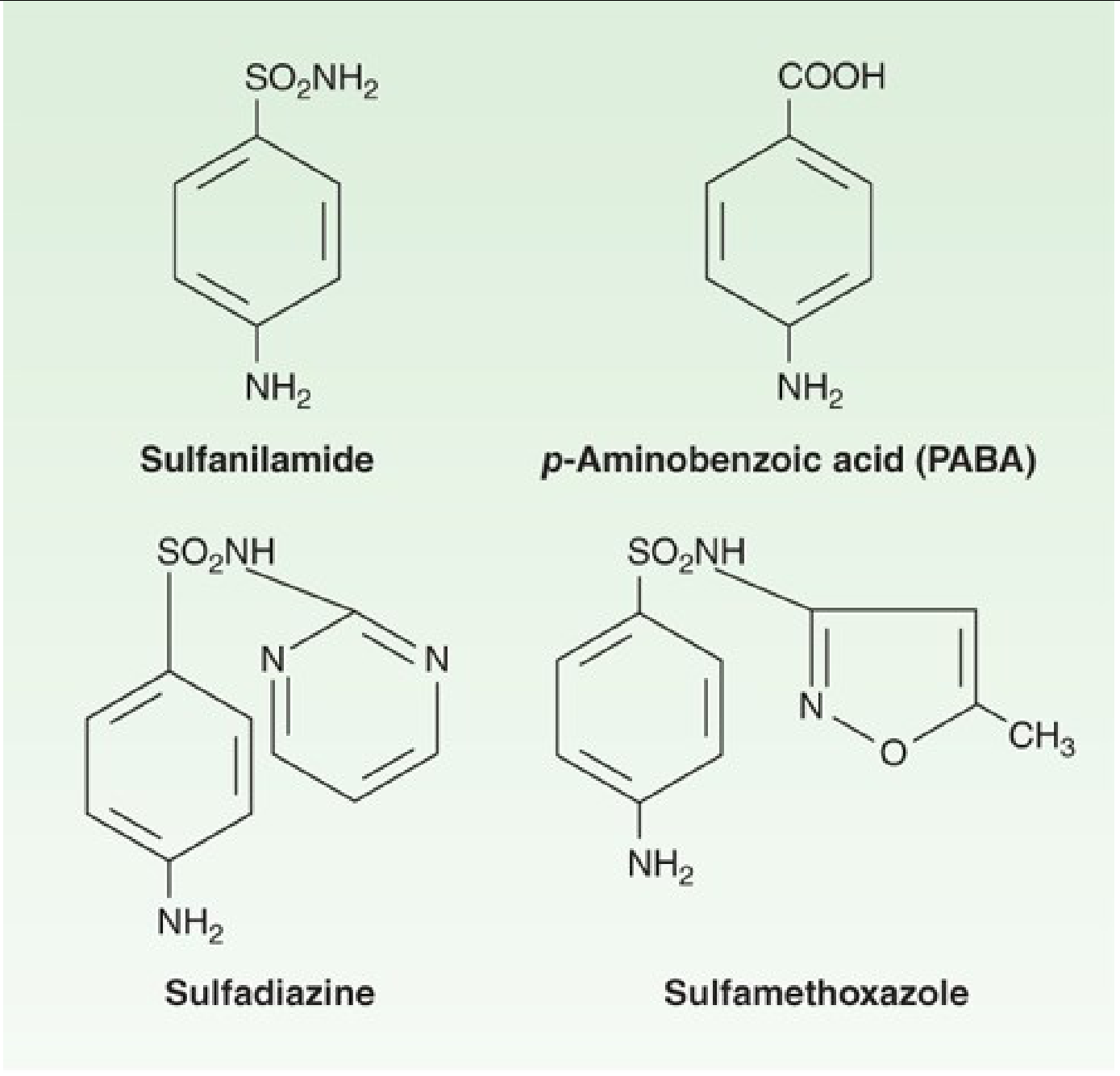
2. Structure
The sulfanilamide nucleus has three functionally important parts:
- p-aminobenzene ring - the core scaffold, structurally mimics PABA
- N1 substitution (on the sulfonamide/–SO₂NH– nitrogen) - determines solubility, potency, and pharmacokinetic behavior (half-life, protein binding, tissue penetration). This is where drugs differ from each other - e.g., sulfadiazine vs sulfamethoxazole.
- N4 free amino group (the aniline nitrogen) - this must remain free/unsubstituted for antibacterial activity, because it is this nitrogen that competes with PABA for the bacterial enzyme. If N4 is substituted (as in prodrugs like sulfasalazine before gut bacteria cleave it), the compound is inactive until released.
This is the classic structure-activity relationship taught for sulfonamides: modify N1 freely to tune drug properties, but keep N4 free to preserve antibacterial action.
3. Classification (by duration of action)
| Class | Duration | Examples |
|---|---|---|
| Short-acting | 4-8 hours | Sulfadiazine |
| Intermediate-acting | 8-12 hours | Sulfamethoxazole |
| Long-acting | ~7 days | Sulfadoxine, Sulfamethopyrazine |
| Special purpose | - | Sulfacetamide sodium (ophthalmic), Silver sulfadiazine (burns), Sulfasalazine (inflammatory bowel disease - locally acting prodrug), Mafenide (burns) |
The special-purpose agents illustrate how substituent changes redirect the same core molecule to very different clinical niches - topical antimicrobial for burns (silver sulfadiazine, mafenide), ophthalmic infection (sulfacetamide), or colon-targeted anti-inflammatory action (sulfasalazine, which is split by colonic bacteria into 5-ASA and sulfapyridine).
4. Mechanism of Action
Sulfonamides are bacteriostatic folate-synthesis inhibitors:
- Susceptible bacteria cannot take up preformed folate from their environment (unlike human cells, which get folate from the diet) - they must synthesize it de novo from PABA.
- Sulfonamides are structural analogs of PABA. They competitively inhibit dihydropteroate synthase, the bacterial enzyme that condenses PABA into dihydropteroic acid, an early step in folate synthesis - Katzung's Basic and Clinical Pharmacology, p. 1298.
- Blocking folate synthesis blocks production of purines and thymidine, and therefore nucleic acid (DNA/RNA) synthesis - which is why the effect is broadly described as inhibiting nucleic acid synthesis.
- Because mammalian cells use dietary (preformed) folate and don't rely on this bacterial pathway, sulfonamides are selectively toxic to bacteria.
Spectrum: active against many gram-positive (e.g., Staphylococcus) and gram-negative organisms (E. coli, Klebsiella, Salmonella, Shigella, Enterobacter), plus Nocardia and Chlamydia trachomatis, and some protozoa. Poor against anaerobes; Pseudomonas aeruginosa is intrinsically resistant; rickettsiae are not inhibited (may even be stimulated).
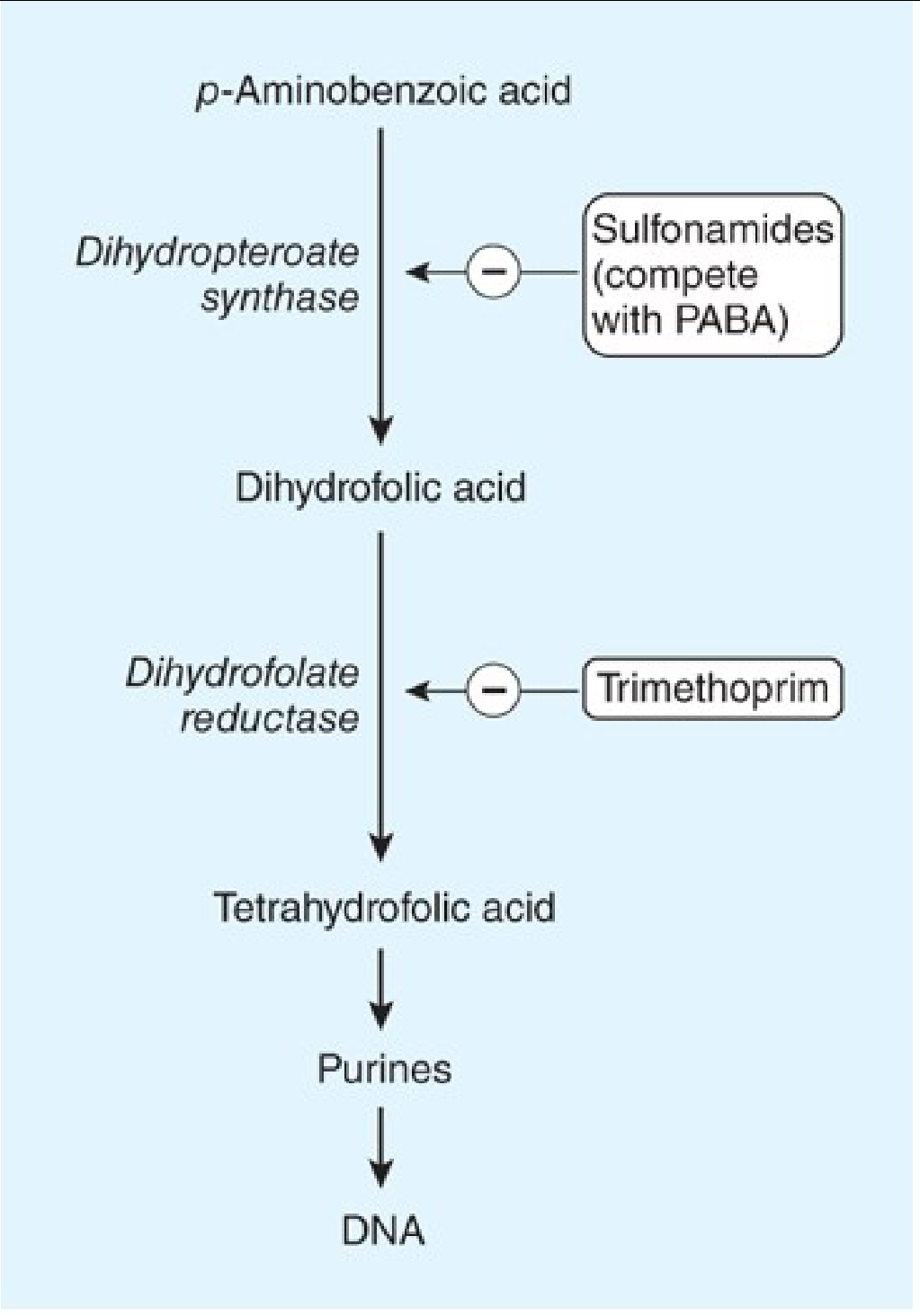
Synergy with trimethoprim: Trimethoprim inhibits the next enzyme in the same pathway, dihydrofolate reductase (which converts dihydrofolate to the active tetrahydrofolate). Combining a sulfonamide with trimethoprim (co-trimoxazole) produces sequential blockade of the same pathway at two steps, which is synergistic (bactericidal rather than merely bacteriostatic) and helps limit development of resistance - Goodman & Gilman's Pharmacological Basis of Therapeutics.
Resistance: Bacteria become resistant mainly through:
- Plasmid-encoded dihydropteroate synthase with low sulfonamide affinity (transmissible, spreads rapidly between bacteria)
- Chromosomal mutations altering the enzyme's affinity for sulfonamides
- Decreased bacterial permeability or drug efflux
- Overproduction of PABA, which outcompetes the drug
Note: a recent (2024) systematic review/meta-analysis on combining antibiotics and resistance (PMID: 39704726) discusses how antibiotic combinations like sulfonamide-trimethoprim affect resistance emergence - broadly consistent with the textbook teaching that combination therapy slows resistance, though real-world effects vary by pathogen and setting.
If you're preparing this for an exam or need the next sections (pharmacokinetics, adverse effects, clinical uses, or specific drug comparisons), let me know which to go deeper on.
This is a shared conversation. Sign in to Orris to start your own chat.