
Menstrual cycle
Reading File
Now let me search the medical library for menstrual cycle content in parallel.
Finding Sources
Finding Sources
Excellent sources found. Let me read the most comprehensive ones in parallel - Costanzo Physiology, Ganong's, and Berek & Novak's Gynecology.
Reading File
Reading File
Reading File
Great material. Let me now read further into Ganong's and Berek & Novak's for more detail on hormonal regulation, and also fetch the key diagram image.
Reading File
Reading File
Loading Image
Good. Let me read more from Berek & Novak's and also get the hormonal cycle diagram from Ganong's.
Reading File
Reading File
I have enough rich content from multiple authoritative textbooks. Let me fetch the uterine/ovarian cycle diagram from Ganong's and then compile the comprehensive answer.
Loading Image
I now have comprehensive material from multiple authoritative sources. Here is the full, detailed answer:
The Menstrual Cycle
The menstrual cycle is a series of recurring physiological changes in the female reproductive system driven by precisely timed hormonal interactions between the hypothalamus, anterior pituitary, ovaries, and uterus. Its primary purpose is to prepare the body for pregnancy each month.
Overview
The average cycle length is 28 days, counted from the first day of one menstrual period to the first day of the next. However, this is notoriously variable between women. By convention, Day 1 = first day of menstrual bleeding.
The cycle has two parallel tracks:
- Ovarian cycle: Follicular phase → Ovulation → Luteal phase
- Uterine (endometrial) cycle: Menstrual phase → Proliferative phase → Secretory phase
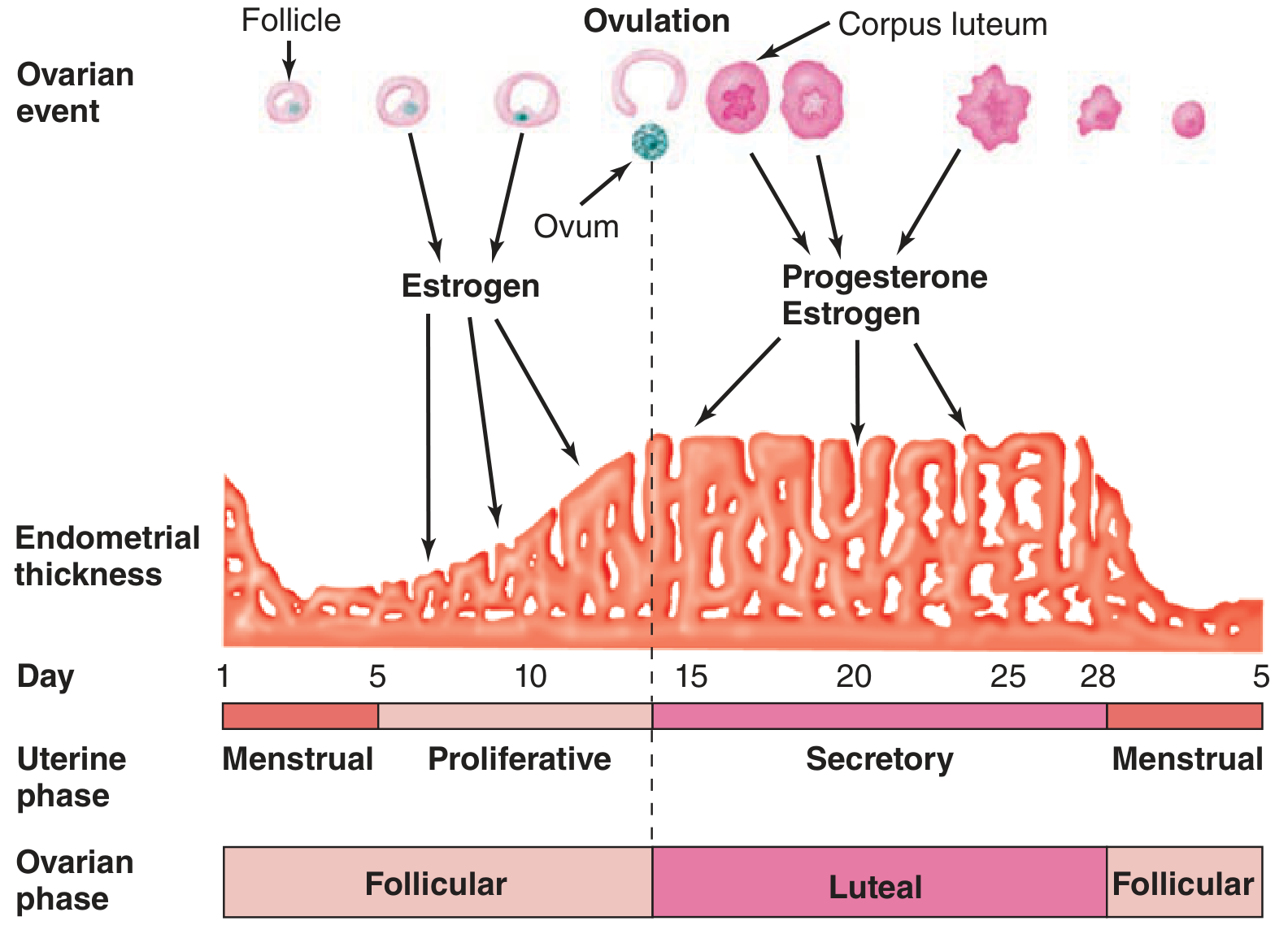
Ganong's Review of Medical Physiology, 26th Ed.
The Neuroendocrine Axis
The cycle is regulated through a 4-level axis:
1. Hypothalamus
- Secretes GnRH (gonadotropin-releasing hormone) in a pulsatile manner
- GnRH pulse frequency is critical: it determines the ratio of LH to FSH secreted by the pituitary
- Inputs from the limbic system, endorphins, and circulating hormones modulate GnRH release
- Endogenous opioids (endorphins, enkephalins, dynorphins) inhibit GnRH; their levels peak in the luteal phase and fall at menses
2. Anterior Pituitary
- Responds to GnRH by releasing FSH and LH (glycoproteins with identical α-subunits, differing β-subunits)
- FSH and LH drive follicular development and ovulation
3. Ovary
- Produces estrogen (mainly 17β-estradiol) and progesterone
- Theca interna cells produce androgens → aromatized to estrogen by granulosa cells
4. Uterus (endometrium)
- Target organ that responds to estrogen and progesterone with cyclic changes
Feedback loops: long (ovarian steroids → hypothalamus/pituitary), short (pituitary hormones → hypothalamus), and ultrashort (hypothalamic hormones → hypothalamus itself).
Phase 1: Follicular / Proliferative Phase (Days 1-14)
Ovarian Events
At the start of each cycle, rising FSH stimulates several primordial follicles to enlarge and develop a fluid-filled cavity (antrum). Around Day 6, one dominant follicle is selected - likely the one most capable of secreting estrogen needed for final maturation. The others undergo apoptotic atresia.
The dominant follicle grows into the Graafian follicle, whose granulosa cells secrete increasing amounts of estradiol.
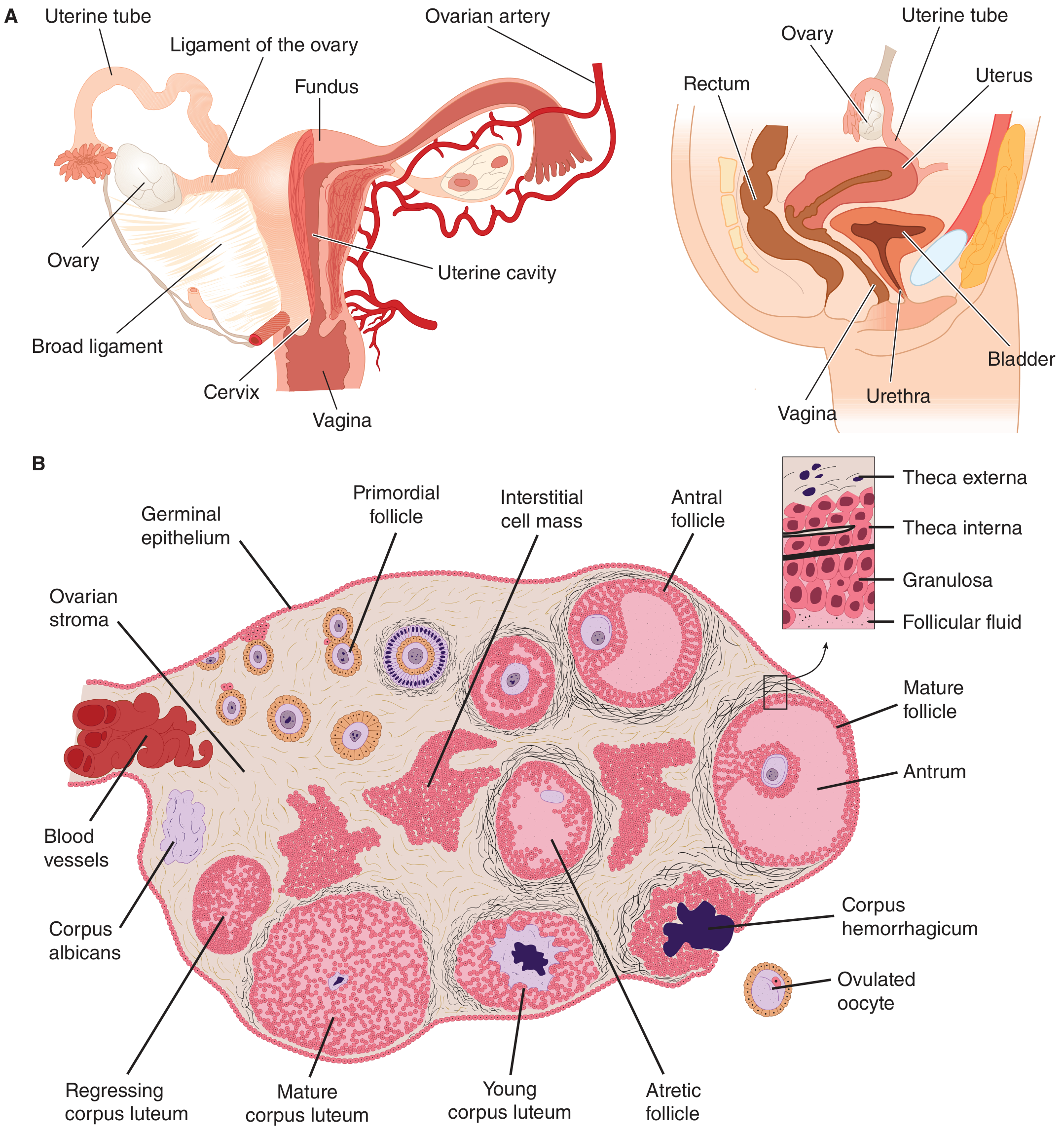
Ganong's Review of Medical Physiology, 26th Ed.
Uterine Events (Proliferative Phase)
Rising estradiol drives endometrial proliferation:
- Endometrium thickens rapidly (Days 5-14)
- Uterine glands lengthen but do not yet secrete
- Spiral arteries elongate
- Cervical mucus becomes copious, watery, elastic, and shows "ferning" on a glass slide (channels form, allowing sperm penetration)
Ovulation (Day ~14)
Rising estradiol eventually exceeds a threshold and switches from negative to positive feedback on the pituitary, triggering the LH surge. This surge causes:
- Completion of the first meiotic division in the oocyte (secondary oocyte + first polar body)
- Rupture of the Graafian follicle at ~Day 14
- Extrusion of the ovum into the abdominal cavity, where it is swept into the fallopian tube by the fimbriae
Minor bleeding into the peritoneal cavity at ovulation can cause transient lower abdominal pain - "Mittelschmerz".
Phase 2: Luteal / Secretory Phase (Days 14-28)
Ovarian Events
The ruptured follicle fills with blood (corpus hemorrhagicum), then granulosa and theca cells proliferate and differentiate into lipid-rich luteal cells, forming the corpus luteum. Its development depends on an adequate blood supply (VEGF is essential).
The corpus luteum secretes both estrogen and progesterone, with progesterone dominating.
- If no pregnancy: corpus luteum degenerates by ~Day 24 (forming the corpus albicans), hormone levels fall, endometrium is shed
- If pregnancy occurs: hCG from the embryo rescues the corpus luteum, which persists through the first trimester
Uterine Events (Secretory Phase)
Under progesterone's influence:
- Endometrial proliferation slows; thickness decreases slightly
- Glands become tortuous and coiled, fill with glycogen vacuoles, increase mucus secretion
- Stroma becomes edematous
- Spiral arteries elongate further and coil
- Cervical mucus becomes thick, non-elastic, non-ferning (no longer permeable to sperm)
The secretory phase is remarkably constant at ~14 days. Variations in total cycle length reflect differences in follicular phase duration.
Menstruation (Days 1-4)
When the corpus luteum regresses, estrogen and progesterone fall abruptly. The endometrium loses hormonal support:
- Endometrium thins
- Spiral arteries undergo vasospasm (driven by locally released prostaglandins, especially PGF₂α)
- Ischemia → necrosis → sloughing of the stratum functionale (the deep stratum basale is spared, supplied by short basilar arteries)
- Bleeding begins
Menstrual blood is ~75% arterial, contains tissue debris, prostaglandins, and fibrinolysin (which lyses clots - explaining why menstrual blood normally does not clot; clots suggest heavy flow).
Summary Table
| Feature | Follicular / Proliferative | Luteal / Secretory |
|---|---|---|
| Days (28-day cycle) | 1-14 | 14-28 |
| Dominant hormone | Estrogen (estradiol) | Progesterone (+estrogen) |
| Dominant structure | Growing follicle | Corpus luteum |
| Endometrium | Thickening, gland elongation | Tortuous glands, glycogen, edema |
| Cervical mucus | Watery, ferning, sperm-friendly | Thick, non-ferning |
| FSH/LH trend | FSH rises → LH surge at Day 14 | LH falls after ovulation |
| Duration variability | Variable | Fixed ~14 days |
Oocyte Numbers Over a Lifetime
- Fetal ovaries: >7 million primordial follicles
- At birth: ~2 million (50% already atretic)
- At puberty: <300,000
- Only ~500 follicles ovulate in a lifetime; the rest undergo atresia
Key Clinical Points
- Ferning of cervical mucus = estrogen effect (follicular phase); its absence = progesterone effect (luteal phase)
- Mittelschmerz = midcycle pain at ovulation
- Prostaglandins drive menstrual cramping (dysmenorrhea) by causing uterine vasoconstriction and myometrial contractions
- Premenstrual symptoms may relate to withdrawal of endogenous opioids in the luteal-menstrual transition; naltrexone has been shown to relieve some premenstrual symptoms
- Prolactin inhibits GnRH pulsatility → disrupts the cycle (explains lactational amenorrhea)
Sources: Ganong's Review of Medical Physiology, 26th Ed. | Costanzo Physiology, 7th Ed. | Berek & Novak's Gynecology
This is a shared conversation. Sign in to Orris to start your own chat.