
Succus entericus
Reading File
Succus entericus is the collective term for the secretions of the small intestinal mucosa (intestinal juice). It is produced by the crypts of Lieberkuhn and Brunner's glands, with a daily output of roughly 1-3 liters.
Searching sources...
Finding Sources
Finding Sources
Finding Sources
Reading File
Finding Sources
Finding Sources
Finding Sources
Finding Sources
Finding Sources
Finding Sources
Reading File
Reading File
Now I have comprehensive information. Let me also fetch the diagram of the crypt of Lieberkuhn from the textbook.
Loading Image
Here is a detailed breakdown of Succus Entericus (intestinal juice):
Succus Entericus
Definition: Succus entericus is the collective name for the secretions of the small intestinal mucosa. It is secreted by cells lining the intestinal wall in response to mechanical stimulation by chyme. - Rosen's Emergency Medicine, p. 1277
Source / Anatomy of Secretion
The small intestinal mucosa contains small pits between the villi called crypts of Lieberkühn. The epithelium lining both the crypts and the villi consists of two main cell types:
- Goblet cells - secrete mucus that lubricates and protects intestinal surfaces
- Enterocytes - secrete large quantities of water and electrolytes in the crypts, then reabsorb these along with digestion products over the adjacent villi surfaces
In addition, Brunner's glands (found in the duodenal submucosa) contribute an alkaline, mucus-rich secretion that protects the proximal duodenum from gastric acid.
The epithelial cells deep in the crypts undergo continuous mitosis, migrating up toward villus tips over a life cycle of about 5 days. This rapid turnover also allows quick repair of mucosal excoriations. - Guyton and Hall Textbook of Medical Physiology
Volume and Physical Properties
| Property | Value |
|---|---|
| Daily volume | ~1,800 mL/day (some estimates up to 3 L) |
| pH | 7.5 - 8.0 (slightly alkaline) |
| Composition | Almost pure extracellular fluid |
The secretions are produced by crypts and rapidly reabsorbed by the villi, providing a watery vehicle for nutrient absorption when chyme contacts the villus surface.
Mechanism of NaCl and Fluid Secretion
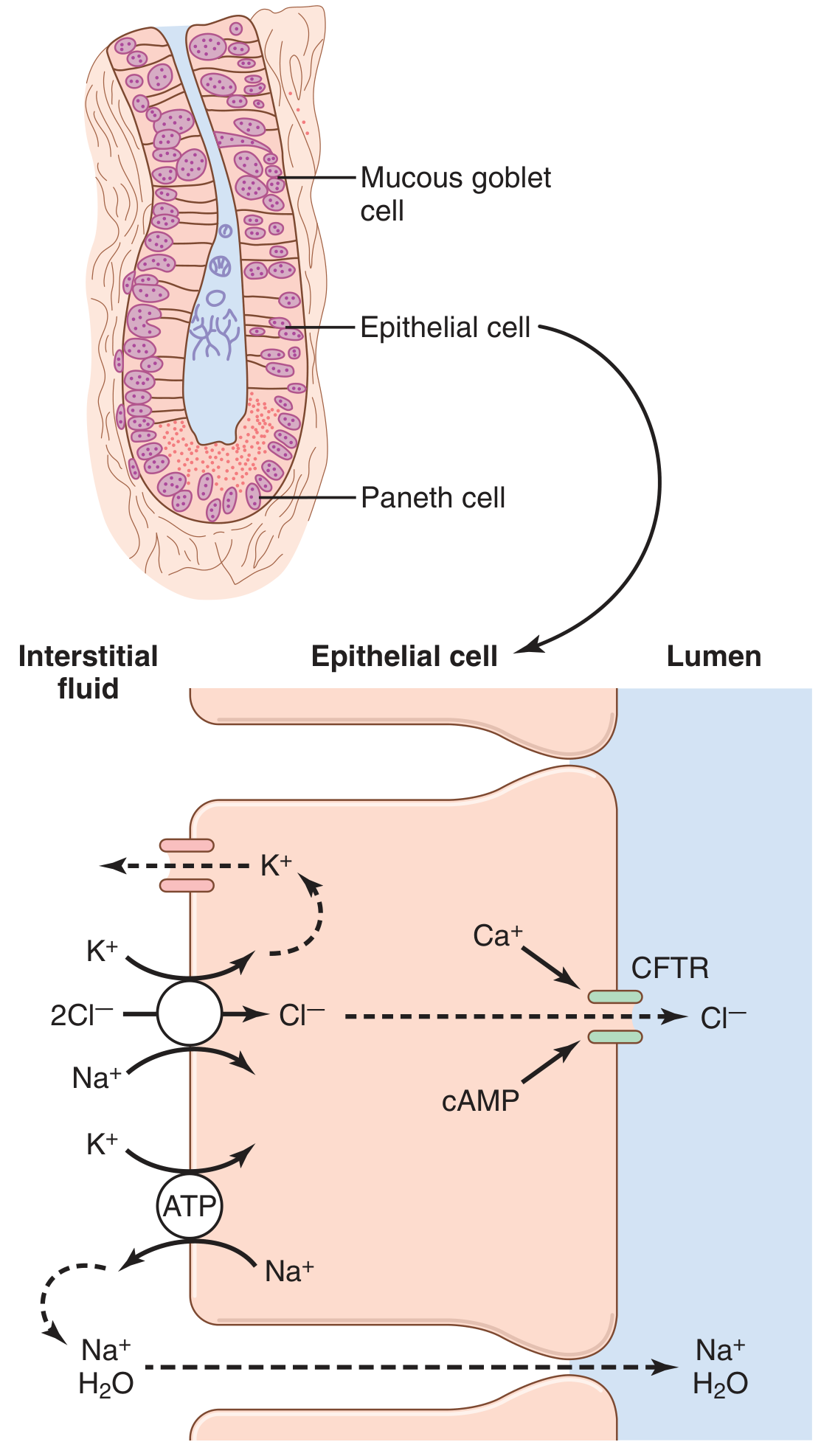
Figure: Crypt of Lieberkühn with goblet cells and Paneth cells (top); mechanism of NaCl and water secretion by the epithelial crypt cell (bottom). - Guyton and Hall Textbook of Medical Physiology
The secretory mechanism works as follows:
- Na⁺-K⁺-ATPase on the basolateral membrane creates a low intracellular Na⁺ concentration
- This drives Na⁺-K⁺-2Cl⁻ co-transporter entry of NaCl into the cell
- K⁺ is recycled out via basolateral K⁺ channels
- Cl⁻ exits through luminal CFTR chloride channels (also other Cl⁻ channels)
- CFTR is regulated by secretagogues (acetylcholine, histamine, gut peptides) via cAMP and Ca²⁺
- Cl⁻ secretion causes electrochemical drag of Na⁺ through the paracellular pathway
- NaCl secretion into the lumen causes osmotic movement of water into the lumen
Net result: large amounts of NaCl and fluid secreted into the crypt lumen. - Guyton and Hall Textbook of Medical Physiology
Enzymes in Succus Entericus
When intestinal secretions are collected without cellular debris, they contain almost no enzymes. The digestive enzymes are actually located in the brush border (microvilli membrane) of the enterocytes, not free in the luminal fluid. Key brush border enzymes include:
- Enteropeptidase (enterokinase) - activates trypsinogen to trypsin; the master activator of pancreatic proteases
- Disaccharidases: lactase, sucrase, maltase, alpha-dextrinase
- Peptidases: cleave small peptides into amino acids
So enzymatic digestion is largely a contact/membrane-bound process at the brush border, rather than occurring freely in the intestinal juice itself.
Regulation of Secretion
- Primarily regulated by local enteric nervous reflexes
- The most important stimulus: tactile or irritative stimuli from chyme in the intestinal lumen
- Increased intestinal dilation (as in obstruction) amplifies secretion, causing further fluid accumulation proximal to the blockage - Rosen's Emergency Medicine, p. 1277
Clinical Relevance
| Context | Significance |
|---|---|
| Small bowel obstruction (SBO) | Succus entericus accumulates proximal to the block, causing distension, peristalsis, vomiting, and fluid/electrolyte loss |
| Cholera | Cholera toxin triggers massive Cl⁻ secretion via cAMP, causing life-threatening secretory diarrhea |
| Ileal atresia | Presence of succus entericus-derived meconium downstream helps indicate timing of the vascular insult in utero |
| Ileostomy | Succus entericus is highly irritating to periostomal skin due to its alkalinity and enzyme content (more so than colostomy effluent) - Schwartz's Principles of Surgery |
| Implant/visceral erosion | Leakage of succus entericus causes intense tissue inflammation - Campbell-Walsh-Wein Urology |
| Colorectal cancer protection | The alkaline, mucus-rich succus entericus of the small bowel may have protective capacity compared to the more solid colonic contents - Maingot's Abdominal Operations |
Summary
Succus entericus is an alkaline (pH 7.5-8.0), nearly enzyme-free extracellular fluid secreted at ~1,800 mL/day by the crypts of Lieberkühn. Its primary role is to provide a fluid vehicle for nutrient absorption at the villus surface. Actual digestion is performed by brush-border membrane-bound enzymes, not by free enzymes in the juice itself. Secretion is driven by CFTR-mediated Cl⁻ transport and regulated mainly by local enteric reflexes responding to luminal mechanical stimuli.
This is a shared conversation. Sign in to Orris to start your own chat.