
Electrotherapy in Orthopaedics 10marks pg answer with flow chart and images
electrotherapy in orthopaedics TENS ultrasound shortwave diathermy LASER types uses
https://www.physiotherapyequipments.com/blog-electrotherapy-…
Flowchart of Electrotherapy in Orthopaedics showing classification of modalities: 1) Thermal (Shortwave Diathermy, Microwave Diathermy, Ultrasound), 2) Non-thermal/Electrical (TENS, IFT, EMS/NMES, Galvanic stimulation), 3) Photobiomodulation (LASER therapy), 4) Mechanical (Traction, Shockwave). Each branch shows indications, mechanism, and clinical uses. Clean medical education flowchart style with boxes and arrows.
Medical diagram showing TENS (Transcutaneous Electrical Nerve Stimulation) electrode placement on human body for pain management, with Gate Control Theory of pain explanation showing dorsal horn, large fibers blocking small fibers, and the spinal cord pathway. Educational anatomy style diagram for orthopaedics.
400, message: Got more than 4194304 bytes when reading: b'data: {"candidates": [{"content": {"role": "model","parts": [{"inlineData": {"mimeType": "image/png"...'.
We encountered an error while processing your request. Please try again or reach out to us for help.
Retry
electrotherapy orthopaedics 10 marks exam answer TENS IFT shortwave diathermy laser ultrasound indications contraindications
A clean medical education flowchart titled "Electrotherapy in Orthopaedics" showing the classification tree: Top box "ELECTROTHERAPY" branching into 4 main categories: 1) THERMAL MODALITIES (boxes: Shortwave Diathermy SWD, Microwave Diathermy MWD, Ultrasound Therapy), 2) ELECTRICAL STIMULATION (boxes: TENS, IFT Interferential Therapy, EMS/NMES, Galvanic), 3) PHOTOBIOMODULATION (box: LASER Therapy LLLT), 4) MECHANICAL-ELECTRICAL (boxes: Shockwave Therapy, PEMF Pulsed Electromagnetic Field, Bone Stimulator). Under each leaf box, small text showing one key use. White background, blue and green color scheme, clear arrows and boxes.
Medical education diagram showing Gate Control Theory of Pain for TENS (Transcutaneous Electrical Nerve Stimulation). Left side shows electrode placement on skin over painful area (knee joint). Center shows spinal cord dorsal horn cross-section with: large diameter A-beta fibers (TENS activates), small diameter C fibers (pain), substantia gelatinosa "gate" mechanism. Arrows show how TENS closes the gate to block pain signals. Right side shows brain with endorphin release. Labels: "TENS electrodes", "A-beta fibers (touch/vibration)", "C fibers (pain)", "Gate closed = pain relief", "Endorphin release". Clean blue and orange diagram on white background.
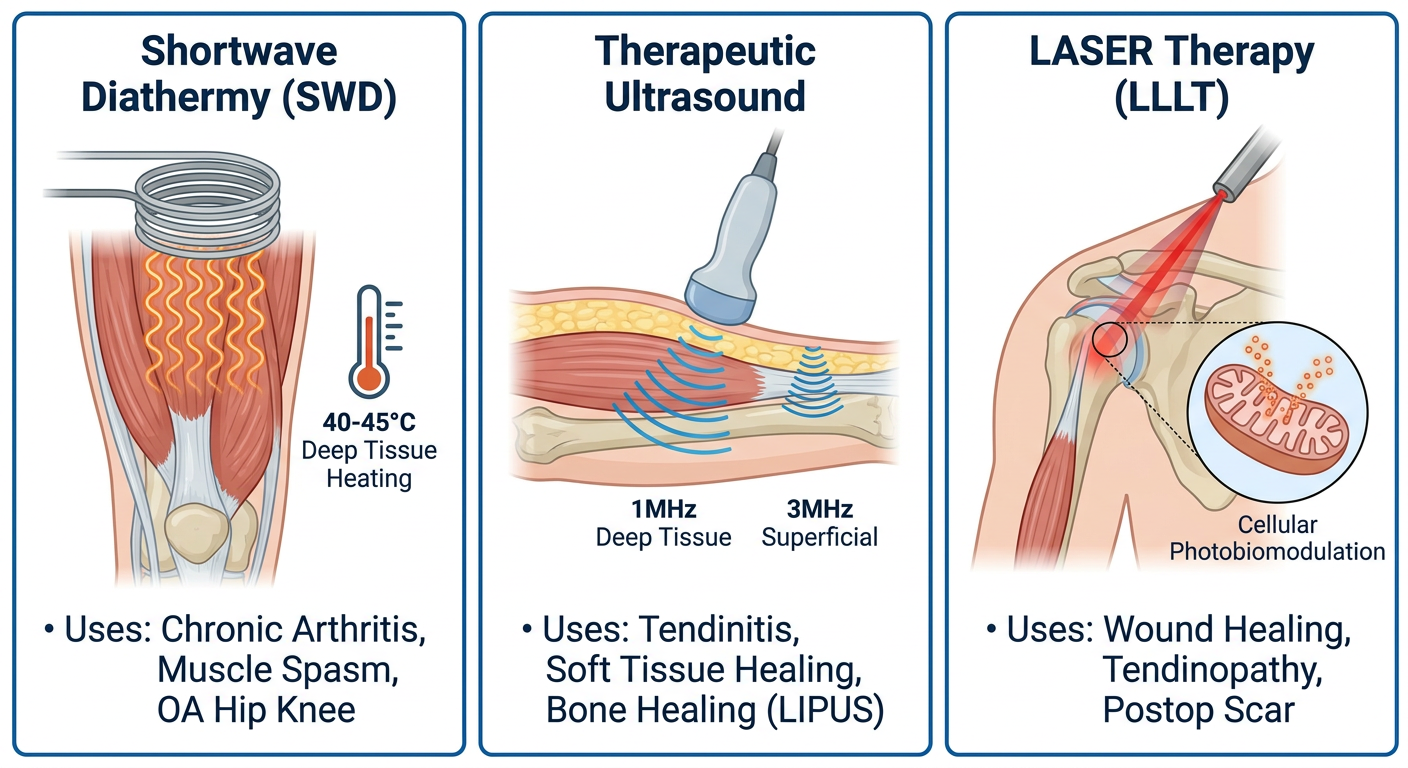
Medical diagram comparing three main electrotherapy modalities used in orthopaedics. Three panels side by side: Panel 1 "Shortwave Diathermy (SWD)" - shows electromagnetic waves penetrating deep muscle tissue, coil applicator, temperature gauge showing 40-45 degrees C deep tissue heating, labeled uses: chronic arthritis, muscle spasm, OA hip knee. Panel 2 "Therapeutic Ultrasound" - shows probe on skin with sound waves penetrating to tendon and bone, 1MHz deep tissue vs 3MHz superficial, labeled uses: tendinitis, soft tissue healing, bone healing (LIPUS). Panel 3 "LASER Therapy (LLLT)" - shows laser probe emitting red/infrared light into tissue, cellular photobiomodulation shown at mitochondria level, labeled uses: wound healing, tendinopathy, postop scar. Clean medical textbook illustration style, white background.
Electrotherapy in Orthopaedics
Definition
Classification Flowchart
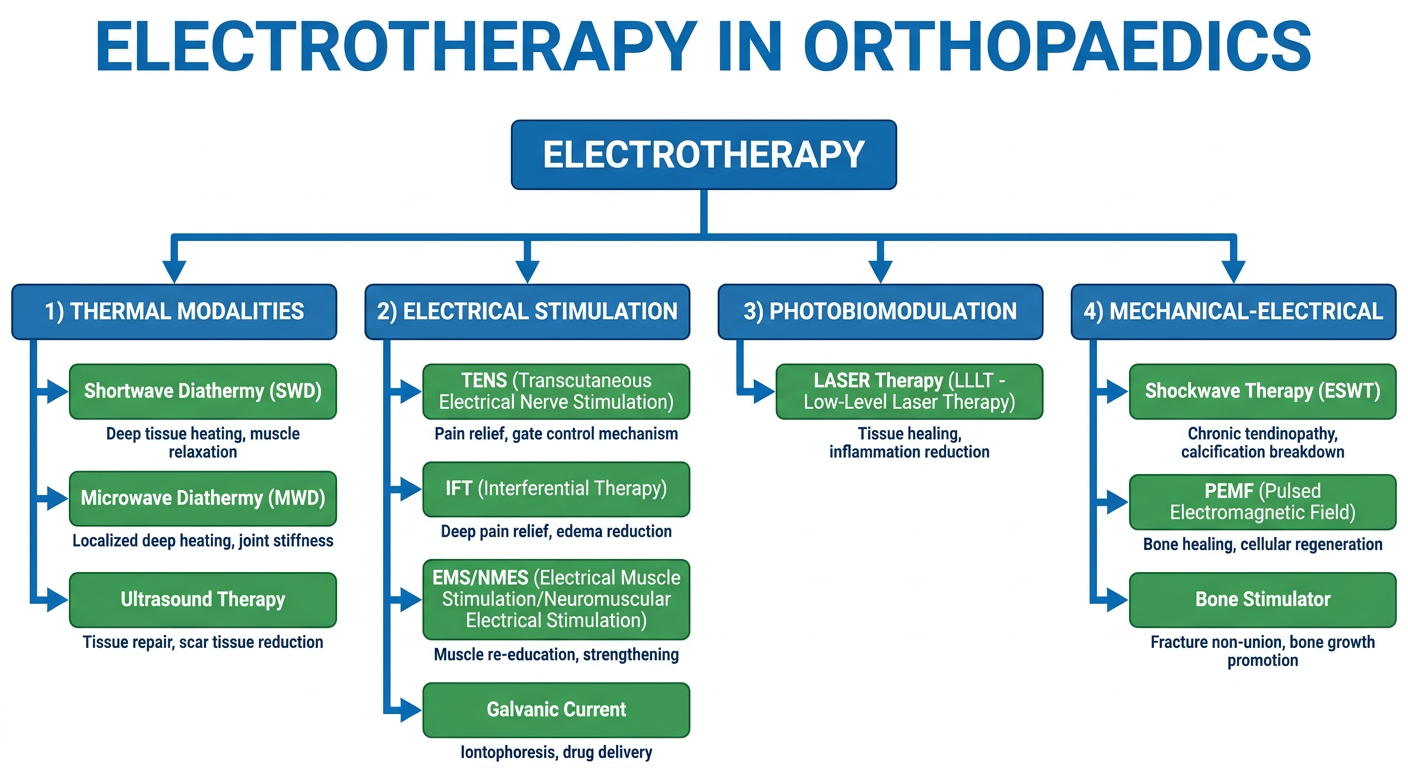
1. THERMAL MODALITIES
A. Shortwave Diathermy (SWD)
- Principle: Uses high-frequency electromagnetic waves (27.12 MHz) to produce deep tissue heating
- Types:
- Continuous SWD - produces thermal effects (deep heating 3-5 cm)
- Pulsed SWD (PSWD) - produces non-thermal (athermal) effects, suitable for acute conditions
- Physiological effects:
- Increases deep tissue temperature to 40-45°C
- Increases blood flow and metabolic rate
- Reduces muscle spasm, joint stiffness, and pain
- Promotes collagen extensibility
- Orthopaedic Indications:
- Osteoarthritis (hip, knee)
- Chronic back pain and cervical spondylosis
- Frozen shoulder (adhesive capsulitis)
- Post-fracture stiffness
- Bursitis and tenosynovitis
- Contraindications: Metallic implants (absolute), pacemakers, malignancy, active infection, pregnancy (over gravid uterus), impaired sensation
B. Microwave Diathermy (MWD)
- Principle: Uses microwave radiation (2450 MHz or 915 MHz) to heat superficial muscles (depth: 3-4 cm)
- Advantage over SWD: More localized heating; easier application
- Indications: Superficial joint pain, muscle spasms, soft tissue injuries
- Contraindications: Similar to SWD; additionally avoid near eyes (cataract risk)
C. Therapeutic Ultrasound (US Therapy)
- Principle: High-frequency sound waves (1 MHz and 3 MHz) cause tissue vibration producing:
- Thermal effects (continuous mode): collagen softening, increased extensibility
- Non-thermal/mechanical effects (pulsed mode): cavitation, acoustic streaming, cell membrane permeability
- Parameters:
- 1 MHz: penetrates deeper (up to 5 cm) - for deep muscles, tendons
- 3 MHz: superficial (1-2 cm) - for superficial tendons, ligaments
- Special use - LIPUS (Low-Intensity Pulsed Ultrasound):
- Intensity: 30 mW/cm²
- Accelerates fracture healing - stimulates osteoblasts and promotes callus formation
- Used for delayed union, non-union fractures
- Orthopaedic Indications:
- Tendinitis (Achilles, rotator cuff, patellar)
- Plantar fasciitis
- Calcific deposits (phonophoresis)
- Soft tissue contractures
- Fracture healing (LIPUS)
- Post-surgical adhesions and scar tissue
- Contraindications: Over malignancy, thrombophlebitis, over gonads, over growing epiphyses in children, over spinal cord after laminectomy
2. ELECTRICAL STIMULATION MODALITIES
A. TENS (Transcutaneous Electrical Nerve Stimulation)
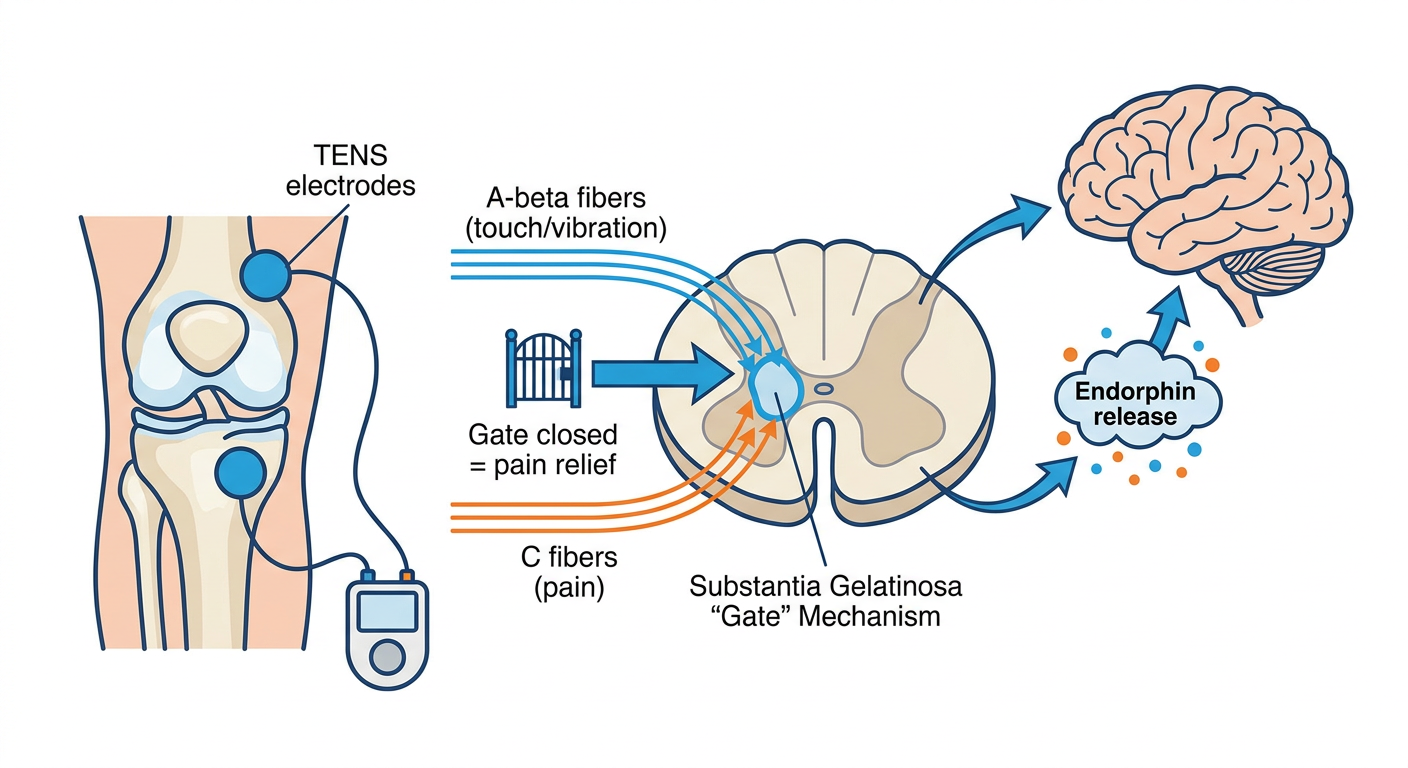
- Principle: Delivers low-voltage electrical pulses through skin electrodes
- Mechanism - Two theories:
- Gate Control Theory (Melzack & Wall): TENS activates large myelinated A-beta fibers → closes the "pain gate" in the dorsal horn (substantia gelatinosa) → blocks transmission of pain signals from thin C-fibers and A-delta fibers
- Endogenous Opioid Theory (High-frequency TENS): Stimulates release of endorphins and enkephalins from the CNS
- Types of TENS:
| Type | Frequency | Pulse Width | Mechanism | Effect |
|---|---|---|---|---|
| Conventional (High-freq) | 80-150 Hz | 10-50 μs | Gate control | Rapid but short-duration relief |
| Acupuncture-like (Low-freq) | 1-10 Hz | 200-300 μs | Endorphin release | Slower onset, longer duration |
| Burst mode | 1-4 Hz (bursts of 80-100 Hz) | Variable | Both | Moderate relief |
- Orthopaedic Indications:
- Acute and chronic musculoskeletal pain
- Post-operative pain (reduces analgesic requirement)
- Low back pain, neck pain
- Osteoarthritis pain
- Phantom limb pain
- Sports injuries
- Contraindications: Pacemaker (absolute), over carotid sinus, over skin with impaired sensation, in pregnancy (over uterus), in epilepsy
B. Interferential Therapy (IFT)
- Principle: Two medium-frequency currents (e.g., 4000 Hz and 4001-4100 Hz) applied simultaneously to produce a low-frequency interference pattern (1-100 Hz) deep within tissues - bypasses skin resistance
- Advantage: Penetrates deeper than TENS without skin discomfort; treats a larger area
- Indications: Chronic joint pain (OA), back and neck pain, post-fracture rehabilitation, oedema reduction, muscle stimulation
- Contraindications: Same as TENS; also avoid over active malignancy
C. Neuromuscular Electrical Stimulation (NMES / EMS)
- Principle: Electrical impulses stimulate motor nerves to produce muscle contractions
- Orthopaedic uses:
- Quadriceps strengthening after ACL reconstruction, knee arthroplasty
- Prevention of disuse atrophy during immobilization
- Re-education of denervated or weakened muscles
- Functional Electrical Stimulation (FES) in spinal cord injury
- Parameters: Frequency 30-80 Hz; pulse width 200-400 μs; duty cycle 1:3 (work:rest)
D. Galvanic Stimulation / Iontophoresis
- Principle: Direct current (DC) used to drive ionized drug molecules through skin into tissues (iontophoresis)
- Drugs used: Dexamethasone (anti-inflammatory), acetic acid (calcific deposits), lidocaine (local anaesthesia)
- Indications: Calcific tendinitis, epicondylitis, plantar fasciitis, local pain control
3. PHOTOBIOMODULATION (LASER Therapy)
- Full form: Low-Level Laser Therapy (LLLT) / Cold Laser / Photobiomodulation Therapy (PBMT)
- Principle: Specific wavelengths of light (630-1000 nm, typically 650 nm red or 810-1064 nm near-infrared) are absorbed by mitochondrial chromophores (cytochrome c oxidase), stimulating:
- ATP production
- Reduced oxidative stress
- Anti-inflammatory mediator release
- Collagen synthesis and cell proliferation
- Orthopaedic Indications:
- Tendinopathy (Achilles, rotator cuff)
- Osteoarthritis pain relief
- Post-surgical wound and scar healing
- Lateral epicondylitis (tennis elbow)
- Neck and back pain
- Contraindications: Over malignancy, over thyroid, pregnancy, directly into eyes (protective goggles mandatory)
4. MECHANICAL-ELECTRICAL MODALITIES
A. Extracorporeal Shockwave Therapy (ESWT)
- Principle: High-energy acoustic shock waves applied to musculoskeletal tissues → microtrauma → neovascularization → healing
- Indications:
- Plantar fasciitis (most common)
- Calcific rotator cuff tendinitis
- Lateral epicondylitis
- Non-union fractures
- Achilles tendinopathy
- Types: Focused ESWT vs Radial ESWT
- Contraindications: Coagulopathy, malignancy at site, over growth plates in children
B. PEMF (Pulsed Electromagnetic Field Therapy) / Bone Stimulators
- Principle: Time-varying electromagnetic fields induce weak electrical currents in bone → stimulate osteogenesis
- Mechanism: Increases calcium uptake, osteoblast differentiation, and bone mineral density
- Indications:
- Delayed union and non-union of fractures
- Avascular necrosis (early stages)
- Osteoporosis (adjunct)
- Stress fractures
- Types: Capacitive coupling vs Inductive coupling devices
- Advantage: Non-invasive, can be used with cast/splint in place
Comparative Overview of Modalities
| Modality | Depth | Primary Use | Key Feature |
|---|---|---|---|
| SWD | 3-5 cm | Chronic arthritis, stiffness | Deep heating |
| Ultrasound | 1-5 cm | Tendinitis, fracture healing | Thermal + mechanical |
| TENS | Superficial nerves | Pain relief (acute/chronic) | Gate control |
| IFT | Deep (4-5 cm) | Joint pain, oedema | Beats low-frequency interference |
| NMES | Motor nerves | Muscle strengthening | Motor re-education |
| LASER | 1-4 cm | Tendinopathy, wound healing | Photobiomodulation |
| ESWT | 3-12 cm | Plantar fasciitis, calcific tendinitis | Neovascularization |
| PEMF | Through bone | Non-union fractures, AVN | Bone stimulation |
Contraindications Common to Most Electrotherapy Modalities
| Category | Examples |
|---|---|
| Implants | Cardiac pacemaker, cochlear implant, spinal stimulator |
| Malignancy | Active cancer at treatment site |
| Vascular | Active thrombophlebitis, arterial disease |
| Neurological | Impaired sensation, epilepsy (electrical modalities) |
| Pregnancy | Over gravid uterus (all thermal; TENS at low back) |
| Infection | Acute infection or open wounds (thermal) |
| Hemorrhage | Acute bleeding or hemarthrosis |
Clinical Protocol - Practical Approach
ORTHOPAEDIC PATIENT
        |
        |--- ACUTE condition (< 2 weeks)?
        |         YES → Pulsed SWD / TENS / Pulsed Ultrasound / IFT (low intensity)
        |         NO  → Continuous SWD / Continuous Ultrasound / IFT / LASER
        |
        |--- FRACTURE healing issue?
        |         → LIPUS (Low-Intensity Pulsed Ultrasound) / PEMF Bone Stimulator
        |
        |--- TENDINOPATHY / SOFT TISSUE?
        |         → Ultrasound + LASER + ESWT (refractory cases)
        |
        |--- MUSCLE WEAKNESS / ATROPHY?
        |         → NMES / EMS
        |
        |--- PAIN MANAGEMENT (home)?
                  → TENS (portable unit)
Summary Points for Exam
- Electrotherapy acts via pain gate control, endorphin release, thermal tissue effects, photobiomodulation, and piezoelectric bone stimulation
- LIPUS is the only FDA-approved electrotherapy modality specifically for fracture non-union
- PEMF devices can be used through casts - unique advantage in fracture management
- IFT penetrates deeper than TENS because medium-frequency currents have lower skin impedance
- SWD is absolutely contraindicated with metallic implants in the field due to localized heating risk
- ESWT has the strongest evidence for plantar fasciitis and calcific rotator cuff tendinitis
- Pulsed modes are used in acute conditions to avoid heating; continuous modes for chronic conditions requiring deep heat