I now have rich, comprehensive content from multiple authoritative sources. Let me compile the complete answer.
Immunization: Complete Guide to Vaccine Types and Details
Sources: Harrison's Principles of Internal Medicine 22E (2025), Red Book 2021 (AAP), Sherris & Ryan's Medical Microbiology 8E, Jawetz Medical Microbiology 28E, Medical Microbiology 9E
What Is Immunization?
Immunization is the process of conferring protection against a specific infectious disease, either by stimulating the body's own immune system (active immunization) or by providing preformed antibodies (passive immunization). Few medical interventions of the past century have had greater impact on longevity, quality of life, and economic savings. Twenty-two diseases are now vaccine-preventable in the United States, and most vaccine-preventable childhood diseases are at historically low levels.
1. Types of Immunity
A. Active Immunization
Administration of all or part of a microorganism (or a modified product thereof - e.g., toxoid, purified antigen, or recombinant antigen) to evoke an immunologic response and clinical protection that mimics natural infection, with little or no risk to the recipient. Protection may result in:
- Antitoxin activity
- Anti-adherence activity
- Anti-invasive activity
- Neutralizing antibody
- Cell-mediated immunity
Some vaccines confer nearly complete lifelong protection; others must be readministered periodically.
B. Passive Immunization
Administration of preformed antibodies (immune globulin, hyperimmune serum) to confer immediate but temporary protection. Does not produce memory.
C. Combined Passive + Active Immunization
Used in some diseases (e.g., tetanus, diphtheria, rabies) where passive immunization provides immediate (but temporary) protection while the vaccine builds long-lasting active immunity. Injections are given at separate sites.
2. Vaccine Classification
Vaccines are broadly categorized as Live or Inactivated.
CATEGORY 1: Live (Attenuated) Vaccines
Definition: Contain living microorganisms that have been weakened (attenuated) so they replicate enough to trigger a strong immune response but do not cause disease.
| Feature | Detail |
|---|
| Immune response | Very strong; mirrors natural infection; stimulates both humoral + cellular immunity |
| Duration | Usually lifelong with 1-2 doses |
| Risk | May rarely revert to virulence; can cause disease in immunocompromised hosts |
| Storage | Require strict cold chain (heat-sensitive) |
| Use in immunocompromised | Generally contraindicated |
| Use in pregnancy | Generally contraindicated (live viral) |
Examples:
| Vaccine | Disease |
|---|
| MMR (Measles, Mumps, Rubella) | Measles, mumps, rubella |
| MMRV | Measles, mumps, rubella, varicella |
| Varicella (VAR) | Chickenpox |
| Zoster (ZVL - Zostavax) | Shingles (older formulation) |
| OPV (Sabin - oral polio) | Polio (not used in US since 2000) |
| LAIV (FluMist) | Influenza (ages 2-49 only) |
| Rotavirus (RV1, RV5) | Rotavirus gastroenteritis |
| Yellow Fever | Yellow fever |
| BCG | Tuberculosis |
| Typhoid (Ty21a - oral) | Typhoid fever |
| Cholera (oral) | Cholera |
| Dengue (CYD-TT) | Dengue (seropositive ages 9-16) |
Note on OPV: The live oral polio vaccine was replaced in the United States in 2000 by inactivated polio vaccine (IPV) because it could rarely revert to virulence - causing vaccine-associated paralytic polio (VAPP). This is a classic example of the risk/benefit calculation of live vaccines.
CATEGORY 2: Inactivated Vaccines
The term "inactivated vaccines" encompasses several sub-types. These vaccines cannot replicate or cause disease. They are generally safe even in immunocompromised patients but typically require multiple doses and boosters.
2a. Whole-Cell Inactivated (Killed)
Entire organism killed (by heat, chemical, or radiation).
| Feature | Detail |
|---|
| Examples | Whole-cell pertussis (wP), inactivated influenza (IIV), HAV, IPV (Salk) |
| Response | Weaker than live vaccines; mainly humoral |
| Doses | Multiple + boosters usually needed |
2b. Toxoid Vaccines
Produced by inactivating bacterial exotoxins with formaldehyde, converting the toxic protein to a non-toxic "toxoid." Stimulates antibodies that neutralize the toxin.
| Vaccine | Disease | Organism |
|---|
| DT / Td / Tdap | Diphtheria + Tetanus | C. diphtheriae, C. tetani |
| Tetanus toxoid | Tetanus | Clostridium tetani |
| Diphtheria toxoid | Diphtheria | Corynebacterium diphtheriae |
2c. Subunit / Protein Vaccines
Contain only specific antigens (proteins or polysaccharides) from the pathogen, not the whole organism.
| Vaccine | Type | Disease |
|---|
| Acellular pertussis (aP in DTaP/Tdap) | Protein subunit | Pertussis |
| Hepatitis B (HepB) | Recombinant protein (HBsAg) | Hepatitis B |
| HPV (Gardasil-9) | Virus-like particle (VLP) | HPV/cervical cancer |
| Influenza (RIV - Flublok) | Recombinant protein | Influenza |
| Zoster (RZV - Shingrix) | Recombinant glycoprotein E + adjuvant | Shingles |
| RSV (Abrysvo, Arexvy) | Recombinant prefusion F protein | RSV |
2d. Polysaccharide Vaccines (Pure)
Use the polysaccharide capsule of encapsulated bacteria. T-cell independent response; poor immunogenicity in children <2 years.
| Vaccine | Disease |
|---|
| PPSV23 (Pneumovax) | Pneumococcal disease (23 serotypes) |
| MPSV4 | Meningococcal disease |
| Vi polysaccharide (injectable typhoid) | Typhoid |
2e. Conjugate Vaccines
Polysaccharide antigens chemically linked ("conjugated") to a carrier protein to convert the response to T-cell dependent, dramatically improving immunogenicity in infants.
| Vaccine | Disease | Conjugate protein |
|---|
| Hib (PRP-T, PRP-OMP) | H. influenzae type b | Tetanus toxoid or meningococcal OMP |
| PCV15, PCV20 (Prevnar) | Pneumococcal disease | Carrier protein |
| MenACWY (Menveo, Menactra) | Meningococcal ACWY | Diphtheria or CRM197 |
| MenB (Bexsero, Trumenba) | Meningococcal B | Factor H binding protein |
2f. Virus-Like Particle (VLP) Vaccines
Self-assembling proteins that mimic the virus surface; no genetic material, cannot replicate.
| Vaccine | Disease |
|---|
| HPV vaccine (Gardasil-9) | HPV types 6,11,16,18,31,33,45,52,58 |
| HepB vaccine (some formulations) | Hepatitis B |
2g. mRNA Vaccines (Nucleic Acid)
Encode the antigen (mRNA) encapsulated in lipid nanoparticles. The cell's own machinery translates the mRNA into viral protein, triggering immunity. No DNA involvement; mRNA degraded rapidly.
| Vaccine | Disease |
|---|
| Comirnaty (Pfizer-BioNTech) | COVID-19 |
| Spikevax (Moderna) | COVID-19 |
| mRNA-1345 (Moderna mRESVIA) | RSV |
2h. Viral Vector Vaccines
A harmless modified virus (e.g., adenovirus) acts as a delivery vehicle carrying genetic code for the target antigen.
| Vaccine | Disease |
|---|
| Janssen/J&J (adenovirus 26) | COVID-19 |
| Oxford-AstraZeneca (ChAdOx1) | COVID-19 |
| rVSV-ZEBOV (Ervebo) | Ebola |
3. Summary Table: Vaccine Types at a Glance
| Type | Mechanism | Immunity | Boosters? | Safe in immunocompromised? | Examples |
|---|
| Live attenuated | Weakened live organism | Strong, long-lasting | Usually not | NO | MMR, varicella, LAIV, BCG, OPV |
| Killed/inactivated | Killed whole organism | Moderate | Yes | Yes | IPV, HAV, IIV, whole-cell pertussis |
| Toxoid | Inactivated toxin | Anti-toxin | Yes | Yes | Tetanus, diphtheria |
| Subunit/protein | Purified antigen | Moderate | Often | Yes | HepB, aP, RZV (Shingrix) |
| Polysaccharide | Capsular sugar | Poor in <2 yrs | Yes | Yes | PPSV23, Vi typhoid |
| Conjugate | Polysaccharide + protein | Good in infants | Varies | Yes | Hib, PCV, MenACWY |
| VLP | Virus shell protein | Good | Sometimes | Yes | HPV (Gardasil-9) |
| mRNA | Lipid nanoparticle + mRNA | Good | Yes (annual) | Yes | COVID-19 (Pfizer, Moderna) |
| Viral vector | Modified carrier virus | Good | Sometimes | Caution | COVID-19 (J&J), Ebola |
4. US Vaccine-Preventable Diseases (2024-2025)
Per Harrison's 22E (Table 129-1), 22 diseases are now preventable with routinely administered vaccines:
| Disease | Target Population |
|---|
| Pertussis | Children, adolescents, adults |
| Diphtheria | Children, adolescents, adults |
| Tetanus | Children, adolescents, adults |
| Poliomyelitis | Children |
| Measles | Children |
| Mumps | Children |
| Rubella / Congenital rubella | Children |
| Hepatitis B | Children + high-risk adults |
| H. influenzae type b | Children + high-risk adults |
| Hepatitis A | Children + high-risk adults |
| Influenza | All ages |
| Varicella | Children |
| Pneumococcal disease | Children + older adults |
| Meningococcal ACWY | Adolescents + high-risk |
| Meningococcal B | High-risk |
| Rotavirus | Infants |
| HPV / cervical cancer | Adolescents + young adults |
| Zoster | Older adults |
| RSV | Infants, pregnant persons |
| COVID-19 | All ages |
| Dengue | High-risk children (endemic areas) |
| Mpox | High-risk adults |
5. Vaccine Impact: Pre-vaccine vs. Current Case Numbers (USA)
| Disease | Pre-vaccine cases (avg/yr) | 2023 cases | Reduction |
|---|
| Smallpox | 29,005 | 0 | 100% |
| Diphtheria | 21,053 | 2 | >99% |
| Measles | 530,217 | 47 | >99% |
| Paralytic Polio | 16,316 | 0 | 100% |
| Rubella | 47,745 | 3 | >99% |
| Pertussis | 200,752 | 5,611 | 97% |
| Tetanus | 580 | 15 | 97% |
| Varicella | 4,085,120 | 26,919 | 99% |
| Hib (<5 yrs) | 20,000 | 27 | >99% |
6. Key Immunologic Concepts
Herd Immunity
When enough of a population is vaccinated, unvaccinated individuals are also protected because the pathogen cannot spread. Threshold varies:
- Measles: ~95% coverage required (highly transmissible)
- Polio: ~80% coverage needed
Adjuvants
Substances added to vaccines to enhance the immune response. Examples:
- Aluminum salts (alum) - used in HepB, DTaP, HPV
- AS01B (liposome + MPL + QS-21) - used in Shingrix (RZV)
- MF59 (squalene oil emulsion) - used in Fluad (adjuvanted flu for elderly)
Correlates of Protection
Measurable immune parameters that predict protection:
- Antibody titer (e.g., anti-HBs ≥10 mIU/mL for HepB)
- Serum neutralizing antibody (measles, polio)
- For some (pertussis, RSV), serum antibody does not fully predict protection
7. Administration Details
| Route | Vaccines | Needle Length (adults) |
|---|
| Intramuscular (IM) | DTaP, Tdap, HepA, HepB, HPV, IPV, influenza, PCV, MenACWY, RZV | 1 inch (<70 kg); 1-1.5 inch (70-90 kg); 1.5 inch (>90 kg) |
| Subcutaneous (SC) | MMR, MMRV, varicella, yellow fever, PPSV23 | 5/8-inch needle, upper outer triceps |
| Intranasal | LAIV (FluMist) | N/A |
| Intradermal | Mpox (JYNNEOS) | N/A |
| Oral | Rotavirus, oral typhoid (Ty21a) | N/A |
Key points:
- Aspiration before injection is not required - no large vessels at injection sites
- Multiple vaccines may be given at the same visit - safe and encouraged
- If two injections in same limb: separate sites by 1-2 inches
- If vaccine + immune globulin: use separate anatomic sites
- Observe patients for 15 minutes post-vaccination (syncope risk, especially adolescents)
- Interruption in a multi-dose series does NOT require restarting; just continue from where left off
8. Special Populations
Pregnancy
- Contraindicated: All live vaccines (MMR, varicella, LAIV, yellow fever - unless high-risk travel)
- Recommended: Tdap (each pregnancy, 27-36 weeks), influenza (IIV, not LAIV), RSV vaccine (Abrysvo at 32-36 weeks, if not infant given nirsevimab), COVID-19 (updated formula)
Immunocompromised Patients
- Contraindicated: All live vaccines (MMR, varicella, LAIV, rotavirus, BCG, yellow fever, zoster live/ZVL)
- Safe: All inactivated, subunit, toxoid, conjugate, mRNA, and VLP vaccines
- Note: Response may be reduced; higher/extra doses sometimes needed
Adults ≥65 Years
- Preferred flu vaccines: High-dose IIV (Fluzone HD), adjuvanted IIV (Fluad), or recombinant RIV (Flublok) - all preferred over standard dose
- RZV (Shingrix) 2-dose series recommended
- PCV20 or PCV15+PPSV23 recommended
- RSV vaccine (Abrysvo or Arexvy) via shared clinical decision-making
9. Cold Chain and Storage
| Vaccine Type | Storage Temperature |
|---|
| Refrigerated vaccines (2-8°C / 36-46°F) | IPV, DTaP, HepA, HepB, Hib, influenza, rotavirus, PCV, Td |
| Frozen vaccines (-15°C or colder) | Varicella, MMRV, LAIV |
| Live attenuated (general) | Strict cold chain essential; never refreeze thawed vaccines |
- Temperatures recorded at least twice daily; continuous data loggers preferred
- Dormitory/bar-style fridge-freezer combos: never acceptable for vaccine storage
- Vaccines stored in door shelves, vegetable drawers, or directly under vents: not acceptable
10. Immunization Schedules (2024-2025)
Childhood Schedule
The 2024 CDC/AAP recommended schedule covers birth through 18 years:
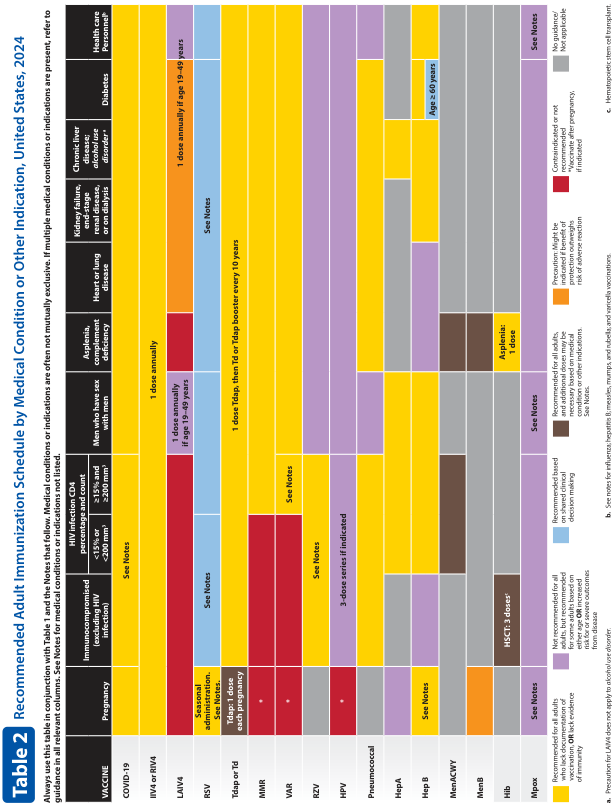
Adult Schedule by Medical Condition
11. Key Regulatory Bodies
| Body | Role |
|---|
| ACIP (Advisory Committee on Immunization Practices) | CDC advisory committee; recommends vaccines for US civilian populations |
| AAP | Publishes Red Book; recommends pediatric immunization schedules |
| AAFP, ACOG, ACNM | Co-approve harmonized schedules |
| FDA | Licenses vaccines for use in the United States |
| VFC (Vaccines for Children) | Federal program providing free vaccines to uninsured/underinsured children |
| NCVIA (National Childhood Vaccine Injury Act) | Mandates documentation of manufacturer, lot number, date, and provider for each vaccine |
References:
- Harrison's Principles of Internal Medicine, 22nd Ed. (2025), Chapter 129 - Immunization Principles and Vaccine Use
- Red Book 2021, 32nd Ed. (AAP) - Active Immunization
- Sherris & Ryan's Medical Microbiology, 8th Ed. - Prevention chapter
- Jawetz, Melnick & Adelberg's Medical Microbiology, 28th Ed. - Types of Vaccines
- Medical Microbiology, 9th Ed. - Inactivated Vaccines

![Summary : This figure presents the 2024 recommended immunization schedule for children and adolescents in the United States, showing the timing and sequence of vaccines from birth through 18 years of age. It uses a Gantt-style chart to indicate when each vaccine dose should be administered, including notes for special circumstances and seasonal recommendations.
gantt chart:
# Title & Axes :
• Title: "Recommended Child and Adolescent Immunization Schedule for ages 18 years or younger, United States, 2024"
• X-axis: Age intervals (Birth, 1 mo, 2 mos, 4 mos, 6 mos, 9 mos, 12 mos, 15 mos, 18 mos, 19–23 mos, 2–3 yrs, 4–6 yrs, 7–10 yrs, 11–12 yrs, 13–15 yrs, 16 yrs, 17–18 yrs)
• Y-axis: Vaccine and other immunizing agents (listed in rows)
# Vaccine Rows :
• Respiratory syncytial virus (RSV-mAb, nirsevimab, clesrovimab)
• Hepatitis B (HepB)
• Rotavirus (RV: RV1, RV5)
• Diphtheria, tetanus, and acellular pertussis (DTaP <7 yrs)
• Haemophilus influenzae type b (Hib)
• Pneumococcal conjugate (PCV15, PCV20)
• Inactivated poliovirus (IPV)
• COVID-19 (1vCOV-mRNA, 1vCOV-aPS)
• Influenza
• Measles, mumps, and rubella (MMR)
• Varicella (VAR)
• Hepatitis A (HepA)
• Tetanus, diphtheria, and acellular pertussis (Tdap ≥7 yrs)
• Human papillomavirus (HPV)
• Meningococcal (MenACWY-CRM ≥2 mos, MenACWY-TT ≥2 years)
• Meningococcal B (MenB-4C, MenB-FHbp)
• Respiratory syncytial virus vaccine (RSV [Abrysvo])
• Dengue (DEN4CYD: 9–16 yrs)
• Mpox
# Dose Timing & Colour Coding :
• Blue ovals: Standard recommended doses (e.g., "1st dose", "2nd dose", "3rd dose", etc.)
• Purple bars: Time windows for additional or catch-up doses
• Orange bars/boxes: Special notes, seasonal recommendations, or age-specific guidance (e.g., "See Notes", "Seasonal administration during pregnancy if not previously vaccinated", "Seropositive in areas with endemic dengue")
• Dotted blue bars: Future or annual recommendations (e.g., COVID-19 vaccine for 2025–2026)
# Design Encodings :
• Each vaccine row uses a combination of blue, purple, and orange to distinguish standard, catch-up, and special/seasonal recommendations.
• Notes and exceptions are highlighted in orange for visibility.
• Overlapping bars indicate flexibility or alternative schedules for certain vaccines.
# Analysis :
• The schedule is densely packed in the first two years of life, with most vaccines administered in multiple doses during infancy and early childhood.
• Several vaccines (e.g., DTaP, Hib, PCV, IPV) have booster doses in later childhood.
• Annual or seasonal vaccines (e.g., Influenza, COVID-19) are indicated for ongoing administration.
• Special recommendations (e.g., RSV, Dengue, Meningococcal, HPV) are highlighted for specific age groups or risk factors.
• The chart visually emphasizes the importance of timely vaccination and provides clear guidance for catch-up and special circumstances.](https://cdn.orris.care/cdss_images/GLGCA_4802261_1766491599420_05de57df-13fd-42af-9913-177c639397d7_307cc31e-5982-4c25-bf7b-b39b10df59fc.png)