
Can u explain me nephrotic nephrotic syndromes pathology in detail, so I can’t forget it and also a digital like with images flowchart, you can say digital something which contains the pneumonic in one page like you know what there should be like image based flow
mkdir -p /home/daytona/workspace/nephrotic-syndrome && ls /home/daytona/workspace/
~/nephrotic-syndrome/nephrotic_syndrome_visual.html
<!DOCTYPE html>
<html lang="en">
<head>
<meta charset="UTF-8">
<meta name="viewport" content="width=device-width, initial-scale=1.0">
<title>Nephrotic Syndrome - Visual Pathology Guide</title>
<style>
@import url('https://fonts.googleapis.com/css2?family=Inter:wght@300;400;600;700;900&family=JetBrains+Mono:wght@400;700&display=swap');
* { margin: 0; padding: 0; box-sizing: border-box; }
body {
font-family: 'Inter', sans-serif;
background: #0a0e1a;
color: #e8eaf6;
min-height: 100vh;
}
/* ===== HEADER ===== */
.header {
background: linear-gradient(135deg, #1a237e 0%, #283593 50%, #1565c0 100%);
padding: 32px 40px 24px;
text-align: center;
border-bottom: 3px solid #42a5f5;
position: relative;
overflow: hidden;
}
.header::before {
content: '';
position: absolute; top: 0; left: 0; right: 0; bottom: 0;
background: url("data:image/svg+xml,%3Csvg width='60' height='60' viewBox='0 0 60 60' xmlns='http://www.w3.org/2000/svg'%3E%3Cg fill='none' fill-rule='evenodd'%3E%3Cg fill='%23ffffff' fill-opacity='0.03'%3E%3Ccircle cx='30' cy='30' r='20'/%3E%3C/g%3E%3C/g%3E%3C/svg%3E");
}
.header h1 {
font-size: 2.4rem; font-weight: 900; color: #fff;
letter-spacing: -0.5px; position: relative; z-index: 1;
text-shadow: 0 2px 20px rgba(66,165,245,0.5);
}
.header .subtitle {
font-size: 1rem; color: #90caf9; margin-top: 8px;
font-weight: 400; position: relative; z-index: 1;
}
.header .mnemonic-banner {
display: inline-block;
background: linear-gradient(90deg, #ff6f00, #ffa000, #ff6f00);
color: #fff; font-size: 1.15rem; font-weight: 800;
padding: 10px 28px; border-radius: 50px; margin-top: 16px;
letter-spacing: 2px; position: relative; z-index: 1;
box-shadow: 0 4px 20px rgba(255,111,0,0.5);
animation: glow 2s infinite alternate;
}
@keyframes glow {
from { box-shadow: 0 4px 20px rgba(255,111,0,0.4); }
to { box-shadow: 0 4px 35px rgba(255,111,0,0.9); }
}
/* ===== MAIN LAYOUT ===== */
.main { padding: 24px 28px; max-width: 1400px; margin: 0 auto; }
/* ===== MNEMONIC DECODE ===== */
.mnemonic-decode {
display: grid; grid-template-columns: repeat(5, 1fr); gap: 10px;
margin-bottom: 28px;
}
.mnemonic-card {
background: linear-gradient(135deg, #1c2a4a, #243050);
border: 1.5px solid #344a7a;
border-radius: 14px; padding: 14px 12px;
text-align: center;
transition: transform 0.2s, border-color 0.2s;
cursor: default;
}
.mnemonic-card:hover { transform: translateY(-3px); }
.mnemonic-letter {
font-size: 2.4rem; font-weight: 900; line-height: 1;
margin-bottom: 4px;
}
.mnemonic-word { font-size: 0.78rem; font-weight: 700; text-transform: uppercase; letter-spacing: 1px; opacity: 0.9; }
.mnemonic-desc { font-size: 0.7rem; color: #aab0d0; margin-top: 4px; }
/* ===== PATHOLOGY DEFINITION BOX ===== */
.definition-box {
background: linear-gradient(135deg, #0d2137, #0a1929);
border: 2px solid #1565c0;
border-left: 6px solid #42a5f5;
border-radius: 12px; padding: 18px 22px;
margin-bottom: 28px;
display: grid; grid-template-columns: 1fr 1fr; gap: 16px;
}
.def-feature {
display: flex; align-items: flex-start; gap: 10px;
padding: 10px 14px;
background: rgba(255,255,255,0.03);
border-radius: 8px;
border-left: 3px solid;
}
.def-icon { font-size: 1.5rem; flex-shrink: 0; }
.def-title { font-size: 0.78rem; font-weight: 700; text-transform: uppercase; letter-spacing: 1px; margin-bottom: 3px; }
.def-value { font-size: 0.85rem; color: #cfd8dc; }
/* ===== MECHANISM FLOW ===== */
.mech-section { margin-bottom: 28px; }
.section-title {
font-size: 1rem; font-weight: 700; text-transform: uppercase;
letter-spacing: 2px; color: #90caf9; margin-bottom: 14px;
display: flex; align-items: center; gap: 10px;
}
.section-title::after { content: ''; flex: 1; height: 1px; background: linear-gradient(to right, #1565c0, transparent); }
.flow-row {
display: flex; align-items: center; gap: 8px;
background: linear-gradient(135deg, #111827, #1a2436);
border: 1px solid #1e3a5f;
border-radius: 12px; padding: 16px 20px; margin-bottom: 10px;
flex-wrap: wrap;
}
.flow-step {
background: rgba(255,255,255,0.05);
border-radius: 8px; padding: 8px 14px;
font-size: 0.82rem; font-weight: 600; text-align: center;
min-width: 120px; flex: 1;
}
.flow-arrow { font-size: 1.2rem; color: #42a5f5; flex-shrink: 0; }
/* ===== DISEASE CARDS GRID ===== */
.diseases-grid {
display: grid; grid-template-columns: repeat(2, 1fr); gap: 16px;
margin-bottom: 28px;
}
.disease-card {
border-radius: 16px; padding: 0;
overflow: hidden;
border: 1.5px solid rgba(255,255,255,0.08);
background: #111827;
transition: transform 0.2s, box-shadow 0.2s;
}
.disease-card:hover { transform: translateY(-4px); box-shadow: 0 12px 40px rgba(0,0,0,0.5); }
.card-header {
padding: 14px 18px;
display: flex; align-items: center; gap: 12px;
}
.card-icon { font-size: 1.8rem; }
.card-name { font-size: 1rem; font-weight: 800; }
.card-tag { font-size: 0.7rem; font-weight: 700; padding: 3px 10px; border-radius: 20px; margin-left: auto; text-transform: uppercase; letter-spacing: 1px; }
.card-body { padding: 16px 18px; display: flex; flex-direction: column; gap: 10px; }
.micro-row {
display: grid; grid-template-columns: repeat(3, 1fr); gap: 8px;
}
.micro-cell {
background: rgba(255,255,255,0.04);
border-radius: 8px; padding: 10px;
border: 1px solid rgba(255,255,255,0.06);
}
.micro-label { font-size: 0.62rem; font-weight: 700; text-transform: uppercase; letter-spacing: 1px; margin-bottom: 4px; opacity: 0.6; }
.micro-value { font-size: 0.78rem; font-weight: 600; }
.path-tags { display: flex; flex-wrap: wrap; gap: 6px; }
.ptag {
font-size: 0.72rem; padding: 4px 10px; border-radius: 20px;
background: rgba(255,255,255,0.07); border: 1px solid rgba(255,255,255,0.12);
font-weight: 600;
}
.ptag.highlight { background: rgba(255,255,255,0.12); font-weight: 700; }
.key-fact {
background: rgba(255,235,59,0.08);
border: 1px solid rgba(255,235,59,0.3);
border-radius: 8px; padding: 8px 12px;
font-size: 0.78rem; color: #fff176;
display: flex; align-items: flex-start; gap: 6px;
}
/* Disease-specific colors */
.mcd .card-header { background: linear-gradient(135deg, #1b5e20, #2e7d32); }
.mcd { border-color: #4caf50; }
.mcd .card-tag { background: rgba(76,175,80,0.2); color: #81c784; border: 1px solid #4caf50; }
.fsgs .card-header { background: linear-gradient(135deg, #b71c1c, #c62828); }
.fsgs { border-color: #f44336; }
.fsgs .card-tag { background: rgba(244,67,54,0.2); color: #ef9a9a; border: 1px solid #f44336; }
.mn .card-header { background: linear-gradient(135deg, #4a148c, #6a1b9a); }
.mn { border-color: #ab47bc; }
.mn .card-tag { background: rgba(171,71,188,0.2); color: #ce93d8; border: 1px solid #ab47bc; }
.mpgn .card-header { background: linear-gradient(135deg, #e65100, #ef6c00); }
.mpgn { border-color: #ff9800; }
.mpgn .card-tag { background: rgba(255,152,0,0.2); color: #ffcc02; border: 1px solid #ff9800; }
/* ===== COMPARISON TABLE ===== */
.compare-section { margin-bottom: 28px; }
.compare-table {
width: 100%; border-collapse: collapse;
background: #111827; border-radius: 12px; overflow: hidden;
font-size: 0.8rem;
}
.compare-table thead tr { background: linear-gradient(135deg, #1a237e, #283593); }
.compare-table th {
padding: 12px 14px; text-align: left; font-weight: 700;
font-size: 0.75rem; text-transform: uppercase; letter-spacing: 1px; color: #90caf9;
}
.compare-table tbody tr { border-bottom: 1px solid #1e2a3e; transition: background 0.15s; }
.compare-table tbody tr:hover { background: rgba(255,255,255,0.03); }
.compare-table td { padding: 11px 14px; vertical-align: middle; }
.compare-table td:first-child { font-weight: 700; }
.badge {
display: inline-block; padding: 3px 8px; border-radius: 4px;
font-size: 0.7rem; font-weight: 700;
}
.badge-green { background: rgba(76,175,80,0.2); color: #81c784; }
.badge-red { background: rgba(244,67,54,0.2); color: #ef9a9a; }
.badge-purple { background: rgba(171,71,188,0.2); color: #ce93d8; }
.badge-orange { background: rgba(255,152,0,0.2); color: #ffcc02; }
.badge-blue { background: rgba(66,165,245,0.2); color: #90caf9; }
.badge-gray { background: rgba(255,255,255,0.08); color: #cfd8dc; }
/* ===== PATHOGENESIS CENTRAL ===== */
.patho-central {
background: linear-gradient(135deg, #0d1421, #131d2e);
border: 1px solid #1e3a5f; border-radius: 16px;
padding: 22px; margin-bottom: 28px;
}
.patho-flow {
display: flex; align-items: center; justify-content: center;
flex-wrap: wrap; gap: 8px; margin-top: 14px;
}
.patho-node {
border-radius: 10px; padding: 12px 16px; text-align: center;
font-size: 0.8rem; font-weight: 700;
min-width: 130px; flex: 1; max-width: 180px;
}
.patho-arrow { font-size: 1.6rem; color: #42a5f5; }
.node-blue { background: linear-gradient(135deg, #1565c0, #1976d2); border: 1.5px solid #42a5f5; }
.node-teal { background: linear-gradient(135deg, #00695c, #00897b); border: 1.5px solid #26a69a; }
.node-amber { background: linear-gradient(135deg, #e65100, #f57c00); border: 1.5px solid #ffa726; }
.node-red { background: linear-gradient(135deg, #b71c1c, #c62828); border: 1.5px solid #ef5350; }
.node-purple { background: linear-gradient(135deg, #4a148c, #6a1b9a); border: 1.5px solid #ab47bc; }
.node-title { font-size: 0.95rem; font-weight: 800; margin-bottom: 4px; }
.node-sub { font-size: 0.7rem; opacity: 0.85; font-weight: 400; }
/* ===== CONSEQUENCES ===== */
.consequences {
display: grid; grid-template-columns: repeat(4, 1fr); gap: 12px;
margin-bottom: 28px;
}
.cons-card {
border-radius: 12px; padding: 16px;
border: 1.5px solid rgba(255,255,255,0.08);
text-align: center;
}
.cons-icon { font-size: 2rem; margin-bottom: 8px; }
.cons-name { font-size: 0.85rem; font-weight: 800; margin-bottom: 4px; }
.cons-mech { font-size: 0.72rem; color: #aab0d0; line-height: 1.4; }
/* ===== MEMORY PEGS ===== */
.memory-grid {
display: grid; grid-template-columns: repeat(4, 1fr); gap: 10px;
margin-bottom: 28px;
}
.mem-card {
background: linear-gradient(135deg, #1a1a2e, #16213e);
border: 1.5px solid #2d3561;
border-radius: 12px; padding: 14px;
text-align: center;
}
.mem-emoji { font-size: 2.2rem; margin-bottom: 8px; }
.mem-label { font-size: 0.78rem; font-weight: 800; color: #fff; margin-bottom: 4px; }
.mem-hint { font-size: 0.68rem; color: #8892b0; line-height: 1.4; font-style: italic; }
/* ===== FOOTER ===== */
.footer {
text-align: center; padding: 16px;
font-size: 0.72rem; color: #546e7a;
border-top: 1px solid #1e2a3e;
}
/* ===== PRINT / RESPONSIVE ===== */
@media (max-width: 900px) {
.diseases-grid { grid-template-columns: 1fr; }
.mnemonic-decode { grid-template-columns: repeat(3, 1fr); }
.consequences { grid-template-columns: repeat(2, 1fr); }
.memory-grid { grid-template-columns: repeat(2, 1fr); }
.definition-box { grid-template-columns: 1fr; }
}
@media print {
body { background: #fff; color: #000; }
.main { max-width: 100%; }
}
</style>
</head>
<body>
<!-- ===== HEADER ===== -->
<div class="header">
<h1>🫘 NEPHROTIC SYNDROME</h1>
<div class="subtitle">Complete Pathology Visual Guide — From Mechanism to Memory</div>
<div class="mnemonic-banner">MNEMONIC | " F-M-M-M " + " PUFFA "</div>
</div>
<div class="main">
<!-- ===== DEFINITION FEATURES ===== -->
<div class="section-title">📌 The Big 5 Features of Nephrotic Syndrome</div>
<div class="definition-box">
<div class="def-feature" style="border-color:#ef5350;">
<div class="def-icon">🌊</div>
<div>
<div class="def-title" style="color:#ef9a9a;">Massive Proteinuria</div>
<div class="def-value">>3.5 g/day (adults) | >40 mg/m²/hr (children)<br><span style="color:#ef5350;font-weight:700;">KEY HALLMARK — glomerular filter breaks down</span></div>
</div>
</div>
<div class="def-feature" style="border-color:#42a5f5;">
<div class="def-icon">💧</div>
<div>
<div class="def-title" style="color:#90caf9;">Hypoalbuminemia</div>
<div class="def-value"><3 g/dL — urinary loss exceeds hepatic synthesis capacity</div>
</div>
</div>
<div class="def-feature" style="border-color:#66bb6a;">
<div class="def-icon">🦵</div>
<div>
<div class="def-title" style="color:#a5d6a7;">Pitting Oedema</div>
<div class="def-value">↓Oncotic pressure → fluid leaks to interstitium (periorbital, pedal, ascites)</div>
</div>
</div>
<div class="def-feature" style="border-color:#ffa726;">
<div class="def-icon">🧈</div>
<div>
<div class="def-title" style="color:#ffcc02;">Hyperlipidaemia & Lipiduria</div>
<div class="def-value">Liver upregulates lipoprotein synthesis (compensatory); urinary oval fat bodies, "Maltese crosses"</div>
</div>
</div>
</div>
<!-- ===== MNEMONIC DECODE ===== -->
<div class="section-title">🔤 MNEMONIC: "PUFFA" — Remember All Features</div>
<div class="mnemonic-decode">
<div class="mnemonic-card" style="border-color:#ef5350;">
<div class="mnemonic-letter" style="color:#ef5350;">P</div>
<div class="mnemonic-word" style="color:#ef9a9a;">Proteinuria</div>
<div class="mnemonic-desc">>3.5 g/day<br>Massive, frothy urine</div>
</div>
<div class="mnemonic-card" style="border-color:#42a5f5;">
<div class="mnemonic-letter" style="color:#42a5f5;">U</div>
<div class="mnemonic-word" style="color:#90caf9;">hypoalbUminemia</div>
<div class="mnemonic-desc"><3 g/dL<br>Loss > synthesis</div>
</div>
<div class="mnemonic-card" style="border-color:#66bb6a;">
<div class="mnemonic-letter" style="color:#66bb6a;">F</div>
<div class="mnemonic-word" style="color:#a5d6a7;">Fluid (Oedema)</div>
<div class="mnemonic-desc">Periorbital + pedal<br>↓oncotic pressure</div>
</div>
<div class="mnemonic-card" style="border-color:#ffa726;">
<div class="mnemonic-letter" style="color:#ffa726;">F</div>
<div class="mnemonic-word" style="color:#ffcc02;">Fat (Lipiduria)</div>
<div class="mnemonic-desc">Maltese cross 🔬<br>Oval fat bodies</div>
</div>
<div class="mnemonic-card" style="border-color:#ab47bc;">
<div class="mnemonic-letter" style="color:#ab47bc;">A</div>
<div class="mnemonic-word" style="color:#ce93d8;">hyperlipidAemia</div>
<div class="mnemonic-desc">↑LDL, ↑VLDL<br>↑Hepatic synthesis</div>
</div>
</div>
<!-- ===== CENTRAL PATHOGENESIS FLOW ===== -->
<div class="section-title">⚙️ Central Pathogenesis — Why Proteinuria Happens</div>
<div class="patho-central">
<div style="text-align:center;color:#aab0d0;font-size:0.8rem;margin-bottom:6px;">The glomerular filtration barrier has 3 layers: Endothelium (fenestrated) → GBM → Podocytes (slit diaphragm)</div>
<div class="patho-flow">
<div class="patho-node node-blue">
<div class="node-title">🎯 Podocyte Injury</div>
<div class="node-sub">Circulating factor / Immune / Genetic mutation (nephrin, podocin)</div>
</div>
<div class="patho-arrow">→</div>
<div class="patho-node node-teal">
<div class="node-title">👣 Foot Process Effacement</div>
<div class="node-sub">Actin cytoskeleton rearranged; slit diaphragm disrupted on EM</div>
</div>
<div class="patho-arrow">→</div>
<div class="patho-node node-amber">
<div class="node-title">🚰 GBM Permeability ↑↑</div>
<div class="node-sub">Charge barrier lost; size barrier disrupted</div>
</div>
<div class="patho-arrow">→</div>
<div class="patho-node node-red">
<div class="node-title">💧 Massive Proteinuria</div>
<div class="node-sub">>3.5 g/day albumin + other proteins lost</div>
</div>
<div class="patho-arrow">→</div>
<div class="patho-node node-purple">
<div class="node-title">🔄 Cascade</div>
<div class="node-sub">↓Albumin → ↓Oncotic P → Oedema + ↑Hepatic lipoprotein synthesis</div>
</div>
</div>
</div>
<!-- ===== DISEASE CARDS ===== -->
<div class="section-title">🔬 The 4 Major Causes — "F-M-M-M" (Focal, Minimal, Membranous, Membranoproliferative)</div>
<div class="diseases-grid">
<!-- MCD -->
<div class="disease-card mcd">
<div class="card-header">
<div class="card-icon">🟢</div>
<div>
<div class="card-name">Minimal Change Disease (MCD)</div>
<div style="font-size:0.72rem;color:#a5d6a7;margin-top:2px;">Nil disease · Lipoid nephrosis</div>
</div>
<div class="card-tag">MCC in Children</div>
</div>
<div class="card-body">
<div class="micro-row">
<div class="micro-cell">
<div class="micro-label" style="color:#81c784;">Light Micro</div>
<div class="micro-value">NORMAL 👁️</div>
</div>
<div class="micro-cell">
<div class="micro-label" style="color:#81c784;">Immunofluorescence</div>
<div class="micro-value">Negative ⛔</div>
</div>
<div class="micro-cell">
<div class="micro-label" style="color:#81c784;">Electron Micro</div>
<div class="micro-value">Foot process effacement only 👣</div>
</div>
</div>
<div class="path-tags">
<span class="ptag highlight" style="color:#a5d6a7;border-color:#4caf50;">Age: 1-7 yrs</span>
<span class="ptag" style="color:#a5d6a7;">T-cell dysfunction → permeability factor</span>
<span class="ptag" style="color:#a5d6a7;">No immune deposits</span>
<span class="ptag" style="color:#a5d6a7;">Steroid-responsive ✓</span>
<span class="ptag" style="color:#a5d6a7;">Good prognosis</span>
</div>
<div class="key-fact">
⭐ <span><strong>Memory hook:</strong> "MINIMAL = nothing on light / nothing on IF / ONLY effacement on EM." MCD = Maximum Corticosteroid Duty (100% steroid responsive in kids)</span>
</div>
<div style="font-size:0.76rem;color:#aab0d0;line-height:1.6;padding:8px 0;">
<strong style="color:#a5d6a7;">Pathogenesis:</strong> Circulating T-cell-derived permeability factor injures podocytes → foot process effacement → loss of charge selectivity → selective proteinuria (albumin > globulins). Associated with Hodgkin lymphoma, NSAIDs, atopy.
</div>
</div>
</div>
<!-- FSGS -->
<div class="disease-card fsgs">
<div class="card-header">
<div class="card-icon">🔴</div>
<div>
<div class="card-name">Focal Segmental Glomerulosclerosis (FSGS)</div>
<div style="font-size:0.72rem;color:#ef9a9a;margin-top:2px;">Podocytopathy spectrum — worse MCD</div>
</div>
<div class="card-tag">MCC in Adults (Black)</div>
</div>
<div class="card-body">
<div class="micro-row">
<div class="micro-cell">
<div class="micro-label" style="color:#ef9a9a;">Light Micro</div>
<div class="micro-value">Focal* + Segmental** Sclerosis & Hyalinosis</div>
</div>
<div class="micro-cell">
<div class="micro-label" style="color:#ef9a9a;">Immunofluorescence</div>
<div class="micro-value">IgM + C3 in scarred areas (non-specific)</div>
</div>
<div class="micro-cell">
<div class="micro-label" style="color:#ef9a9a;">Electron Micro</div>
<div class="micro-value">Foot process effacement + epithelial denudation</div>
</div>
</div>
<div style="font-size:0.68rem;color:#ef9a9a;margin:-4px 0 6px;">*Focal = some glomeruli affected | **Segmental = part of glomerulus</div>
<div class="path-tags">
<span class="ptag highlight" style="color:#ef9a9a;border-color:#f44336;">APOL1 gene risk (African ancestry)</span>
<span class="ptag" style="color:#ef9a9a;">Cardiotrophin-like cytokine-1</span>
<span class="ptag" style="color:#ef9a9a;">HIV, heroin nephropathy</span>
<span class="ptag" style="color:#ef9a9a;">Steroid-resistant ✗</span>
<span class="ptag" style="color:#ef9a9a;">Recurs post-transplant</span>
</div>
<div class="key-fact">
⭐ <span><strong>Memory hook:</strong> "F-S-G-S = Few Scars, Going South" — progressive, hard to treat, FSGS is MCD's evil twin. Collapsing variant → HIV → worst prognosis</span>
</div>
<div style="font-size:0.76rem;color:#aab0d0;line-height:1.6;padding:8px 0;">
<strong style="color:#ef9a9a;">Pathogenesis:</strong> Primary FSGS — circulating permeability factor (possibly cardiotrophin-like cytokine 1) or genetic podocyte mutations (NPHS1, NPHS2, WT1). Secondary FSGS — adaptive response to nephron loss (obesity, reflux, sickle cell). Collapsing FSGS — HIV/parvovirus B19 → podocyte proliferation + tuft collapse.
</div>
</div>
</div>
<!-- Membranous Nephropathy -->
<div class="disease-card mn">
<div class="card-header">
<div class="card-icon">🟣</div>
<div>
<div class="card-name">Membranous Nephropathy (MN)</div>
<div style="font-size:0.72rem;color:#ce93d8;margin-top:2px;">Subepithelial immune complex disease</div>
</div>
<div class="card-tag">MCC in White Adults</div>
</div>
<div class="card-body">
<div class="micro-row">
<div class="micro-cell">
<div class="micro-label" style="color:#ce93d8;">Light Micro</div>
<div class="micro-value">Diffuse GBM thickening; "spike & dome" (silver stain)</div>
</div>
<div class="micro-cell">
<div class="micro-label" style="color:#ce93d8;">Immunofluorescence</div>
<div class="micro-value">Granular IgG + C3 along GBM (subepithelial)</div>
</div>
<div class="micro-cell">
<div class="micro-label" style="color:#ce93d8;">Electron Micro</div>
<div class="micro-value">Subepithelial electron-dense deposits (between podocyte & GBM)</div>
</div>
</div>
<div class="path-tags">
<span class="ptag highlight" style="color:#ce93d8;border-color:#ab47bc;">Anti-PLA2R Ab (70%) — PATHOGNOMONIC</span>
<span class="ptag" style="color:#ce93d8;">IgG4 subclass; MBL complement activation</span>
<span class="ptag" style="color:#ce93d8;">Secondary: HBV, malignancy, SLE, drugs</span>
<span class="ptag" style="color:#ce93d8;">"Rule of thirds": 1/3 remit, 1/3 persist, 1/3 progress</span>
</div>
<div class="key-fact">
⭐ <span><strong>Memory hook:</strong> "MN = Membrane Nailing deposits SUBepithelially (SPADE-shaped spikes on silver stain)." PLA2R = PLease Ask 2 Recall (the receptor autoantibody)</span>
</div>
<div style="font-size:0.76rem;color:#aab0d0;line-height:1.6;padding:8px 0;">
<strong style="color:#ce93d8;">Pathogenesis:</strong> Anti-PLA2R IgG4 autoantibodies bind M-type phospholipase A2 receptor on podocyte surface → in-situ immune complex formation → C5b-9 MAC insertion → podocyte injury → proteinuria. GBM "spikes" = GBM matrix growing between subepithelial deposits.
</div>
</div>
</div>
<!-- MPGN -->
<div class="disease-card mpgn">
<div class="card-header">
<div class="card-icon">🟠</div>
<div>
<div class="card-name">MPGN (Membranoproliferative GN)</div>
<div style="font-size:0.72rem;color:#ffcc02;margin-top:2px;">Nephrotic + Nephritic overlap syndrome</div>
</div>
<div class="card-tag">Nephrotic-Nephritic</div>
</div>
<div class="card-body">
<div class="micro-row">
<div class="micro-cell">
<div class="micro-label" style="color:#ffcc02;">Light Micro</div>
<div class="micro-value">Lobular glomeruli; "tram-track" GBM splitting (mesangial interposition)</div>
</div>
<div class="micro-cell">
<div class="micro-label" style="color:#ffcc02;">Immunofluorescence</div>
<div class="micro-value">Type I: IgG+C3 granular<br>Type II (DDD): C3 only (no Ig)</div>
</div>
<div class="micro-cell">
<div class="micro-label" style="color:#ffcc02;">Electron Micro</div>
<div class="micro-value">Type I: Subendothelial deposits<br>Type II: Intramembranous dense deposits ("ribbon")</div>
</div>
</div>
<div class="path-tags">
<span class="ptag highlight" style="color:#ffcc02;border-color:#ff9800;">↓C3 (alternative pathway activation)</span>
<span class="ptag" style="color:#ffcc02;">C3 Nephritic Factor (C3NeF) in DDD</span>
<span class="ptag" style="color:#ffcc02;">HCV infection (Type I)</span>
<span class="ptag" style="color:#ffcc02;">Poor prognosis — 50% ESRD at 10 yrs</span>
</div>
<div class="key-fact">
⭐ <span><strong>Memory hook:</strong> "TRAM-TRACK = Two Railing Appearance Means-Mesangial ingrowth That Replicates A Capsule Kinda." DDD = Dense Deposits Deep in membrane</span>
</div>
<div style="font-size:0.76rem;color:#aab0d0;line-height:1.6;padding:8px 0;">
<strong style="color:#ffcc02;">Pathogenesis:</strong> Type I — immune complex deposition (subendothelial) → classical complement pathway → mesangial proliferation + GBM remodeling. Type II (Dense Deposit Disease) — C3NeF (IgG autoAb against C3bBb) → uncontrolled alternative complement activation → C3 consumption → dense intramembranous deposits.
</div>
</div>
</div>
</div>
<!-- ===== COMPARISON TABLE ===== -->
<div class="section-title">📊 Side-by-Side Comparison — The Ultimate Cheat Table</div>
<div class="compare-section">
<table class="compare-table">
<thead>
<tr>
<th>Feature</th>
<th>MCD 🟢</th>
<th>FSGS 🔴</th>
<th>Membranous 🟣</th>
<th>MPGN 🟠</th>
</tr>
</thead>
<tbody>
<tr>
<td>Age</td>
<td><span class="badge badge-green">Children 1-7</span></td>
<td><span class="badge badge-red">Any, more adults</span></td>
<td><span class="badge badge-purple">Adults 40-60</span></td>
<td><span class="badge badge-orange">Young adults</span></td>
</tr>
<tr>
<td>LM Finding</td>
<td><span class="badge badge-green">NORMAL</span></td>
<td><span class="badge badge-red">Focal segmental sclerosis</span></td>
<td><span class="badge badge-purple">Spike & dome</span></td>
<td><span class="badge badge-orange">Tram-track</span></td>
</tr>
<tr>
<td>IF Pattern</td>
<td><span class="badge badge-gray">Negative</span></td>
<td><span class="badge badge-gray">IgM/C3 (non-specific)</span></td>
<td><span class="badge badge-purple">Granular IgG+C3 GBM</span></td>
<td><span class="badge badge-orange">IgG+C3 (Type I) / C3 only (DDD)</span></td>
</tr>
<tr>
<td>EM Finding</td>
<td><span class="badge badge-green">Effacement only</span></td>
<td><span class="badge badge-red">Effacement + denudation</span></td>
<td><span class="badge badge-purple">SUBepithelial deposits</span></td>
<td><span class="badge badge-orange">SUBendothelial / intramembranous</span></td>
</tr>
<tr>
<td>Deposit Location</td>
<td><span class="badge badge-gray">None</span></td>
<td><span class="badge badge-gray">None (immune-neg)</span></td>
<td><span class="badge badge-purple">Subepithelial ↑</span></td>
<td><span class="badge badge-orange">Subendothelial ↓ (Type I)</span></td>
</tr>
<tr>
<td>Complement</td>
<td><span class="badge badge-green">Normal</span></td>
<td><span class="badge badge-green">Normal</span></td>
<td><span class="badge badge-gray">Normal / low</span></td>
<td><span class="badge badge-orange">↓↓ C3 (key!)</span></td>
</tr>
<tr>
<td>Key Marker</td>
<td><span class="badge badge-green">Steroid response</span></td>
<td><span class="badge badge-red">APOL1, podocin mutations</span></td>
<td><span class="badge badge-purple">Anti-PLA2R antibody</span></td>
<td><span class="badge badge-orange">C3NeF (DDD)</span></td>
</tr>
<tr>
<td>Steroid Response</td>
<td><span class="badge badge-green">Excellent ✓✓</span></td>
<td><span class="badge badge-red">Poor ✗</span></td>
<td><span class="badge badge-gray">Variable</span></td>
<td><span class="badge badge-red">Poor ✗</span></td>
</tr>
<tr>
<td>Prognosis</td>
<td><span class="badge badge-green">Excellent</span></td>
<td><span class="badge badge-red">50% ESRD if resistant</span></td>
<td><span class="badge badge-gray">Rule of thirds</span></td>
<td><span class="badge badge-red">50% ESRD at 10 yrs</span></td>
</tr>
<tr>
<td>Secondary Causes</td>
<td><span class="badge badge-blue">Hodgkin lymphoma, NSAIDs, atopy</span></td>
<td><span class="badge badge-blue">HIV, heroin, obesity, reflux</span></td>
<td><span class="badge badge-blue">HBV, SLE, gold, penicillamine, malignancy</span></td>
<td><span class="badge badge-blue">HCV, SBE, cryoglobulinemia</span></td>
</tr>
</tbody>
</table>
</div>
<!-- ===== CONSEQUENCES ===== -->
<div class="section-title">⛓️ Downstream Consequences of Nephrotic Syndrome</div>
<div class="consequences">
<div class="cons-card" style="background:linear-gradient(135deg,#1a0a0a,#2c1010);border-color:#c62828;">
<div class="cons-icon">🩸</div>
<div class="cons-name" style="color:#ef9a9a;">Hypercoagulability</div>
<div class="cons-mech">Loss of antithrombin III + proteins C & S → DVT, renal vein thrombosis (esp. MN), PE</div>
</div>
<div class="cons-card" style="background:linear-gradient(135deg,#0a1820,#102030);border-color:#1976d2;">
<div class="cons-icon">🫀</div>
<div class="cons-name" style="color:#90caf9;">Increased Infection Risk</div>
<div class="cons-mech">Loss of IgG & complement (opsonins) → susceptibility to encapsulated bacteria (Pneumococcus)</div>
</div>
<div class="cons-card" style="background:linear-gradient(135deg,#1a1200,#2c2000);border-color:#f57f17;">
<div class="cons-icon">🧈</div>
<div class="cons-name" style="color:#ffd54f;">Atherosclerosis</div>
<div class="cons-mech">Chronic ↑LDL, ↑VLDL → accelerated cardiovascular disease</div>
</div>
<div class="cons-card" style="background:linear-gradient(135deg,#0a1a0a,#102010);border-color:#388e3c;">
<div class="cons-icon">🦴</div>
<div class="cons-name" style="color:#a5d6a7;">Bone Disease</div>
<div class="cons-mech">Loss of Vitamin D-binding protein → ↓Vit D → hypocalcaemia → hyperparathyroidism</div>
</div>
</div>
<!-- ===== MEMORY PEGS ===== -->
<div class="section-title">🧠 Memory Pegs — Visual Anchors for Each Disease</div>
<div class="memory-grid">
<div class="mem-card" style="border-color:#4caf50;">
<div class="mem-emoji">👶✨</div>
<div class="mem-label" style="color:#81c784;">MCD = Baby Clean</div>
<div class="mem-hint">Child + CLEAN glomerulus on LM. "Nothing to see here" — but EM tells the real story (effaced feet). Steroids fix it fast. Think: a baby's blank canvas.</div>
</div>
<div class="mem-card" style="border-color:#f44336;">
<div class="mem-emoji">🗺️🔴</div>
<div class="mem-label" style="color:#ef9a9a;">FSGS = Scar on the Map</div>
<div class="mem-hint">FOCAL = some glomeruli; SEGMENTAL = patch on the glomerulus. Like a scar on a map — not everywhere, just some spots. APOL1 = African Population Only Likes 1 (risk allele).</div>
</div>
<div class="mem-card" style="border-color:#ab47bc;">
<div class="mem-emoji">🦔🔮</div>
<div class="mem-label" style="color:#ce93d8;">MN = Spike Hedgehog</div>
<div class="mem-hint">Silver stain spikes look like a hedgehog's back. Subepithelial deposits = ABOVE the GBM (between podocyte and GBM). PLA2R = the receptor that triggers the war.</div>
</div>
<div class="mem-card" style="border-color:#ff9800;">
<div class="mem-emoji">🚃🛤️</div>
<div class="mem-label" style="color:#ffcc02;">MPGN = Tram Tracks</div>
<div class="mem-hint">Mesangial cell grows between GBM layers → TWO tracks (tram-track). "MPGN = Most Problems, Great Nephrons Needed." DDD = Really Dense deposits stuck in the membrane like fossils.</div>
</div>
</div>
<!-- ===== DEPOSIT LOCATION VISUAL ===== -->
<div class="section-title">📍 Deposit Location Guide — Where the Immune Complexes Land</div>
<div style="background:#111827;border:1.5px solid #1e3a5f;border-radius:14px;padding:22px;margin-bottom:28px;">
<div style="display:flex;align-items:center;justify-content:center;gap:0;flex-wrap:wrap;margin-bottom:18px;">
<!-- Simplified GBM cross section -->
<div style="text-align:center;padding:12px 16px;background:rgba(100,200,255,0.1);border-radius:8px;border:1.5px dashed #42a5f5;min-width:100px;">
<div style="font-size:1.3rem;">🔵</div>
<div style="font-size:0.75rem;font-weight:700;color:#90caf9;margin-top:4px;">Endothelium</div>
<div style="font-size:0.65rem;color:#546e7a;">(fenestrated)</div>
</div>
<div style="font-size:0.6rem;padding:4px 8px;background:#1e3a5f;color:#ffcc02;border-radius:4px;margin:0 6px;text-align:center;">
MPGN<br>Type I<br>↓SUBendothelial
</div>
<div style="text-align:center;padding:12px 20px;background:rgba(255,200,100,0.1);border-radius:8px;border:2px solid #ffa726;min-width:120px;">
<div style="font-size:1.3rem;">🟫</div>
<div style="font-size:0.75rem;font-weight:700;color:#ffd54f;margin-top:4px;">GBM</div>
<div style="font-size:0.65rem;color:#546e7a;">(glomerular basement membrane)</div>
<div style="font-size:0.65rem;color:#ff9800;margin-top:4px;">◉ DDD deposits here</div>
</div>
<div style="font-size:0.6rem;padding:4px 8px;background:#1e3a5f;color:#ce93d8;border-radius:4px;margin:0 6px;text-align:center;">
MN<br>↑SUBepithelial<br>(spikes)
</div>
<div style="text-align:center;padding:12px 16px;background:rgba(100,255,150,0.1);border-radius:8px;border:1.5px dashed #66bb6a;min-width:100px;">
<div style="font-size:1.3rem;">🦶</div>
<div style="font-size:0.75rem;font-weight:700;color:#a5d6a7;margin-top:4px;">Podocyte</div>
<div style="font-size:0.65rem;color:#546e7a;">(foot processes)</div>
</div>
</div>
<div style="display:grid;grid-template-columns:repeat(4,1fr);gap:10px;margin-top:4px;">
<div style="text-align:center;background:rgba(76,175,80,0.1);border-radius:8px;padding:10px;border:1px solid #4caf50;">
<div style="font-size:0.8rem;font-weight:700;color:#81c784;">MCD</div>
<div style="font-size:0.7rem;color:#aab0d0;">No deposits<br>Effacement only</div>
</div>
<div style="text-align:center;background:rgba(244,67,54,0.1);border-radius:8px;padding:10px;border:1px solid #f44336;">
<div style="font-size:0.8rem;font-weight:700;color:#ef9a9a;">FSGS</div>
<div style="font-size:0.7rem;color:#aab0d0;">No immune deposits<br>Segmental scarring</div>
</div>
<div style="text-align:center;background:rgba(171,71,188,0.1);border-radius:8px;padding:10px;border:1px solid #ab47bc;">
<div style="font-size:0.8rem;font-weight:700;color:#ce93d8;">MN</div>
<div style="font-size:0.7rem;color:#aab0d0;">SUBepithelial<br>(above GBM)</div>
</div>
<div style="text-align:center;background:rgba(255,152,0,0.1);border-radius:8px;padding:10px;border:1px solid #ff9800;">
<div style="font-size:0.8rem;font-weight:700;color:#ffcc02;">MPGN</div>
<div style="font-size:0.7rem;color:#aab0d0;">SUBendothelial (I)<br>Intramembranous (II/DDD)</div>
</div>
</div>
</div>
<!-- ===== BIG PICTURE MNEMONIC ===== -->
<div style="background:linear-gradient(135deg,#1a0a2e,#2d1a4e);border:2px solid #7b1fa2;border-radius:14px;padding:22px;margin-bottom:28px;text-align:center;">
<div class="section-title" style="justify-content:center;margin-bottom:14px;">🏆 The ONE Mnemonic to Remember All 4 Causes</div>
<div style="font-size:1.8rem;font-weight:900;color:#e040fb;letter-spacing:6px;margin-bottom:12px;text-shadow:0 0 20px rgba(224,64,251,0.6);">
" FIRM "
</div>
<div style="display:grid;grid-template-columns:repeat(4,1fr);gap:10px;max-width:600px;margin:0 auto 16px;">
<div style="padding:12px;background:rgba(255,255,255,0.05);border-radius:8px;">
<div style="font-size:1.6rem;font-weight:900;color:#4caf50;">F</div>
<div style="font-size:0.8rem;font-weight:700;color:#a5d6a7;">Focal Segmental</div>
<div style="font-size:0.68rem;color:#8892b0;">FSGS — Scarring</div>
</div>
<div style="padding:12px;background:rgba(255,255,255,0.05);border-radius:8px;">
<div style="font-size:1.6rem;font-weight:900;color:#42a5f5;">I</div>
<div style="font-size:0.8rem;font-weight:700;color:#90caf9;">Idiopathic MCD</div>
<div style="font-size:0.68rem;color:#8892b0;">Minimal Change — Clean</div>
</div>
<div style="padding:12px;background:rgba(255,255,255,0.05);border-radius:8px;">
<div style="font-size:1.6rem;font-weight:900;color:#ab47bc;">R</div>
<div style="font-size:0.8rem;font-weight:700;color:#ce93d8;">Ridged GBM (MN)</div>
<div style="font-size:0.68rem;color:#8892b0;">Membranous — Spikes</div>
</div>
<div style="padding:12px;background:rgba(255,255,255,0.05);border-radius:8px;">
<div style="font-size:1.6rem;font-weight:900;color:#ffa726;">M</div>
<div style="font-size:0.8rem;font-weight:700;color:#ffcc02;">Mesangial (MPGN)</div>
<div style="font-size:0.68rem;color:#8892b0;">Tram-tracks</div>
</div>
</div>
<div style="font-size:0.82rem;color:#ce93d8;max-width:600px;margin:0 auto;">
<strong>FIRM</strong> — imagine the kidney's glomerulus going from <em>minimal</em> (I=idiopathic MCD, nothing to see) through increasing <em>firmness</em> of damage: focal scarring → subepithelial spikes → tram-track doubling.
</div>
</div>
</div><!-- end main -->
<div class="footer">
Sources: Robbins & Kumar Basic Pathology | Comprehensive Clinical Nephrology 7th Ed | Brenner & Rector's The Kidney — All content for educational purposes
</div>
</body>
</html>
ls -la /home/daytona/workspace/nephrotic-syndrome/ && wc -l /home/daytona/workspace/nephrotic-syndrome/nephrotic_syndrome_visual.html
🫘 Nephrotic Syndrome — Full Pathology Deep Dive
What IS Nephrotic Syndrome?
🔤 MNEMONIC: "PUFFA" — The 5 Features
| Letter | Feature | Detail |
|---|---|---|
| P | Proteinuria | >3.5 g/day (adults) / >40 mg/m²/hr (children) — MASSIVE, frothy urine |
| U | hypo-Ulbuminemia | <3 g/dL — urinary loss outpaces hepatic synthesis |
| F | Fluid (Oedema) | Periorbital (classic in kids), pedal, ascites — caused by ↓oncotic pressure |
| F | Fat (Lipiduria) | Maltese cross birefringent oval fat bodies in urine under polarized light |
| A | hyper-lipid-Aemia | ↑LDL, ↑VLDL, ↑cholesterol — liver compensates for low oncotic pressure by making more lipoproteins |
⚙️ Central Pathogenesis Flow
Podocyte Injury
     ↓
Foot Process Effacement (actin cytoskeleton disruption)
     ↓
Slit Diaphragm Breakdown
     ↓
GBM Charge + Size Barrier Lost
     ↓
Massive Proteinuria (>3.5 g/day)
     ↓
↓ Albumin → ↓ Oncotic Pressure → Oedema
                              ↘ Liver ↑ Lipoprotein synthesis → Hyperlipidaemia + Lipiduria
🔬 The 4 Major Causes — Mnemonic: "FIRM"
🟢 1. Minimal Change Disease (MCD)
- Most common nephrotic syndrome in children (65% of pediatric cases), peak age 1-7 years
- Pathogenesis: T-cell-derived circulating permeability factor injures podocytes → selective proteinuria (mainly albumin). Strongly associated with Hodgkin lymphoma, NSAIDs, atopy
- LM: COMPLETELY NORMAL (hence "minimal change")
- IF: Negative — no immune deposits
- EM: Diffuse foot process effacement ONLY — no deposits
- Steroid response: Excellent — >90% in children respond to prednisone
- Prognosis: Excellent — may relapse but rarely progresses to ESRD
- Memory: MCD = Maximum Corticosteroid Dependence — steroids fix it. Clean glomerulus = empty canvas.
🔴 2. Focal Segmental Glomerulosclerosis (FSGS)
- Most common primary nephrotic syndrome in adults, especially Black Americans (APOL1 risk alleles on chromosome 22)
- Focal = only SOME glomeruli involved | Segmental = only PART of each glomerulus scarred
- Pathogenesis:
- Primary FSGS: Circulating factor (cardiotrophin-like cytokine-1 candidate) + podocyte gene mutations (NPHS1, NPHS2/podocin, WT1)
- Secondary FSGS: Adaptive scarring due to nephron loss (obesity, reflux, sickle cell, reduced renal mass)
- Collapsing FSGS: HIV/Parvovirus B19 — podocyte proliferates + tuft collapses → massive proteinuria, worst prognosis
- LM: Focal, segmental areas of sclerosis (collagen deposition) and hyalinosis in some glomeruli
- IF: Non-specific IgM and C3 trapped in scarred areas (not diagnostic)
- EM: Foot process effacement + epithelial denudation (bare GBM)
- Steroid response: Poor — often steroid-resistant
- Key complication: Recurs rapidly post-renal transplant (hours!) — confirms circulating factor
- Memory: "Few Scars, Going South" — progressive, steroid-resistant, FSGS is MCD's evil twin
🟣 3. Membranous Nephropathy (MN)
- Most common primary nephrotic syndrome in white adults (age 40-60), 30% of adult cases
- Subepithelial immune complex disease
- Pathogenesis:
- Anti-PLA2R (M-type phospholipase A2 receptor) IgG4 autoantibodies bind podocyte surface receptor → in-situ immune complex formation → C5b-9 (MAC) complement activation → podocyte injury → proteinuria
- Anti-PLA2R positive in ~70% of idiopathic cases — diagnostic and can monitor disease activity
- Deposits are SUBEPITHELIAL (between podocyte and GBM surface)
- Secondary causes: HBV, SLE, gold/penicillamine, malignancy (lung, colon)
- LM: Diffuse GBM thickening; "spike and dome" on silver stain — GBM matrix grows up between deposits like spikes
- IF: Granular IgG + C3 along GBM — "lumpy bumpy" fluorescence
- EM: Subepithelial electron-dense deposits (EDD) — above the GBM
- Prognosis: "Rule of Thirds" — 1/3 spontaneous remission, 1/3 persistent proteinuria, 1/3 progress to ESRD
- Memory: Hedgehog back = silver stain spikes. PLA2R = "PLease Ask 2 Recall the receptor"
🟠 4. MPGN (Membranoproliferative GN)
- Can present as both nephrotic AND nephritic syndrome
- "Membrano" = GBM changes | "Proliferative" = mesangial cell proliferation
- Pathogenesis:
- Type I MPGN: Subendothelial immune complexes (HCV, SBE, cryoglobulinemia) → classical complement activation → mesangial cell proliferates and "interposes" between endothelium and GBM → GBM splits into two layers ("tram-track")
- Type II (Dense Deposit Disease/DDD): C3 Nephritic Factor (C3NeF, an IgG autoAb against C3bBb convertase) → uncontrolled alternative complement pathway activation → ↓↓C3 → intramembranous dense deposits
- LM: Lobular glomeruli; "tram-track" GBM splitting (double contour) on silver/PAS stain; mesangial proliferation
- IF: Type I — granular IgG + C3 + C1q; Type II — C3 ONLY (no immunoglobulin)
- EM: Type I — subendothelial deposits; Type II — dense osmiophilic intramembranous "ribbon" deposits
- Labs: ↓↓ Serum C3 (KEY diagnostic clue — hypocomplementemia)
- Prognosis: Poor — 50% reach ESRD within 10 years
- Memory: TRAM-TRACK = Two Rails Are Mesangial-Mediated. DDD = Dense deposits Deeply embedded.
📍 Deposit Location — The Ultimate Cheat
BLOOD SIDE                              URINE SIDE
[Endothelium] --- [GBM] --- [Podocyte foot processes]
      ↑                ↑               ↑
  MPGN Type I      DDD (intramembranous)   MN (subepithelial)
  (subendothelial)

MCD = NO deposits | FSGS = NO immune deposits
⛓️ Consequences of Nephrotic Syndrome
| Loss in Urine | Consequence |
|---|---|
| Antithrombin III, Proteins C & S | Hypercoagulability → DVT, renal vein thrombosis (esp. MN!), PE |
| IgG, complement factors | ↑ Infection risk (especially encapsulated organisms — Streptococcus pneumoniae) |
| Vit D-binding protein | Hypocalcaemia → secondary hyperparathyroidism → bone disease |
| Albumin | Oedema, drug toxicity (↓albumin = ↑free drug fraction) |
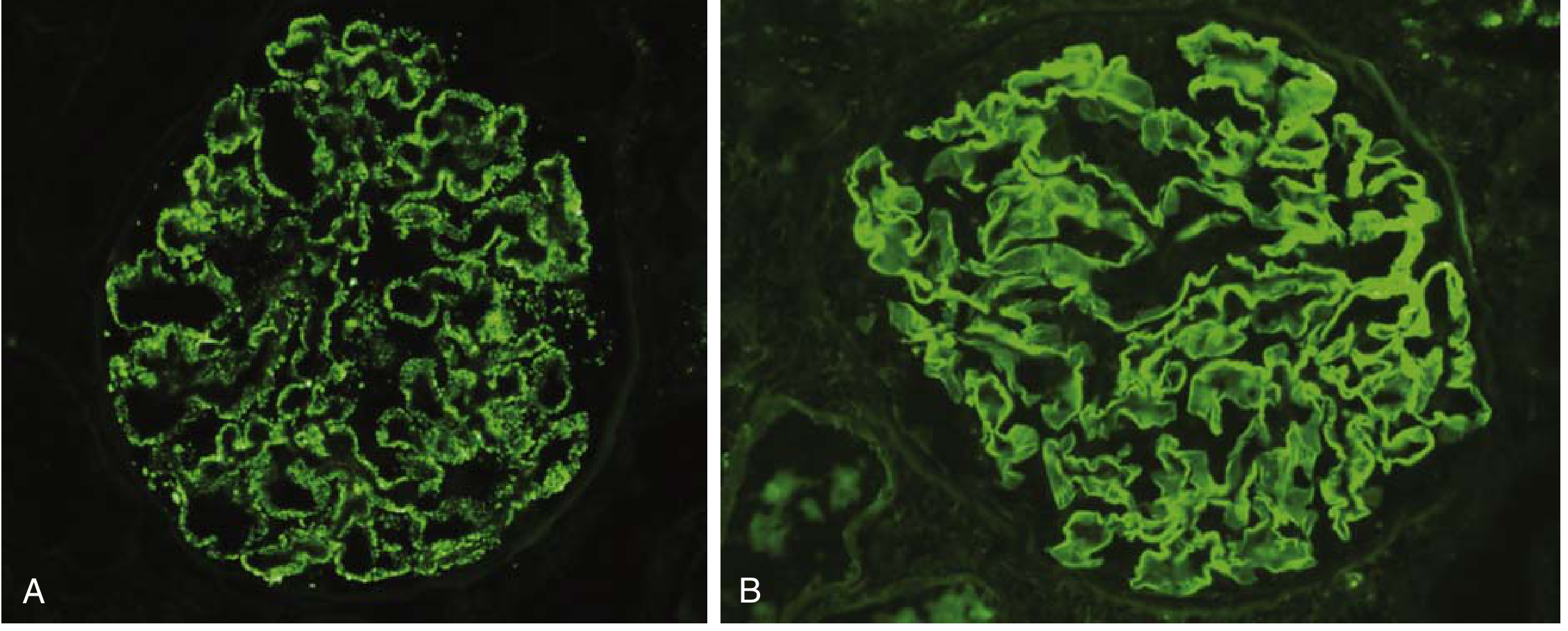
🎯 Textbook Histology Images
🖥️ Your Visual Flowchart/Infographic
- PUFFA mnemonic decoded
- FIRM mnemonic for the 4 causes
- All 4 disease cards with LM/IF/EM findings
- Side-by-side comparison table
- Deposit location diagram
- Downstream consequences
- Memory pegs for each disease
nephrotic syndrome visual
HTML File · HTML
Make a quick reference poster comparing all 4 nephrotic syndromes side-by-side
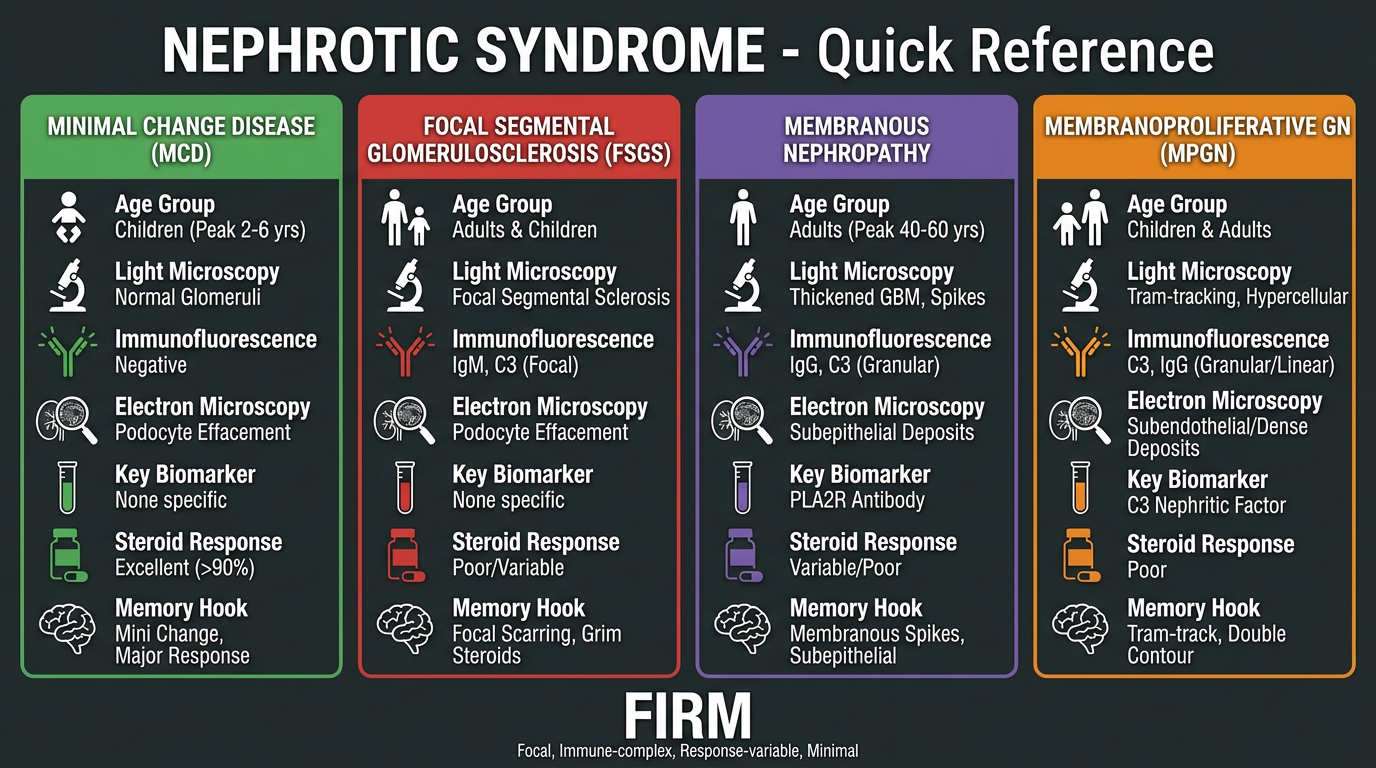
A medical quick reference poster comparing 4 nephrotic syndromes side by side: Minimal Change Disease, FSGS, Membranous Nephropathy, and MPGN. Dark background with 4 color-coded columns (green, red, purple, orange). Each column shows: disease name, age group, light microscopy finding, immunofluorescence, electron microscopy deposit location, key biomarker, steroid response, and memory hook. Include a header "NEPHROTIC SYNDROME - Quick Reference" and a mnemonic "FIRM" at the bottom. Clean, professional medical education style with icons and bold text labels.
nephrotic syndrome visual
HTML File · HTML
| 🟢 MCD | 🔴 FSGS | 🟣 Membranous | 🟠 MPGN | |
|---|---|---|---|---|
| Age | Kids 1-7 | Adults (Black) | White adults 40-60 | Young adults |
| LM | NORMAL | Focal segmental sclerosis | Spike & dome | Tram-track |
| IF | Negative | IgM/C3 (non-specific) | Granular IgG+C3 GBM | IgG+C3 (Type I) / C3 only (DDD) |
| EM | Effacement only | Effacement + denudation | SUBepithelial deposits | SUBendothelial / intramembranous |
| Key marker | Steroid response | APOL1 / podocin | Anti-PLA2R Ab | ↓C3 / C3NeF |
| Steroids | ✅ Excellent | ❌ Resistant | Variable | ❌ Poor |
| Hook | Baby Clean | Scar on Map | Spike Hedgehog | Tram Tracks |
What’s happed ?
- What happened with the poster/output? — Did something not load or look wrong?
- What happened in nephrotic syndrome? — Like the pathological events/cascade?
- Something else entirely?
Generate a PDF version of the nephrotic syndrome quick reference poster
python3 -c "import weasyprint; print('weasyprint ok')" 2>&1
which wkhtmltopdf 2>&1; which chromium 2>&1; which chromium-browser 2>&1; which google-chrome 2>&1; python3 -c "from reportlab.lib import colors; print('reportlab ok')" 2>&1; python3 -c "import fpdf; print('fpdf ok')" 2>&1
chromium --headless --no-sandbox --disable-gpu --print-to-pdf=/home/daytona/workspace/nephrotic-syndrome/nephrotic_syndrome_poster.pdf --print-to-pdf-no-header --no-pdf-header-footer "file:///home/daytona/workspace/nephrotic-syndrome/nephrotic_syndrome_visual.html" 2>&1
nephrotic syndrome poster
PDF Document · PDF