
How blood clot ?
Reading File
Finding Sources
Searching the Web
blood clotting coagulation cascade mechanism overview
Finding Sources
Finding Sources
Good findings. Let me read the most comprehensive sources — Medical Physiology for the mechanism, Robbins for pathology, and search for a diagram.
Reading File
Reading File
Searching Images
blood coagulation cascade clotting factors diagram
I have rich content. Let me also read the Robbins section on coagulation factors and the fibrinolysis section for a complete picture.
Reading File
I now have excellent content from Robbins and Medical Physiology. Let me compile a comprehensive, well-organized answer.
How Blood Clots — The Mechanisms of Hemostasis
Blood clotting (hemostasis) is a tightly regulated response to vascular injury. It involves four overlapping steps: vascular spasm, platelet plug formation, coagulation cascade, and fibrinolysis.
Step 1 — Vascular Spasm
Immediately after injury, the damaged vessel constricts reflexively. This reduces blood flow and limits blood loss while the platelet and coagulation responses catch up. A tourniquet works on this same principle — increasing external pressure decreases the vessel's transmural pressure and flow.
Step 2 — Primary Hemostasis (Platelet Plug)
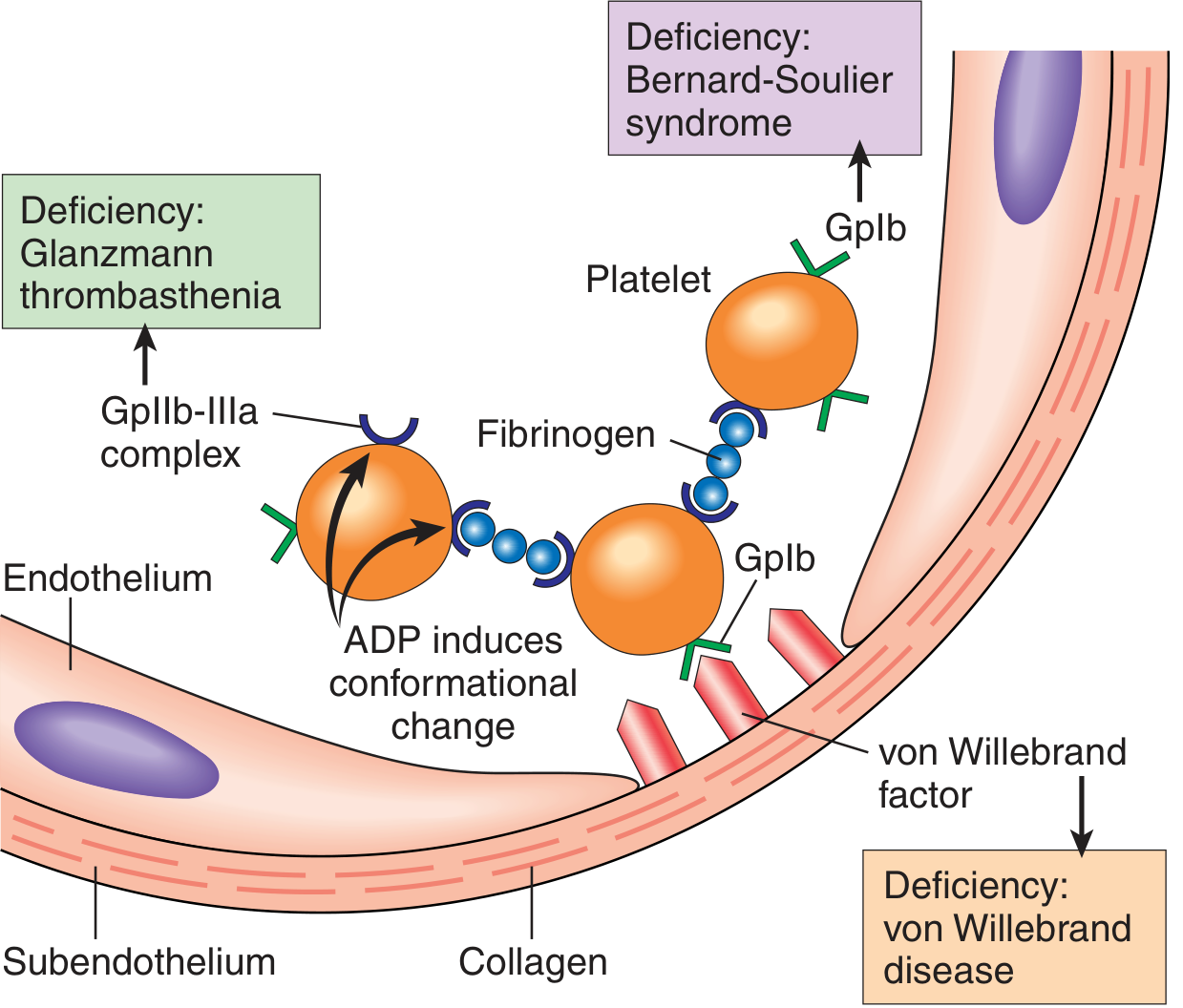
When the vessel wall is breached, the subendothelial matrix is exposed. Three sequential platelet events follow:
Adhesion
- Collagen and von Willebrand factor (vWF) — secreted by endothelial cells and stored in their Weibel-Palade bodies — are exposed.
- vWF acts as a molecular bridge, binding to glycoprotein Ib (GpIb) on the platelet surface.
- Collagen also binds directly to platelet GpIa/IIa. Genetic loss of vWF causes von Willebrand disease; loss of GpIb causes Bernard-Soulier syndrome, both presenting as bleeding disorders.
Activation
- Ligand binding triggers intracellular signaling → shape change (smooth disc → spiky "sea urchin" with greatly increased surface area).
- Two types of granules are released:
- α-granules: fibrinogen, factor V, vWF, fibronectin, PDGF, TGF-β, P-selectin
- Dense (δ) granules: ADP, ATP, calcium, serotonin, epinephrine
- ADP from dense granules recruits more platelets (recruitment amplification).
- Activated platelets produce thromboxane A₂ (TxA₂), a potent platelet aggregation inducer. Aspirin inhibits cyclooxygenase, blocking TxA₂ synthesis and impairing this step.
- Negatively charged phosphatidylserine flips to the outer leaflet, serving as a scaffold for coagulation factor assembly.
Aggregation
- Platelet activation changes the conformation of GpIIb/IIIa, allowing fibrinogen to bridge adjacent platelets → reversible platelet aggregate (primary plug).
- Loss of GpIIb/IIIa = Glanzmann thrombasthenia (bleeding disorder).
Step 3 — Secondary Hemostasis (Coagulation Cascade)
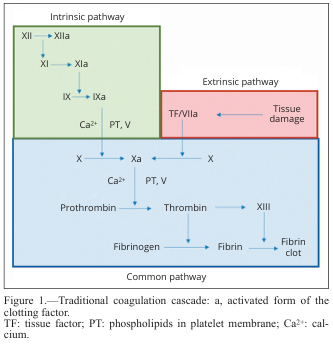
The coagulation cascade converts the soft, reversible platelet plug into a hard, stable fibrin clot. Each step involves an enzyme (activated factor) + substrate (proenzyme) + cofactor, all assembled on the phospholipid surface of activated platelets, in the presence of Ca²⁺.
Two Initiation Pathways
| Pathway | Trigger | Lab Test |
|---|---|---|
| Extrinsic | Tissue factor (TF) released from injured tissue | Prothrombin Time (PT) |
| Intrinsic | Contact with negatively charged surfaces (collagen, glass) | aPTT |
Both converge at Factor X → the common pathway.
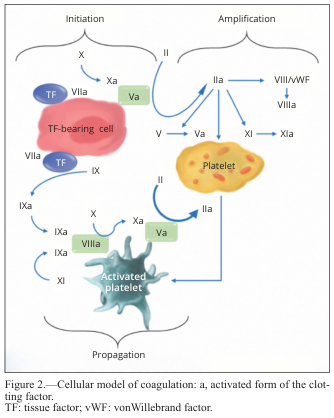
The Cascade in vivo
In living tissue, the extrinsic pathway dominates:
- Tissue factor (TF) is exposed at the injury site
- TF binds Factor VIIa → activates Factor IX and Factor X
- Factor Xa (with cofactor Va) forms the prothrombinase complex → converts prothrombin (II) → thrombin (IIa)
- Thrombin is the central enzyme — it:
- Cleaves fibrinogen → fibrin monomers
- Activates Factor XIII → crosslinks fibrin into a stable mesh
- Activates Factors V, VIII, XI (positive feedback amplification)
- Activates platelets via protease-activated receptors (PAR)
The intrinsic pathway (Factors XII → XI → IX → VIII) amplifies thrombin generation, especially via Factor XIa feedback — explaining why Factor XII deficiency causes no bleeding but Factor VIII/IX deficiency causes hemophilia.
Vitamin K Dependence
Factors II, VII, IX, X require vitamin K for γ-carboxylation of glutamic acid residues — this allows them to bind Ca²⁺ and assemble on phospholipid surfaces. Warfarin inhibits vitamin K recycling, blocking this process.
Step 4 — Anticoagulant Mechanisms (Limits to Clotting)
The body prevents clotting from spreading beyond the injury site:
| Inhibitor | Action |
|---|---|
| Antithrombin (AT-III) | Inactivates thrombin and Factor Xa; potentiated by heparin |
| Protein C/S | Thrombin activates Protein C (via thrombomodulin on endothelium); Protein C + Protein S degrade Factors Va and VIIIa |
| TFPI (Tissue Factor Pathway Inhibitor) | Inhibits the TF/VIIa complex |
| Prostacyclin (PGI₂) | Released by intact endothelium; inhibits platelet activation |
Step 5 — Fibrinolysis (Clot Dissolution)
Once the vessel heals, the clot is dissolved:
- Plasminogen (embedded in the clot) is activated to plasmin by tissue plasminogen activator (tPA) released from endothelial cells.
- Plasmin degrades the fibrin mesh → fibrin degradation products (FDPs/D-dimers).
- FDPs themselves inhibit thrombin, providing further anticoagulant feedback.
- PAI-1 (plasminogen activator inhibitor-1) limits excessive fibrinolysis.
Summary Flowchart
Vascular injury
       ↓
Vascular spasm + collagen/TF exposure
       ↓
Platelet adhesion (vWF–GpIb) → Activation → Aggregation (GpIIb/IIIa–fibrinogen)
       ↓                                              ↓
  Primary platelet plug                    Phospholipid scaffold
                                                   ↓
                            TF + VIIa → IX/X activation (Extrinsic)
                            XII→XI→IX→VIII (Intrinsic amplification)
                                                   ↓
                                    Prothrombinase complex (Xa + Va)
                                                   ↓
                              Prothrombin → THROMBIN (IIa)
                                                   ↓
                       Fibrinogen → Fibrin → Crosslinked fibrin (XIIIa)
                                                   ↓
                                     Stable secondary hemostatic plug
                                                   ↓
                                   Fibrinolysis (plasmin) → clot dissolution
Sources:
- Robbins & Kumar Basic Pathology, pp. 83–86
- Medical Physiology (Boron & Boulpaep), pp. 641–643
- Perioperative Drug and Hemostasis Management in Vascular Surgery (cascade diagrams)
This is a shared conversation. Sign in to Orris to start your own chat.