
Arterial supply of the upper limb till the hand. I want to know the exact beginning point from the heart till the prefer arteries in the hand. You may come across anastomosis as well. So explain that too I guess there are three anastomosis in the upper limb so explain in easy language. And if I am missing anything kindly cover it up and give me good mnemonics to learn.
Reading File
Now let me search the medical library for the arterial supply of the upper limb.
Finding Sources
Finding Sources
Finding Sources
Finding Sources
Good - I found Gray's Anatomy for Students has a section on subclavian artery and its branches. Let me read those key sections in parallel.
Reading File
Reading File
Excellent! Let me now search for more detailed sections on axillary, brachial, radial, ulnar arteries and palmar arches from Gray's Anatomy for Students.
Finding Sources
Finding Sources
Reading File
Finding Sources
Reading File
Finding Sources
Reading File
Reading File
I now have comprehensive information. Let me also fetch the key anatomical images to include in my answer.
Loading Image
Reading File
I now have all the information needed. Let me also fetch the hand artery diagram.
Loading Image
Loading Image
I now have everything I need - comprehensive textbook content and clear anatomical images. Let me write the full answer.
Arterial Supply of the Upper Limb - Complete Guide
The Big Picture: Route from Heart to Fingers
Heart (Left Ventricle)
→ Aorta (Arch of Aorta)
→ Brachiocephalic trunk (Right side) / Direct from aorta (Left side)
→ Subclavian Artery
→ Axillary Artery (at lateral border of Rib I)
→ Brachial Artery (at lower border of Teres Major)
→ Radial Artery + Ulnar Artery (at cubital fossa)
→ Palmar Arches → Digital Arteries → Fingers
1. AORTA to SUBCLAVIAN ARTERY
- Right side: Aortic arch → Brachiocephalic trunk → splits into right common carotid + right subclavian artery
- Left side: Aortic arch → left subclavian artery directly (it is the 3rd branch of the aortic arch)
2. SUBCLAVIAN ARTERY
The subclavian artery is divided into 3 parts by the anterior scalene muscle:
| Part | Location | Mnemonic |
|---|---|---|
| 1st part | Medial to anterior scalene | "1 branch" |
| 2nd part | Behind anterior scalene | "2 branches possible" |
| 3rd part | Lateral to anterior scalene - ends at lateral border of Rib I | "3rd = dorsal scapular may arise here" |
Branches of Subclavian (Remember: VIT C D):
- V - Vertebral artery
- I - Internal thoracic (mammary) artery
- T - Thyrocervical trunk (gives suprascapular + transverse cervical + inferior thyroid)
- C - Costocervical trunk (gives deep cervical + supreme intercostal)
- D - Dorsal scapular artery (from 3rd part or thyrocervical trunk)
At the lateral border of Rib I, the subclavian becomes the Axillary Artery.
3. AXILLARY ARTERY
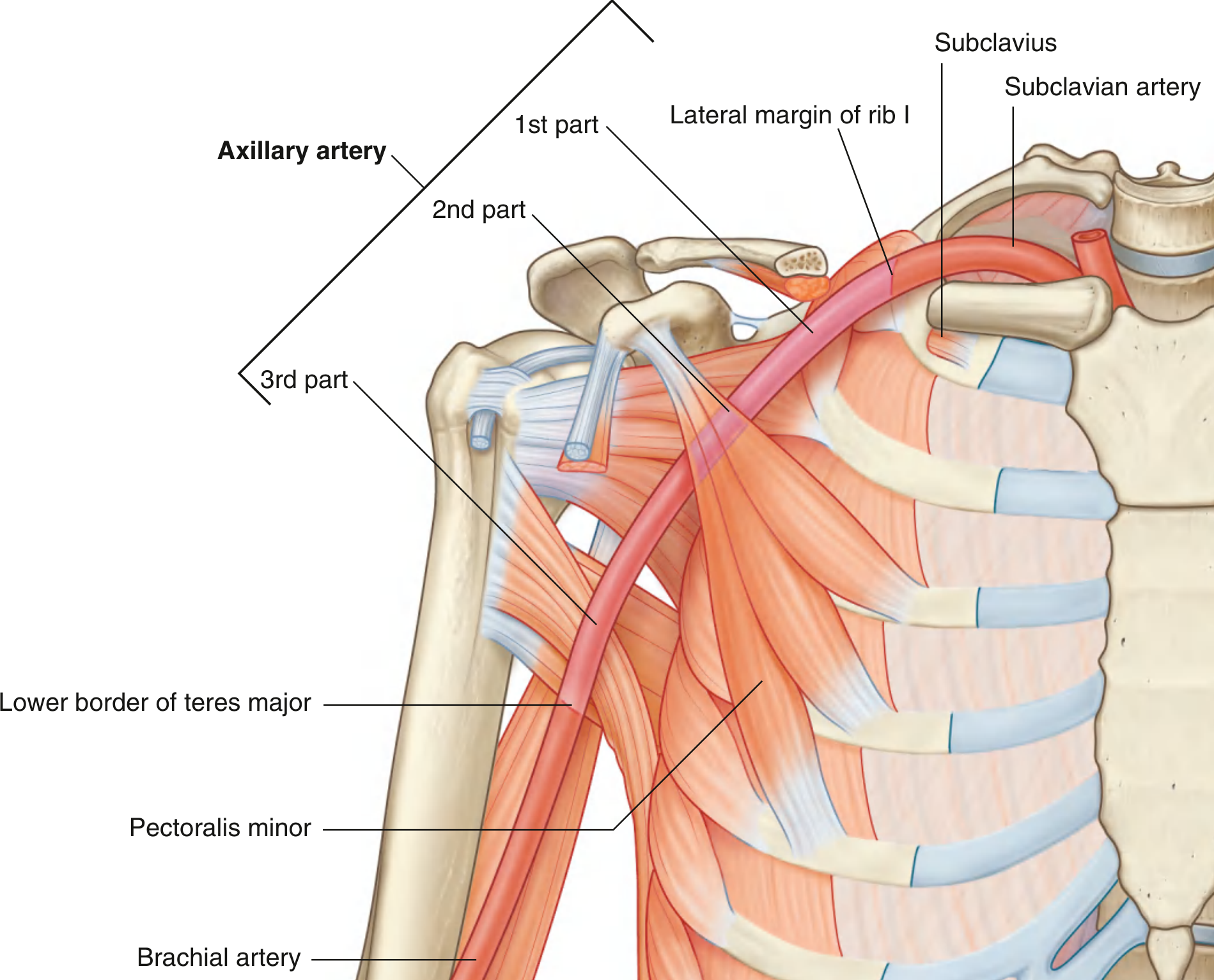
The axillary artery is divided into 3 parts by pectoralis minor muscle:
| Part | Location | Number of Branches |
|---|---|---|
| 1st | Proximal to pec minor | 1 branch |
| 2nd | Behind pec minor | 2 branches |
| 3rd | Distal to pec minor | 3 branches |
Mnemonic: "1 branch, 2 branches, 3 branches" OR "She Takes Lunch, So After School, Popsicle Arrives Promptly"
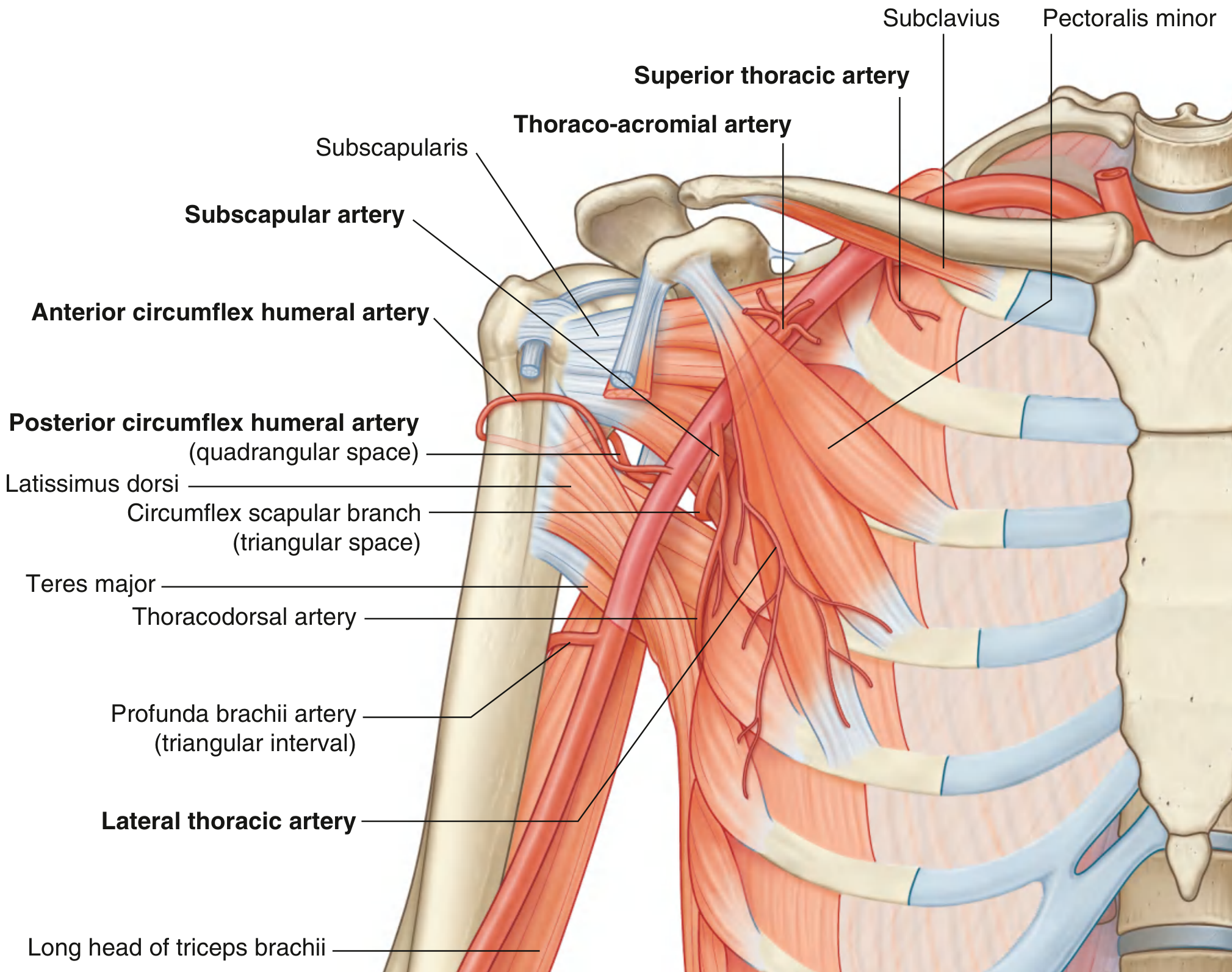
Branches (mnemonic: "S T L S A P A" - Some Times Lawyers Steal All People's Assets):
- Superior thoracic (1st part) - supplies upper axillary walls
- Thoraco-acromial (2nd part) - divides into pectoral, deltoid, clavicular, acromial branches
- Lateral thoracic (2nd part) - supplies medial/anterior axillary wall + breast in women
- Subscapular (3rd part) - the LARGEST branch; divides into circumflex scapular + thoracodorsal arteries
- Anterior circumflex humeral (3rd part) - wraps around surgical neck of humerus
- Posterior circumflex humeral (3rd part) - passes through quadrangular space with axillary nerve; larger of the two circumflex arteries
At the lower border of teres major, the axillary artery becomes the Brachial Artery.
4. BRACHIAL ARTERY
- Runs in the anterior compartment of the arm
- Starts medially in the proximal arm, then moves to the midline distally
- Lies medial to biceps tendon in the cubital fossa - this is where you feel the pulse for blood pressure!
- Ends just distal to the elbow (in the cubital fossa) where it bifurcates
Branches of Brachial Artery (mnemonic: "P U N" - Profunda, Ulnar collaterals, Nutrient):
- Profunda brachii (deep brachial) - the largest branch; passes through the triangular interval with the radial nerve, travels along the radial groove of the humerus; terminates as radial and middle collateral arteries
- Superior ulnar collateral artery - accompanies the ulnar nerve around the medial epicondyle
- Inferior ulnar collateral artery - arises above the elbow
- Nutrient artery to the humerus
- Muscular branches
At the cubital fossa (just below the elbow), the brachial artery bifurcates into Radial and Ulnar arteries.
5. RADIAL ARTERY
- Passes laterally down the forearm along the radius
- At the wrist, it crosses the scaphoid bone in the anatomical snuff box (where you feel the radial pulse)
- Enters the palm between the 1st and 2nd metacarpals
- Forms the deep palmar arch (mainly)
Key branches:
- Radial recurrent artery (anastomoses with radial collateral around elbow)
- Muscular branches
- Palmar carpal branch + Dorsal carpal branch (for carpal arches)
- Superficial palmar branch (contributes to superficial palmar arch)
- Princeps pollicis - main artery to the thumb
- Radialis indicis - to radial side of index finger
- Deep palmar arch (terminal branch)
6. ULNAR ARTERY
- Passes medially down the forearm
- At the wrist, it passes through Guyon's canal (between pisiform and hook of hamate)
- Forms the superficial palmar arch (mainly)
Key branches:
- Ulnar recurrent artery (anterior + posterior divisions for elbow anastomosis)
- Common interosseous artery - a major branch that divides into:
- Anterior interosseous artery - runs on the interosseous membrane (main blood supply to deep forearm muscles)
- Posterior interosseous artery - passes through the gap above the interosseous membrane into the posterior forearm
- Muscular branches
- Palmar carpal + Dorsal carpal branches
- Superficial palmar arch (terminal branch)
- Deep branch (contributes to deep palmar arch)
7. IN THE HAND - The Palmar Arches
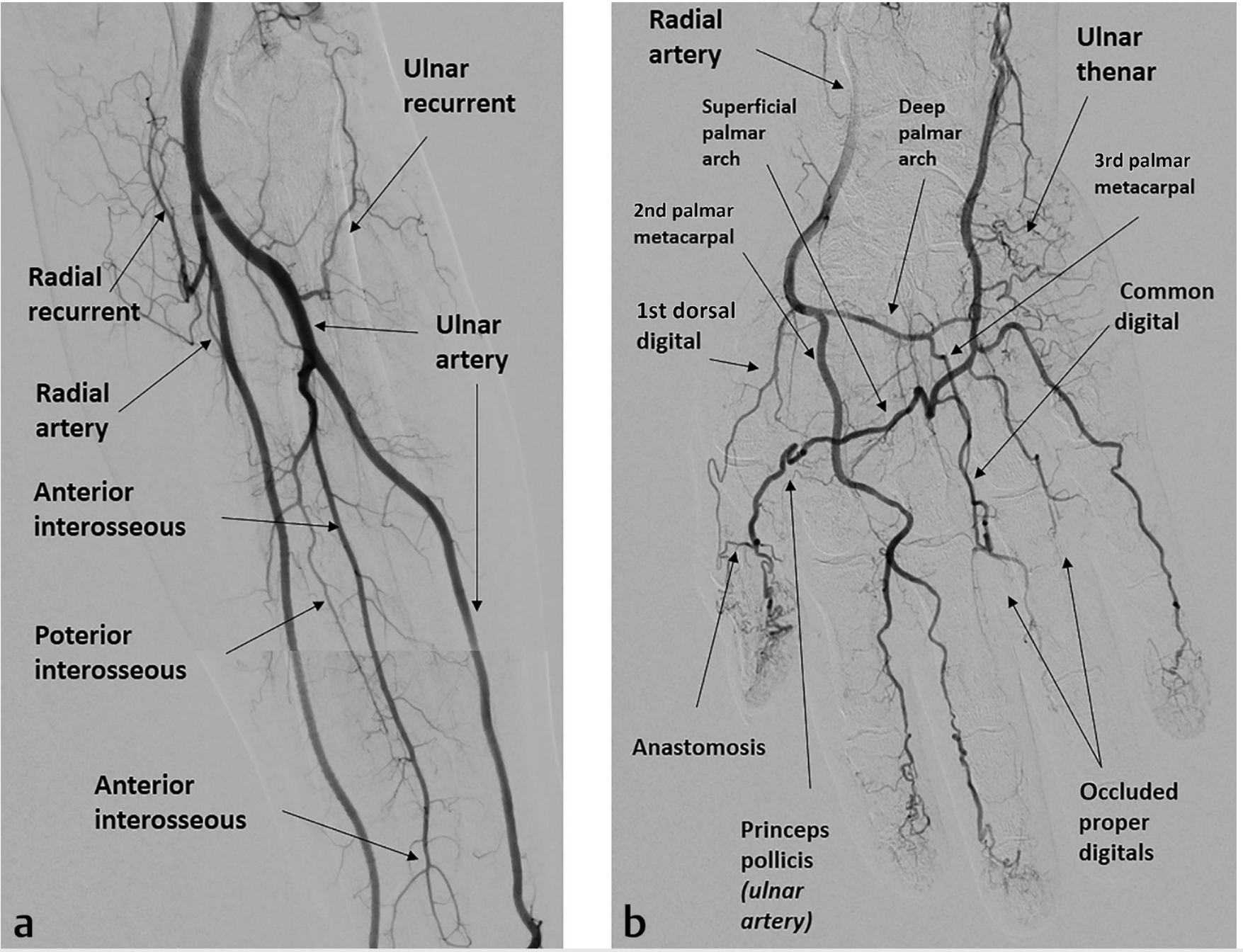
Superficial Palmar Arch
- Mainly formed by: Ulnar artery (the dominant contributor)
- Completed by the superficial palmar branch of radial artery
- Lies superficial to the flexor tendons (deep to palmar aponeurosis)
- Level: roughly at the level of the outstretched thumb tip
- Gives off 3 common palmar digital arteries (for 2nd-5th fingers)
- These split into proper palmar digital arteries (one for each side of adjacent fingers)
Deep Palmar Arch
- Mainly formed by: Radial artery (the dominant contributor)
- Completed by the deep branch of ulnar artery
- Lies deep to the flexor tendons, on the metacarpal bases
- About 1 cm proximal to the superficial arch
- Gives off 3-4 palmar metacarpal arteries which join the common digital arteries distally
- Also gives off princeps pollicis and radialis indicis
Simple way to remember which arch is dominant: "Ulnar = Superficial, Radial = Deep" Mnemonic: "URDS" - Ulnar-Radial, Deep-Superficial
THE THREE ANASTOMOSES OF THE UPPER LIMB
Anastomosis 1: Around the Scapula (Scapular Anastomosis)
Location: Posterior chest/scapular region
Why it matters: If the subclavian artery is blocked proximal to the thyrocervical trunk, blood can still reach the axillary artery via this route.
Vessels involved:
- Suprascapular artery (from thyrocervical trunk of subclavian) passes OVER the superior transverse scapular ligament
- Circumflex scapular artery (from subscapular artery of axillary) passes through the triangular space
- These two meet on the posterior surface of the scapula
Mnemonic: "Supra goes OVER, Circumflex goes UNDER (the ligament)"
Anastomosis 2: Around the Elbow (Periarticular Elbow Anastomosis)
Location: Around the elbow joint
Why it matters: If the brachial artery is damaged above the elbow, this network maintains blood supply to the forearm.
Vessels involved - Think ABCD pairs (each collateral meets a recurrent):
| Collateral (coming DOWN) | Recurrent (going UP) |
|---|---|
| Radial collateral (from profunda brachii) | Radial recurrent (from radial artery) |
| Middle collateral (from profunda brachii) | Posterior interosseous recurrent (from posterior interosseous) |
| Superior ulnar collateral (from brachial) | Posterior ulnar recurrent (from ulnar) |
| Inferior ulnar collateral (from brachial) | Anterior ulnar recurrent (from ulnar) |
Mnemonic: "RIMS meets RPPA" - or just remember 4 collaterals (2 from profunda + 2 from brachial) meet 4 recurrents (1 radial + 1 posterior interosseous + 2 ulnar) around the elbow.
Anastomosis 3: In the Hand (Palmar Arch Anastomosis)
Location: The palm
Why it matters: Either the radial or ulnar artery alone can supply the entire hand through cross-connections. This is tested by the Allen test / Barbeau test before radial artery procedures.
Four levels of anastomosis in the wrist and hand:
- Palmar carpal arch - radial + ulnar palmar carpal branches meet across the carpals
- Dorsal carpal arch - radial + ulnar dorsal carpal branches meet (dorsal carpal arch arises from radial in 80% of people)
- Superficial palmar arch - ulnar artery + superficial palmar branch of radial
- Deep palmar arch - radial artery + deep branch of ulnar
Mnemonic: "2 arches in the wrist, 2 arches in the palm"
MASTER MNEMONIC - The Whole Route
"Archie Bought Banana Rice Under Palms"
- Aorta
- Brachiocephalic (right) or direct from arch (left)
- Subclavian - VIT C D branches
- Axillary (at Rib I) - S-T-L / S-A-P = "Some Times Lunch / Stops All Progress"
- Brachial (at teres major) - Profunda + Ulnar collaterals + Nutrient
- Radial + Ulnar (at cubital fossa) - Common interosseous from ulnar
- Palmar arches (Superficial = Ulnar dominant, Deep = Radial dominant) → Digital arteries
QUICK SUMMARY TABLE
| Artery | Begins | Ends | Key Branch |
|---|---|---|---|
| Subclavian | Brachiocephalic / Aortic arch | Lateral border Rib I | Vertebral, Internal thoracic, Thyrocervical |
| Axillary | Lateral border Rib I | Lower border Teres Major | Subscapular, Circumflex humeral arteries |
| Brachial | Lower border Teres Major | Cubital fossa | Profunda brachii, Ulnar collaterals |
| Radial | Cubital fossa | Deep palmar arch | Princeps pollicis, Superficial palmar branch |
| Ulnar | Cubital fossa | Superficial palmar arch | Common interosseous artery |
Sources: Gray's Anatomy for Students; Imaging Anatomy: Bones, Joints, Vessels and Nerves (Vol. 3)
This is a shared conversation. Sign in to Orris to start your own chat.