
**Topic:** diff bw alpha and beta hemihydrate **Reference:** philips **Format/Marks:** [5–7 Short note Give me a **BDS university-exam-oriented answer** according to the reference, in **very easy language**, following the format/marks I specify. Include **important headings, classifications, tables, examples, mnemonics, flowcharts, and simple hand-drawn-style diagrams** wherever useful, and generate **PNG flowcharts/diagrams** when they would help. End with **⭐ high-yield points, quick revision, likely viva questions, and the most important points to write in the exam**.
A clean hand-drawn style educational diagram comparing alpha hemihydrate vs beta hemihydrate (calcium sulfate hemihydrate) for dental students. Show two columns side by side. Left column: Alpha Hemihydrate (Dental Stone) - dense, regular, prismatic crystals, autoclaved under steam pressure, low water/powder ratio 0.22-0.30, high strength. Right column: Beta Hemihydrate (Plaster of Paris) - porous, irregular, sponge-like crystals, dry heat calcination/open kettle method, high water/powder ratio 0.45-0.50, low strength. Include a simple flowchart at bottom showing: Gypsum (CaSO4.2H2O) → Heat → Hemihydrate (CaSO4.½H2O) with two branches: Autoclave steam pressure (130°C) → Alpha, and Open kettle/dry heat (110-130°C) → Beta. Use pastel colors, clear labels, arrows, and a title at the top.
Alpha Hemihydrate vs Beta Hemihydrate
(Short Note - 5 to 7 Marks | Ref: Phillips' Science of Dental Materials)
Quick Intro (Write this first in exam)
- Alpha (α) hemihydrate - dental stone
- Beta (β) hemihydrate - dental/impression plaster (Plaster of Paris)
Diagram / Flowchart
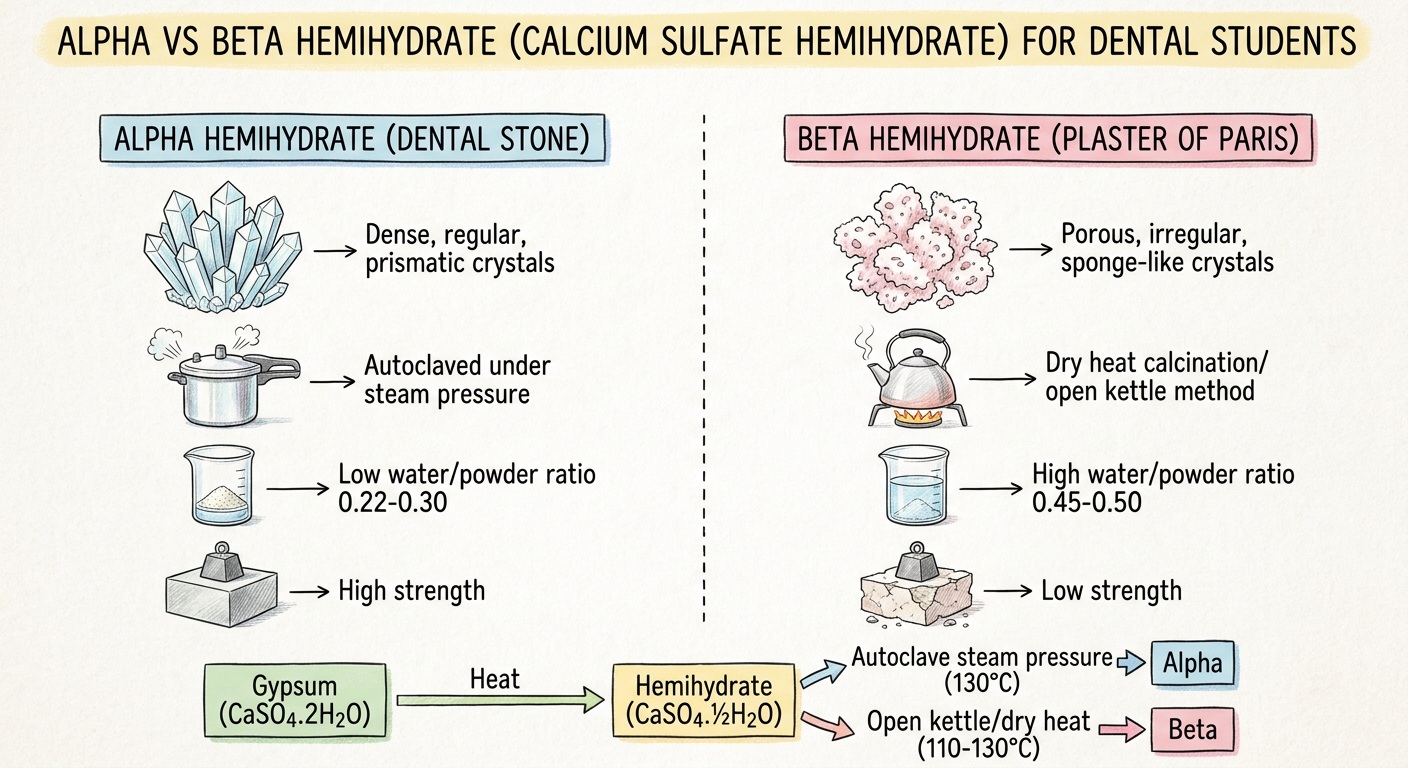
How They Are Made (Manufacturing / Calcination)
Gypsum (CaSO₄.2H₂O)
         |
      [HEAT]
         |
    _____|_____
   |           |
AUTOCLAVE     OPEN KETTLE / DRY HEAT
(Steam, 130°C) (110-130°C, atmospheric)
   |                   |
Alpha (α)          Beta (β)
Hemihydrate        Hemihydrate
(Dental Stone)  (Plaster of Paris)
- Alpha: Calcined in a closed autoclave under steam pressure (1.25 atm, ~130°C). The water is driven off slowly as liquid, giving dense, regular crystals.
- Beta: Calcined in an open vessel/dry heat at atmospheric pressure (~110-130°C). Water is driven off as steam, leaving behind porous, irregular crystals.
Main Comparison Table
| Property | Alpha (α) Hemihydrate | Beta (β) Hemihydrate |
|---|---|---|
| Common Name | Dental Stone / Improved Stone | Plaster of Paris / Impression Plaster |
| Manufacturing | Autoclave - steam under pressure (130°C, 1.25 atm) | Open kettle / dry calcination (110-130°C) |
| Crystal Shape | Dense, regular, prismatic / well-formed | Porous, irregular, sponge-like, fibrous |
| Surface Area | Small (dense crystals) | Large (porous = more surface area) |
| Water/Powder Ratio (W/P) | 0.22 - 0.30 | 0.45 - 0.50 |
| Why more water for β? | Porous crystals absorb more water | Fewer pores = less absorption |
| Compressive Strength (set) | 20 - 35 MPa (HIGH) | 8 - 12 MPa (LOW) |
| Setting Expansion | Less (~0.06%) | More (~0.3 - 0.5%) |
| Setting Time | Slightly longer | Shorter (more reactive surface) |
| Porosity of set product | Low (denser, stronger) | High (more porous, weaker) |
| Surface Hardness | High | Low |
| Uses in Dentistry | Dies, models, study casts, articulator mounting | Primary impressions, mounting casts, flasking, articulator bases |
| ADA Classification | Type II (dental plaster), Type III & IV (stone) | Type I (impression plaster), Type II (dental plaster) |
| Cost | Higher | Lower |
Crystal Structure - Simple Diagram (Draw in Exam)
ALPHA (Dense, Regular)      BETA (Porous, Irregular)
  ________________            _ _ _ _ _ _ _
 |  [][][][][][]  |          | . . . . . . |
 |  [][][][][][]  |          |   (holes)   |
 |  [][][][][][]  |          | . . . . . . |
 |________________|          |_ _ _ _ _ _ _|
  Solid, prismatic            Sponge-like, fibrous
  Small surface area          Large surface area
  Low W/P ratio               High W/P ratio
Why Does Crystal Shape Affect W/P Ratio?
- Beta crystals are porous - they soak up water like a sponge, so more water is needed just to wet the surface and make a workable mix.
- Alpha crystals are dense - less surface area means less water is needed for the same consistency.
- More water in the set product = more porosity = weaker final material (Beta).
- Less water = denser set product = stronger (Alpha).
Key Principle (Phillips): "The strength of a set gypsum product is inversely related to the W/P ratio used to mix it."
Setting Reaction (Same for Both)
CaSO₄.½H₂O  +  1½H₂O  →  CaSO₄.2H₂O  +  Heat
(Hemihydrate)             (Dihydrate/Gypsum)
- The reaction is the same for both alpha and beta.
- The difference lies in the physical form of the crystals, not the chemistry.
Mnemonic to Remember
"Alpha Autoclave - Amazingly Strong; Beta Boils Open - Becomes Brittle"
| Letter | Alpha | Beta |
|---|---|---|
| A | Autoclave | Atmospheric/Open kettle |
| W/P | 0.22-0.30 (Less water) | 0.45-0.50 (More water) |
| S | Strong | Soft/Weak |
| C | Compact crystals | Crumbly/Porous crystals |
ADA Types of Gypsum Products (Quick Reference)
| ADA Type | Product | Form |
|---|---|---|
| Type I | Impression plaster | Beta |
| Type II | Dental plaster (model plaster) | Beta |
| Type III | Dental stone (Class 1) | Alpha |
| Type IV | Die stone / High-strength stone | Alpha (special) |
| Type V | High-strength, high-expansion stone | Alpha (special) |
Uses Summary
| Alpha Hemihydrate | Beta Hemihydrate |
|---|---|
| Dental dies | Primary impressions |
| Working models (crown/bridge) | Diagnostic study models |
| Articulator mounting (for accuracy) | Flasking in complete dentures |
| Orthodontic study models (Type III) | Articulator base mounting (sometimes) |
⭐ HIGH-YIELD POINTS
- Alpha = Autoclave (steam pressure) | Beta = Open kettle (dry heat) - the most tested difference.
- W/P ratio: Alpha = 0.22-0.30 (LOW); Beta = 0.45-0.50 (HIGH) - ALWAYS comes in exams.
- Alpha is STRONGER because lower W/P = denser set product.
- Beta has MORE setting expansion than alpha.
- Crystal shape: Alpha = dense/prismatic; Beta = porous/irregular/sponge-like.
- The chemical formula is same (CaSO₄.½H₂O) - only physical form differs.
- Strength is inversely proportional to W/P ratio (Phillips' key principle).
- Alpha = dental stone (Type III, IV, V); Beta = plaster of Paris (Type I, II).
- Beta crystals have larger surface area → need more water → weaker product.
- Both undergo same setting reaction to form dihydrate (gypsum).
Quick Revision Summary (30 seconds before exam)
- Alpha: Autoclave → Dense crystals → Low W/P (0.22-0.30) → High strength → Dental stone → Dies & models
- Beta: Open kettle → Porous crystals → High W/P (0.45-0.50) → Low strength → Plaster of Paris → Impressions & flasking
- Same chemical formula, different physical form, same setting reaction
Likely Viva Questions
-
Q: What is the W/P ratio of alpha and beta hemihydrate? A: Alpha = 0.22-0.30; Beta = 0.45-0.50
-
Q: Why does beta hemihydrate require more water? A: Beta crystals are porous and irregular, with large surface area - they absorb more water.
-
Q: How is alpha hemihydrate manufactured? A: By autoclaving gypsum in steam under pressure at 130°C / 1.25 atm.
-
Q: Which is stronger - alpha or beta? Why? A: Alpha is stronger because its lower W/P ratio results in a denser, less porous set product.
-
Q: What is the setting reaction of gypsum products? A: CaSO₄.½H₂O + 1½H₂O → CaSO₄.2H₂O + Heat
-
Q: Name one dental use of alpha and one of beta hemihydrate. A: Alpha = dental die/working model; Beta = primary impression/flasking
-
Q: Is the chemical formula of alpha and beta the same? A: Yes - both are CaSO₄.½H₂O; they differ only in physical crystal structure.
-
Q: Which type of hemihydrate has more setting expansion? A: Beta hemihydrate has more setting expansion (~0.3-0.5%) compared to alpha (~0.06%).
Most Important Lines to Write in Exam (Don't Skip These)
- "Alpha and beta hemihydrates have the same chemical formula (CaSO₄.½H₂O) but differ in physical crystal structure due to different methods of calcination."
- "Alpha is manufactured by autoclaving under steam pressure (130°C); Beta by dry calcination in open vessel."
- "Beta crystals are porous and irregular with large surface area, requiring a higher W/P ratio (0.45-0.50), resulting in lower strength."
- "Alpha crystals are dense and prismatic with small surface area, requiring a lower W/P ratio (0.22-0.30), resulting in higher strength and hardness."
- "Strength is inversely proportional to W/P ratio (Phillips)."