
Definition of fracture, dislocation and subluxation
Reading File
Finding Sources
Finding Sources
Finding Sources
Finding Sources
Finding Sources
Finding Sources
Good — I have key sources. Let me read the most relevant passages from Robbins Pathology, Rosen's Emergency Medicine, and Rockwood & Green's.
Reading File
Reading File
Reading File
Reading File
Reading File
Reading File
I now have comprehensive definitions from authoritative textbooks. Let me compile the answer.
Fracture, Dislocation, and Subluxation — Definitions
1. Fracture
Definition: A fracture is a break in the continuity of bone, which may result from mechanical injury and/or diminished bone strength.
- Rosen's Emergency Medicine defines it as: "A break in the continuity of bone, which may be more subtle in children."
- Robbins & Kumar Basic Pathology defines it as: "Loss of bone integrity resulting from mechanical injury and/or diminished bone strength."
Clinically, a fracture is suggested by a history of trauma, loss of function, pain, tenderness, swelling, abnormal motion, and deformity.
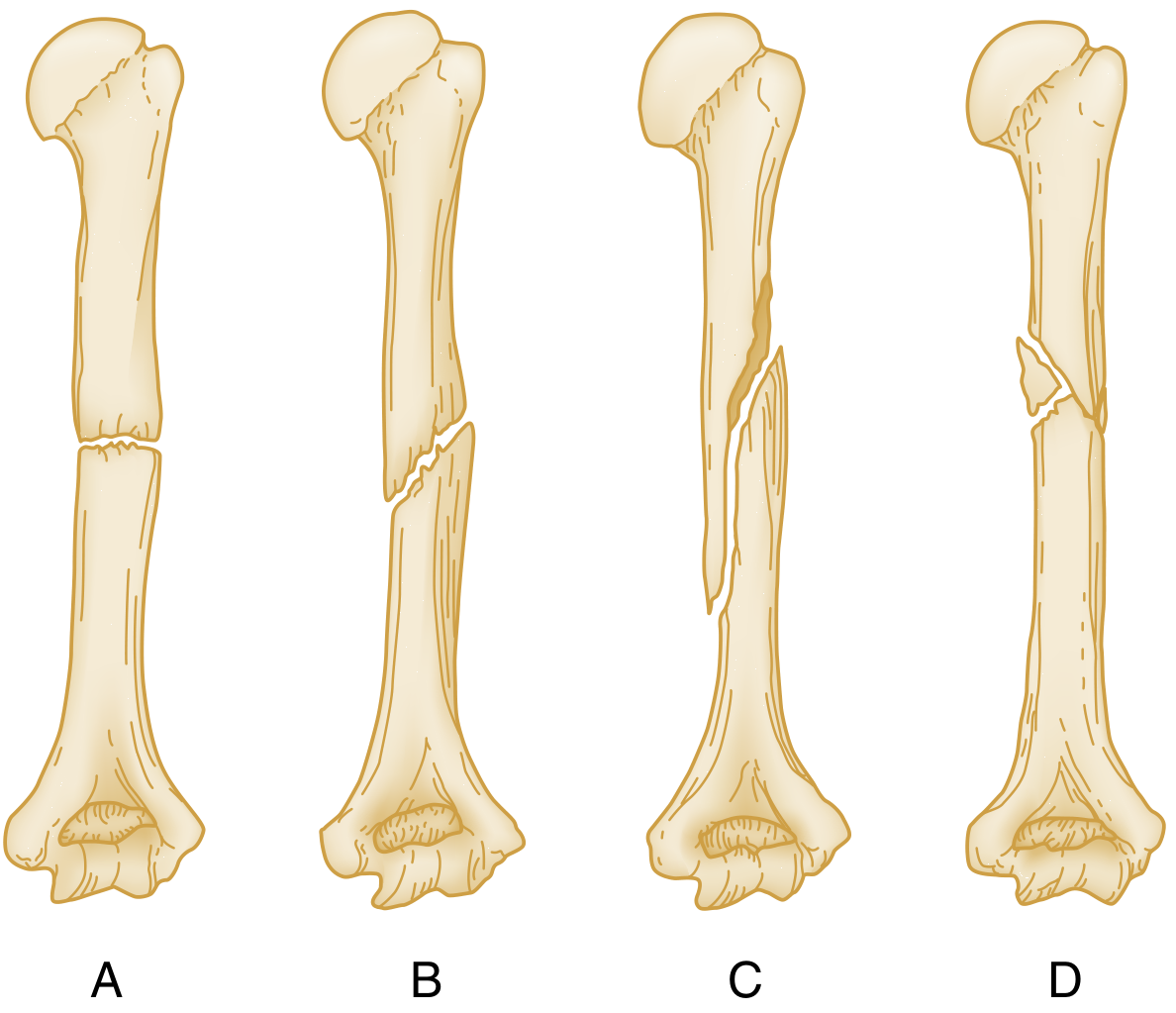
Key Descriptive Types (Rosen's / Robbins):
| Type | Description |
|---|---|
| Closed (Simple) | Overlying skin is intact |
| Open (Compound) | Bone communicates with the external environment |
| Comminuted | More than two fragments |
| Transverse | Fracture line at a right angle to the long axis of bone |
| Oblique | Fracture line runs oblique to the long axis |
| Spiral | Results from rotational/torsional force; encircles shaft |
| Displaced | Ends at the fracture site are not aligned |
| Stress | Slowly developing fracture from repetitive loading |
| Greenstick | Extends only partially through bone; seen in children |
| Pathologic | Occurs through bone weakened by underlying disease (e.g., tumor) |
2. Dislocation
Definition: A dislocation is the complete loss of continuity between two articulating surfaces of a joint — i.e., complete separation of the articular surfaces such that they no longer maintain contact.
From Rosen's Emergency Medicine:
"Abnormal forces applied to joints may result in the loss of continuity between two articulating surfaces. Complete loss of continuity is termed dislocation."
From Rockwood & Green's Fractures in Adults:
"Excessive translation of the humeral head results in complete separation of the articular surfaces. The humeral head may not self-reduce when the abnormal force is removed."
Key Points:
- Named for the major joint involved (e.g., dislocation of the knee, dislocation of the shoulder).
- Described by the direction of the distal segment relative to the proximal (e.g., dorsal dislocation of the interphalangeal joint).
- Fracture-dislocation: when disruption of articulation occurs in combination with a fracture.
- If the overlying skin is broken → termed open dislocation (treated as an emergency like open fracture).
- Clinically: severe pain, obvious deformity, loss of joint range of motion, risk of neurovascular injury.
- Often requires manual reduction with sedation or analgesia; some require surgical intervention.
3. Subluxation
Definition: A subluxation is a partial loss of continuity between two articulating surfaces — i.e., incomplete or partial displacement of a joint where the articular surfaces remain in partial contact.
From Rosen's Emergency Medicine:
"Partial loss of continuity is termed subluxation."
From Rockwood & Green's Fractures in Adults:
"Subluxation is defined as the translation of the humeral head against the glenoid without complete separation of the articular surfaces. Spontaneous reduction occurs once the abnormal force is removed and the humeral head reduces back to the normal anatomic position."
Key Points:
- Unlike full dislocation, articular surfaces retain partial contact.
- Self-reducing — the joint typically returns to normal position once the abnormal force is removed (unlike dislocation which often requires manual reduction).
- Can occur in any direction: anterior, posterior, or inferior (for the glenohumeral joint).
- Transient luxation (proposed by Owens et al.) is an intermediate concept — a subluxation that momentarily causes full articular surface separation but self-reduces; it may still produce Bankart or Hill-Sachs lesions.
Summary Comparison
| Feature | Fracture | Dislocation | Subluxation |
|---|---|---|---|
| Structure involved | Bone | Joint | Joint |
| Definition | Break in bone continuity | Complete loss of joint articulation | Partial loss of joint articulation |
| Articular contact | N/A | None (complete separation) | Partial contact maintained |
| Self-reduction | No | Usually not | Usually yes |
| Skin involvement | Open or closed | Open or closed | Open or closed |
| Combined injury | Fracture-dislocation | Fracture-dislocation | — |
Sources: Rosen's Emergency Medicine, 10th ed., Ch. 41; Robbins & Kumar Basic Pathology, Ch. 19; Rockwood and Green's Fractures in Adults, 10th ed., 2025
This is a shared conversation. Sign in to Orris to start your own chat.