
How to depotash a patient
Reading File
"Depotashing" a patient refers to lowering elevated serum potassium (treating hyperkalemia). The approach involves membrane stabilization, shifting potassium into cells, and removing potassium from the body.
Searching sources...
Finding Sources
Searching PubMed
hyperkalemia management treatment
Reading File
Reading File
Reading File
Loading Image
Here is a complete, evidence-based guide to "depotashing" (lowering potassium in) a patient with hyperkalemia. Treatment is organized into three sequential stages.
How to Depotash a Patient (Treating Hyperkalemia)
Hyperkalemia = serum K+ ≥ 5.5 mmol/L. K+ ≥ 6.0 mmol/L OR any ECG changes = medical emergency.
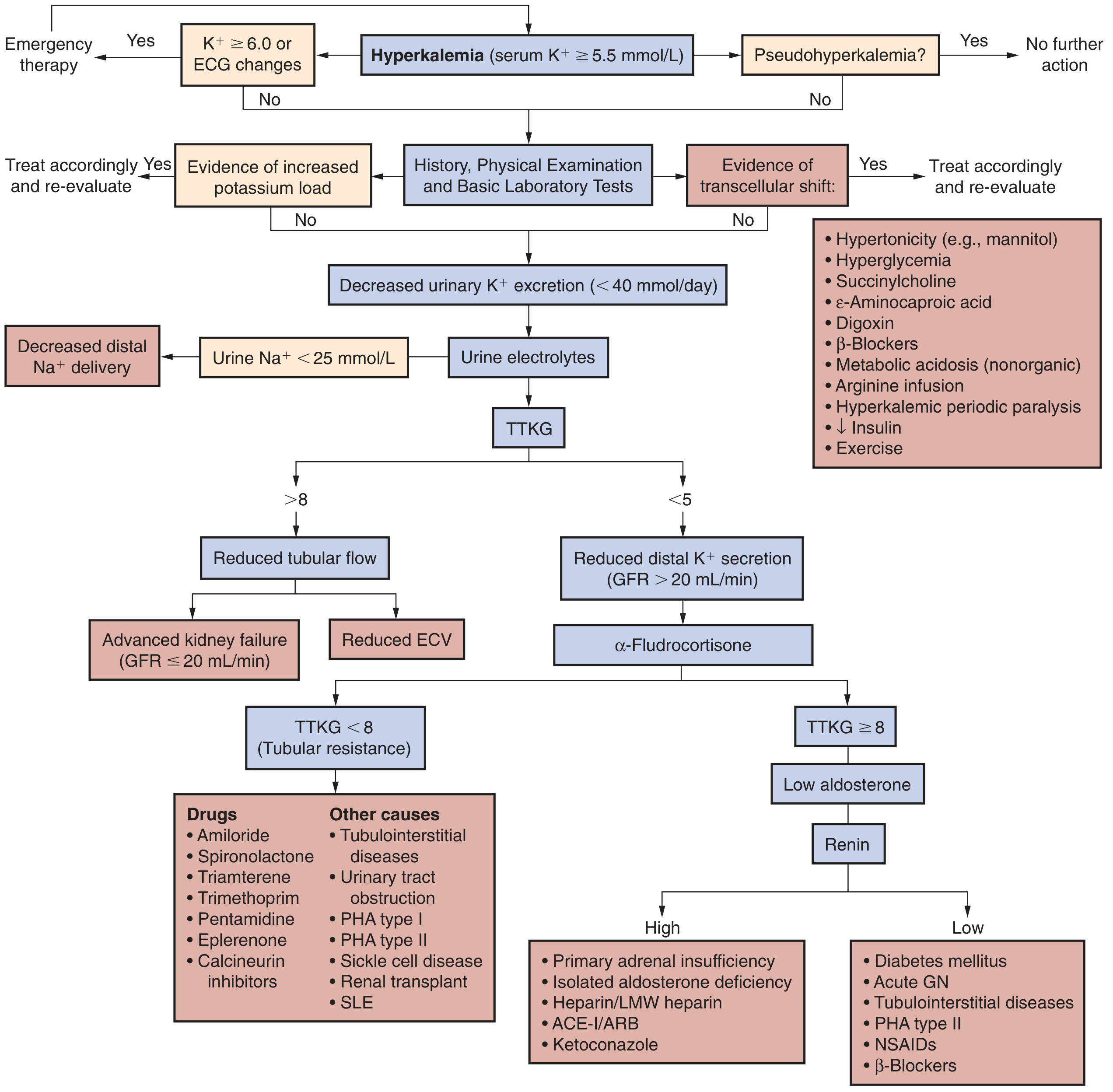
Step 0 - First, Rule Out Pseudohyperkalemia & Start Monitoring
- Check for pseudohyperkalemia (haemolysed sample, extreme thrombocytosis/leukocytosis) - repeat the test
- Admit, start continuous cardiac monitoring and 12-lead ECG
- Restrict dietary K+ (typically 60 mEq/day)
- Review and stop/adjust offending medications (ACE inhibitors, ARBs, K+-sparing diuretics, NSAIDs, heparin, TMP-SMX)
Stage 1 - Cardiac Membrane Stabilization (Immediate)
Goal: Protect the heart NOW - does NOT lower K+
| Agent | Dose | Onset | Duration | Notes |
|---|---|---|---|---|
| Calcium gluconate 10% | 10 mL IV over 2-3 min | 1-3 min | 30-60 min | Preferred - safe via peripheral line; repeat if ECG changes persist or recur |
| Calcium chloride 10% | 3-4 mL IV | 1-3 min | 30-60 min | More elemental Ca2+; requires central line (tissue necrosis if it extravasates) |
Digoxin caution: If the patient is on digoxin, hypercalcemia worsens digoxin toxicity. Instead, dilute 10 mL of 10% calcium gluconate in 100 mL D5W and infuse over 20-30 min to avoid acute hypercalcemia.
Stage 2 - Redistribute K+ Into Cells (Rapid, 10-90 min)
A. Insulin + Glucose (First-line)
- Insulin: 10 units regular insulin IV
- Glucose: 50 mL of 50% dextrose (D50W, 25g) immediately after
- Onset: 10-20 min | Peak: 30-60 min | Duration: 4-6 h
- Follow with 10% dextrose infusion at 50-75 mL/h to prevent hypoglycemia (monitor glucose closely)
- If glucose is already ≥ 200-250 mg/dL: give insulin alone (no glucose), with close glucose monitoring
B. Nebulized Albuterol (Additive to Insulin)
- Dose: 10-20 mg nebulized in 4 mL normal saline over 10 min
- Onset: ~30 min | Peak: ~90 min | Duration: 2-6 h
- Albuterol + insulin have an additive effect
- Caution: ~20% of ESRD patients are resistant; should never be used alone without insulin
- Side effects: tachycardia, hyperglycemia - use with caution in known cardiac disease
C. Sodium Bicarbonate (Limited role)
- No role in acute treatment for immediate effect
- May slowly attenuate K+ over 4-6 h in metabolic acidosis patients
- Give as isotonic infusion (150 mEq NaHCO3 in 1 L D5W) - do NOT give repeated hypertonic boluses (risk of hypernatremia)
Stage 3 - Remove K+ From the Body (Definitive)
A. Diuretics
- Loop diuretics (furosemide) or thiazides: useful if patient has adequate renal function and is volume-replete or hypervolemic
- May combine with IV saline or isotonic bicarbonate to maintain euvolemia
- IV saline alone: useful in hypovolemic patients with oliguria and reduced distal Na+ delivery
B. Gastrointestinal Cation Exchangers (Potassium Binders)
| Agent | Mechanism | Dose | Notes |
|---|---|---|---|
| Patiromer (Veltassa) | Binds K+, releases Ca2+ | Powder suspension | Preferred over SPS - no intestinal toxicity; watch for hypomagnesemia |
| Sodium zirconium cyclosilicate (SZC/Lokelma) | Exchanges Na+/H+ for K+/NH4+ | Powder suspension | Preferred over SPS; fast-acting for a binder |
| Sodium polystyrene sulfonate (SPS/Kayexalate) | Exchanges Na+ for K+ in GI tract | 15-30 g powder in 33% sorbitol suspension | Last resort - full effect takes up to 24 h; rare but often fatal intestinal necrosis, especially in post-op patients or opioid users |
Patiromer and SZC are preferred over SPS whenever available, per Harrison's 22nd ed and recent systematic review evidence (PMID: 40542996).
C. Dialysis (Most Effective)
- Hemodialysis: most effective and fastest definitive K+ removal - use when K+ is life-threatening and medical therapy is insufficient or for AKI/ESRD patients
- Peritoneal dialysis: considerably less effective than hemodialysis
- Amount removed depends on: dialyzer type/surface area, blood/dialysate flow rates, duration, and plasma-to-dialysate K+ gradient
Quick Summary Table
| Stage | Goal | Agent(s) | Onset |
|---|---|---|---|
| 1 - Membrane stabilization | Protect heart | IV Calcium | 1-3 min |
| 2 - Shift K+ into cells | Lower serum K+ temporarily | Insulin + Glucose, Albuterol, NaHCO3 | 10-90 min |
| 3 - Remove K+ from body | Permanently lower K+ | Diuretics, K+ binders (patiromer/SZC), Dialysis | Hours |
Special Situations
- Digoxin toxicity causing hyperkalemia: treat with anti-digoxin Fab (DigiFab) first; avoid calcium if possible
- Hyperkalemia from metabolic acidosis: bicarbonate infusion over hours can help
- ESRD patient: hemodialysis is often the primary definitive treatment
- Post-op/opioid patients: avoid SPS (high risk of intestinal necrosis)
Sources: Harrison's Principles of Internal Medicine 22e, p. 404; Brenner & Rector's The Kidney, p. 774; National Kidney Foundation Primer on Kidney Diseases 8e
This is a shared conversation. Sign in to Orris to start your own chat.