
situs inversus and sirenomelia from langman
Reading File
Finding Sources
Finding Sources
Finding Sources
Reading File
Reading File
Reading File
Now let me also fetch the sirenomelia section and the key images:
Reading File
Loading Image
I now have all the content needed. Here is a complete summary from Langman's Medical Embryology:
Sirenomelia (Caudal Dysgenesis)
Embryological Basis
Sirenomelia arises from a disruption of gastrulation — specifically, insufficient mesoderm formation in the caudalmost region of the embryo during the third week of development.
The caudal mesoderm normally contributes to:
- Lower limb buds (somatic/lateral plate mesoderm)
- Urogenital system (intermediate mesoderm)
- Lumbosacral vertebrae (paraxial mesoderm)
When this mesoderm is deficient, all three derivative systems are malformed simultaneously.
Clinical Features (Variable Range)
- Fusion of the lower limbs (the defining "mermaid" appearance)
- Vertebral abnormalities (lumbosacral)
- Renal agenesis
- Imperforate anus
- Genital organ anomalies
Causes / Associations
- Maternal diabetes (most important human association)
- Genetic mutations (mouse models): abnormalities of BRACHYURY (T), WNT, and ENGRAILED genes produce a similar phenotype
- General teratogenic disruption of gastrulation
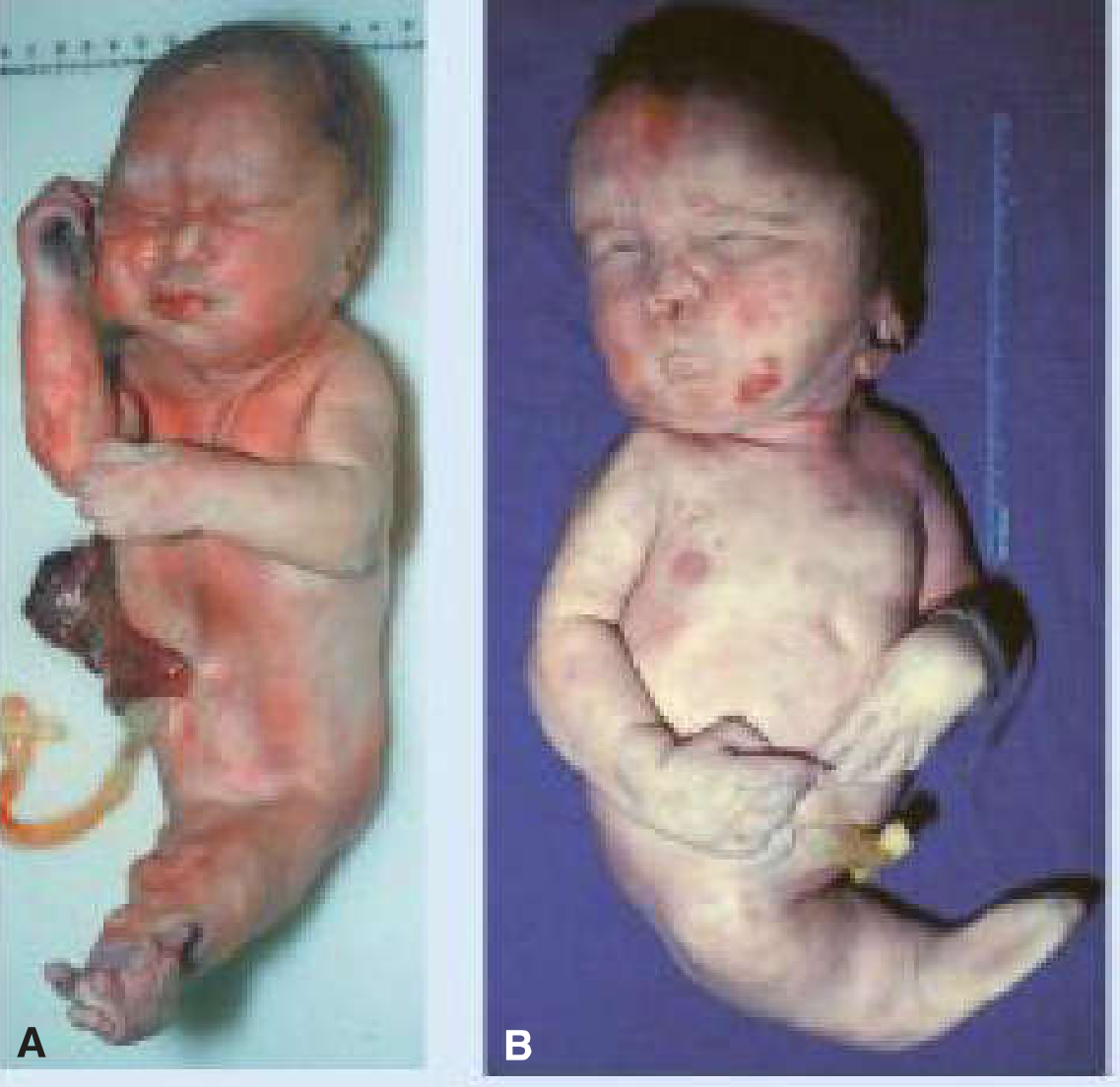
Figure 5.8 A,B — Two examples of sirenomelia. Fusion of the lower limb buds is evident.
Situs Inversus
Definitions
| Term | Meaning |
|---|---|
| Situs solitus | Normal positioning of all internal organs |
| Situs inversus | Complete mirror-image reversal of all organ positions |
| Situs ambiguus / Heterotaxy | One or more organs abnormally positioned, or isomerisms/inversions present (incomplete reversal) |
Embryological Basis — L-R Axis Establishment
Laterality is established by a signaling cascade originating at the primitive node during the third week:
- FGF8 (secreted by node/streak cells) induces NODAL and LEFTY2 expression on the left side
- NODAL + LEFTY2 upregulate PITX2 — a homeobox transcription factor and master gene for left-sidedness; expressed on the left side of the heart, stomach, and gut primordia as they assume asymmetric positions
- Serotonin (5-HT) is concentrated on the left side → activates MAD3 → restricts NODAL signaling to the left
- SNAIL (zinc finger transcription factor) is restricted to the right lateral plate mesoderm and helps establish right-sided identity
Cilia on the ventral surface of the primitive node may also create a gradient of NODAL signaling toward the left (or via gap junctions and ion transport).
If PITX2 is expressed ectopically (e.g., on the right), the result is laterality defects including situs inversus and dextrocardia.
Clinical Features of Situs Inversus
- Individuals with complete situs inversus have a low risk of other congenital abnormalities (slightly elevated risk of heart defect only)
- Their offspring have an increased risk for laterality defects and even higher risk for severe cardiac malformations
- ~20% of patients with complete situs inversus have bronchiectasis and chronic sinusitis due to abnormal cilia → this is Kartagener syndrome (Primary Ciliary Dyskinesia)
Situs Ambiguus / Heterotaxy — Contrast
- High risk of wide variety of birth defects (midline malformations: NTDs, cleft palate, anal atresia, omphalocele)
- ~90% will have complex congenital heart defects (the heart has more laterality sensitivity than most organs)
- Polysplenia → left-sided bilaterality; Asplenia/hypoplastic spleen → right-sided bilaterality
- ZIC3 mutations (X-linked) → X-linked heterotaxy with severe cardiac malformations, NTDs, limb abnormalities, omphalocele
Disruption of 5-HT Signaling
Pharmaceutical agents that alter 5-HT levels can cause:
- Situs inversus
- Dextrocardia
- Heart malformations
- Heterotaxy
Summary (as stated in Langman's): Normal L-R positioning = situs solitus; complete reversal = situs inversus; partial/isomeric reversal = situs ambiguus/heterotaxy. Situs inversus alone carries low birth defect risk; heterotaxy carries high risk, especially cardiac. Sirenomelia (caudal dysgenesis) results from inadequate caudal mesoderm formation during gastrulation, causing fused lower limbs, renal agenesis, vertebral and anorectal anomalies, associated with maternal diabetes and BRACHYURY/WNT/ENGRAILED gene mutations.
— Langman's Medical Embryology, Chapter 5 (Gastrulation & Body Axes), pp. 85–90
This is a shared conversation. Sign in to Orris to start your own chat.