
Lipid digestion, absorption and metabolism of fat in very simple easy to understand
Reading File
Now let me search the medical library for lipid digestion, absorption, and metabolism content in parallel.
Finding Sources
Finding Sources
Finding Sources
Reading File
Now let me read the Guyton (physiology) content on lipid digestion and Yamada's content on lipid digestion/absorption in parallel:
Reading File
Reading File
Finding Sources
Reading File
Finding Sources
Reading File
Finding Sources
Reading File
Reading File
Reading File
Reading File
Now let me fetch the diagram images to include in the answer:
Loading Image
Loading Image
Loading Image
I now have all the information and diagrams needed to write a clear, complete, easy-to-understand explanation. Here it is:
Lipid Digestion, Absorption, and Metabolism - Made Simple
What are Lipids (Fats)?
Dietary fats come mainly as triglycerides (three fatty acids attached to glycerol), plus some phospholipids, cholesterol, and cholesterol esters. Since fat and water don't mix, the body has a clever multi-step system to handle them.
PART 1: DIGESTION - Breaking Fat Down
Fat digestion happens in three stages: mouth → stomach → small intestine.
Step 1 - A Little in the Mouth & Stomach (minor)
- Lingual lipase (from the tongue) and gastric lipase (in the stomach) begin breaking down a small amount of fat (less than 10%)
- The stomach physically churns fat into smaller droplets and slowly releases them into the small intestine - this slow release is controlled by CCK (cholecystokinin), a hormone released when fat hits the duodenum
Step 2 - Emulsification in the Small Intestine (key step)
Think of this like dish soap on grease:
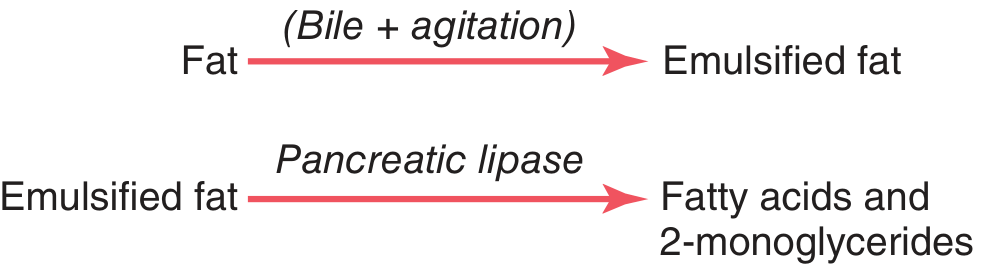
- Bile (made by the liver, stored in the gallbladder) squirts into the duodenum
- Bile contains bile salts and lecithin (a phospholipid) - these act like detergents
- They surround fat globules, breaking them into tiny droplets = emulsification
- This increases fat surface area up to 1000-fold, allowing digestive enzymes to attack more effectively
Step 3 - Enzyme Digestion
Three pancreatic enzymes do the cutting:
| Enzyme | What it digests | Products |
|---|---|---|
| Pancreatic lipase (+ colipase helper) | Triglycerides | 1 monoglyceride + 2 fatty acids |
| Cholesterol ester hydrolase | Cholesterol esters | Cholesterol + fatty acids |
| Phospholipase A2 | Phospholipids | Lysolecithin + fatty acids |
Note on Colipase: Bile salts would normally inactivate pancreatic lipase. Colipase (secreted by the pancreas, activated by trypsin) rescues the situation - it displaces bile salts and anchors lipase to the droplet surface so digestion can proceed.
Final products of digestion: monoglycerides, free fatty acids, cholesterol, lysolecithin, and glycerol.
PART 2: ABSORPTION - Getting Fat Into the Body
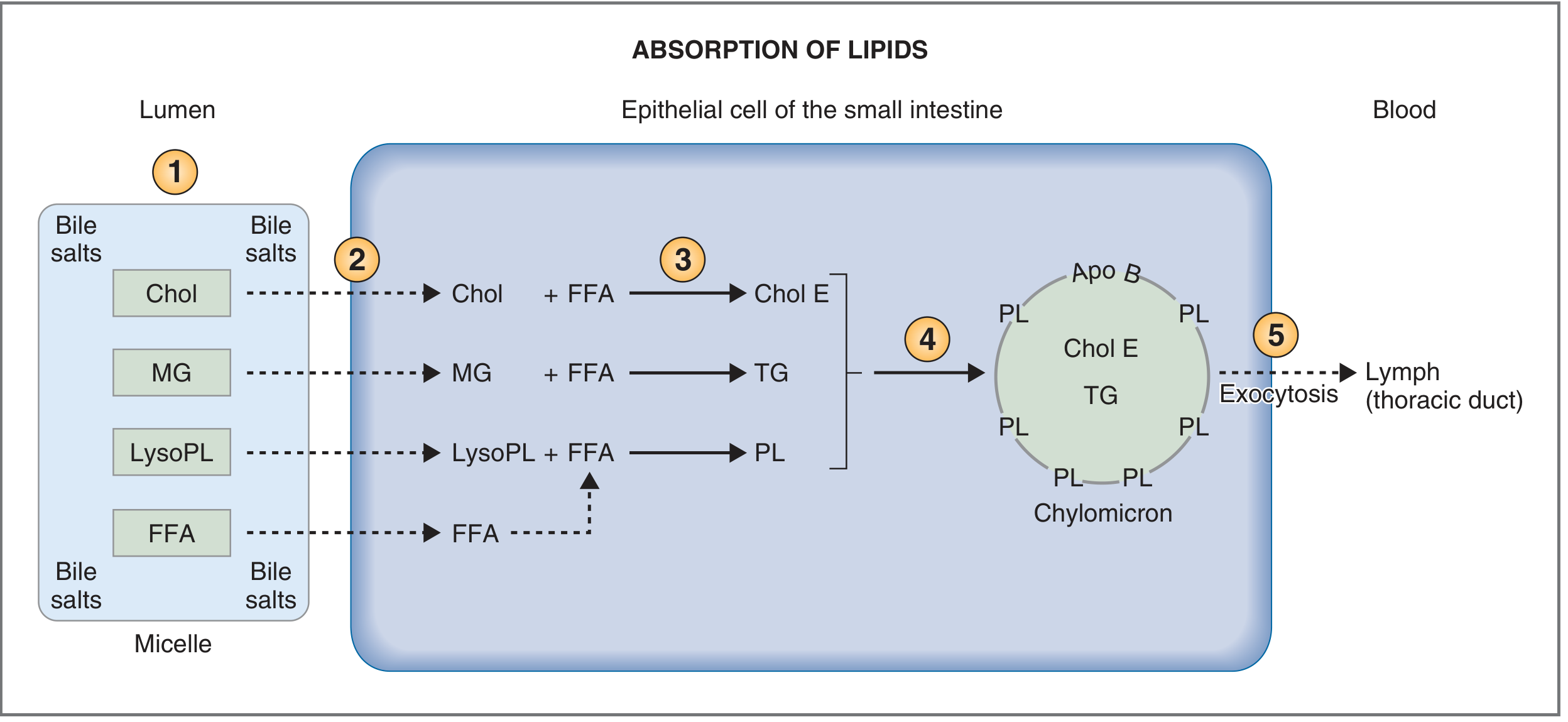
Since digested fat products are hydrophobic (water-fearing), they can't just float freely in the watery gut contents. Here's how they get absorbed in 5 steps:
Step 1 - Micelle Formation (the "ferry" system)
- Bile salts wrap around the fat products (monoglycerides, fatty acids, cholesterol) to form tiny disk-shaped particles called micelles (~50 Å diameter)
- The inside of the micelle is fat-soluble; the outside faces the water - perfect for transport
Step 2 - Diffusion into Intestinal Cells
- Micelles float to the brush-border (apical) membrane of intestinal cells (enterocytes)
- The fat products are released from the micelle and diffuse into the cell down a concentration gradient
- The bile salts stay behind in the gut lumen - they travel to the ileum for recycling (enterohepatic circulation)
Step 3 - Re-synthesis Inside the Cell
- Inside the enterocyte, fatty acids and monoglycerides are reassembled into triglycerides, cholesterol esters, and phospholipids on the smooth endoplasmic reticulum
Step 4 - Chylomicron Assembly
- The re-synthesized lipids are packaged with proteins (especially Apolipoprotein B) into large particles called chylomicrons
- Structure: fatty core (triglycerides + cholesterol) surrounded by a shell of phospholipids + apolipoproteins
- Size: ~1000 Å diameter
Step 5 - Exit via Lymph
- Chylomicrons are too big to enter blood capillaries directly
- They exit via exocytosis through the basolateral membrane into lacteals (lymphatic capillaries in the intestinal villi)
- Lymph carries them through the thoracic duct → directly into the bloodstream (at the junction of jugular and subclavian veins)
Glycerol (the backbone of triglycerides) is water-soluble, so it skips all of this and is absorbed directly into the portal blood.
PART 3: METABOLISM - What Happens to Fat in the Blood
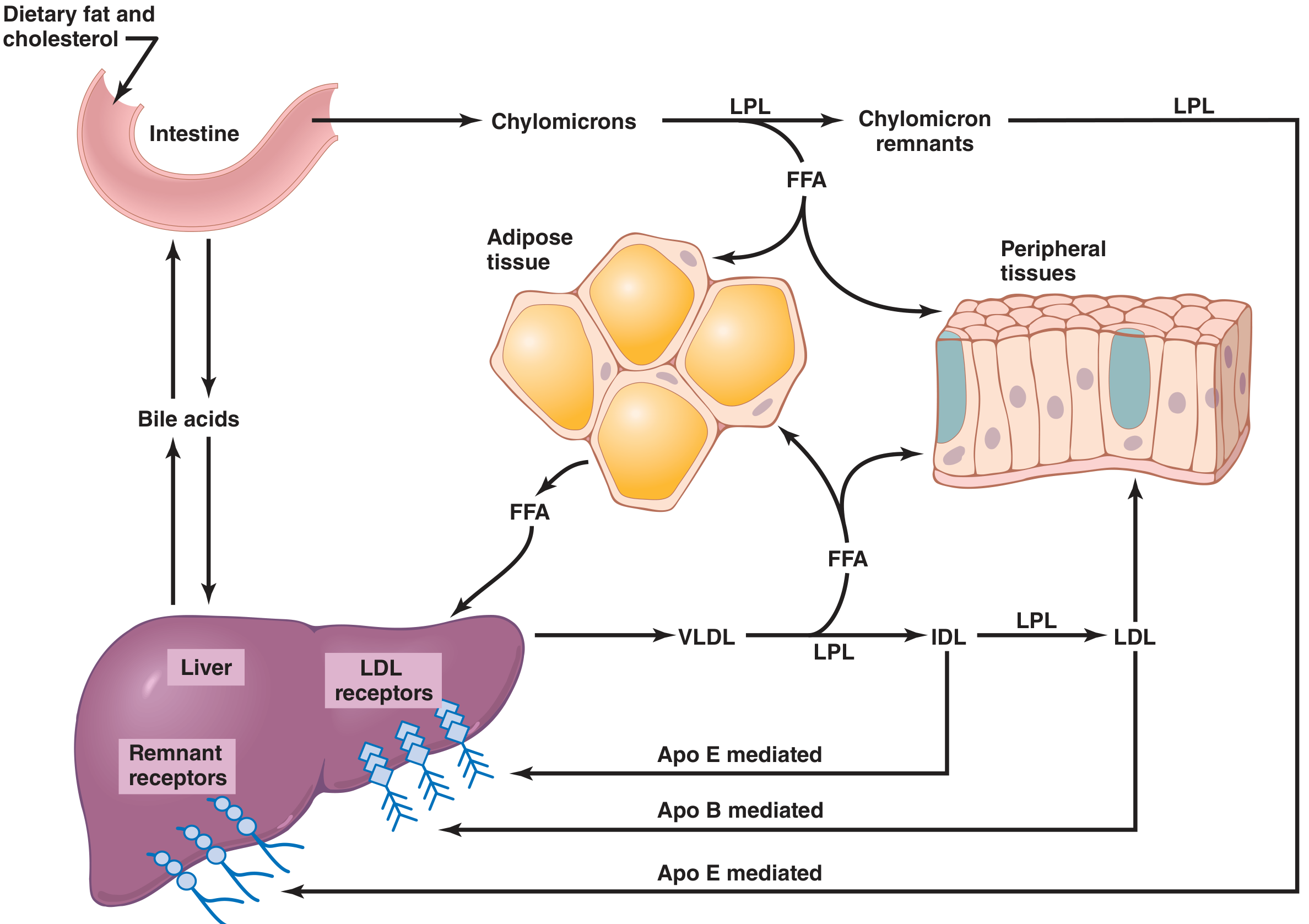
The Chylomicron Phase (after a meal)
- Chylomicrons enter the bloodstream and circulate
- Capillaries in adipose tissue, muscle, and heart contain an enzyme called lipoprotein lipase (LPL) on their walls
- LPL hydrolyzes chylomicron triglycerides → free fatty acids (FFA) + glycerol
- Fatty acids enter cells - either burned for energy (muscle) or re-stored as fat (adipose tissue)
- What's left is a chylomicron remnant (enriched in cholesterol) - these are cleared by the liver via remnant receptors
Lipoproteins - The Fat Transport System
After the chylomicrons are cleared, lipids in the blood travel as lipoproteins (fat + protein particles). The liver makes most of them:
| Lipoprotein | Made by | Main cargo | Function |
|---|---|---|---|
| VLDL | Liver | Triglycerides | Delivers TG to peripheral tissues |
| IDL | From VLDL | TG + cholesterol | Intermediate; mostly goes back to liver |
| LDL | From IDL | Cholesterol | Delivers cholesterol to cells ("bad") |
| HDL | Liver + intestine | Protein + cholesterol | Picks up cholesterol from tissues; brings it back to liver ("good") |
Free Fatty Acid Transport (during fasting/exercise)
- When energy is needed, fat cells (adipocytes) break down stored triglycerides via hormone-sensitive lipase
- Released fatty acids bind to albumin in the blood = Free Fatty Acids (FFA)
- These FFAs circulate to muscle, heart, etc., to be burned for energy
- The liver converts them to ketone bodies during prolonged fasting/starvation
The Liver's Role in Fat Metabolism
The liver is the central hub for fat processing:
- Beta-oxidation - breaks fatty acids into acetyl-CoA for energy
- Lipogenesis - converts excess carbohydrates/protein into fat (triglycerides)
- Synthesizes cholesterol, phospholipids, and bile acids
- Packages excess triglycerides into VLDL for export
Quick Summary Table
| Stage | Where | Key Players | Output |
|---|---|---|---|
| Digestion | Mouth, stomach, small intestine | Lingual/gastric/pancreatic lipase, bile salts, colipase | Fatty acids, monoglycerides, cholesterol |
| Absorption | Small intestine (jejunum) | Micelles, bile salts, enterocytes, ApoB | Chylomicrons enter lymph |
| Blood transport | Bloodstream | Chylomicrons, VLDL, LDL, HDL, LPL, albumin | Fat delivered to adipose/muscle/liver |
| Metabolism | Adipose, liver, muscle | LPL, hormone-sensitive lipase, beta-oxidation | Energy (ATP) or storage as fat |
If Any Step Goes Wrong = Steatorrhea (fat in stools)
Problems can occur at every step:
- Pancreatic insufficiency (e.g., chronic pancreatitis, cystic fibrosis) → no lipase → undigested triglycerides in stool
- Low duodenal pH (e.g., Zollinger-Ellison syndrome) → inactivates pancreatic lipase (optimum pH = 6)
- Bile salt deficiency (e.g., ileal resection breaks enterohepatic circulation) → no micelles → fat not absorbed
- Abetalipoproteinemia → can't make ApoB → can't form chylomicrons → fat trapped in enterocytes
Sources: Guyton and Hall Textbook of Medical Physiology; Costanzo Physiology 7th Edition
This is a shared conversation. Sign in to Orris to start your own chat.