
Speech centers of brain
The brain has two main speech centers, both typically in the left hemisphere: Broca's area (inferior frontal gyrus - speech production) and Wernicke's area (posterior superior temporal gyrus - speech comprehension). They are connected by the arcuate fasciculus. Damage to either produces distinct aphasia syndromes.
Searching sources...
Reading File
Finding Sources
Finding Sources
Finding Sources
Finding Sources
Good results from multiple authoritative textbooks. Let me now read the key sections for depth.
Reading File
Reading File
Reading File
Excellent content from multiple authoritative textbooks. Let me fetch the key diagram images.
Loading Image
Loading Image
Reading File
I now have comprehensive textbook content and two excellent diagrams. Here is the full answer:
Speech Centers of the Brain
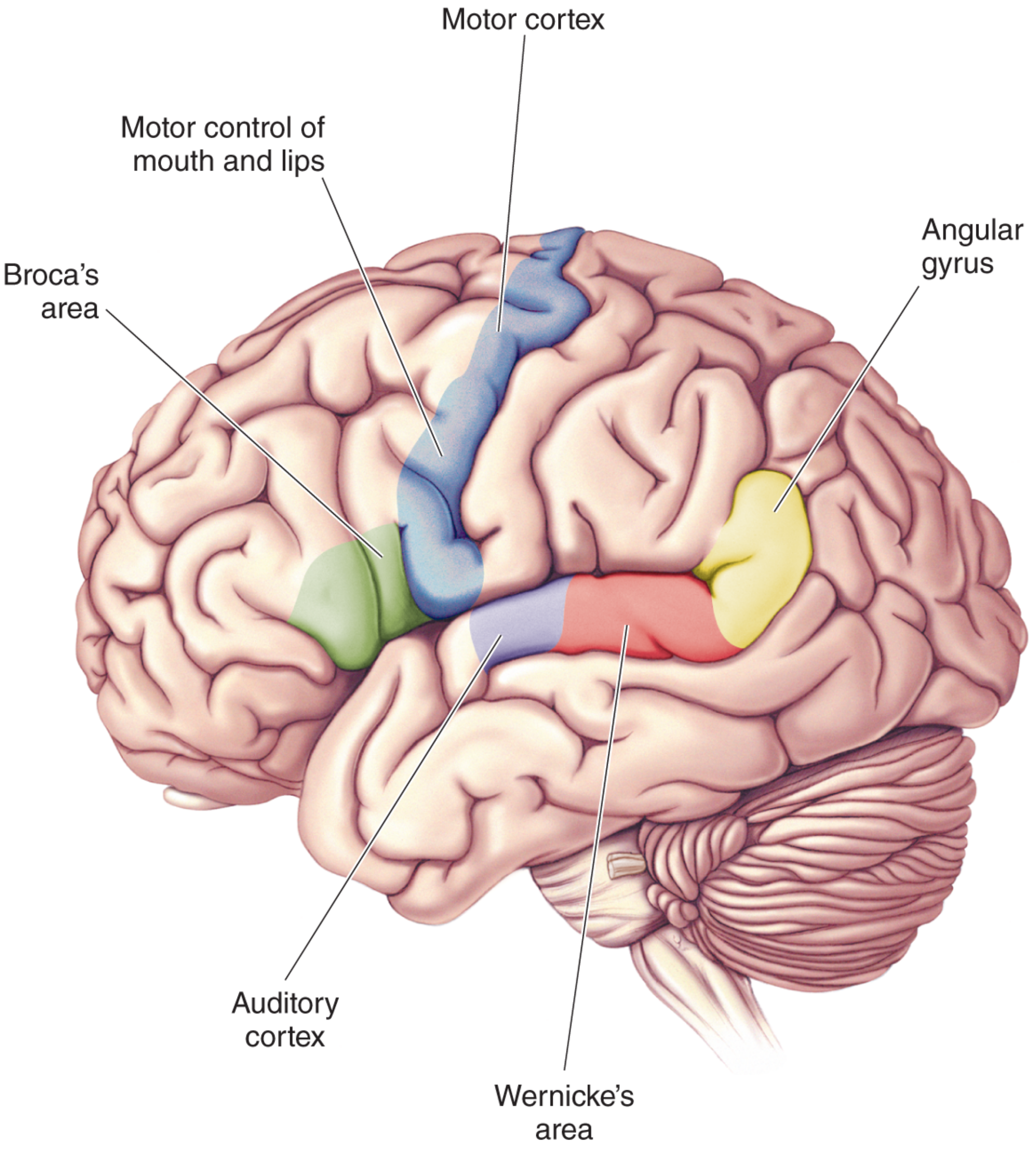
Fig 1: Key language areas of the dominant (left) hemisphere. (Neuroscience: Exploring the Brain, 5th ed.)
Hemispheric Dominance
Language is largely lateralized to the left (dominant) hemisphere in ~95% of right-handers and ~70% of left-handers. The primary speech areas are arranged along and near the Sylvian fissure (lateral cerebral sulcus). - Ganong's Review of Medical Physiology, 26th ed.
1. Broca's Area - Speech Production
| Feature | Detail |
|---|---|
| Location | Inferior frontal gyrus, opercular and triangular portions |
| Brodmann areas | 44 and 45 |
| Function | Formulates the motor program for articulated speech; converts word representations into sequences of sounds |
| Output | Projects via a speech articulation area in the insula to the motor cortex, which activates muscles of lips, tongue, and larynx |
Broca's area sits immediately rostral to the area of the motor cortex controlling the mouth and lips. It connects with the prefrontal cortex, premotor cortex, and supplementary motor area for higher-order speech planning and grammatical structure (syntax).
Damage → Broca's (expressive/nonfluent) aphasia: halting, telegraphic speech with poor fluency; comprehension relatively preserved. - Neuroanatomy through Clinical Cases, 3rd ed.
2. Wernicke's Area - Language Comprehension
| Feature | Detail |
|---|---|
| Location | Posterior superior temporal gyrus, superior surface of the temporal lobe |
| Brodmann area | 22 (posterior two-thirds); often extended to include areas 37, 39, 40 |
| Function | Comprehension of auditory and visual language; associates sounds with meaning; contains the lexicon (sound-to-meaning mapping) |
| Connections | Reciprocal connections with supramarginal gyrus and angular gyrus (parietal), and temporal area 37 |
Damage → Wernicke's (receptive/fluent) aphasia: fluent but meaningless speech (paraphasias, neologisms); poor comprehension. - Guyton & Hall Textbook of Medical Physiology
3. The Arcuate Fasciculus - The Connection
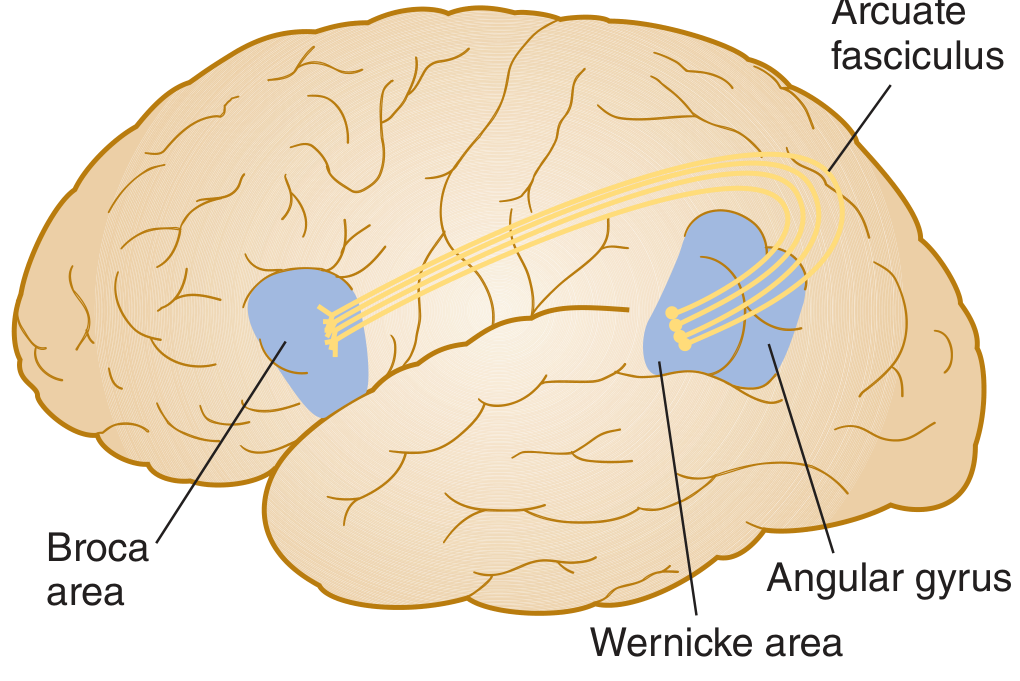
Fig 2: The arcuate fasciculus connecting Broca's area and Wernicke's area. (Ganong's Review of Medical Physiology, 26th ed.)
The arcuate fasciculus is a subcortical white matter bundle that directly connects Wernicke's area to Broca's area. Additional polysynaptic connections run along the peri-Sylvian cortex between the two areas.
Damage → Conduction aphasia: fluent speech and good comprehension are preserved, but repetition is severely impaired - the hallmark deficit. - Neuroscience: Exploring the Brain, 5th ed.
4. The Angular Gyrus
- Location: posterior parietal lobe (Brodmann area 39), just behind Wernicke's area
- Function: processes visually read words, converting them into auditory word-forms that Wernicke's area can process; critical for reading and writing
- Damage: alexia (inability to read) and agraphia (inability to write)
5. The Wernicke-Geschwind Model
This classical model (proposed by Wernicke, extended by Geschwind) describes the circuit for repeating a spoken word:
Auditory input → Auditory cortex → Wernicke's area (sounds understood as words) → Arcuate fasciculus → Broca's area (motor code formulated) → Insula (speech articulation area) → Motor cortex (lips, tongue, larynx activated) → Speech output
When reading aloud: Visual cortex → Visual association cortex → Angular gyrus → Wernicke's area → Broca's area → Motor cortex.
6. Summary of Aphasias by Lesion Site
| Aphasia Type | Lesion | Fluency | Comprehension | Repetition |
|---|---|---|---|---|
| Broca's | Broca's area (BA 44/45) | Non-fluent, telegraphic | Intact | Impaired |
| Wernicke's | Wernicke's area (BA 22) | Fluent (paraphasias) | Impaired | Impaired |
| Conduction | Arcuate fasciculus | Fluent | Intact | Severely impaired |
| Global | Large perisylvian lesion | Non-fluent | Impaired | Impaired |
| Transcortical Motor | Anterior to Broca's | Non-fluent | Intact | Intact |
| Transcortical Sensory | Posterior to Wernicke's | Fluent | Impaired | Intact |
7. Additional Language Areas
- Supplementary Motor Area (SMA): initiation of speech; bilateral SMA lesions can cause mutism
- Insula: speech articulation relay between Broca's area and motor cortex; selective insular damage can cause apraxia of speech (aphemia)
- Non-dominant hemisphere: contributes to prosody - the emotional tone and rhythm of speech. Lesions here cause flat, monotone speech without true aphasia
- Corpus callosum: connects dominant language network with the non-dominant hemisphere, allowing whole-brain coordination of language
Memory tip: Broca's = Broken speech (production); Wernicke's = Word salad (comprehension). Broca = BA 44 (twice Wernicke = BA 22). - Neuroanatomy through Clinical Cases, 3rd ed.
Make it simple and easy
Speech Centers of the Brain
The Two Main Areas
🟢 Broca's Area — "Speaking"
- Where: Front of the brain (left frontal lobe)
- Job: Produces speech - forms words and sentences
- Damage: You understand but can't speak properly → slow, broken speech ("I... want... water")
🔴 Wernicke's Area — "Understanding"
- Where: Side of the brain (left temporal lobe)
- Job: Understands spoken and written language
- Damage: You speak fluently but it makes no sense → word salad ("The sky is running the table")
How They Connect
Hear a word → Wernicke's area understands it
                      ↓
              Arcuate fasciculus (nerve bundle)
                      ↓
              Broca's area plans the words
                      ↓
              Motor cortex moves lips/tongue
                      ↓
                  You speak
Plus Two Supporting Areas
| Area | Job |
|---|---|
| Angular gyrus | Reading and writing |
| Right hemisphere | Tone and emotion in speech |
Simple Memory Trick
- Broca = Broken speech (can't speak)
- Wernicke = Word salad (can't understand)
- They talk to each other via the arcuate fasciculus
Stenosis
"Stenosis" is a broad medical term. Let me clarify what you're looking for before diving in.
Asking for Preferences
Which type of stenosis are you asking about?
What is meaning of stenosis
Stenosis — Simple Meaning
Stenosis means the abnormal narrowing of a passage or opening in the body.
- From Greek: "stenos" = narrow
- The narrowing restricts normal flow — of blood, fluid, air, or food
Where It Can Happen
| Location | Name | What Gets Blocked |
|---|---|---|
| Heart valve | Aortic / Mitral stenosis | Blood flow out of heart |
| Spine | Spinal stenosis | Spinal cord / nerves |
| Artery | Carotid / Renal stenosis | Blood to brain / kidneys |
| Stomach outlet | Pyloric stenosis | Food leaving stomach |
| Airway | Tracheal stenosis | Air flow |
| Urethra | Urethral stenosis | Urine flow |
Key Concept
Normal passage → narrows → flow is restricted → symptoms appear
The narrower the passage, the worse the symptoms. Stenosis can be:
- Congenital (born with it)
- Acquired (develops over time - due to plaque, scarring, calcium deposits, inflammation)
Simple Analogy
Think of a garden hose. Stenosis = a kink in the hose. Water (blood/fluid) struggles to get through, pressure builds up behind the kink, and less reaches the other side.
What is meant by stroke volume?
Stroke volume is the amount of blood pumped out of the left ventricle with each single heartbeat, normally about 70 mL at rest. It equals the difference between end-diastolic volume (how full the heart gets) and end-systolic volume (how much stays after contraction).
Searching sources...
Finding Sources
Reading File
Stroke Volume
Simple Definition
Stroke volume (SV) = the amount of blood pumped out by the heart's left ventricle in one single beat.
Normal value: ~70 mL per beat
The Formula
Stroke Volume = End-Diastolic Volume − End-Systolic Volume

               EDV (heart full)  −  ESV (heart after squeeze)
                   ~140 mL       −        ~70 mL
                              = 70 mL
| Term | Meaning | Normal Value |
|---|---|---|
| EDV (End-Diastolic Volume) | Blood in heart before it contracts | ~140 mL |
| ESV (End-Systolic Volume) | Blood remaining after contraction | ~70 mL |
| Stroke Volume | Blood actually ejected | ~70 mL |
Simple Analogy
Think of the heart like a squeezing a water balloon:
- You fill it up (EDV)
- You squeeze it (contraction)
- Some water comes out (stroke volume)
- Some stays inside (ESV)
What Affects Stroke Volume?
Three main factors:
| Factor | What it means | Effect on SV |
|---|---|---|
| Preload | How full the heart is before beating | More filling → ↑ SV |
| Afterload | Resistance the heart pumps against (blood pressure) | More resistance → ↓ SV |
| Contractility | Strength of the heart muscle | Stronger squeeze → ↑ SV |
Why Does It Matter?
Stroke volume directly determines Cardiac Output - how much blood the whole body receives per minute:
Cardiac Output = Stroke Volume × Heart Rate
     5,040 mL/min  =   70 mL     ×   72 beats/min
Also related is the Ejection Fraction (EF):
EF = Stroke Volume ÷ EDV = 70 ÷ 140 = 50–55%
EF is a key measure of heart function - a low EF (below 40%) signals heart failure. - Costanzo Physiology, 7th ed.
This is a shared conversation. Sign in to Orris to start your own chat.