
Flower spray ending of muscles
The "flower spray ending" is the primary sensory nerve ending found in muscle spindles - specifically the annulospiral (primary) endings of Group Ia afferent fibers that wrap around the central (nuclear bag and nuclear chain) regions of intrafusal muscle fibers.
Searching sources...
Reading File
Finding Sources
Finding Sources
Reading File
Reading File
Loading Image
Loading Image
Here is a complete, textbook-based explanation of the flower-spray ending of muscles:
Flower-Spray Ending (Secondary Afferent Ending) of the Muscle Spindle
What is it?
The flower-spray ending is the secondary sensory ending of the muscle spindle - a specialized proprioceptor embedded within skeletal muscle. It gets its name from its characteristic appearance: the nerve terminals spread out like branches on a bush (or a flower spray), in contrast to the tightly wound spiral of the primary ending.
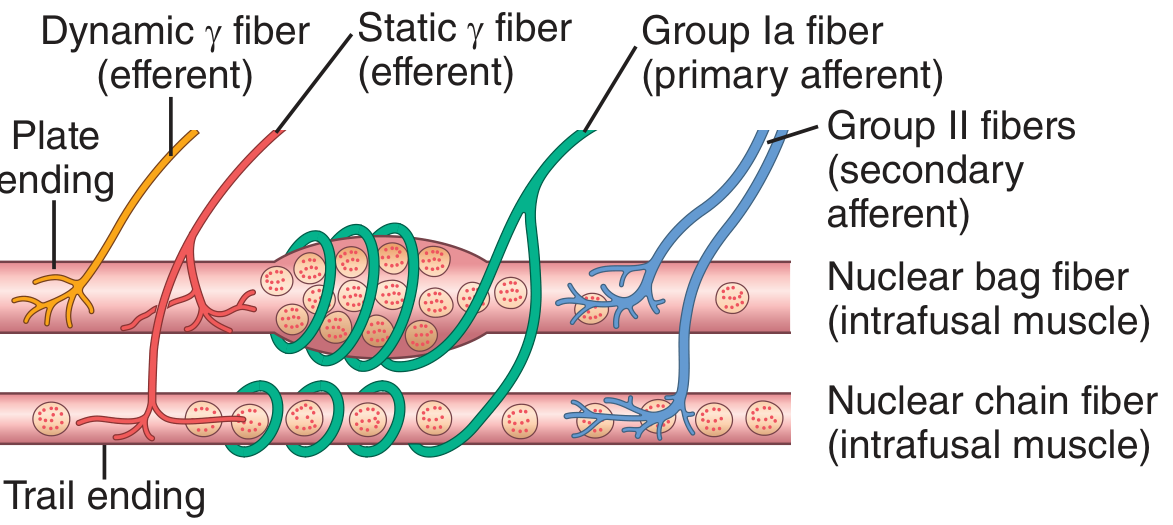
Guyton & Hall - Figure 55.4: Group II fibers (blue) form the flower-spray endings; Group Ia fibers (teal) form the annulospiral primary endings
Key Properties
| Feature | Flower-Spray (Secondary) Ending | Annulospiral (Primary) Ending |
|---|---|---|
| Nerve fiber type | Group II (Type II), Aβ fibers | Group Ia, Aα fibers |
| Fiber diameter | ~8 µm average | ~17 µm average |
| Conduction velocity | ~30-70 m/sec | ~70-120 m/sec |
| Location on spindle | Striated (polar) portions of bag fibers; nuclear chain fibers | Central (equatorial) region of all intrafusal fibers |
| Intrafusal fibers innervated | Nuclear chain fibers + static nuclear bag fibers | Both nuclear bag AND nuclear chain fibers |
| Morphology | Branches spreading like a bush/spray | Tight spiral wrapping (annulospiral) |
Where exactly does it sit?
The muscle spindle contains two types of intrafusal fibers:
- Nuclear bag fibers (1-3 per spindle) - nuclei clumped in a central "bag"
- Nuclear chain fibers (3-9 per spindle) - nuclei in a chain along the central region
The flower-spray (type II) endings sit on either side of the primary ending, over the striated polar portions of the nuclear bag fibers and along the nuclear chain fibers. - Histology: A Text and Atlas, p. 833
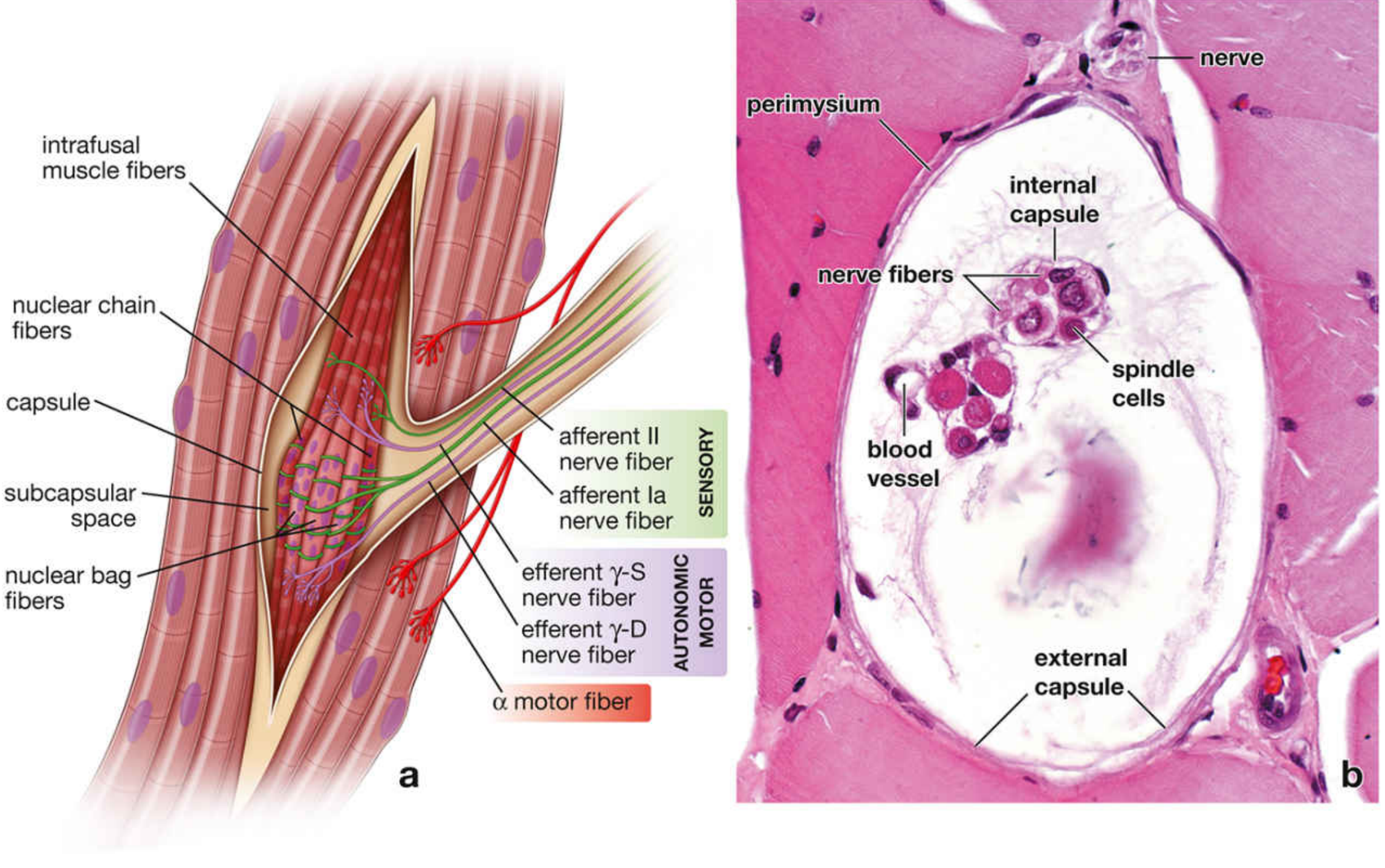
Histology A Text and Atlas - Figure 11.16: Schematic and H&E photomicrograph of the muscle spindle
Functional Response
The flower-spray endings respond only to the static (length) component of stretch:
- When the muscle is slowly or steadily stretched, they fire in proportion to the degree of elongation and continue firing as long as the stretch is maintained - this is the static response.
- Unlike primary endings, they do NOT respond to the rate of change of stretch (i.e., no dynamic response).
- They therefore signal absolute muscle length, not velocity of change.
In contrast, primary (annulospiral) endings respond to BOTH static length AND the rate of stretch (dynamic response). - Guyton and Hall Medical Physiology, p. 678
Summary in one sentence
The flower-spray ending = the secondary afferent ending of the muscle spindle, carried by Group II (Aβ) fibers, located over the striated poles of intrafusal fibers (especially nuclear chain), responding only to static muscle length (not velocity).
This is a shared conversation. Sign in to Orris to start your own chat.