
Cbc
Complete Blood Count (CBC)
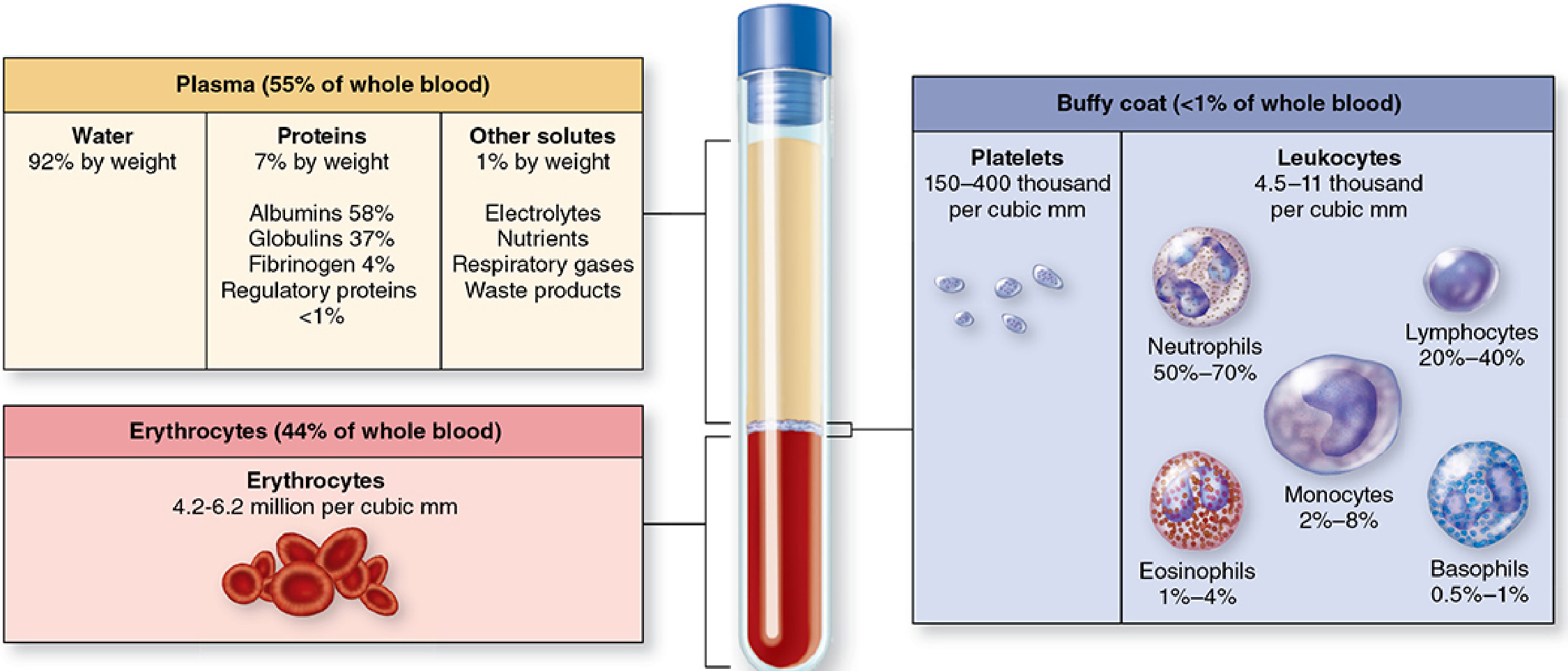
CBC Components and Normal Reference Ranges
Red Blood Cell Parameters
| Test | Description | Normal Range (Male) | Normal Range (Female) |
|---|---|---|---|
| Hemoglobin (Hb) | O2-carrying capacity of blood | 13.5-17.5 g/dL | 12.0-16.0 g/dL |
| Hematocrit (Hct) | % of whole blood volume occupied by RBCs | 39-49% | 35-45% |
| RBC count | Erythrocyte count | 4.3-5.7 × 10⁶ cells/µL | 3.8-5.1 × 10⁶ cells/µL |
| MCV (Mean Corpuscular Volume) | Average RBC size | 80-100 fL | 80-100 fL |
| MCH (Mean Corpuscular Hgb) | Hb per RBC (Hb ÷ RBC) | 27-33 pg | 27-33 pg |
| MCHC (Mean Corpuscular Hgb Concentration) | Hb concentration per volume of RBCs | 33-36 g/dL | 33-36 g/dL |
| RDW (Red Cell Distribution Width) | Variation in RBC size (anisocytosis) | 11.5-14.5% | 11.5-14.5% |
| Reticulocyte count | Immature RBCs; reflects bone marrow activity | 0.5-1.5% of RBCs |
White Blood Cell Parameters
| Test | Normal Range |
|---|---|
| Total WBC count | 4,500-11,000 cells/mm³ |
| Neutrophils (segs + bands) | 50-70% (absolute: 1,800-7,000/µL) |
| Lymphocytes | 20-40% |
| Monocytes | 2-8% |
| Eosinophils | 1-4% |
| Basophils | 0.5-1% |
Platelet Parameters
| Test | Normal Range |
|---|---|
| Platelet count | 150,000-400,000/mm³ |
| MPV (Mean Platelet Volume) | 7.5-12.5 fL |
Classifying Anemia by MCV
- Microcytic (MCV < 80 fL): Think iron deficiency, thalassemia, anemia of chronic disease. Check ferritin - if < 30 ng/mL, confirms iron deficiency.
- Normocytic (MCV 80-100 fL): Think acute blood loss, hemolysis, renal insufficiency, early mixed deficiency. In early anemia, MCV may change before Hb/Hct.
- Macrocytic (MCV > 100 fL): Think B12/folate deficiency, alcohol, hypothyroidism, medications (hydroxyurea, methotrexate).
WBC Differential - Key Abnormalities
| Finding | Definition | Common Causes |
|---|---|---|
| Leukocytosis | WBC > 10,000/mm³ | Infection, inflammation, leukemia, steroids, stress |
| Leukopenia | WBC < 4,500/mm³ | Viral infection, drugs, autoimmune, B12/folate deficiency |
| Neutrophilia | ANC > 7,000/µL | Bacterial infection, steroids, stress, burns, MI |
| Neutropenia | ANC < 1,800/µL (severe: <500) | Drug reaction, viral infection, aplastic anemia |
| Lymphocytosis | Lymphs > 4,000/µL (adult) | Viral infections (EBV, CMV), CLL, pertussis |
| Lymphopenia | Lymphs < 1,500/µL (adult) | HIV, steroids, radiation, immunosuppressants |
| Eosinophilia | Eosinophils > 500/µL | Parasites, atopy/asthma, drug reactions, vasculitis |
| Monocytosis | Monocytes > 800/µL | Chronic infection (TB), inflammatory disease, malignancy |
Platelet Abnormalities
- Thrombocytopenia (platelets < 150,000/mm³): Causes include decreased production (B12/folate deficiency, aplastic anemia, chemotherapy, leukemia, alcohol, viral infections including HIV) or increased destruction (immune thrombocytopenia [ITP], DIC, HUS, heparin-induced [HIT], HELLP syndrome, sepsis, splenic sequestration).
- Thrombocytosis (platelets > 400,000/mm³): Reactive (iron deficiency, infection, inflammation, post-splenectomy) or primary (essential thrombocythemia).
Peripheral Blood Smear
- Suspected hemolysis
- RBC inclusions (Howell-Jolly bodies, Heinz bodies, malaria)
- Myelodysplasia or megaloblastic changes
- Unexplained thrombocytopenia/thrombocytosis
- Immature or abnormal WBCs (blasts)
Clinical Use of CBC
- Screening for anemia, infection, or clotting disorders
- Monitoring bone marrow response to treatment (e.g., chemotherapy)
- Evaluating unexplained fatigue, fever, bruising, or bleeding
- Surveillance in chronic disease (CKD, HIV, autoimmune diseases)
- Pre-operative assessment
Create a quick reference PDF guide for CBC interpretation
ls -la /home/daytona/workspace/ 2>/dev/null || echo "workspace not found"
mkdir -p /home/daytona/workspace/cbc-guide
~/cbc-guide/generate_cbc_pdf.py
from reportlab.lib.pagesizes import A4
from reportlab.lib import colors
from reportlab.lib.units import mm, cm
from reportlab.lib.styles import getSampleStyleSheet, ParagraphStyle
from reportlab.lib.enums import TA_CENTER, TA_LEFT, TA_RIGHT
from reportlab.platypus import (
    SimpleDocTemplate, Paragraph, Spacer, Table, TableStyle,
    HRFlowable, KeepTogether
)
from reportlab.lib.colors import HexColor
import os

OUTPUT = "/home/daytona/workspace/cbc-guide/CBC_Quick_Reference.pdf"

# --- Colour palette ---
DEEP_BLUE   = HexColor("#1A3C5E")
MED_BLUE    = HexColor("#2E6DA4")
LIGHT_BLUE  = HexColor("#D6E8F7")
RED_COL     = HexColor("#C0392B")
ORANGE_COL  = HexColor("#E67E22")
GREEN_COL   = HexColor("#27AE60")
GREY_BG     = HexColor("#F4F6F8")
GREY_LINE   = HexColor("#BDC3C7")
WHITE       = colors.white
BLACK       = colors.black

# --- Document ---
doc = SimpleDocTemplate(
    OUTPUT,
    pagesize=A4,
    leftMargin=15*mm, rightMargin=15*mm,
    topMargin=15*mm, bottomMargin=15*mm,
    title="CBC Quick Reference Guide",
    author="Orris Medical"
)

W, H = A4
CONTENT_W = W - 30*mm

styles = getSampleStyleSheet()

def style(name, **kw):
    base = styles[name] if name in styles else styles["Normal"]
    s = ParagraphStyle(name + "_custom", parent=base, **kw)
    return s

# Custom styles
TITLE_S   = style("Title",   fontSize=22, textColor=WHITE,
                  alignment=TA_CENTER, spaceAfter=2, fontName="Helvetica-Bold")
SUBTITLE_S= style("Normal",  fontSize=10, textColor=HexColor("#AED6F1"),
                  alignment=TA_CENTER, spaceAfter=0, fontName="Helvetica")
SEC_S     = style("Heading1",fontSize=11, textColor=WHITE,
                  fontName="Helvetica-Bold", spaceBefore=0, spaceAfter=0,
                  alignment=TA_LEFT)
BODY_S    = style("Normal",  fontSize=8.5, textColor=BLACK,
                  fontName="Helvetica", leading=12, spaceAfter=2)
BOLD_S    = style("Normal",  fontSize=8.5, textColor=DEEP_BLUE,
                  fontName="Helvetica-Bold", leading=12)
SMALL_S   = style("Normal",  fontSize=7.5, textColor=HexColor("#555555"),
                  fontName="Helvetica", leading=11)
CELL_HDR  = style("Normal",  fontSize=8, textColor=WHITE,
                  fontName="Helvetica-Bold", alignment=TA_CENTER, leading=10)
CELL_S    = style("Normal",  fontSize=8, textColor=BLACK,
                  fontName="Helvetica", leading=10)
CELL_B    = style("Normal",  fontSize=8, textColor=DEEP_BLUE,
                  fontName="Helvetica-Bold", leading=10)
NOTE_S    = style("Normal",  fontSize=7.5, textColor=HexColor("#7F8C8D"),
                  fontName="Helvetica-Oblique", leading=10)
FORMULA_S = style("Normal",  fontSize=8, textColor=DEEP_BLUE,
                  fontName="Helvetica-Bold", leading=11, alignment=TA_CENTER)


# ============================================================
# HELPER: section banner
# ============================================================
def section_banner(title, color=MED_BLUE):
    tbl = Table([[Paragraph(title, SEC_S)]], colWidths=[CONTENT_W])
    tbl.setStyle(TableStyle([
        ("BACKGROUND", (0,0), (-1,-1), color),
        ("TOPPADDING",    (0,0), (-1,-1), 5),
        ("BOTTOMPADDING", (0,0), (-1,-1), 5),
        ("LEFTPADDING",   (0,0), (-1,-1), 8),
        ("RIGHTPADDING",  (0,0), (-1,-1), 8),
        ("ROUNDEDCORNERS", [4]),
    ]))
    return tbl


# ============================================================
# TITLE BLOCK
# ============================================================
def title_block():
    tbl = Table(
        [[Paragraph("CBC Quick Reference Guide", TITLE_S)],
         [Paragraph("Complete Blood Count • Normal Values • Interpretation • Clinical Pearls", SUBTITLE_S)]],
        colWidths=[CONTENT_W]
    )
    tbl.setStyle(TableStyle([
        ("BACKGROUND", (0,0), (-1,-1), DEEP_BLUE),
        ("TOPPADDING",    (0,0), (-1,-1), 10),
        ("BOTTOMPADDING", (0,0), (-1,-1), 10),
        ("LEFTPADDING",   (0,0), (-1,-1), 10),
        ("RIGHTPADDING",  (0,0), (-1,-1), 10),
        ("ROUNDEDCORNERS", [6]),
    ]))
    return tbl


# ============================================================
# 1. RBC PARAMETERS TABLE
# ============================================================
def rbc_table():
    headers = ["Parameter", "Description", "Male", "Female", "SI Units"]
    data = [
        ["Hemoglobin (Hb)", "O2-carrying capacity", "13.5-17.5 g/dL", "12.0-16.0 g/dL", "135-175 / 120-160 g/L"],
        ["Hematocrit (Hct)", "% volume of RBCs in blood", "39-49%", "35-45%", "0.39-0.49 / 0.35-0.45"],
        ["RBC Count", "Erythrocyte count", "4.3-5.7 x10\u2076/µL", "3.8-5.1 x10\u2076/µL", "x10\u00b9\u00b2/L"],
        ["MCV", "Mean cell volume (size)", "80-100 fL", "80-100 fL", "Same"],
        ["MCH", "Mean cell Hb (Hb / RBC)", "27-33 pg", "27-33 pg", "Same"],
        ["MCHC", "Mean cell Hb concentration", "33-36 g/dL", "33-36 g/dL", "330-360 g/L"],
        ["RDW", "Size variation of RBCs", "11.5-14.5%", "11.5-14.5%", "Same"],
        ["Reticulocytes", "Immature RBCs (BM activity)", "0.5-1.5%", "0.5-1.5%", "Same"],
    ]
    rows = [[Paragraph(h, CELL_HDR) for h in headers]]
    for i, row in enumerate(data):
        cells = [Paragraph(row[0], CELL_B)] + [Paragraph(c, CELL_S) for c in row[1:]]
        rows.append(cells)

    col_w = [38*mm, 48*mm, 28*mm, 28*mm, 38*mm]
    tbl = Table(rows, colWidths=col_w, repeatRows=1)
    tbl.setStyle(TableStyle([
        ("BACKGROUND",    (0,0), (-1,0), MED_BLUE),
        ("BACKGROUND",    (0,1), (-1,-1), WHITE),
        ("ROWBACKGROUNDS",(0,1), (-1,-1), [WHITE, GREY_BG]),
        ("GRID",          (0,0), (-1,-1), 0.4, GREY_LINE),
        ("TOPPADDING",    (0,0), (-1,-1), 4),
        ("BOTTOMPADDING", (0,0), (-1,-1), 4),
        ("LEFTPADDING",   (0,0), (-1,-1), 5),
        ("RIGHTPADDING",  (0,0), (-1,-1), 5),
        ("VALIGN",        (0,0), (-1,-1), "MIDDLE"),
        ("LINEBELOW",     (0,0), (-1,0), 1, DEEP_BLUE),
    ]))
    return tbl


# ============================================================
# 2. WBC TABLE
# ============================================================
def wbc_table():
    headers = ["Cell Type", "% (Differential)", "Absolute Count", "Key Role"]
    data = [
        ["Neutrophils (segs+bands)", "50-70%", "1,800-7,000/µL", "First responders; bacterial/fungal infection"],
        ["Lymphocytes", "20-40%", "1,000-4,800/µL", "Adaptive immunity; viral defense"],
        ["Monocytes", "2-8%", "200-800/µL", "Phagocytosis; antigen presentation"],
        ["Eosinophils", "1-4%", "45-440/µL", "Parasites; allergic/hypersensitivity reactions"],
        ["Basophils", "0.5-1%", "0-100/µL", "IgE-mediated allergy; heparin release"],
        ["Total WBC", "—", "4,500-11,000/µL", "Overall leukocyte burden"],
    ]
    rows = [[Paragraph(h, CELL_HDR) for h in headers]]
    bg_col = [HexColor("#EAF4FD"), HexColor("#F0FBF4"), HexColor("#FDF6E3"),
              HexColor("#FDF0ED"), HexColor("#F3EDF7"), GREY_BG]
    for i, row in enumerate(data):
        bg = bg_col[i]
        cells = [Paragraph(row[0], CELL_B)] + [Paragraph(c, CELL_S) for c in row[1:]]
        rows.append(cells)

    col_w = [42*mm, 30*mm, 32*mm, 76*mm]
    tbl = Table(rows, colWidths=col_w, repeatRows=1)
    tbl.setStyle(TableStyle([
        ("BACKGROUND",    (0,0), (-1,0), MED_BLUE),
        ("GRID",          (0,0), (-1,-1), 0.4, GREY_LINE),
        ("ROWBACKGROUNDS",(0,1), (-1,-1), [WHITE, GREY_BG]),
        ("TOPPADDING",    (0,0), (-1,-1), 4),
        ("BOTTOMPADDING", (0,0), (-1,-1), 4),
        ("LEFTPADDING",   (0,0), (-1,-1), 5),
        ("RIGHTPADDING",  (0,0), (-1,-1), 5),
        ("VALIGN",        (0,0), (-1,-1), "MIDDLE"),
        ("LINEBELOW",     (0,0), (-1,0), 1, DEEP_BLUE),
    ]))
    return tbl


# ============================================================
# 3. ANEMIA CLASSIFICATION
# ============================================================
def anemia_table():
    headers = ["Type", "MCV", "Common Causes", "Key Initial Test"]
    data = [
        ["Microcytic",  "< 80 fL",
         "Iron deficiency, Thalassemia, Anemia of chronic disease (late), Sideroblastic",
         "Serum Ferritin (<30 ng/mL = iron def.)"],
        ["Normocytic",  "80-100 fL",
         "Acute blood loss, Hemolysis, Renal failure (CKD), Early mixed deficiency, Aplastic anemia",
         "Reticulocyte count, BMP, LFTs"],
        ["Macrocytic",  "> 100 fL",
         "B12 / Folate deficiency, Alcohol, Hypothyroidism, Meds (MTX, hydroxyurea, AZT)",
         "B12, Folate, TFTs, peripheral smear"],
    ]
    row_colors = [HexColor("#FDECEA"), HexColor("#EAF4FD"), HexColor("#F0FBF4")]
    rows = [[Paragraph(h, CELL_HDR) for h in headers]]
    for i, row in enumerate(data):
        cells = [Paragraph(row[0], CELL_B),
                 Paragraph(row[1], FORMULA_S),
                 Paragraph(row[2], CELL_S),
                 Paragraph(row[3], CELL_S)]
        rows.append(cells)

    col_w = [25*mm, 18*mm, 72*mm, 65*mm]
    tbl = Table(rows, colWidths=col_w, repeatRows=1)
    tbl.setStyle(TableStyle([
        ("BACKGROUND",    (0,0), (-1,0), MED_BLUE),
        ("BACKGROUND",    (0,1), (1,1), HexColor("#FDECEA")),
        ("BACKGROUND",    (0,2), (1,2), HexColor("#EAF4FD")),
        ("BACKGROUND",    (0,3), (1,3), HexColor("#F0FBF4")),
        ("GRID",          (0,0), (-1,-1), 0.4, GREY_LINE),
        ("ROWBACKGROUNDS",(0,1), (-1,-1), [HexColor("#FDECEA"), HexColor("#EAF4FD"), HexColor("#F0FBF4")]),
        ("TOPPADDING",    (0,0), (-1,-1), 4),
        ("BOTTOMPADDING", (0,0), (-1,-1), 4),
        ("LEFTPADDING",   (0,0), (-1,-1), 5),
        ("RIGHTPADDING",  (0,0), (-1,-1), 5),
        ("VALIGN",        (0,0), (-1,-1), "TOP"),
        ("LINEBELOW",     (0,0), (-1,0), 1, DEEP_BLUE),
    ]))
    return tbl


# ============================================================
# 4. WBC ABNORMALITIES TABLE
# ============================================================
def wbc_abnorm_table():
    headers = ["Finding", "Definition", "Common Causes"]
    data = [
        ["Leukocytosis",  "WBC > 11,000/µL",
         "Bacterial infection, inflammation, steroids, stress, CML, leukemoid reaction"],
        ["Leukopenia",    "WBC < 4,500/µL",
         "Viral infections, medications, autoimmune, B12/folate deficiency, aplastic anemia"],
        ["Neutrophilia",  "ANC > 7,000/µL",
         "Bacterial infection, trauma, MI, burns, surgery, steroids, myeloproliferative disorders"],
        ["Neutropenia",   "ANC < 1,500/µL (severe <500)",
         "Chemotherapy/radiation, drug reaction (clozapine, carbimazole), viral infection, SLE, aplastic anemia"],
        ["Lymphocytosis", "Lymphs > 4,000/µL (adult)",
         "Viral (EBV/CMV/hepatitis), CLL, ALL, pertussis, toxoplasmosis"],
        ["Lymphopenia",   "Lymphs < 1,500/µL",
         "HIV/AIDS, corticosteroids, immunosuppressants, radiation, autoimmune"],
        ["Eosinophilia",  "Eos > 500/µL",
         "Parasites (NAACP), atopy/asthma, drug hypersensitivity, Addison's, malignancy, vasculitis"],
        ["Monocytosis",   "Monos > 800/µL",
         "Chronic infections (TB, SBE), inflammatory bowel disease, myelomonocytic leukemia"],
        ["Basophilia",    "Basos > 100/µL",
         "CML (hallmark), myeloproliferative disorders, hypothyroidism, allergic states"],
    ]
    rows = [[Paragraph(h, CELL_HDR) for h in headers]]
    for i, row in enumerate(data):
        cells = [Paragraph(row[0], CELL_B),
                 Paragraph(row[1], CELL_S),
                 Paragraph(row[2], CELL_S)]
        rows.append(cells)

    col_w = [33*mm, 42*mm, 105*mm]
    tbl = Table(rows, colWidths=col_w, repeatRows=1)
    tbl.setStyle(TableStyle([
        ("BACKGROUND",    (0,0), (-1,0), MED_BLUE),
        ("ROWBACKGROUNDS",(0,1), (-1,-1), [WHITE, GREY_BG]),
        ("GRID",          (0,0), (-1,-1), 0.4, GREY_LINE),
        ("TOPPADDING",    (0,0), (-1,-1), 4),
        ("BOTTOMPADDING", (0,0), (-1,-1), 4),
        ("LEFTPADDING",   (0,0), (-1,-1), 5),
        ("RIGHTPADDING",  (0,0), (-1,-1), 5),
        ("VALIGN",        (0,0), (-1,-1), "TOP"),
        ("LINEBELOW",     (0,0), (-1,0), 1, DEEP_BLUE),
    ]))
    return tbl


# ============================================================
# 5. PLATELET TABLE
# ============================================================
def platelet_table():
    headers = ["Finding", "Count", "Decreased Production", "Increased Destruction / Sequestration"]
    data = [
        ["Normal",              "150-400 x10\u00b3/µL",  "—",   "—"],
        ["Mild Thrombocytopenia","100-149 x10\u00b3/µL", "Observe; low bleeding risk", "ITP (early)"],
        ["Moderate",            "50-99 x10\u00b3/µL",
         "B12/folate def., chemotherapy, alcohol",
         "ITP, DIC, HIT, HUS/TTP, HELLP"],
        ["Severe",              "< 50 x10\u00b3/µL",
         "Aplastic anemia, leukemia, infiltration",
         "Sepsis, massive transfusion, cardiopulmonary bypass"],
        ["Thrombocytosis",      "> 400 x10\u00b3/µL",
         "Reactive: infection, iron def., post-splenectomy",
         "Primary: Essential thrombocythemia, PV, CML"],
    ]
    rows = [[Paragraph(h, CELL_HDR) for h in headers]]
    row_bgs = [HexColor("#E8F5E9"), HexColor("#FFF9C4"), HexColor("#FFE0B2"),
               HexColor("#FFCDD2"), HexColor("#E3F2FD")]
    for i, row in enumerate(data):
        cells = [Paragraph(row[0], CELL_B)] + [Paragraph(c, CELL_S) for c in row[1:]]
        rows.append(cells)

    col_w = [33*mm, 30*mm, 54*mm, 63*mm]
    tbl = Table(rows, colWidths=col_w, repeatRows=1)
    tbl.setStyle(TableStyle([
        ("BACKGROUND",    (0,0), (-1,0), MED_BLUE),
        ("ROWBACKGROUNDS",(0,1), (-1,-1), [HexColor("#E8F5E9"), HexColor("#FFF9C4"),
                                           HexColor("#FFE0B2"), HexColor("#FFCDD2"),
                                           HexColor("#E3F2FD")]),
        ("GRID",          (0,0), (-1,-1), 0.4, GREY_LINE),
        ("TOPPADDING",    (0,0), (-1,-1), 4),
        ("BOTTOMPADDING", (0,0), (-1,-1), 4),
        ("LEFTPADDING",   (0,0), (-1,-1), 5),
        ("RIGHTPADDING",  (0,0), (-1,-1), 5),
        ("VALIGN",        (0,0), (-1,-1), "TOP"),
        ("LINEBELOW",     (0,0), (-1,0), 1, DEEP_BLUE),
    ]))
    return tbl


# ============================================================
# 6. CLINICAL PEARLS (2-column layout)
# ============================================================
def pearls_block():
    pearls = [
        ("ANC Formula",
         "ANC = Total WBC x (% Segs + % Bands)\nSevere neutropenia: ANC < 500 — high infection risk"),
        ("Anemia in Acute Hemorrhage",
         "Hb/Hct may be NORMAL initially (takes 12-24 h for plasma to equilibrate). Check reticulocytes + clinical context."),
        ("Left Shift",
         "Increased bands/metamyelocytes in peripheral blood. Suggests active bacterial infection or sepsis. May correct the automated WBC count upward."),
        ("Pancytopenia",
         "All 3 cell lines low. Consider: aplastic anemia, B12/folate def., hypersplenism, bone marrow infiltration, leukemia."),
        ("Reactive vs. Leukemic Leukocytosis",
         "Leukemoid reaction (>50,000/µL) — check LAP score, BCR-ABL, and smear morphology. Blasts suggest leukemia."),
        ("Smear Indications",
         "Order peripheral smear for: suspected hemolysis, RBC inclusions, blast cells, unexplained cytopenias, thrombocytopenia, myelodysplasia."),
        ("RDW Significance",
         "Elevated RDW (>14.5%) = anisocytosis. Helps differentiate iron def. anemia (high RDW) from thalassemia trait (normal RDW, low MCV)."),
        ("Polycythemia Vera Clues",
         "Elevated RBC + WBC + Platelets together. Check JAK2 V617F mutation. Erythropoietin level low (vs. secondary erythrocytosis)."),
    ]

    rows = []
    for i in range(0, len(pearls), 2):
        left = pearls[i]
        right = pearls[i+1] if i+1 < len(pearls) else ("", "")
        left_cell = [
            Paragraph(left[0], BOLD_S),
            Paragraph(left[1].replace("\n", "<br/>"), SMALL_S)
        ]
        right_cell = [
            Paragraph(right[0], BOLD_S),
            Paragraph(right[1].replace("\n", "<br/>"), SMALL_S)
        ] if right[0] else [Paragraph("", SMALL_S)]
        rows.append([left_cell, right_cell])

    # Flatten for Table
    flat_rows = []
    for row in rows:
        flat_rows.append([row[0], row[1]])

    # We can't put lists in Table cells — convert to nested tables
    col_w_half = CONTENT_W / 2 - 2*mm

    outer_rows = []
    for row in rows:
        left_tbl = Table([[c] for c in row[0]], colWidths=[col_w_half - 6*mm])
        left_tbl.setStyle(TableStyle([
            ("TOPPADDING",    (0,0), (-1,-1), 1),
            ("BOTTOMPADDING", (0,0), (-1,-1), 1),
            ("LEFTPADDING",   (0,0), (-1,-1), 0),
            ("RIGHTPADDING",  (0,0), (-1,-1), 0),
        ]))
        right_tbl = Table([[c] for c in row[1]], colWidths=[col_w_half - 6*mm])
        right_tbl.setStyle(TableStyle([
            ("TOPPADDING",    (0,0), (-1,-1), 1),
            ("BOTTOMPADDING", (0,0), (-1,-1), 1),
            ("LEFTPADDING",   (0,0), (-1,-1), 0),
            ("RIGHTPADDING",  (0,0), (-1,-1), 0),
        ]))
        outer_rows.append([left_tbl, right_tbl])

    tbl = Table(outer_rows, colWidths=[col_w_half, col_w_half])
    tbl.setStyle(TableStyle([
        ("BACKGROUND",    (0,0), (-1,-1), GREY_BG),
        ("ROWBACKGROUNDS",(0,0), (-1,-1), [GREY_BG, WHITE]),
        ("GRID",          (0,0), (-1,-1), 0.4, GREY_LINE),
        ("TOPPADDING",    (0,0), (-1,-1), 6),
        ("BOTTOMPADDING", (0,0), (-1,-1), 6),
        ("LEFTPADDING",   (0,0), (-1,-1), 7),
        ("RIGHTPADDING",  (0,0), (-1,-1), 7),
        ("VALIGN",        (0,0), (-1,-1), "TOP"),
    ]))
    return tbl


# ============================================================
# 7. FOOTER
# ============================================================
def footer_block():
    tbl = Table(
        [[Paragraph(
            "For educational reference only. Always interpret CBC in clinical context. "
            "Reference ranges may vary by laboratory and patient age. "
            "Sources: Textbook of Family Medicine 9e • Henry's Clinical Diagnosis & Management by Laboratory Methods • Junqueira's Basic Histology 17e",
            NOTE_S)]],
        colWidths=[CONTENT_W]
    )
    tbl.setStyle(TableStyle([
        ("BACKGROUND",    (0,0), (-1,-1), HexColor("#ECF0F1")),
        ("TOPPADDING",    (0,0), (-1,-1), 5),
        ("BOTTOMPADDING", (0,0), (-1,-1), 5),
        ("LEFTPADDING",   (0,0), (-1,-1), 8),
        ("RIGHTPADDING",  (0,0), (-1,-1), 8),
        ("LINEABOVE",     (0,0), (-1,0), 1, GREY_LINE),
    ]))
    return tbl


# ============================================================
# BUILD STORY
# ============================================================
story = []

# Title
story.append(title_block())
story.append(Spacer(1, 5*mm))

# 1. RBC Parameters
story.append(KeepTogether([
    section_banner("1.  RED BLOOD CELL (RBC) PARAMETERS"),
    Spacer(1, 1.5*mm),
    rbc_table(),
]))
story.append(Spacer(1, 4*mm))

# 2. WBC Differential
story.append(KeepTogether([
    section_banner("2.  WHITE BLOOD CELL (WBC) DIFFERENTIAL"),
    Spacer(1, 1.5*mm),
    wbc_table(),
]))
story.append(Spacer(1, 4*mm))

# 3. Anemia Classification
story.append(KeepTogether([
    section_banner("3.  ANEMIA CLASSIFICATION BY MCV", color=HexColor("#1A5276")),
    Spacer(1, 1.5*mm),
    anemia_table(),
    Spacer(1, 1.5*mm),
    Paragraph(
        "<b>Tip:</b> In early anemia, MCV may change before Hb/Hct become abnormal. "
        "Always check reticulocyte count to assess bone marrow response.",
        NOTE_S
    ),
]))
story.append(Spacer(1, 4*mm))

# 4. WBC Abnormalities
story.append(section_banner("4.  WBC ABNORMALITIES", color=HexColor("#6E2F82")))
story.append(Spacer(1, 1.5*mm))
story.append(wbc_abnorm_table())
story.append(Spacer(1, 4*mm))

# 5. Platelet Interpretation
story.append(KeepTogether([
    section_banner("5.  PLATELET INTERPRETATION", color=HexColor("#7D3C0A")),
    Spacer(1, 1.5*mm),
    platelet_table(),
    Spacer(1, 1.5*mm),
    Paragraph(
        "<b>Bleeding risk:</b> Spontaneous bleeding rare with platelets >50,000; "
        "major surgery safe >100,000; prophylactic transfusion threshold typically <10,000 (stable) or <20,000 (fever/active bleeding).",
        NOTE_S
    ),
]))
story.append(Spacer(1, 4*mm))

# 6. Clinical Pearls
story.append(KeepTogether([
    section_banner("6.  CLINICAL PEARLS & INTERPRETATION TIPS", color=HexColor("#1A5C3A")),
    Spacer(1, 1.5*mm),
    pearls_block(),
]))
story.append(Spacer(1, 5*mm))

# Footer
story.append(footer_block())

# Build
doc.build(story)
print(f"PDF saved to: {OUTPUT}")
cd /home/daytona/workspace/cbc-guide && python generate_cbc_pdf.py 2>&1
ls -lh /home/daytona/workspace/cbc-guide/CBC_Quick_Reference.pdf
python3 -c " from pypdf import PdfReader r = PdfReader('/home/daytona/workspace/cbc-guide/CBC_Quick_Reference.pdf') print(f'Pages: {len(r.pages)}') for i,p in enumerate(r.pages): t = p.extract_text() print(f'--- Page {i+1} ({len(t)} chars) ---') print(t[:400]) print() "
python3 -c " from pypdf import PdfReader r = PdfReader('/home/daytona/workspace/cbc-guide/CBC_Quick_Reference.pdf') for i,p in enumerate(r.pages): t = p.extract_text() print(f'--- Page {i+1} FULL ---') print(t) print() "
CBC Quick Reference
PDF Document · PDF
What's inside (2 pages, A4):
| Section | Content |
|---|---|
| 1. RBC Parameters | Hb, Hct, RBC count, MCV, MCH, MCHC, RDW, Reticulocytes with male/female/SI ranges |
| 2. WBC Differential | All 5 cell types with % ranges, absolute counts, and clinical roles |
| 3. Anemia by MCV | Micro/Normo/Macrocytic classification, causes, and first-line tests |
| 4. WBC Abnormalities | Leukocytosis, leukopenia, neutrophilia/penia, lymphocytosis/penia, eosinophilia, monocytosis, basophilia |
| 5. Platelet Interpretation | Severity grading from normal to severe thrombocytopenia + thrombocytosis, bleeding thresholds |
| 6. Clinical Pearls | ANC formula, acute hemorrhage caveat, left shift, pancytopenia, reactive vs. leukemic leukocytosis, smear indications, RDW significance, PV clues |