

5294B181-2EE2-4ED6-853E-F0ED1AF1CEF2.jpg
What will be tge best treatment
analyse_media
Reading File
Finding Sources
Searching PubMed
"splenic abscess" treatment drainage splenectomy
Searching the Web
splenic abscess treatment guidelines 2024 percutaneous drainage splenectomy antibiotics
Reading File
Reading File
Reading Article
PMID: 35612434
Reading File
Loading Image
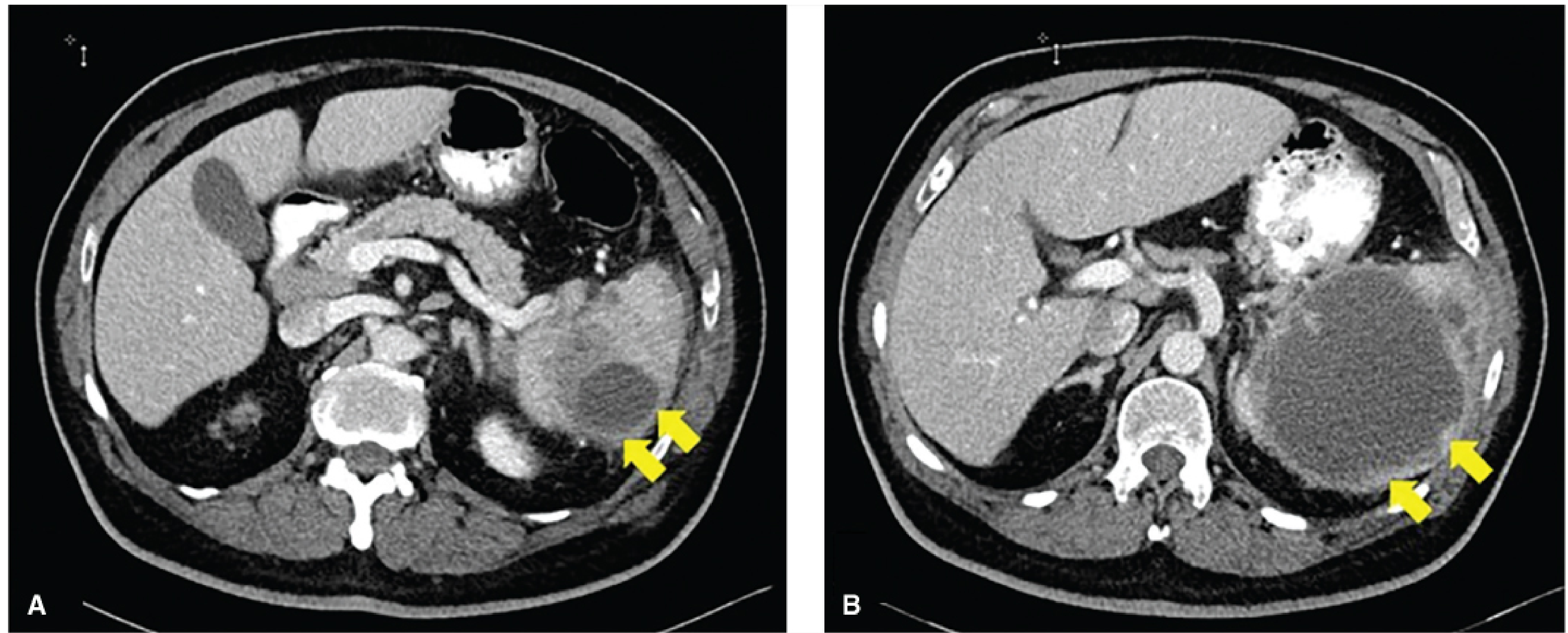
Here is a detailed, evidence-based treatment plan based on the CECT findings for this 56-year-old male (Kusheswar Konwar):
CECT Findings - Summary
The scan shows:
- Gross splenic abscess - multiloculated, peripherally enhancing lesion measuring 149 x 134 x 94 mm (975 cc) involving the upper 2/3 of an already grossly enlarged spleen (192 mm)
- Mild hepatomegaly with a small simple cyst in segment VIII
- Left renal Bosniak I cysts + one hemorrhagic cyst (benign, no treatment needed)
- Minimal ascites
- Loaded right colon
The dominant and life-threatening finding is the massive splenic abscess (975 cc), which requires urgent intervention.
Treatment Plan
⚠️ This is a Surgical/Interventional Emergency
Splenic abscess carries significant mortality if not treated promptly. Immediate hospital admission (if not already done) is required.
1. IMMEDIATE STEPS (on admission)
- Blood cultures x 2 - drawn BEFORE starting antibiotics (positive in up to 60% of cases)
- CBC, CRP, procalcitonin, renal/liver function, coagulation profile
- Empiric broad-spectrum IV antibiotics within 1 hour (per Surviving Sepsis Guidelines)
- Standard regimens include:
- Piperacillin-tazobactam (4.5g IV q8h) ± metronidazole, OR
- Ceftriaxone + metronidazole, OR
- Meropenem (if critically ill / septic)
- Antibiotics alone are rarely sufficient for an abscess this size - they are a bridge to intervention
- Standard regimens include:
- Workup for underlying source: echocardiography (rule out infective endocarditis), blood cultures for Salmonella/typhoid in endemic areas, serology for parasitic/TB causes
2. THE KEY DECISION: Drainage vs. Splenectomy
This is the most critical clinical decision point. For this patient's lesion:
| Factor | This Patient | Implication |
|---|---|---|
| Abscess size | 975 cc (very large) | Favors definitive surgery |
| Morphology | Multiloculated | Major problem for percutaneous drainage |
| Splenic parenchyma involvement | Upper 2/3 of spleen | Extensive |
| Patient age | 56 years | Can tolerate surgery |
| Ascites | Minimal present | Septic source ongoing |
Multiloculation is the key factor here. Medscape guidelines and BMC Infectious Diseases 2024 are explicit: multilocular abscesses, septations, and necrotic debris typically do NOT respond to percutaneous drainage. Percutaneous catheter drainage (PCD) is best for unilocular or bilocular collections.
Recommended approach for this patient: Splenectomy
3. SPLENECTOMY (Recommended - Open or Laparoscopic)
Per Fischer's Mastery of Surgery (8th ed.) and Bailey & Love's Short Practice of Surgery (28th ed.):
- Laparoscopic splenectomy is safe and feasible when the surgeon has expertise
- Open splenectomy is preferred if the patient is hemodynamically unstable or the abscess has ruptured
- A 2022 Systematic Review and Meta-Analysis (Gutama et al., PMID 35612434) comparing splenectomy vs. PCD in 589 patients showed:
- Mortality: 12% (splenectomy) vs. 8% (PCD) - not statistically significant
- Complications: 26% (splenectomy) vs. 10% (PCD) - favoring PCD in uncomplicated cases
- However, PCD success is lower in multilocular abscesses like this one
Preoperative preparation:
- Goal-directed IV fluid resuscitation
- Correction of coagulopathy if present
- Bowel preparation (non-emergency)
- Type and crossmatch (splenic surgery carries hemorrhage risk)
- Nasogastric tube to decompress stomach
4. IF SPLENECTOMY IS NOT FEASIBLE (high surgical risk patient)
- Percutaneous Catheter Drainage (PCD) under CT or ultrasound guidance
- Use a large-bore catheter (10-14F)
- Multiple sessions may be needed for multiloculated abscess
- Avoid transpleural route (risk of empyema)
- Send drain fluid for culture and sensitivity
- Success rate: 51-72% in solitary/bilocular lesions; lower for multilocular
5. POST-PROCEDURE CARE (after splenectomy)
- Continue IV antibiotics; de-escalate based on culture/sensitivity results
- Total antibiotic duration: typically 4-6 weeks for complicated splenic abscess
- Vaccination is mandatory for all splenectomized patients before discharge:
- Pneumococcal vaccine (PCV13 + PPSV23)
- Meningococcal vaccine (MenACWY + MenB)
- Haemophilus influenzae type B (Hib) vaccine
- Annual influenza vaccine
- Lifelong risk of Overwhelming Post-Splenectomy Infection (OPSI) - educate patient
- Medical alert card/bracelet indicating asplenia
- Consider antibiotic prophylaxis (amoxicillin or penicillin) lifelong or for at least 2 years
6. Other Incidental Findings - Management
| Finding | Action |
|---|---|
| Simple hepatic cyst (6x8mm, Seg VIII) | No treatment - follow-up imaging in 1 year |
| Left renal Bosniak I cysts (5x7, 8x8mm) | No treatment - benign |
| Left renal hemorrhagic cyst (6x5mm) | Repeat CT in 3-6 months to confirm stability |
| Minimal ascites | Will likely resolve with treatment of infection |
| Loaded right colon | Dietary advice + laxatives; colonoscopy if age-appropriate screening pending |
Summary - Recommended Treatment Pathway
Admit → Blood cultures → IV broad-spectrum antibiotics → Surgical consult → Splenectomy (open or laparoscopic) → Post-op antibiotics (culture-guided) → Pre-discharge vaccinations → Long-term OPSI education
Disclaimer: This analysis is for educational/clinical decision support purposes. The treating surgical and infectious disease team must make the final treatment decision based on the full clinical picture, patient comorbidities, hemodynamic status, and local expertise.
This is a shared conversation. Sign in to Orris to start your own chat.